Introduction
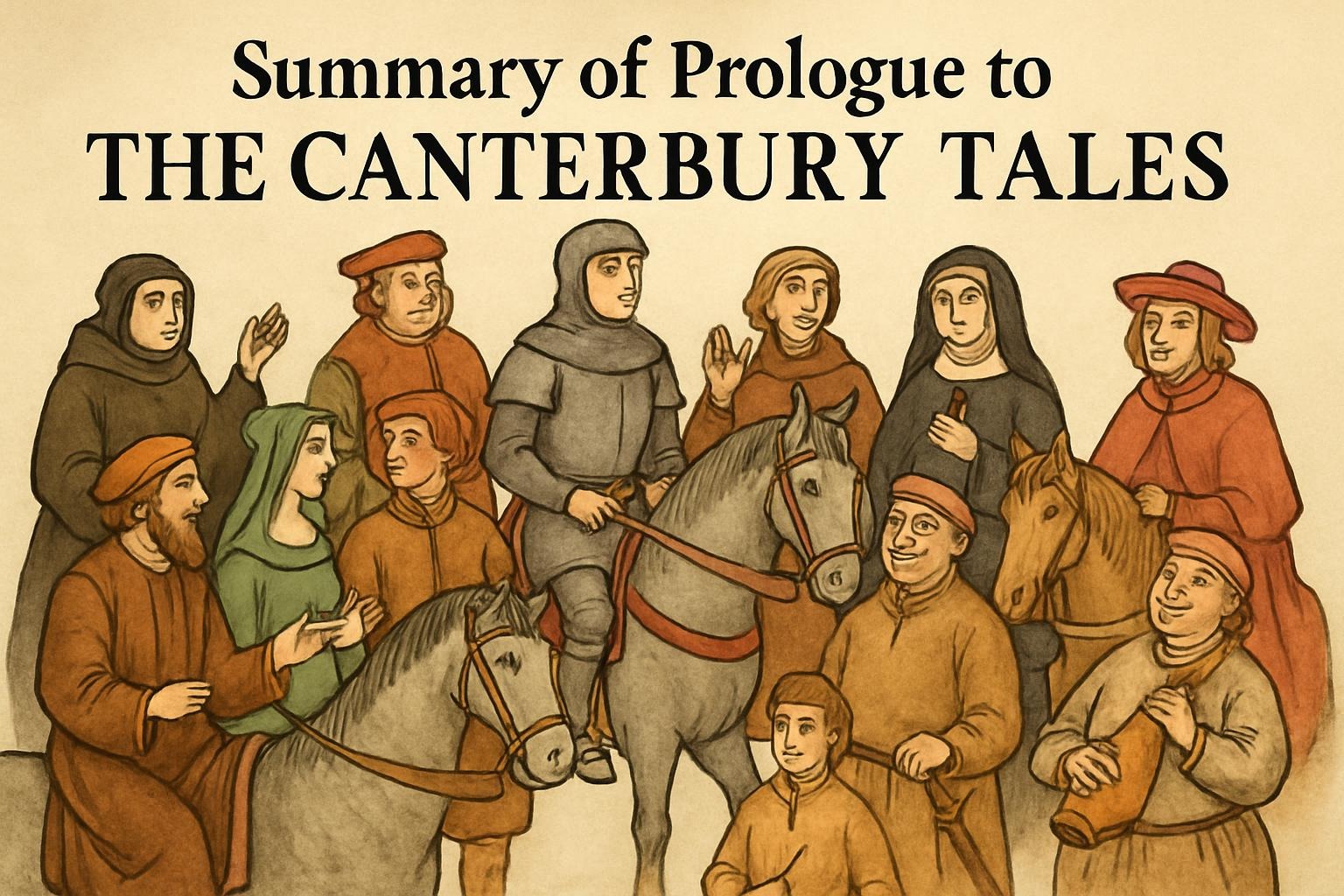
The Summary of Prologue to the Canterbury Tales explores the vivid beginning of Chaucer’s timeless masterpiece. In this section, Chaucer introduces a diverse group of pilgrims gathering at the Tabard Inn in Southwark. Each pilgrim represents a unique part of medieval English society. Moreover, Chaucer’s description blends humor, realism, and insight. Through careful observation, he portrays every social class with precision and warmth. Therefore, the summary of Prologue highlights both moral lessons and human variety. Chaucer’s lively portraits reflect universal human nature. Furthermore, his narrative framework unites individual stories within one spiritual journey. As the travelers head to Canterbury, their shared pilgrimage symbolizes faith and fellowship. Ultimately, the prologue sets the foundation for storytelling, social satire, and moral reflection. It establishes a world filled with diversity, wit, and enduring literary brilliance.
Chaucer builds the Summary of Prologue to the Canterbury Tales through masterful realism and poetic rhythm. He gives each pilgrim a distinct personality, appearance, and moral tone. Moreover, he balances satire with sympathy, creating depth in every portrayal. The Knight embodies honor, while the Wife of Bath symbolizes independence. Therefore, the summary of Prologue reveals the contrast between virtue and hypocrisy. Through vivid characterization, Chaucer examines faith, corruption, and social mobility. Furthermore, his language mixes elegance with simplicity, reflecting human diversity in expression. Each description contributes to a larger moral vision. At the same time, humor softens judgment, encouraging reflection rather than condemnation. Because Chaucer’s pilgrims mirror real life, his poetry transcends time. Ultimately, the prologue unites realism, morality, and art, shaping one of English literature’s greatest achievements in observation and narrative unity.
The General Prologue serves as both introduction and moral compass for The Canterbury Tales. Through its vibrant imagery, it sets the tone for storytelling and ethical inquiry. Moreover, Chaucer’s narrator observes society without bias, allowing readers to form their own conclusions. The structure moves from reverence to realism, blending holiness with humor. Therefore, the introduction becomes a mirror of human nature. Each pilgrim’s tale promises moral insight and entertainment. Furthermore, the gathering at the inn transforms travel into metaphor for life. Chaucer captures human contradiction with poetic grace. At the same time, laughter and morality coexist harmoniously. Because of this duality, the Prologue remains eternally relevant. Ultimately, it celebrates diversity, unity, and reflection. With vivid detail and moral depth, Chaucer creates a world that speaks across centuries. He invites readers into truth, virtue, and timeless imagination.
Background of Prologue to the Canterbury Tales
Historical Context of the Prologue
The Background of Prologue to the Canterbury Tales reflects England’s vibrant fourteenth-century society. During this period, social transformation reshaped moral values and class identity. Moreover, the Black Death and the Hundred Years’ War created both hardship and reflection. Chaucer observed these tensions with wit and insight. Therefore, the Background of Prologue to the Canterbury Tales captures shifting beliefs about morality and authority. The rise of the middle class challenged traditional hierarchies. Furthermore, urban life introduced new voices into literature. Chaucer’s pilgrims embody these changing dynamics through varied occupations and virtues. At the same time, faith and materialism coexist uneasily within their world. Because of this contrast, Chaucer’s narrative becomes social commentary as well as entertainment. The Background of Prologue to the Canterbury Tales ultimately shows that medieval experience inspired timeless portraits. These portraits reveal human ambition, faith, and humor.
Cultural Influences and Social Change
The Background of Prologue to the Canterbury Tales draws heavily on medieval culture’s richness and contradiction. Chaucer lived during a time of linguistic growth and moral uncertainty. Moreover, English replaced French and Latin as the dominant literary language. Through this shift, poetry became accessible to a wider audience. Therefore, the Background of Prologue to the Canterbury Tales demonstrates how language and identity evolved together. Chaucer’s use of the vernacular gave new dignity to common life. Furthermore, his depiction of merchants, clergy, and workers reflects expanding awareness of individuality. At the same time, moral satire exposed corruption within religious institutions. Because Chaucer combined humor and truth, he bridged realism and idealism. Ultimately, the Background of Prologue shows how changing cultural values encouraged reflection on justice. These reflections also concerned faith and social equality. This process shaped modern literary consciousness.
Chaucer’s Life and Personal Experience
The Background of Prologue to the Canterbury Tales cannot be understood. One must consider Chaucer’s personal life. His career as court official, traveler, and diplomat enriched his understanding of human nature. Moreover, he interacted with people from all walks of life, observing virtue and folly firsthand. Therefore, the Background of Prologue to the Canterbury Tales mirrors his worldly experience and moral vision. His education in philosophy and literature deepened his insight into character and motive. Furthermore, exposure to Italian writers such as Boccaccio and Dante shaped his poetic technique. At the same time, Chaucer’s humor softened criticism, blending observation with empathy. Because his writing emerged from lived reality, it transcended mere fiction. The Background of Prologue reveals that Chaucer’s wisdom stemmed from actively engaging with life, faith, and human diversity.
Religious Atmosphere and Moral Reflection
The Background of Prologue to the Canterbury Tales also reflects medieval spirituality and moral discipline. Religion influenced every part of life, shaping both conscience and behavior. Moreover, the Church’s power defined social order and ethical standards. However, corruption and greed weakened its authority. Therefore, the Background of Prologue to the Canterbury Tales includes both devotion and criticism. Chaucer’s portraits of the Monk, Friar, and Pardoner expose hypocrisy while preserving reverence for true faith. Furthermore, moral reflection strengthens the poem’s spiritual message. At the same time, humor makes its lessons accessible. Because of this combination, readers experience guidance through laughter. Ultimately, the Background of Prologue portrays religion as a moral foundation. It also presents religion as a human struggle. This demonstrates Chaucer’s ability to balance satire, compassion, and reverence in his exploration of faith’s role in daily life.
Literary Foundations and Classical Influence
The Background of Prologue to the Canterbury Tales draws inspiration from earlier literary traditions. Chaucer admired classical poets like Virgil and Ovid, whose storytelling shaped his narrative craft. Moreover, medieval allegory and courtly romance influenced his tone and imagery. Therefore, the Background of Prologue to the Canterbury Tales connects ancient wisdom with English realism. His frame narrative unites multiple voices, echoing Boccaccio’s Decameron. Furthermore, classical ideals of virtue and order merge with Christian moral vision. At the same time, humor replaces abstraction, making philosophy accessible. Because Chaucer integrates past and present, he transforms imitation into innovation. His verse rhythm and vivid detail elevate English poetry to new dignity. Ultimately, the Background of Prologue reveals the blending of classical harmony and moral inquiry. It also shows how social realism merges perfectly within Chaucer’s art. This combination forms the foundation of modern narrative tradition.
Characters in Prologue to the Canterbury Tales
The Knight
The Knight stands as the highest model of honor and bravery. He has fought in many battles for truth and faith. Moreover, his noble spirit defines true chivalry. He serves God, his king, and the ideal of justice. Therefore, Chaucer presents him as the moral pillar of the group. His modesty strengthens his dignity. Furthermore, his calm temperament contrasts with his heroic past. He never exaggerates his achievements or desires fame. At the same time, he remains humble in both words and dress. Because his life blends valor with humility, he represents medieval virtue perfectly through harmony and discipline.
The Squire
The Squire follows his father, the Knight, yet reflects youthful passion. His love of music, poetry, and courtly manners defines his charm. Moreover, his romantic enthusiasm adds brightness to the pilgrimage. He is energetic, creative, and polite. Therefore, Chaucer contrasts his freshness with his father’s maturity. His clothing expresses his lively spirit and elegance. Furthermore, his devotion to love and service gives him emotional depth. He seeks admiration through skill and appearance. At the same time, his courteous speech reveals inherited grace. Because ambition guides his youth, he symbolizes the blending of emotion, vitality, and early chivalric ideals.
The Yeoman
The Yeoman serves the Knight and Squire with loyalty and skill. His green attire reflects his closeness to nature and hunting. Moreover, his weapons display expertise and discipline. He represents the hardworking class of medieval England. Therefore, Chaucer honors his dedication through vivid description. His appearance reveals strength and precision. Furthermore, his horn and bow suggest readiness and vigilance. He guards his masters with silent dignity. At the same time, his independence shines beneath service. Because of his simplicity and honesty, he stands apart as model of steadiness. Ultimately, the Yeoman symbolizes courage grounded in practical faith.
The Prioress
The Prioress combines tenderness with worldly sophistication. Her refined manners and delicate speech impress her companions. Moreover, her compassion extends even to animals. However, Chaucer humorously exposes her vanity. Therefore, her character mixes grace and pretension. Her careful eating and elegant dress reflect social ambition. Furthermore, her golden brooch engraved with “Love conquers all” deepens her irony. She represents religion touched by romantic ideals. At the same time, her sentimentality reveals human warmth. Because Chaucer treats her with gentle wit, she becomes memorable for charm rather than piety. Ultimately, the Prioress embodies moral sweetness wrapped in social aspiration.
The Monk
The Monk rejects strict monastic rule in favor of worldly pleasure. He loves hunting, fine clothes, and rich food. Moreover, he values freedom over religious discipline. His bold disregard for tradition shocks pious readers. Therefore, Chaucer uses him to criticize corruption gently. His fat face and bright eyes suggest indulgence. Furthermore, his self-confidence makes hypocrisy almost admirable. At the same time, humor protects the portrait from bitterness. Because he prefers comfort to sacrifice, he reflects moral decay within religion. Ultimately, the Monk’s charm and weakness reveal Chaucer’s gift for blending satire, realism, and truth in graceful poetic detail.
The Friar
The Friar manipulates faith for wealth and pleasure. He sells forgiveness for money, forgetting true repentance. Moreover, he uses charm to exploit the poor. His merry laughter hides greed. Therefore, Chaucer’s portrait blends comedy with moral warning. His white neck and smooth talk show corruption behind gentleness. Furthermore, his musical talent disguises deceit. He frequents taverns more than churches. At the same time, his popularity contrasts with moral emptiness. Because Chaucer writes with humor, judgment feels kind. The Friar thus represents moral blindness beneath elegance, reminding readers of the fragility of virtue in religious institutions.
The Merchant
The Merchant stands as a proud symbol of trade and wealth. He dresses in expensive clothes and speaks of profit constantly. Moreover, he hides debt beneath confidence. Therefore, Chaucer portrays him as master of disguise. His intelligence commands respect, yet his honesty remains uncertain. Furthermore, his skill in negotiation reflects ambition. He values appearance over truth. At the same time, his worldly wisdom contrasts with spiritual ignorance. Because Chaucer maintains balance, satire never becomes cruelty. Ultimately, the Merchant reflects the rise of economic self-interest, illustrating how wealth redefined character in a world shifting from faith to finance.
The Clerk
The Clerk of Oxford represents the power of knowledge and idealism. He lives for study, not for wealth or pleasure. Moreover, his thin frame and humble dress reflect purity of spirit. His devotion to learning defines intellectual holiness. Therefore, Chaucer admires him deeply. He spends his little money on books rather than food. Furthermore, his speech shows wisdom and modesty. His silence reveals thoughtfulness rather than pride. At the same time, his detachment from worldly concerns emphasizes virtue. Because knowledge becomes his faith, he symbolizes truth through reason. Ultimately, the Clerk embodies integrity within spiritual and academic devotion.
The Lawyer
The Lawyer, or Man of Law, appears wise and industrious. He knows every law and record of his age. Moreover, he appears busier than he truly is. Therefore, Chaucer exposes vanity through subtle irony. His reputation matters more than his sincerity. Furthermore, his cautious speech reveals pride in learning. At the same time, his wealth and dress confirm high status. Because he values order, he symbolizes society’s dependence on intellect. His skill earns respect, yet his ambition weakens integrity. Ultimately, the Lawyer becomes image of moral ambiguity, blending wisdom, diligence, and quiet self-interest within Chaucer’s living portrait.
The Franklin
The Franklin personifies hospitality and generosity. His cheerful nature and love of good food define his life. Moreover, he serves as model of social harmony. Therefore, Chaucer portrays him with warmth and admiration. His table always remains open to guests. Furthermore, his wealth supports community joy. He believes pleasure expresses gratitude to God. At the same time, moderation keeps his indulgence noble. Because kindness guides his prosperity, he avoids greed. His rosy face symbolizes both health and moral cheer. Ultimately, the Franklin represents the ideal of balanced living, where material success nourishes virtue rather than corruption.
The Haberdasher, Carpenter, Weaver, Dyer, and Tapestry Maker
These five Guildsmen reflect growing middle-class ambition in medieval England. Their clean clothes and silver accessories show pride in trade. Moreover, their wives encourage social advancement. Therefore, Chaucer portrays them as symbols of new prosperity. They seek status through work and appearance. Furthermore, their unity demonstrates rising urban cooperation. At the same time, their vanity reveals moral simplicity. Because Chaucer balances humor with respect, their portrait remains kind. They illustrate how wealth reshapes social identity. Ultimately, these craftsmen represent honest labor’s dignity and aspiration, marking an era where commerce began challenging noble privilege and feudal pride.
The Cook
The Cook stands out for his culinary mastery and earthy humor. He prepares delicious dishes for the Guildsmen. Moreover, Chaucer adds realism through sensory detail. His sore on the leg becomes symbol of physical decay. Therefore, his character mixes skill and imperfection. His sharp wit matches his talent. Furthermore, his drunkenness reveals weakness beneath artistry. At the same time, his pride in food reflects passion for craft. Because Chaucer’s tone remains sympathetic, moral lesson softens. The Cook represents flawed humanity within daily labor. Ultimately, he shows that excellence and imperfection coexist naturally in every social class.
The Shipman
The Shipman symbolizes adventure and rough experience. He knows every harbor and sea path. Moreover, his manners reveal toughness rather than politeness. He steals wine from merchants during voyages. Therefore, Chaucer portrays him as daring yet dishonest. His brown skin shows life under the sun. Furthermore, his courage commands respect despite flaws. At the same time, his lack of conscience questions moral stability. Because humor tempers criticism, his story feels human. The Shipman reflects survival over virtue. Ultimately, Chaucer presents him as product of necessity, revealing moral conflict between commerce, danger, and human instinct for freedom.
The Physician
The Physician combines science with greed. He studies astrology to treat illness. Moreover, he profits from plague and pain. Therefore, Chaucer exposes moral weakness hidden beneath intelligence. His careful diet shows discipline but not compassion. Furthermore, his love for gold outweighs spiritual care. At the same time, his skill earns recognition. Because Chaucer admires learning, judgment stays gentle. His character illustrates tension between knowledge and virtue. Ultimately, the Physician warns against materialism in science. This proves that wisdom without morality fails to heal either body or soul within the Summary of Prologue.
The Wife of Bath
The Wife of Bath dominates her world with energy and independence. She has married five husbands and traveled widely. Moreover, she values experience over tradition. Therefore, Chaucer celebrates her spirit through humor and affection. Her bold speech reflects wisdom born from life. Furthermore, her clothes and confidence show prosperity. At the same time, her sensuality reveals human honesty. Because she seeks control and respect, she becomes symbol of freedom. Her laughter masks loneliness, deepening complexity. Ultimately, she represents both passion and resilience, expressing womanhood’s voice with power and wit in the Summary of Prologue.
The Parson
The Parson stands as the moral ideal among pilgrims. His faith, humility, and dedication contrast sharply with hypocrisy. Moreover, he lives his sermons, guiding through example. Therefore, Chaucer honors him as spiritual perfection. He helps the poor without demanding payment. Furthermore, his sincerity restores dignity to religion. At the same time, his patience shows moral strength. Because he practices what he preaches, he symbolizes true virtue. His life becomes sermon of faith and service. Ultimately, Chaucer’s respect transforms him into beacon of purity and truth within the Summary of Prologue.
The Plowman
The Plowman represents honest labor and Christian simplicity. He serves others with joy and faith. Moreover, his love for work reflects spiritual purity. His brotherhood with the Parson reinforces moral unity. Therefore, Chaucer celebrates the dignity of physical toil. His kindness enriches his humility. Furthermore, his cheerfulness conveys inner peace. At the same time, his devotion contrasts greed around him. Because his heart remains uncorrupted, he stands as example for all. His charity reveals divine grace in common life. Ultimately, the Plowman embodies the holiness of effort and the sanctity of simple, selfless living.
The Miller
The Miller roars with energy and mischief. His red beard and broad shoulders symbolize power. Moreover, his crude jokes show working-class humor. He cheats customers by stealing grain. Therefore, Chaucer turns deceit into comedy. His bagpipe and brawling spirit enliven the group. Furthermore, his roughness contrasts with the Clerk’s refinement. At the same time, his strength becomes moral weakness. Because Chaucer’s humor hides criticism, tone remains playful. The Miller symbolizes vitality unchecked by conscience. Ultimately, he embodies the raw human side of society. He is earthy, flawed, and irresistibly real in the Summary of Prologue.
The Manciple
The Manciple manages food supplies for a college of lawyers. He is illiterate yet outsmarts educated men. Moreover, his cleverness symbolizes practical intelligence. Therefore, Chaucer uses him to praise wisdom beyond learning. His honesty remains uncertain, yet his skill commands admiration. Furthermore, his thriftiness ensures success. At the same time, his manipulation exposes deceit within necessity. Because he thrives through cunning, he mirrors society’s imbalance between intellect and morality. His story reminds readers that knowledge alone does not guarantee virtue. Ultimately, the Manciple personifies wit surviving within corruption, revealing truth about moral imperfection in human ambition.
The Reeve
The Reeve rules his estate with strict control. He knows every trick of the workers. Moreover, he saves money by cheating his master subtly. Therefore, Chaucer’s irony highlights quiet corruption. His thin body suggests cold calculation. Furthermore, his anger hides insecurity. At the same time, his efficiency commands respect. Because Chaucer balances admiration with critique, his portrait feels human. He gains wealth through precision and deceit. Ultimately, the Reeve becomes a symbol of hidden power among the common class. This proves that intellect and secrecy often replace honesty within worldly success. Moral compromise accompanies this.
The Summoner
The Summoner enforces Church law with open corruption. He accepts bribes to ignore sin. Moreover, his red face and pimples symbolize moral disease. Therefore, Chaucer exposes hypocrisy through grotesque humor. His Latin phrases impress only the ignorant. Furthermore, his cruelty toward sinners mocks religion. At the same time, his loud laughter hides emptiness. Because satire softens criticism, character becomes entertaining. The Summoner’s corruption exposes spiritual failure within authority. He embodies a decayed conscience disguised as holiness. This ultimately teaches that outward devotion without morality corrupts faith and justice deeply in Chaucer’s moral landscape of vivid pilgrims.
The Pardoner
The Pardoner symbolizes spiritual decay behind religious power. He sells fake relics and indulgences. Moreover, his smooth voice and golden hair conceal deceit. Therefore, Chaucer crafts him as symbol of greed and manipulation. His sermons condemn avarice while feeding it. Furthermore, his hypocrisy reveals moral darkness. At the same time, his self-awareness adds tragic irony. Because Chaucer’s tone remains measured, moral lesson strengthens. The Pardoner shows that truth can exist even in corruption. In the end, he embodies contradiction. He is the sinner who preaches virtue. This exposure reveals how religion without sincerity loses grace. It loses human compassion within sacred duty.
The Host
The Host unites the pilgrims with humor and leadership. He suggests the storytelling contest that drives the narrative. Moreover, his cheerful personality brings balance to diverse travelers. Therefore, Chaucer gives him voice of reason and fellowship. His fairness ensures harmony within difference. Furthermore, his laughter softens argument. At the same time, his warmth turns the group into family. Because he represents everyday wisdom, he becomes moral center. His practicality reveals common sense as virtue. Ultimately, the Host symbolizes human connection through communication, turning simple journey into reflection of society’s shared truth and lasting companionship.
Summary of Prologue to the Canterbury Tales
1. Opening Scene at the Tabard Inn
April’s warmth awakens life and hope across England. Flowers bloom, and birds sing with joyful melody. Moreover, spiritual renewal fills every heart. Therefore, pilgrims prepare for a holy journey to Canterbury. Chaucer begins by describing nature’s rebirth alongside human faith. The atmosphere radiates freshness and devotion. Furthermore, the season reflects renewal of moral purpose. At the same time, Chaucer links spring’s vitality with human aspiration. Because nature inspires faith, pilgrimage becomes both spiritual and symbolic. The Tabard Inn serves as the gathering place for travelers. Its setting unites people from diverse backgrounds. Consequently, this lively inn becomes a microcosm of medieval society. Chaucer introduces each pilgrim with humor and precision. Ultimately, this introduction captures the essence of movement, renewal, and unity, defining the poetic rhythm that drives the Summary of Prologue to the Canterbury Tales.
2. The Spirit of Pilgrimage
Pilgrimage reflects both spiritual duty and human fellowship. People journey together, seeking blessing and companionship. Moreover, Chaucer emphasizes shared humanity within sacred purpose. Therefore, the road to Canterbury becomes moral theatre. Each pilgrim carries personal motives and emotions. Furthermore, the pilgrimage unites sinners and saints through common devotion. At the same time, Chaucer highlights social variety through vivid portraits. Because the journey represents moral testing, each traveler reveals inner truth. Conversation and laughter blend with prayer and reflection. Consequently, human nature unfolds through shared adventure. Chaucer’s depiction balances humor, virtue, and irony. The pilgrimage thus mirrors life’s diversity and moral tension. Through unity and difference, the poem celebrates collective spirit. Ultimately, this journey illustrates moral pilgrimage of all humanity, transforming common travel into divine metaphor within the Summary of Prologue.
3. Chaucer as Narrator and Observer
Chaucer appears within the story as both pilgrim and poet. He observes others with curiosity and warmth. Moreover, his narration blends objectivity with charm. Therefore, he acts as guide between reader and travelers. His presence shapes tone and perspective. Furthermore, his humility invites trust and reflection. At the same time, his humor reveals insight into human behavior. Because Chaucer participates yet observes, narration gains credibility and depth. His commentary enhances character detail through wit and sympathy. Consequently, his role bridges storyteller and participant. Through direct involvement, the narrative feels intimate and alive. Ultimately, Chaucer’s self-inclusion blurs boundary between fiction and truth. His voice shapes interpretation while respecting each character’s individuality. Therefore, the narrator’s presence ensures balance between realism and artifice. This balance makes the Summary of Prologue a living mirror of human society.
4. The Knight’s Noble Presence
The Knight represents honor, discipline, and virtue. He fights for faith and justice across many lands. Moreover, Chaucer describes him with reverence and simplicity. Therefore, his appearance conveys quiet dignity. His clothes are modest despite his fame. Furthermore, his humility contrasts sharply with worldly pride. At the same time, the Knight’s courtesy reflects spiritual nobility. Because his deeds express moral strength, he becomes symbol of ideal chivalry. Chaucer respects his balance between valor and devotion. Consequently, the Knight embodies unity of strength and virtue. His tale later confirms his refined nature. Through him, Chaucer preserves the medieval code of honor. Ultimately, the Knight’s portrait glorifies inner purity over appearance, reinforcing the poem’s moral foundation within the Summary of Prologue and exemplifying how integrity defines human greatness.
5. The Squire’s Youthful Energy
The Squire, the Knight’s son, radiates beauty and enthusiasm. He serves his father with pride and grace. Moreover, Chaucer depicts him as youthful lover of life. Therefore, his manners reflect charm and ambition. His clothes shine with artistic flair. Furthermore, he sings, dances, and writes poetry. At the same time, his spirit reflects courtly ideals. Because he seeks love and approval, his youth mirrors worldly desire. Chaucer portrays him with gentle humor. Consequently, the Squire represents romance and enthusiasm of youth. His joy contrasts his father’s calm maturity. Through this dynamic, Chaucer explores generational contrast. Ultimately, the Squire’s passion and artistry reveal the vitality of new ideals. They show that even noble hearts must learn moderation through experience and faith in the Summary of Prologue.
6. The Yeoman’s Practical Skill
The Yeoman serves the Knight with loyalty and efficiency. He carries weapons with pride and care. Moreover, his appearance suggests discipline and expertise. Therefore, Chaucer uses him to represent service and modesty. His green attire symbolizes nature and readiness. Furthermore, he knows every craft of wood and field. At the same time, his devotion defines practical virtue. Because he works without vanity, Chaucer honors his sincerity. The Yeoman’s realism balances noble glamour. Consequently, his portrait celebrates labor’s dignity. His quiet strength embodies the medieval work ethic. Through him, Chaucer values action over pretense. Ultimately, the Yeoman reflects steadfast character and faith. This shows that devotion and simplicity yield greatness within the Summary of Prologue.
7. The Prioress’s Grace and Sentiment
The Prioress combines elegance with deep emotion. She speaks French and behaves with courtly manners. Moreover, Chaucer portrays her with gentle satire. Therefore, her character blends piety and vanity. Her jewelry reveals worldly sentiment. Furthermore, her compassion toward animals reflects tenderness. At the same time, her refinement contrasts monastic simplicity. Because she embodies religious charm, Chaucer admires and questions her virtue. Her tears at small sorrow express exaggerated feeling. Consequently, her spirituality seems theatrical yet sincere. Through her, Chaucer explores outer grace and inner complexity. Ultimately, the Prioress represents the tension between devotion and appearance. She illustrates human frailty beneath the facade of holiness in the Summary of Prologue.
8. The Monk’s Love for Luxury
The Monk defies traditional monastic ideals. He loves horses, feasting, and fine clothing. Moreover, Chaucer uses humor to reveal hypocrisy. Therefore, his character exposes religious corruption through charm. His actions challenge strict discipline. Furthermore, his boldness reflects worldly enjoyment. At the same time, his appetite symbolizes spiritual neglect. Because he prefers pleasure to prayer, Chaucer critiques moral laxity. Yet, he portrays him with humor, not cruelty. Consequently, the Monk’s portrait blends satire and realism. His lively energy contrasts spiritual indifference. Through him, Chaucer highlights tension between rule and freedom. Ultimately, the Monk’s extravagance represents social commentary on clerical decline within the Summary of Prologu, emphasizing moral decay through wit and irony.
9. The Friar’s Worldly Dealings
The Friar manipulates confession and charity for gain. He flatters wealthy patrons with polished speech. Moreover, Chaucer’s description reveals cunning beneath charm. Therefore, his generosity hides greed and deceit. His social grace conceals moral emptiness. Furthermore, his authority rests on manipulation. At the same time, his humor distracts from sin. Because he exploits faith for wealth, Chaucer mocks false holiness. The Friar’s corruption contrasts true religious ideals. Consequently, his presence deepens satire against clerical greed. Through him, Chaucer exposes social hypocrisy. Ultimately, the Friar’s deceit embodies the collapse of sincerity. It illustrates how appearance often disguises moral corruption.
10. The Merchant’s Pride and Secrecy
The Merchant values wealth, fashion, and reputation. He speaks wisely yet hides personal troubles. Moreover, Chaucer portrays him with irony and respect. Therefore, his confidence masks inner uncertainty. His beard and attire symbolize prosperity. Furthermore, his opinions sound rational and firm. At the same time, his debts contradict his image. Because Chaucer values wit, he presents him neutrally. His practicality reflects mercantile growth in society. Consequently, the Merchant stands as symbol of material ambition. Through him, Chaucer illustrates new social order’s complexity. Ultimately, his portrait captures economic pride and hidden anxiety. It reflects moral ambiguity through wit and subtle humor in the Summary of Prologue.
11. The Clerk’s Devotion to Learning
The Clerk lives for books and study rather than wealth. He values knowledge above comfort or pleasure. Moreover, his thin appearance reflects his intellectual hunger. Therefore, Chaucer honors him as symbol of wisdom. His speech carries depth and sincerity. Furthermore, his faith in learning defines moral strength. At the same time, his poverty reveals spiritual wealth. Because he speaks little but meaningfully, others respect him deeply. His humility contrasts worldly ambition. Consequently, the Clerk embodies spiritual pursuit over material gain. Through him, Chaucer celebrates intellect guided by virtue. Ultimately, the Clerk’s devotion transforms scholarship into moral art. It proves that true wisdom shines through simplicity and reflection within the Summary of Prologue.
12. The Lawyer’s Command of Respect
The Lawyer, or Man of Law, commands authority through skill and precision. His mind works with careful order and logic. Moreover, Chaucer depicts him as respected but cautious. Therefore, his diligence hides self-interest. His clothes and manners show discipline and control. Furthermore, he knows every law and ruling. At the same time, his ambition hints at pride. Because he values reputation, he guards every word. His professionalism ensures dignity and power. Consequently, Chaucer portrays legal wisdom with irony. Through him, intellect serves ambition rather than virtue. Ultimately, the Lawyer’s portrait reveals tension between integrity and self-advancement, representing professional pride within the Summary of Prologue.
13. The Franklin’s Generous Lifestyle
The Franklin loves food, hospitality, and cheer. He lives for pleasure guided by reason. Moreover, his generosity defines noble character. Therefore, Chaucer praises moderation within joy. His table remains open to all visitors. Furthermore, his wealth supports communal happiness. At the same time, his kindness expresses civic virtue. Because he enjoys comfort without greed, Chaucer admires his nature. His balanced life unites honor and delight. Consequently, the Franklin symbolizes prosperity grounded in goodness. Through him, Chaucer connects happiness with virtue. Ultimately, the Franklin’s warmth and charity embody moral contentment. They celebrate harmony between worldly success and moral simplicity in the Summary of Prologue.
14. The Guildsmen’s Ambition
The Guildsmen—Haberdasher, Carpenter, Weaver, Dyer, and Tapestry-maker—reflect rising middle-class ambition. They value respect, prosperity, and public image. Moreover, their unity shows collective pride. Therefore, Chaucer highlights social transformation through commerce. Their silver knives symbolize advancement and refinement. Furthermore, their wives encourage further distinction. At the same time, ambition outweighs humility. Because appearance defines worth, morality becomes secondary. Chaucer’s humor reveals vanity beneath success. Consequently, these craftsmen represent ambition without corruption. Through them, social progress and pride intertwine. Ultimately, the Guildsmen’s portrayal captures growth of civic identity, showing dignity and desire within changing society in the Summary of Prologue to the Canterbury Tales.
15. The Cook’s Professional Skill
The Cook’s artistry defines his pride and livelihood. His dishes delight travelers and nobles alike. Moreover, Chaucer honors his expertise with warmth. Therefore, culinary craft becomes moral metaphor. His precision reveals discipline and care. Furthermore, his humor enriches companionship among pilgrims. At the same time, his ulcer symbolizes human imperfection. Because Chaucer loves realism, he shows beauty within flaw. The Cook’s story reflects pride in ordinary labor. Consequently, his presence affirms dignity of work. Through him, the poem celebrates craftsmanship as moral art. Ultimately, the Cook’s skill mirrors creative devotion, elevating daily work into virtue within the Summary of Prologue.
16. The Shipman’s Fearless Nature
The Shipman rules his vessel with authority and courage. He knows every sea, port, and storm. Moreover, his daring spirit defines leadership. Therefore, Chaucer respects his strength yet questions his ethics. His temper mirrors the ocean’s force. Furthermore, he uses cunning to achieve success. At the same time, his lack of mercy reveals moral flaw. Because survival demands ruthlessness, Chaucer excuses his harshness. His portrait balances respect and caution. Consequently, the Shipman symbolizes human will’s power. Through him, the poem explores ambition within moral challenge. Ultimately, the Shipman’s vigor embodies independence and worldly wisdom in the Summary of Prologue.
17. The Physician’s Learned Art
The Physician practices medicine with knowledge and precision. He studies planets, humors, and ancient texts. Moreover, Chaucer admires his discipline yet mocks his greed. Therefore, his healing reflects intellect without faith. His robes display wealth and vanity. Furthermore, his gold symbolizes spiritual emptiness. At the same time, his science lacks compassion. Because he profits from illness, Chaucer exposes moral hollowness. His wisdom serves fortune, not charity. Consequently, the Physician illustrates conflict between intellect and virtue. Through him, knowledge becomes moral test. Ultimately, the Physician’s brilliance reveals spiritual failure, warning that learning without conscience corrupts the heart within the Summary of Prologue.
18. The Wife of Bath’s Bold Personality
The Wife of Bath lives freely and speaks boldly. She marries five times and enjoys mastery in love. Moreover, Chaucer portrays her with humor and respect. Therefore, she embodies independence and sensual wisdom. Her travels show experience and confidence. Furthermore, her clothing displays wealth and pride. At the same time, her storytelling reveals intelligence and wit. Because she challenges male dominance, Chaucer honors her courage. Her boldness redefines virtue through honesty. Consequently, the Wife of Bath symbolizes self-expression and strength. Through her, Chaucer celebrates womanly freedom and moral individuality. Ultimately, she becomes voice of passion, wit, and truth within the Summary of Prologue.
19. The Parson’s Spiritual Purity
The Parson lives by faith, humility, and compassion. He guides his flock with kindness and discipline. Moreover, Chaucer reveres him as true cleric. Therefore, his simplicity contrasts corruption of others. His devotion reflects Christlike patience. Furthermore, he practices what he teaches. At the same time, his virtue inspires moral clarity. Because he rejects luxury, Chaucer admires his strength. His charity reaches poor and sinful alike. Consequently, the Parson represents pure faith and integrity. Through him, Chaucer defines ideal priesthood. Ultimately, the Parson’s holiness restores balance, proving that moral leadership endures through humility and grace in the Summary of Prologue to the Canterbury Tales.
20. The Plowman’s Honest Labor
The Plowman works tirelessly with sincerity and devotion. His labor sustains society through faith and effort. Moreover, Chaucer praises his humility and love. Therefore, he embodies Christian charity and endurance. His plain clothes symbolize moral purity. Furthermore, his generosity enriches community harmony. At the same time, his loyalty defines working virtue. Because he seeks no reward, Chaucer honors his faithfulness. His work becomes service to both God and man. Consequently, the Plowman completes the moral cycle. Through him, Chaucer glorifies simplicity as divine strength. Ultimately, the Plowman’s labor transforms humility into greatness, embodying moral truth within the Summary of Prologue to the Canterbury Tales.
21. The Clerk’s Modest Nature
The Clerk’s character in the Prologue to the Canterbury Tales highlights intellect and humility. He values knowledge over wealth and prefers books to luxury. Moreover, his silent nature reflects inner wisdom and patience. Although poor, he possesses moral richness and spiritual clarity. He speaks only when necessary and values truth deeply. Therefore, his actions convey a disciplined scholar’s essence. His learning symbolizes faith in education and virtue. At the same time, his speech offers moral insight and restraint. He demonstrates harmony between faith and reason. Through his simplicity, Chaucer honors integrity. The Clerk’s presence strengthens moral tone, emphasizing the nobility of intellect. Thus, he represents wisdom’s quiet dignity, embodying the balance of learning and faith. The key phrase Summary of Prologue to the Canterbury Tales appears to unite intellect, virtue, and grace.
22. The Sergeant at Law’s Authority
The Sergeant at Law demonstrates mastery in his field. Chaucer describes him as learned and respected. Moreover, his vast experience earns him noble repute. Though he appears busy, his calm confidence reflects deep knowledge. Therefore, he symbolizes law’s structure and order. His dress shows moderation, aligning with reason and duty. Furthermore, he represents stability within the social hierarchy. His presence ensures that the Summary of Prologue to the Canterbury Tales conveys balance between wisdom and justice. Chaucer subtly admires his diligence while exposing hidden pride. He values rules yet remains driven by recognition. His skill mirrors the precision of language. Thus, he becomes a bridge between intellect and practicality. His role highlights discipline as essential to moral society. Through him, Chaucer reveals law’s duality—virtue shaped by ambition.
23. The Franklin’s Love of Life
The Franklin represents generosity and social harmony. He values joy, hospitality, and moral freedom. Moreover, his cheerful nature brightens every gathering. Chaucer portrays him as a man of pleasure and principle. Therefore, he symbolizes contentment through balanced living. His wealth never overshadows his kindness. Furthermore, he uses abundance to spread joy among others. His open heart reflects moral warmth and sincerity. In the Summary of Prologue to the Canterbury Tales, he stands for ideal fellowship. His belief in moderation enhances his nobility. At the same time, his household becomes a symbol of order and hospitality. His happiness stems from self-control, not greed. Thus, Chaucer praises moderation as a path to virtue. The Franklin’s simple yet noble life conveys moral and social grace.
24. The Haberdasher and Guildsmen
The Guildsmen in Chaucer’s Prologue to the Canterbury Tales embody rising middle-class ambition. They represent craft, prosperity, and civic pride. Moreover, their unity highlights brotherhood and professionalism. Chaucer subtly admires their order yet questions materialism. Therefore, their image merges social respectability and vanity. Each carries the dignity of honest labor. Furthermore, their wives seek higher social standing through display. This duality reflects societal evolution and moral tension. In the Summary of Prologue to the Canterbury Tales, they illustrate pride wrapped in piety. Their attire symbolizes progress and desire for recognition. Although industrious, they crave prestige over humility. Through them, Chaucer reveals society’s shifting moral values. Ultimately, their presence underscores ambition’s dual edge—industry paired with vanity. Their portrayal blends humor, realism, and ethical awareness beautifully.
25. The Cook’s Earthy Humor
The Cook adds humor and realism to Chaucer’s Prologue to the Canterbury Tales. He represents the working class with craft and imperfection. Moreover, his culinary skills earn respect despite flaws. Therefore, he blends artistry with human weakness. His ulcer symbolizes moral imperfection amid worldly success. Furthermore, his stories reflect everyday struggles and desires. Through him, Chaucer humanizes labor and survival. The Summary of Prologue to the Canterbury Tales reveals moral balance through such contrasts. His humor contrasts the solemnity of others, offering relief. Although flawed, he evokes sympathy through sincerity. His character reminds readers of universal imperfection. Thus, Chaucer portrays humanity with warmth and irony. The Cook embodies the earthy spirit of medieval realism, blending laughter with moral reflection effortlessly.
26. The Shipman’s Worldly Wit
The Shipman is bold, cunning, and practical. He navigates life’s storms with skill and risk. Moreover, his courage defines adventure’s moral side. Chaucer admires his independence and vitality. Therefore, he symbolizes realism in the Summary of Prologue to the Canterbury Tales. His sharp mind and rough honesty express freedom’s cost. Furthermore, his moral ambiguity reflects life’s unpredictability. He defends survival with wisdom and action. His journeys mirror life’s uncertain moral seas. At the same time, he represents class diversity and wit. His presence widens the poem’s social vision. Chaucer’s portrayal celebrates experience tempered by danger. The Shipman reveals human adaptability within ethical complexity. Through him, Chaucer captures courage, instinct, and worldly knowledge. Thus, his realism enriches the tapestry of human variety beautifully.
27. The Physician’s Learned Pride
The Physician embodies science, intellect, and material desire. He practices medicine with unmatched skill. Moreover, his knowledge connects ancient learning with modern ambition. Therefore, his figure represents intellect detached from faith. His gold symbolizes greed’s quiet rule. Furthermore, he values wealth as a moral measure. Chaucer admires his learning but questions his heart’s purity. The Summary of Prologue to the Canterbury Tales blends admiration and critique through him. His logic replaces compassion, revealing imbalance. Yet, his mastery reveals order in human pursuit of knowledge. At the same time, his character reminds readers of intellect’s moral limits. His presence contrasts spiritual insight with worldly desire. Thus, Chaucer balances reverence for learning with caution. The Physician’s tale enriches moral complexity within this poetic pilgrimage.
28. The Wife of Bath’s Independence
The Wife of Bath shines through boldness and individuality. She challenges social norms with wisdom and wit. Moreover, she celebrates love’s power and freedom. Therefore, she becomes one of Chaucer’s most iconic creations. Her experience in marriage defines her worldview. Furthermore, she represents womanhood’s autonomy in the Summary of Prologue to the Canterbury Tales. Her vibrant speech reveals confidence and sensual honesty. She demands respect through her life’s narrative. At the same time, she symbolizes moral tension between virtue and pleasure. Her laughter becomes moral protest against repression. Chaucer admires her courage without ignoring her vanity. Through her, he explores gender, morality, and truth. The Wife of Bath’s character thus embodies medieval feminism, revealing freedom through love, speech, and human experience.
29. The Parson’s Moral Purity
The Parson stands as the ideal of Christian virtue. He lives simply, preaching through example. Moreover, he practices humility and truth. Therefore, his role reflects spiritual balance and sincerity. His words carry moral clarity without pride. Furthermore, he represents purity in the Summary of Prologue to the Canterbury Tales. His guidance contrasts corruption within other clergy members. His actions mirror divine compassion and human integrity. At the same time, his simplicity enhances his moral strength. He values faith over wealth, service over status. His presence redeems the moral tone of the pilgrimage. Chaucer honors him as a light within worldly imperfection. Thus, the Parson symbolizes the poem’s spiritual anchor, teaching faith, goodness, and moral discipline. His character completes the poem’s ethical vision perfectly.
30. The Ploughman’s Honest Labor
The Ploughman exemplifies Christian humility through honest toil. He works diligently with pure devotion. Moreover, his charity reflects true brotherhood and faith. Therefore, he embodies labor’s sacred virtue. His kindness extends to all without bias. Furthermore, he stands for simplicity in the Summary of Prologue to the Canterbury Tales. His moral purity contrasts with hypocrisy around him. Chaucer elevates him as a model of spiritual equality. At the same time, his labor symbolizes faith through action. His life teaches that holiness resides in sincerity. His devotion to God through work defines moral dignity. Thus, he brings the poem’s ethical vision full circle. The Ploughman’s quiet grace strengthens the moral unity of Chaucer’s creation, reminding readers that service, love, and humility form the essence of virtue.
31. The Miller’s Bold Spirit
The Miller in the Summary of Prologue to the Canterbury Tales symbolizes vitality and rebellion. He lives loudly and freely, enjoying every worldly pleasure. Moreover, his humor exposes truth within moral flaws. Chaucer portrays him as coarse yet clever. Therefore, he becomes a mirror of rustic honesty and folly. His bagpipe leads the pilgrims, adding energy to their journey. Furthermore, his storytelling reveals human weakness with laughter. Although rude, he reflects society’s realism. His strength and wit symbolize survival’s raw power. At the same time, he contrasts refinement with instinct. Chaucer uses him to balance moral tone with earthy humor. The Miller’s vigor embodies human imperfection embraced with courage. Thus, he strengthens the narrative’s humanity, revealing life’s rough yet honest nature beautifully.
32. The Manciple’s Practical Wisdom
The Manciple represents cunning intelligence and resourceful living. He thrives through strategy and observation. Moreover, his success defies his limited education. Chaucer admires his wit while questioning moral depth. Therefore, he becomes a symbol of worldly intelligence. His thrift mirrors social adaptability and inner craft. Furthermore, he illustrates intellect outside academic boundaries. In the Summary of Prologue to the Canterbury Tales, he bridges wisdom and instinct. His skill in managing accounts reflects sharp judgment. At the same time, he exposes the irony of education’s hierarchy. Though unlearned, he outsmarts his superiors effortlessly. His cleverness blends humor with realism. Chaucer uses him to highlight intellect’s practical side. Thus, the Manciple enriches the social tapestry through wit, prudence, and moral subtlety.
33. The Reeve’s Stern Precision
The Reeve’s character in the Summary of Prologue to the Canterbury Tales expresses discipline and control. He governs property with unmatched skill. Moreover, his management reflects both order and suspicion. Chaucer admires his efficiency yet mocks his pride. Therefore, he becomes a paradox of power and insecurity. His thin frame symbolizes restraint and internal tension. Furthermore, his sharp temper reveals hidden vanity. Though feared, he earns grudging respect for precision. At the same time, his cunning mirrors social rivalry. His wealth and secrecy make him formidable among pilgrims. Chaucer presents him as balance between intellect and bitterness. Through the Reeve, ambition becomes self-defense. Thus, he represents control’s darker edge, teaching restraint’s moral lesson within life’s hierarchy.
34. The Summoner’s Corruption
The Summoner in the Summary of Prologue to the Canterbury Tales exposes moral decay within the Church. He abuses authority for profit and pleasure. Moreover, his physical grotesqueness mirrors inner corruption. Chaucer describes his face as diseased and symbolic. Therefore, he becomes a satire of religious hypocrisy. His drunkenness and greed distort spiritual duty. Furthermore, his partnership with the Pardoner magnifies deceit. He manipulates sinners with false promises of pardon. At the same time, his character entertains through vivid realism. His speech filled with Latin phrases mocks false learning. Through him, Chaucer condemns moral emptiness disguised as piety. The Summoner’s presence adds dark humor and truth. Thus, he warns against using religion for selfish gain, blending morality and satire brilliantly.
35. The Pardoner’s Deceptive Charm
The Pardoner stands as a master of hypocrisy and persuasion. He sells indulgences for personal gain. Moreover, his eloquence manipulates faith and fear. Chaucer portrays him as a chilling figure of corruption. Therefore, he symbolizes spiritual decay through greed and performance. His smooth voice masks moral emptiness. Furthermore, he represents deceit sanctified by ritual. In the Summary of Prologue to the Canterbury Tales, his presence deepens ethical critique. His relics and sermons reveal irony within sacred commerce. At the same time, his intelligence exposes faith’s fragile boundary. Through him, Chaucer questions religion’s moral core. The Pardoner’s charm fascinates yet disgusts. Thus, he embodies moral inversion—virtue turned into profit. His tale warns against false holiness and deceptive authority powerfully.
36. The Host’s Leadership
The Host in Chaucer’s Summary of Prologue to the Canterbury Tales unites the pilgrims through humor and fairness. He proposes storytelling as a contest of wit. Moreover, his energy keeps the group cohesive. Therefore, he becomes the human link between all characters. His cheerful nature balances moral diversity. Furthermore, his practical sense ensures order amid difference. Chaucer portrays him as wise, sociable, and commanding. At the same time, his humor smooths tension and conflict. His idea gives structure to the poetic journey. Through him, storytelling transforms from entertainment into fellowship. The Host represents reason, hospitality, and moral moderation. Thus, his leadership ensures harmony within the pilgrimage, turning diverse voices into one shared spiritual and artistic journey beautifully.
37. The Knight’s Tale Overview
The Knight’s tale in the Summary of Prologue to the Canterbury Tales reflects chivalric ideals. It narrates noble love, fate, and divine justice. Moreover, it introduces the collection’s moral dignity. Chaucer uses classical themes to elevate human experience. Therefore, the tale unites valor with compassion. Its characters embody devotion through struggle and sacrifice. Furthermore, its tone reveals faith in higher justice. The tale’s balance between romance and morality enhances unity. At the same time, it contrasts human will and destiny. Through it, Chaucer defines virtue through suffering. The Knight’s tale becomes a foundation for moral exploration. Thus, it reinforces the collection’s serious tone while honoring medieval ideals of honor and grace perfectly.
38. The Miller’s Tale Humor
The Miller’s tale provides earthy humor and comic relief. It contrasts the Knight’s nobility with crude realism. Moreover, it celebrates wit over decorum. Chaucer uses it to reveal social equality through laughter. Therefore, it enriches the Summary of Prologue to the Canterbury Tales with diversity. Its mischief mirrors life’s impulsive energy. Furthermore, its humor challenges moral rigidity. The tale’s vivid scenes highlight creativity and rebellion. At the same time, it mocks human folly affectionately. Through this story, Chaucer proves art’s power to entertain and teach. The Miller’s laughter exposes truth beneath pretension. Thus, his tale becomes satire in motion, showing that laughter too can reveal moral awareness and human unity delightfully.
39. The Pilgrimage Symbolism
The pilgrimage in the Summary of Prologue to the Canterbury Tales symbolizes humanity’s moral journey. Each pilgrim represents a distinct social class and spiritual stage. Moreover, their shared goal reflects universal longing for salvation. Chaucer transforms travel into moral metaphor. Therefore, movement becomes growth, not just distance. Their journey mirrors the soul’s path toward truth. Furthermore, fellowship replaces isolation through storytelling. The blend of humor and morality deepens symbolism. At the same time, differences among pilgrims reveal unity in diversity. Chaucer’s pilgrimage becomes an image of the world in miniature. Thus, it embodies the eternal balance of sin, grace, and wisdom beautifully. The pilgrimage reflects faith through life’s shared struggle and storytelling.
40. Conclusion: Moral Harmony and Art
The Summary of Prologue to the Canterbury Tales concludes in unity and moral reflection. Chaucer’s pilgrims embody humanity’s full moral spectrum. Moreover, his art harmonizes laughter, virtue, and truth. Therefore, the work transcends its medieval frame to achieve timeless meaning. Every character contributes to ethical vision and poetic form. Furthermore, structure and tone sustain balance between humor and holiness. Through storytelling, Chaucer fuses moral insight with human joy. At the same time, his poetry teaches compassion through laughter. The Summary of Prologue to the Canterbury Tales ultimately glorifies both art and morality. It celebrates life’s imperfections as pathways to wisdom. Thus, Chaucer’s work remains a radiant mirror of human nature and divine understanding forever.
The Legend of Good Women Summary: https://englishlitnotes.com/2025/05/15/legend-of-good-women-summary/
Notes on English for All Classes: https://englishwithnaeemullahbutt.com/
Discover more from Naeem Ullah Butt - Mr.Blogger
Subscribe to get the latest posts sent to your email.