Introduction to the Tests and Temptations in Gawain
Sir Gawain and the Green Knight presents tests and temptations in Gawain to explore moral and ethical growth. Clearly, these trials are carefully structured rather than random. Moreover, each challenge forces Gawain to examine courage, honor, and integrity. The Green Knight’s game initiates a journey that blends physical danger with spiritual scrutiny. Consequently, temptation often disguises itself in ordinary circumstances. In addition, the poem emphasizes that true valor encompasses conscience as well as strength. Gawain faces threats to both body and soul simultaneously. Therefore, the journey becomes a moral pilgrimage. Each step exposes virtues and flaws equally. Furthermore, the narrative shows that honor depends on adherence to ethical and spiritual principles consistently. Thus, tests and temptations reveal character more than physical prowess.
The Nature of Testing in Medieval Literature
Medieval literature emphasizes trials as necessary for proving virtue. Clearly, authors believed moral strength requires challenge. Therefore, heroes cannot claim honor without ordeal. In Gawain, tests and temptations in Gawain reflect this idea fully. Moreover, the Green Knight’s initial challenge is both literal and symbolic. As a result, Gawain’s vow to meet the return blow becomes morally binding. Consequently, the journey tests his patience, courage, and honesty simultaneously. Furthermore, each encounter along the path magnifies ethical demands. The hero must balance self-interest with duty. In addition, reflection accompanies action constantly. Therefore, the narrative demonstrates that true virtue involves continuous vigilance. Indeed, endurance, faith, and humility are tested repeatedly. Clearly, medieval texts link external trial to inner moral growth naturally.
The Beheading Game: Test of Courage and Honor
The Green Knight introduces the first formal trial of tests and temptations in Gawain by proposing a dangerous beheading game. Moreover, he arrives at Arthur’s court unexpectedly, demonstrating both challenge and spectacle. Clearly, whoever strikes must accept a return blow, enforcing moral accountability. Consequently, Gawain accepts the strike, displaying courage and adherence to honor. In addition, this trial illustrates that physical bravery intertwines with ethical responsibility. Moreover, the Green Knight survives, creating suspense and reinforcing the binding nature of promises. Therefore, courage alone is insufficient; integrity and fidelity govern knightly action. Furthermore, this opening test sets the rhythm for subsequent trials. Clearly, the game underscores that virtue extends beyond immediate action. Indeed, tests and temptations require reflection alongside bravery.
The Journey as Spiritual Preparation
As the year wanes, Gawain embarks on a journey that blends physical endurance with spiritual preparation. Clearly, he faces hunger, cold, and threats from nature itself. Moreover, prayer punctuates his path, sustaining both hope and resolve. Consequently, trials outside the castle mirror inner ethical struggle. In addition, solitude emphasizes reflection, forcing Gawain to confront fear and moral uncertainty simultaneously. Furthermore, these moments illustrate that virtue emerges through repeated testing. Indeed, his approach to Bertilak’s castle signals both readiness and apprehension. Therefore, the pilgrimage becomes more than travel; it is moral training. Moreover, the knight internalizes lessons along the way. As a result, tests and temptations integrate spiritual insight with action, preparing him for challenges that blend ethical, physical, and psychological demands naturally.
The Castle as a Place of Temptation
Bertilak’s castle offers comfort that masks moral danger, demonstrating the subtlety of tests and temptations. Clearly, food, warmth, and fellowship provide relief from the journey. However, Lady Bertilak’s presence introduces ethical complexity. Moreover, her visits challenge Gawain’s courage, manners, and virtue simultaneously. Consequently, he must balance politeness with fidelity. In addition, too much coldness would appear rude, whereas too much warmth could betray honor. Furthermore, the tension exemplifies how moral decisions require constant vigilance. Therefore, the castle becomes a microcosm of ethical testing, where social expectation, temptation, and personal conscience intersect continuously. Clearly, each encounter prepares Gawain for the moral lessons embedded in the narrative. Ultimately, tests and temptations reveal that virtue is rarely straightforward and requires active discernment constantly.
Lady Bertilak’s First Visit
Lady Bertilak’s initial visit combines playfulness with moral probing. Clearly, her compliments test Gawain’s humility subtly. Moreover, her attention encourages reflection on internal versus external virtue. Consequently, Gawain responds politely, navigating courtesy without breaching ethical standards. In addition, he measures desire against duty, showing early evidence of self-control. Furthermore, these moments illustrate how small interactions reinforce moral vigilance. Indeed, tests and temptations emerge not only from dramatic events but also from nuanced social encounters. Therefore, Gawain’s responses reveal character gradually. Additionally, the poet demonstrates that virtue requires constant awareness, even in seemingly trivial situations. Consequently, this opening interaction sets a precedent for the ethical tension. It defines the remainder of his trials naturally and consistently.
Lady Bertilak’s Second Visit: The Stakes Increase
On the second day, Lady Bertilak intensifies ethical pressure. Clearly, her comments probe loyalty, courage, and humility. Moreover, Gawain resists overt temptation while navigating social expectation. Consequently, he accepts a kiss, which later factors into Bertilak’s hunting game. In addition, the poet demonstrates that small ethical decisions accumulate significance. Furthermore, each action intersects with personal conscience and religious awareness. Indeed, the narrative shows that virtue requires negotiation between fear, desire, and duty. Therefore, tests and temptations expand in scope, linking moral choice with long-term consequence. Additionally, reflection accompanies action repeatedly, reinforcing internal discipline. Clearly, Gawain’s careful responses highlight the difficulty of ethical navigation. Consequently, these moments blend subtle social challenge with profound moral instruction naturally.
Lady Bertilak’s Third Visit: The Girdle as Final Test
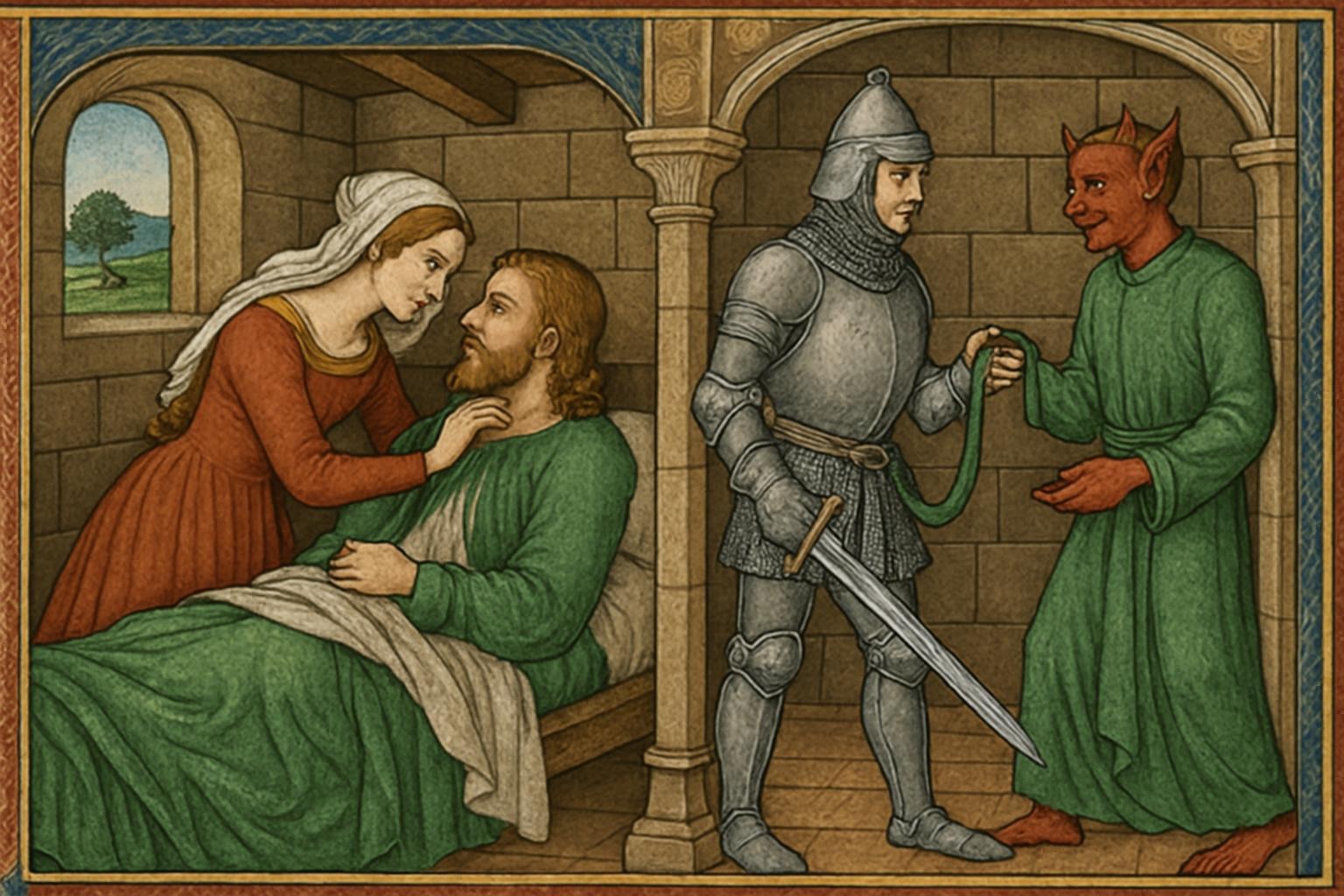
The final visit introduces the green girdle, symbolizing both temptation and survival instinct. Clearly, Gawain hesitates, recognizing the ethical breach. Moreover, fear and human weakness momentarily override conscience. Consequently, he accepts the gift but conceals it, marking his first moral failing. In addition, the poet highlights that ethical judgment requires courage as much as restraint. Furthermore, the girdle exemplifies how tangible objects can embody moral and spiritual significance simultaneously. Indeed, tests and temptations culminate in this symbolic exchange. Therefore, the narrative reinforces the lesson that even minor lapses carry consequence. Additionally, reflection after acceptance illustrates the interplay of action and conscience. Clearly, virtue emerges through awareness, humility, and acknowledgment of imperfection repeatedly and gradually.
The Green Chapel: Fulfillment and Revelation
Gawain’s arrival at the Green Chapel represents culmination of physical and moral testing. Clearly, he bows before the Green Knight, confronting fear and judgment. Moreover, the revelation of Bertilak’s identity clarifies the orchestrated nature of all trials. Consequently, lessons learned through deception, flirtation, and vigilance gain meaning. In addition, the narrative shows that ethical reflection is inseparable from experience. Furthermore, tests and temptations manifest in both overt and subtle ways. Indeed, Gawain’s humility and acknowledgment of error demonstrate growth. Therefore, moral instruction is reinforced through confrontation with truth. Additionally, the chapel setting symbolizes both sacred space and ethical threshold. Clearly, the combination of fear, insight, and accountability conveys the intertwined nature of spiritual and human development continuously.
The Judgment: Gawain’s Self-Reproach
After the Green Knight reveals the truth, Gawain feels profound shame despite forgiveness. Clearly, the green girdle becomes a symbol of human imperfection. Moreover, he judges himself harshly, acknowledging that concealment represents moral failure. Consequently, tests and temptations in Gawain illustrate that integrity requires accountability. In addition, his self-reproach demonstrates ethical awareness and spiritual reflection simultaneously. Furthermore, he wears the girdle publicly, transforming private guilt into visible humility. Indeed, the narrative shows that confession and acknowledgment enhance moral growth. Therefore, Gawain’s internal judgment reinforces the poem’s theme: ethical development depends on self-examination. Additionally, reflection, repentance, and awareness become tools for cultivating virtue repeatedly. Clearly, understanding one’s flaws is integral to navigating tests and temptations effectively.
Arthur’s Court and Collective Response
Gawain returns to Camelot to share the entire ordeal. Clearly, the court responds with admiration rather than judgment. Moreover, knights wear green sashes in solidarity, acknowledging lessons learned from his journey. Consequently, tests and temptations extend socially, influencing communal behavior. In addition, the court reinforces moral norms through symbolic action and shared understanding. Furthermore, Gawain’s story demonstrates that ethical reflection benefits both individual and group. Indeed, collective response validates personal growth and encourages humility in all. Therefore, the narrative emphasizes interdependence between personal virtue and societal reinforcement. Additionally, shared observation teaches that ethical principles operate beyond private reflection. Clearly, the court amplifies moral insight, ensuring that lessons from tests and temptations resonate broadly and persistently.
Moral Purpose of the Tests
The poem clarifies that all tests serve a moral and instructive purpose. Clearly, Gawain’s experiences illustrate that no knight can achieve perfection without challenge. Moreover, errors are framed as opportunities for reflection rather than simple failures. Consequently, tests and temptations highlight the interplay of courage, faith, and ethical vigilance. In addition, the narrative demonstrates that virtue grows through conscious effort, struggle, and humility. Furthermore, repeated trials reinforce that even honorable individuals require guidance and correction. Indeed, the moral structure of these tests provides insight into medieval ethical thought. Therefore, Gawain’s journey reflects the poem’s broader theme: human striving, tempered by reflection and faith, leads to moral refinement. Additionally, awareness of limitation strengthens character continuously, emphasizing practical lessons alongside spiritual instruction.
Symbolism of the Green Girdle
The green girdle carries layered moral and symbolic meaning. Clearly, it signifies Gawain’s failure to maintain complete honesty. Moreover, it becomes a visible emblem of learning, humility, and human imperfection. Consequently, tests and temptations converge on this tangible object, reinforcing ethical lessons. In addition, the girdle’s green color evokes nature, growth, and both danger and renewal. Furthermore, the narrative illustrates that objects can communicate moral and spiritual truths simultaneously. Indeed, reflection on the girdle’s meaning provides insight into ethical conduct, conscience, and faith. Therefore, the poem emphasizes that visible symbols encourage continuous awareness of moral responsibility. Additionally, the green girdle reminds both hero and audience that virtue develops through engagement, error, and thoughtful consideration repeatedly. Clearly, moral symbols guide understanding of tests and temptations naturally.
Conclusion: The Lasting Power of Gawain’s Tests
Sir Gawain and the Green Knight demonstrates that tests and temptations define both narrative and ethical arc. Clearly, these trials guide him from pride and fear to humility and reflection. Moreover, the poem suggests that failure does not diminish honor; rather, it provides learning opportunities. Consequently, virtue emerges through experience, repentance, and sustained self-awareness. In addition, ethical insight grows through interaction with challenge, temptation, and reflection. Furthermore, the poem underscores that courage and conscience coexist in moral decision-making. Indeed, Gawain’s journey exemplifies the balance between personal responsibility and spiritual guidance. Therefore, the narrative honors honesty, vigilance, and the courage to confront imperfection repeatedly. Additionally, reflection transforms human error into ethical development. Clearly, tests and temptations demonstrate that virtue is cultivated, not innate, and develops through conscious effort continuously.
Chivalry as Foundation of Virtue
Gawain’s moral and knightly conduct begins with foundational chivalry. Clearly, adherence to honor, courage, and loyalty forms the backbone of ethical decision-making. Moreover, faith reinforces these ideals, linking human effort with divine guidance. Consequently, tests and temptations reveal the interdependence of chivalric and spiritual duty. In addition, moral courage depends on consistency and reflection. Furthermore, ethical choice requires balancing personal desire with responsibility. Indeed, the narrative emphasizes that virtue manifests through action guided by conscience. Therefore, chivalric training is inseparable from moral development. Additionally, medieval readers understand that honor requires continuous vigilance and self-examination. Clearly, Gawain’s chivalry serves as a lens for exploring tests and temptations repeatedly.
Faith and Prayer as Moral Anchor
Throughout the journey, Gawain relies on prayer to navigate trials. Clearly, prayer strengthens courage and clarifies ethical choice. Moreover, spiritual reflection informs every decision he makes in dangerous and tempting situations. Consequently, tests and temptations intertwine with religious practice consistently. In addition, faith operates as both guide and shield, offering reassurance during uncertainty. Furthermore, reflection alongside prayer highlights the connection between conscience and divine oversight. Indeed, moral insight emerges from attentive devotion and active mindfulness. Therefore, Gawain exemplifies how ethical reasoning relies on spiritual grounding. Additionally, repeated prayer reinforces commitment to virtue, courage, and humility. Clearly, religious reflection complements chivalric responsibility continually. Thus, the poem demonstrates that tests and temptations cannot be separated from spiritual practice naturally.
Nature as Ethical Teacher
Gawain’s journey occurs amid forests, winter storms, and isolated landscapes. Clearly, nature itself becomes a source of moral instruction. Moreover, environmental hardships mirror inner struggle and spiritual growth. Consequently, tests and temptations integrate physical endurance with ethical reflection. In addition, forests, rivers, and wildlife symbolize trials of courage, humility, and patience. Furthermore, natural observation encourages interpretation of signs, fostering reflection and ethical awareness. Indeed, the narrative shows that environment and morality intertwine continuously. Therefore, lessons emerge from both action and context. Additionally, Gawain learns that attentive observation strengthens character. Clearly, the poet emphasizes that nature functions as a moral teacher. Ultimately, tests and temptations in meaning when combined with insight derived from surroundings repeatedly.
Solitude and Reflection
Isolation on the journey accentuates reflection and moral decision-making. Clearly, Gawain’s solitary moments foster deep contemplation of virtue and error. Moreover, tests and temptations are magnified when alone, emphasizing accountability. Consequently, solitude strengthens both courage and ethical clarity simultaneously. In addition, personal reflection converts trial into moral insight. Furthermore, the narrative demonstrates that inner vigilance is essential to resisting temptation. Indeed, spiritual guidance becomes internalized through isolation and prayer. Therefore, the journey illustrates that self-examination is continuous, not episodic. Additionally, ethical lessons crystallize in moments of quiet contemplation. Clearly, the poem highlights the interplay between solitude, reflection, and tests and temptations consistently. Thus, isolation supports conscious engagement with both fear and moral responsibility naturally.
Loyalty to Lord and Divine Authority
Gawain must reconcile obligations to Bertilak and God simultaneously. Clearly, ethical decisions involve balancing earthly and spiritual duty. Moreover, tests and temptations demonstrate that loyalty requires reflection, courage, and moral judgment. Consequently, failure to align both can compromise virtue. In addition, faith informs judgment and strengthens ethical action. Furthermore, moral order intertwines human and divine principles throughout the poem. Indeed, chivalric responsibility operates alongside spiritual accountability repeatedly. Therefore, the narrative emphasizes that true honor combines worldly duty with ethical reflection. Additionally, Gawain’s decisions illustrate integration of loyalty, courage, and conscience. Clearly, tests and temptations in Gawain reinforce the idea that virtue requires harmonizing multiple spheres of responsibility continuously.
Every Challenge as Ethical Test
Every challenge Gawain faces carries moral significance. Clearly, courage alone does not define heroism. Moreover, tests and temptations reveal how bravery must align with conscience. Consequently, physical risk becomes ethical trial simultaneously. In addition, fear and reflection intersect constantly, shaping decisions. Furthermore, symbols such as the green girdle emphasize moral choice. Indeed, each action demonstrates the importance of honesty, humility, and vigilance. Therefore, the narrative highlights that true heroism depends on ethical awareness. Additionally, every encounter teaches insight into both personal and spiritual responsibility. Clearly, tests and temptations reinforce the connection between action and moral principle repeatedly.
Prayer as Guidance
Throughout the journey, prayer provides both support and reflection. Clearly, spiritual practice strengthens ethical resolve. Moreover, tests and temptations intertwine with devotion naturally. Consequently, prayer helps Gawain navigate fear, desire, and temptation. In addition, reflection amplifies moral insight continuously. Furthermore, faith transforms experience into instruction. Indeed, spiritual engagement becomes essential for ethical discernment. Therefore, prayer guides both thought and action repeatedly. Additionally, consistent devotion reinforces courage and humility. Clearly, tests and temptations cannot be separated from religious reflection effectively.
Contemplation of Mortality
Awareness of mortality shapes Gawain’s ethical reasoning. Clearly, tests and temptations gain urgency through fear of death. Moreover, life and death heighten reflection on duty and virtue. Consequently, courage is informed by awareness of human limitation. In addition, mortality encourages prayer and contemplation. Furthermore, facing death sharpens moral clarity. Indeed, ethical decisions require both reflection and vigilance. Therefore, the narrative emphasizes that life’s brevity enhances spiritual growth. Additionally, awareness strengthens humility and ethical perseverance. Clearly, tests and temptations in Gawain are intensified by the constant presence of mortality repeatedly.
Fairness and Ethical Reciprocity
Gawain experiences justice and mercy throughout his trials. Clearly, religious principles govern both action and response. Moreover, tests and temptations in Gawain reflect divine oversight in human affairs. Consequently, ethical reciprocity reinforces the importance of fairness and piety. In addition, forgiveness complements accountability naturally. Furthermore, moral understanding develops through observation and reflection. Indeed, divine principles shape human interaction continuously. Therefore, ethical lessons balance consequence with grace effectively. Additionally, mercy guides moral development repeatedly. Clearly, tests and temptations in Gawain illustrate that virtue involves both action and response consistently.
Lady Bertilak’s Gifts as Ethical Measure
Lady Bertilak’s gifts carry profound moral meaning. Clearly, tests and temptations intersect with desire, courtesy, and duty. Moreover, the green girdle becomes a tangible emblem of choice and consequence. Consequently, each gift tests honesty and loyalty simultaneously. In addition, symbolic exchange instructs on piety and vigilance repeatedly. Furthermore, human response reflects ethical awareness. Indeed, moral insight emerges from thoughtful decision-making continuously. Therefore, these gifts highlight the integration of spiritual and worldly principles naturally. Additionally, reflection upon these exchanges strengthens understanding of virtue. Clearly, tests and temptations use material objects to reinforce ethical instruction effectively.
Chivalry and Religious Virtue
Gawain’s knightly conduct aligns with spiritual principles consistently. Clearly, ethical action relies on both courage and piety. Moreover, tests and temptations demonstrate that chivalric ideals complement religious duty. Consequently, honor and faith intersect in decision-making repeatedly. In addition, ethical courage depends on moral reflection. Furthermore, virtue extends beyond martial skill into spiritual insight. Indeed, Gawain embodies the integration of human and divine expectation continuously. Therefore, chivalric principles guide behavior and reinforce accountability naturally. Additionally, knights illustrate that ethical development requires both training and conscience. Clearly, tests and temptations reinforce the fusion of chivalry with moral and religious practice effectively.
Nature as Moral Teacher
Forests, seasons, and landscapes serve as ethical instructors. Clearly, tests and temptations are mirrored by environmental challenges continuously. Moreover, nature reflects inner struggle and spiritual development simultaneously. Consequently, physical hardship becomes a pedagogical instrument naturally. In addition, observation of surroundings encourages reflection and insight. Furthermore, signs in the environment highlight virtue and vigilance. Indeed, natural trials emphasize endurance, patience, and humility. Therefore, ethical growth occurs in conjunction with environmental awareness repeatedly. Additionally, the narrative shows that moral lessons extend beyond human interaction. Clearly, tests and temptations gain meaning through engagement with natural surroundings consistently.
Solitude and Moral Reflection
Gawain’s isolation strengthens both courage and conscience. Clearly, tests and temptations in Gawain are intensified during moments of solitude. Moreover, reflection converts trial into ethical insight effectively. Consequently, self-examination becomes essential to resisting temptation. In addition, prayer and contemplation reinforce awareness and moral vigilance. Furthermore, solitude allows for personal responsibility to emerge naturally. Indeed, internal struggle mirrors external challenge repeatedly. Therefore, the poem demonstrates that virtue develops through attentive reflection continuously. Additionally, self-guided ethical practice strengthens character effectively. Clearly, tests and temptations rely on solitude as a tool for moral and spiritual development consistently.
Loyalty and Ethical Balance
Gawain navigates obligations to both lord and God carefully. Clearly, ethical decisions involve balancing earthly and divine responsibility repeatedly. Moreover, tests and temptations in Gawain reveal the tension between duty and conscience. Consequently, moral judgment requires integration of multiple principles simultaneously. In addition, faith informs loyalty, while reflection guides action. Furthermore, ethical balance sustains character and honor continuously. Indeed, alignment of virtue with responsibility strengthens spiritual growth naturally. Therefore, the narrative emphasizes that true heroism merges ethical, spiritual, and social commitments. Additionally, conscientious decision-making cultivates integrity effectively. Clearly, tests and temptations highlight the constant negotiation between human desire and divine expectation repeatedly.
Integration of Individual and Communal Morality
Gawain’s journey links personal virtue with social influence consistently. Clearly, tests and temptations in Gawain impact both individual character and communal ethical norms. Moreover, reflection and confession extend lessons to the entire court simultaneously. Consequently, moral insight spreads socially through example and story. In addition, shared observation encourages collective adherence to virtue naturally. Furthermore, ethical behavior in public reinforces private integrity continuously. Indeed, personal reflection informs communal practice repeatedly. Therefore, the poem demonstrates that human morality functions in both personal and social dimensions effectively. Additionally, collective acknowledgment strengthens the value of confession and humility. Clearly, tests and temptations in Gawain unify individual growth with societal ethical reinforcement consistently.
Role of Religion an d Piety in Gawain by the Pearl Poet: https://englishlitnotes.com/2025/07/12/role-of-religion-and-piety-gawain/
American Literature:http://americanlit.englishlitnotes.com
Discover more from Naeem Ullah Butt - Mr.Blogger
Subscribe to get the latest posts sent to your email.