
Introduction: The Stage as a Platform for Ideas
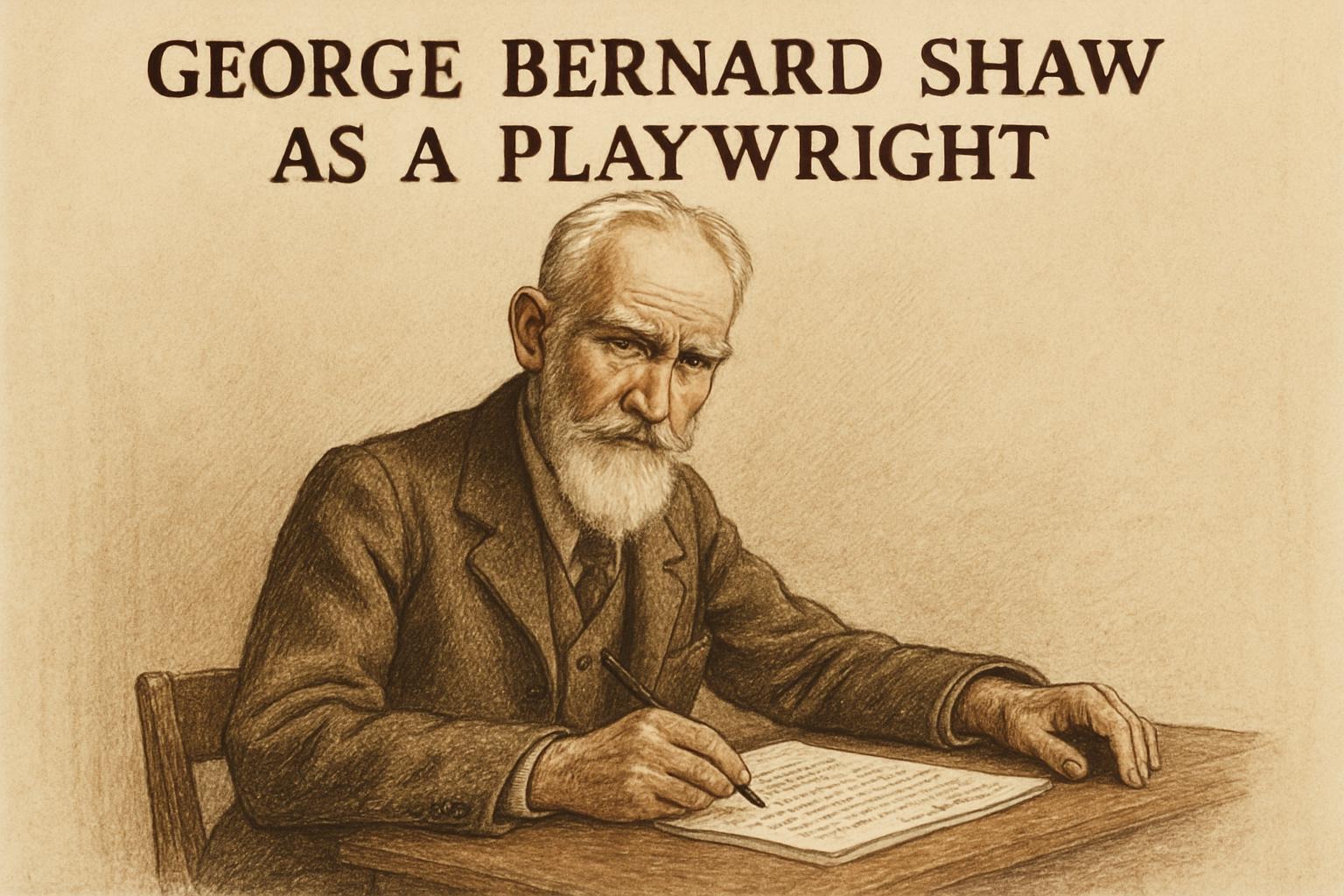
George Bernard Shaw revolutionized the English stage during the late nineteenth century. He transformed the popular theatre from a venue for mere entertainment into a forum for serious social and intellectual debate. Consequently, he deliberately rejected the sentimentalism and structural rigidity of the Victorian well-made play consistently. Furthermore, he utilized the stage to relentlessly critique societal flaws, moral hypocrisy, and economic injustice effectively. His dramatic work blends sharp, satirical wit with a profound, underlying moral purpose clearly. He championed rational inquiry and evolutionary progress as the true engines of human improvement consistently. Thus, he consistently challenged his audiences to abandon comfortable illusions for uncomfortable truths. He believed in the power of sustained discussion to reshape human consciousness profoundly. George Bernard Shaw as playwright stands as the foremost exponent of the intellectual drama tradition.
1. Dramatic Social Criticism
Shaw’s drama functions primarily as a powerful, relentless instrument of social criticism. Therefore, he actively used his plays to expose the deep, systemic failures of contemporary society constantly. George Bernard Shaw as playwright employed the stage as a surgical tool for precise, unsparing dramatic social criticism. Consequently, he attacked institutions like marriage, medicine, and militarism with unyielding rational scrutiny effectively. Specifically, his plays challenged the audience to reconsider their comfortable assumptions about morality and class consistently. Moreover, the dramatic tension often arises not from action but from the clash of opposing social viewpoints clearly. Hence, he believed that theatre must first challenge the mind before it could possibly move the heart profoundly. Indeed, his characters frequently articulate highly unconventional, provocative sociological positions truly. Furthermore, he sought to awaken the public conscience to the urgent need for fundamental societal reform entirely. Thus, every play is ultimately a call to profound, collective moral action clearly.
2. Intellectual Comedy Technique
Shaw perfected the technique of intellectual comedy, blending wit with serious, sustained philosophical inquiry. Therefore, his comedies entertain the audience while simultaneously forcing them to confront uncomfortable truths consistently. George Bernard Shaw as playwright mastered the intellectual comedy technique, using wit to enforce profound philosophical debate. Consequently, the humor often springs from the shocking inversion of conventional morality or character roles effectively. Specifically, the rapid-fire, dazzling wit serves as a sophisticated vehicle for complex, abstract ideas clearly. Moreover, he refused to provide simple, sentimental resolutions typical of drawing-room comedies consistently. Hence, the laughter often dissolves into critical reflection on the play’s deep, central moral argument profoundly. Indeed, the technique ensured that his plays, though didactic, remained profoundly engaging and highly theatrical truly. Furthermore, he used the comedic structure to make radical ideas palatable to a bourgeois audience initially. Thus, he weaponized wit to dismantle complacency and intellectual laziness effectively.
3. Satire of Social Institutions
Shaw engaged in systematic, fierce satire targeting the most revered social institutions of his entire era. Therefore, he consistently exposed the underlying corruption and hypocrisy that supported institutions like the legal system and the church effectively. George Bernard Shaw as playwright conducted a fierce, systematic satire of social institutions, questioning their moral and economic foundations. Consequently, he frequently showed how institutions were fundamentally designed to protect the interests of the privileged few clearly. Specifically, his prefaces offered elaborate, argumentative critiques that buttressed the dramatic action profoundly. Moreover, plays like Major Barbara satirized the inherent inadequacy of organized charity and philanthropy clearly. Hence, he often presented the institutional ideal against its ugly, practical reality for maximum satirical effect consistently. Indeed, he believed that honest satire was a necessary prelude to genuine, lasting social improvement truly. Furthermore, he used inversion to show that the ‘villains’ of society often operated with the purest institutional logic effectively. Thus, he made every play a profound interrogation of established social order constantly.
4. Fabian Socialist Ideology
Shaw’s dramatic output is profoundly informed by his lifelong commitment to Fabian Socialist ideology. Therefore, his plays consistently advocate for gradual, pragmatic, and highly intellectual reform rather than violent revolution clearly. George Bernard Shaw as playwright infused his drama with Fabian Socialist ideology, advocating for gradual, rational economic and social reform. Consequently, he focused intensely on exposing the economic determinism that shaped all human behavior and morality effectively. Specifically, his dramatic solutions often involved rational, administrative reorganization of key societal functions consistently. Moreover, the economic basis of marriage, poverty, and war forms a constant, deep thread running through all his narratives clearly. Hence, he used characters like Undershaft to articulate a powerful, uncomfortable defense of money’s vital importance truly. Indeed, his dramatic purpose was ultimately to popularize and justify the intellectual foundations of the Fabian movement successfully. Furthermore, he consistently sought to replace romantic, capitalist illusions with concrete, economic realities truly. Thus, the stage became his most visible platform for propagating Fabian principles consistently.
5. Political Drama Innovation
Shaw innovated the structure and purpose of the modern political drama fundamentally. Therefore, he moved political content from mere background setting to the very core of the dramatic conflict consistently. George Bernard Shaw as playwright revolutionized the form of political drama by making ideological conflict the central dramatic action. Consequently, the tension arises from the clash of profoundly opposing political and ethical viewpoints clearly. Specifically, the drama frequently culminates not in physical action but in an extended, highly charged rhetorical debate effectively. Moreover, he elevated the complexity of political argument beyond simple good-versus-evil melodrama profoundly. Hence, plays like Heartbreak House offered complex, symbolic examinations of a failing political class entirely. Indeed, he treated political systems and theories as living, dynamic forces that actively shape individual destiny truly. Furthermore, his innovations paved the way for future playwrights focused on social justice and political critique entirely. Thus, he transformed the political stage from caricature to philosophical arena constantly.
6. Realism with Intellectual Wit
Shaw’s unique style fuses the stark reality of the Ibsenite stage with dazzling, relentless intellectual wit completely. Thus, he depicted contemporary social problems with unflinching realism, avoiding sentimental compromise consistently. Consequently, the realistic settings and recognizable character types immediately ground the philosophical discussions in the real world clearly. Therefore, the intellectual wit then provides a necessary engine for driving the complex, often dry, arguments forward effectively. The wit operates as a continuous challenge to the audience’s ingrained emotional and intellectual biases clearly. Moreover, the humor often highlights the absurdity inherent in the gap between social convention and practical human nature profoundly. Hence, he ensured his realism was never merely grim but always crackling with subversive, rational energy constantly. Nevertheless, the fusion creates a theatrical experience that is both highly engaging and deeply unsettling readily.
7. Attack on Victorian Morality
Shaw launched a comprehensive, sustained attack on the profound hypocrisy of Victorian moral codes. Therefore, he consistently exposed the vast, often destructive, gap between public moral pretense and private, economic reality consistently. George Bernard Shaw as playwright launched a relentless, rational attack on the hypocrisy and structural flaws of Victorian conventional morality. Consequently, he challenged taboos surrounding poverty, prostitution, and societal definitions of appropriate gender roles effectively. Specifically, he often showed that the officially “immoral” characters frequently possessed greater ethical honesty than the supposedly “respectable” ones clearly. Moreover, plays like Mrs. Warren’s Profession directly interrogated the economic foundations of social judgment profoundly. Hence, he argued that true morality must be based on rational conduct and social utility, not outdated religious dogma constantly. Indeed, his attacks forced a powerful, necessary public debate on the entire structure of conventional ethics truly. Furthermore, he stripped the veneer of sentimentality from the era’s most cherished illusions relentlessly. Thus, his work served as a powerful corrective to the entire Victorian age constantly.
8. Drama of Ideas Tradition
Shaw is the undisputed master of the “drama of ideas,” where concepts and philosophies take center stage entirely. Thus, the play’s fundamental action resides in the clash and evolution of highly complex intellectual arguments constantly. Consequently, the characters are often less important as unique personalities and more as articulate carriers of competing philosophical viewpoints clearly. Therefore, the debate itself becomes the true, essential dramatic climax of the performance consistently. This tradition prioritizes rational discussion and ethical inquiry over traditional plotting or physical action entirely. Moreover, Shaw believed that the theatre should challenge and stimulate the audience’s intellect rather than merely their emotions profoundly. Hence, he utilized extensive prefaces to expand the ideas introduced on stage into sustained critical arguments clearly. Nevertheless, he masterfully disguised this intellectual core within a highly entertaining, witty theatrical structure effectively.
9. Dialogue-Driven Construction
Shaw’s plays are fundamentally dialogue-driven, where the power of the word supersedes the primacy of physical action entirely. Thus, the entire dramatic structure is built upon long, sustained speeches and rapid, intricate rhetorical exchanges consistently. Consequently, the development of the plot and the progression of the dramatic conflict occur almost entirely through the characters’ verbal sparring clearly. Therefore, he was a master of the extended monologue, using it to articulate his most complex and provocative ideas effectively. The dialogue is characterized by its intense intellectual energy, clarity, and highly rhythmic wit constantly. Moreover, the speeches often serve the crucial function of exposition, eliminating the need for contrived, traditional stage action clearly. Hence, the strength of his drama relies upon the compelling nature of the ideas being expressed and debated profoundly. Nevertheless, this dialogue, though wordy, possesses an undeniable, hypnotic theatrical energy truly.
10. Debate-Centered Plot
The typical Shavian plot structure is built around a central, sustained philosophical or ethical debate. George Bernard Shaw as playwright constructed debate-centered plots where the climax is an intellectual confrontation rather than a physical or romantic resolution. Therefore, the dramatic arc moves not toward a conventional romantic or physical climax but toward an intellectual confrontation consistently. Consequently, the central conflict often revolves around two articulate characters arguing opposing ideological positions clearly. Specifically, the tension builds as the characters logically dismantle each other’s moral and intellectual illusions effectively. Moreover, the final moments often involve one character converting another, or a definitive statement closing the profound argument clearly. Hence, this structure allows for a thorough, intellectually rigorous examination of the play’s core ethical question profoundly. Indeed, he stripped the stage of unnecessary action to focus the audience’s attention entirely on the rhetorical battle truly. Furthermore, this debate structure ensures that the play’s meaning remains open to continuous, complex intellectual analysis constantly. Thus, the dialogue is the true engine of the entire plot’s progression clearly.
11. Conflict of Ideologies
The fundamental engine driving Shaw’s drama is the powerful, relentless conflict of opposing ideologies completely. Thus, his plays rarely feature simple clashes between good individuals and bad individuals constantly. Consequently, the core tension arises from the confrontation between deeply held, well-articulated philosophical or political viewpoints clearly. Therefore, characters often represent specific ideological positions—Socialism versus Capitalism, Idealism versus Realism, or Authority versus Anarchy effectively. The dramatic success lies in presenting each ideology with great rhetorical force and convincing logical clarity consistently. Moreover, the audience is then forced to weigh the strengths and weaknesses of each competing worldview independently. Hence, this emphasis on ideological conflict elevated the drama beyond mere personal tragedy or simple melodrama profoundly. Nevertheless, the conflict ensures the plays remain challenging, relevant, and highly stimulating to the intellect truly.
12. Critique of Capitalist Systems
Shaw maintained a lifelong, trenchant critique of the foundational principles and ethical consequences of capitalist systems. As a playwright, George Bernard Shaw used his stage to express a systematic critique of capitalism’s foundations. He highlighted the ethical consequences involved. Therefore, he consistently exposed the inherent immorality and systemic exploitation built into the capitalist framework consistently. Consequently, he often showed that poverty and crime were direct, logical results of economic injustice, not individual moral failure clearly. Specifically, plays like Major Barbara challenge the audience to confront the ugly, material source of their own economic comfort profoundly. Moreover, he argued that morality was often a mere superstructure. It was built upon the shifting, unstable sands of economic necessity. Hence, he advocated for rational, social ownership of the means of production to eliminate economic determinism consistently. Indeed, his dramatic purpose was to demonstrate that true reform must address the underlying economic root of the problem truly. Furthermore, he used the stage to make complex economic theories accessible and dramatically compelling powerfully. Thus, his critique of capitalism remains a central theme across his entire theatrical canon clearly.
13. Rational Moral Inquiry
Shaw’s work is driven by a profound, continuous commitment to rational moral inquiry. Thus, he consistently argued that morality must be based on practical, social utility and clear, rational thought constantly. Consequently, he rejected moral codes based solely on sentimental tradition, outdated superstition, or blind dogma effectively. Therefore, his plays function as public experiments, testing the logical validity of various ethical propositions consistently. He used the dramatic form to systematically dismantle the comfortable, illogical premises of conventional ethics profoundly. Moreover, his characters often engage in rigorous, sustained debates about what constitutes genuinely right and useful action clearly. Hence, the plays challenge the audience to apply the same intense rational scrutiny to their own deeply held moral assumptions constantly. Nevertheless, he believed that human intelligence was the only tool capable of advancing the ethical evolution of the entire race truly.
14. Exposure of Social Hypocrisy
Shaw was an unparalleled master at exposing the pervasive, debilitating effects of social hypocrisy entirely. Thus, he consistently attacked the vast, dishonest gap between what society claimed to believe and how it truly operated constantly. Consequently, he revealed how individuals used moral and social conventions as shields to protect self-interest and economic advantage effectively. Therefore, characters who appear morally upstanding are often revealed to be the most corrupt or self-deluded individuals clearly. He often employed paradox to show that those deemed “immoral” by society possessed greater ethical honesty and clarity clearly. Moreover, his meticulous exposure of pretense served his ultimate Fabian goal of promoting honesty and pragmatic, clear reform consistently. Hence, the dramatic irony in his plays is frequently directed at the audience’s own complicity in perpetuating these hypocritical systems truly.
15. Paradox and Dramatic Irony
Shaw employed paradox and dramatic irony as his most potent weapons against audience complacency. George Bernard Shaw as playwright employed paradox and dramatic irony as his most potent weapons against the moral complacency of his audience. Therefore, he consistently inverted conventional wisdom, presenting the most shocking ideas as self-evident truths consistently. Consequently, the effect of his paradoxes was to jar the audience into questioning their own ingrained moral assumptions profoundly. Specifically, his irony stems from the audience recognizing a truth that the character either ignores or simply cannot yet articulate effectively. Moreover, the famous Shavian inversion—where the saintly figure is revealed as the villain—is a masterstroke of ironic technique clearly. Hence, this constant stream of paradox and irony ensured the plays remained intellectually engaging and highly unpredictable constantly. Indeed, he used these devices to demonstrate the sheer, inherent absurdity of conventional thinking profoundly. Furthermore, the irony forces the audience to acknowledge their own complicity in the very hypocrisy being attacked truly. Thus, his wit was always a tool serving a higher intellectual purpose effectively.
16. Critique of Middle-Class Values
The entire foundation of Shaw’s social critique rests on his deep skepticism of entrenched middle-class values entirely. Thus, he viewed the narrow, conventional morality of the bourgeoisie as the primary obstacle to genuine societal progress constantly. Consequently, he attacked their commitment to sentimentalism, their aversion to uncomfortable truths, and their profound economic self-interest clearly. Therefore, his plays frequently show that middle-class respectability is merely a fragile disguise for intellectual cowardice and moral stagnation effectively. Characters like Mrs. Warren are often the logical product of the very values the middle class purports to despise clearly. Moreover, he sought to replace their comforting, emotional illusions with the rigorous, clear-eyed demands of rational, ethical inquiry consistently. Hence, the dramatic conflict is often the confrontation between a rational, clear-sighted Shavian hero and the stifling mediocrity of the middle-class environment profoundly.
17. Anti-Romantic Dramatic Approach
Shaw deliberately cultivated a forceful anti-romantic approach in all his dramatic writing. George Bernard Shaw as playwright maintained a resolute anti-romantic dramatic approach, stripping his subjects of sentimentality and illusion. Therefore, he relentlessly stripped away the sentimental, idealized illusions surrounding subjects like war, love, and heroism consistently. Consequently, he attacked the dangerous notion that passion or idealism should ever supersede the clear, rational demands of reality effectively. Specifically, he often showed romantic love to be an economic transaction or a biological imperative, not a mystical, elevated emotion truly. Moreover, plays like Arms and the Man dismantle the pervasive, destructive illusions of military glory and romantic heroism clearly. Hence, his anti-romanticism served his Fabian goal of grounding all human action firmly in clear, practical, observable reality consistently. Indeed, he believed that romantic illusion was a major impediment to all necessary, fundamental social reform truly. Furthermore, this approach ensures his plays maintain a tone of cool, intellectual clarity and rigor constantly. Thus, he replaced the poetry of emotion with the rhetoric of reason effectively.
18. Strong Female Protagonists
Shaw created some of the most independent, articulate, and strong female protagonists in modern theatre history constantly. Thus, his heroines consistently challenge traditional gender roles and the stifling expectations of a patriarchal society effectively. Consequently, characters like Vivie Warren, Major Barbara, and Eliza Doolittle exhibit remarkable intellectual clarity and powerful determination clearly. Therefore, they often serve as the true voice of Shavian reason, possessing a pragmatic clarity often lacking in the male characters consistently. These women take charge of their own economic destinies and reject sentimental illusions decisively. Moreover, their strength is inherently rational, reflecting Shaw’s belief that women, once freed, would be the true engine of human evolution clearly. Hence, their presence on stage was a profound dramatic and political statement about the burgeoning feminist movement profoundly.
19. Feminist Dramatic Concerns
Shaw was a passionate advocate for feminist ideals, integrating feminist dramatic concerns directly into his plays entirely. Thus, he used the stage to examine the economic and social subjugation of women in Victorian and Edwardian society consistently. Consequently, his work exposes the ways in which marriage and societal expectations often function as profound instruments of female oppression clearly. Therefore, he championed women’s right to economic independence, intellectual freedom, and full political equality consistently. Plays like Mrs. Warren’s Profession directly link the oppression of women to underlying economic structures profoundly. Moreover, his female characters often choose professional or intellectual careers over conventional marriage, asserting their complete autonomy clearly. Hence, his dramatic focus on female agency was a radical, necessary intervention into the existing theatrical canon clearly.
20. Social Reform Consciousness
Every single play written by Shaw is imbued with an intense, profound social reform consciousness. George Bernard Shaw as playwright infused his entire body of work with an intense social reform consciousness advocating for practical, rational change. Therefore, his ultimate goal as an artist was always to stimulate necessary public thought toward practical, rational change consistently. Consequently, he meticulously researched every social problem he addressed, ensuring his dramatic critique was grounded in clear fact effectively. Specifically, he used the dramatic form to systematically dismantle the illogical resistance to necessary, fundamental change entirely. Moreover, his extensive prefaces served as a direct call to action, outlining concrete political and social solutions clearly. Hence, he believed that theatre must be a tool for civic education, driving the ethical evolution of society constantly. Indeed, his commitment to reform elevates his drama above mere entertainment into the realm of profound, public utility truly. Furthermore, he viewed his artistry as a direct extension of his lifelong Fabian commitment entirely. Thus, the stage was the ultimate public laboratory for his entire reform agenda clearly.
21. Influence of Henrik Ibsen
Shaw’s entire career was fundamentally shaped by the powerful, revolutionary influence of Henrik Ibsen completely. Thus, Ibsen’s pioneering work in realistic, problem-centered drama provided the essential structural blueprint for Shaw’s own plays consistently. Consequently, Shaw adopted Ibsen’s technique of building the plot around the gradual, relentless exposure of a profound social lie effectively. Therefore, he openly championed Ibsen as the founder of the new, serious, intellectual drama in his highly influential book The Quintessence of Ibsenism clearly. He learned from Ibsen how to make the stage a forum for uncomfortable, necessary social and moral debate profoundly. Moreover, Shaw, however, infused Ibsen’s often tragic realism with his own unique brand of paradox and comedic wit clearly. Hence, the influence is clear in his early problem plays, which directly address profound social scandals consistently.
22. Dramatic Evolution of Realism
Shaw took the concept of theatrical realism and evolved it into a powerful, dialectical tool for change. George Bernard Shaw as playwright dramatically evolved theatrical realism by prioritizing intellectual debate and sociological critique over conventional domestic drama. Therefore, he utilized realistic settings and dialogue only to establish a credible stage for highly abstract, profound debate consistently. Consequently, he rejected the narrow focus of mere domestic realism, expanding the stage to include vast, ethical, and political concerns clearly. Specifically, his realism was not a photographic reproduction of life but a selective presentation designed to expose the underlying truth effectively. Moreover, the ultimate dramatic reality was the confrontation of clear ideas, not the superficial reproduction of surface reality entirely. Hence, he moved realism from simply showing a problem to actively debating its complex, necessary solution profoundly. Indeed, his evolutionary realism ensured that the drama maintained its moral and intellectual potency constantly. Furthermore, he believed realism must serve a profound intellectual purpose, not just aesthetic representation truly. Thus, his stage realism was always a means to a higher philosophical end clearly.
23. Exploration of Human Motivation
Shaw’s drama engages in a relentless, rational exploration of the entire complexity of human motivation constantly. Thus, he consistently refused to accept simple, sentimental explanations for his characters’ complex actions effectively. Consequently, he often revealed that seemingly noble actions were fundamentally driven by economic need or profound biological impulse clearly. Therefore, he showed that self-interest and survival were often the purest, most honest motives, despite societal judgment consistently. He used the dramatic form to challenge the entire audience’s belief in selfless, idealized, or purely romantic motivation profoundly. Moreover, characters who claim high moral ground are often revealed to be motivated by fear or profound hypocrisy clearly. Hence, this clear-eyed, rational examination ensures that his characters remain complex, believable, and utterly unforgettable truly.
24. Dismantling of Social Illusions
The central, persistent theme running through Shaw’s entire body of work is the need to dismantle profound social illusions entirely. Thus, he viewed the collective acceptance of comfortable lies as the greatest single impediment to all human progress constantly. Consequently, his plays systematically target the illusions surrounding love, money, war, and the very concept of heroism effectively. Therefore, he forces his audience to confront the harsh, often uncomfortable, reality that lies beneath the sentimental surface consistently. The dramatic tension is often the internal struggle of a character shedding their illusions and confronting clear truth profoundly. Moreover, the Shavian hero is frequently the person who has achieved a complete, rational clarity by discarding all sentimental falsehoods clearly. Hence, the final, profound lesson of every play is the necessity of facing reality without the protective shield of comforting lies truly.
25. Psychological Depth in Dialogue
Shaw achieved profound psychological depth through the very structure and content of his extended dialogue. George Bernard Shaw as playwright achieved profound psychological depth not through inner monologue but through the clarity and complexity of public dialogue. Therefore, the true psychological landscape of his characters is revealed not in private monologues but in public, sustained intellectual combat consistently. Consequently, the clarity and force of a character’s argument reveal their ultimate intellectual and moral fiber effectively. Specifically, the psychological weight is carried by the ideas the character chooses to champion and defend fiercely. Moreover, the subtle shifts in their rhetorical strategy or the sudden emotional break reveal deep, internal vulnerability clearly. Hence, the audience must infer the inner life from the external, clear articulation of the character’s profound, chosen principles truly. Indeed, he believed that true character was expressed through sustained, highly rational, and public action constantly. Furthermore, this technique ensured that the intellectual action was always grounded in highly believable human motivation clearly. Thus, his dialogue serves as both philosophical argument and psychological portrait profoundly.
26. Satirical Character Treatment
Shaw’s treatment of his characters is primarily satirical, using them as tools to expose and challenge social norms entirely. Thus, his characters are often highly stylized types, representing specific philosophical or sociological positions constantly. Consequently, he frequently uses exaggeration, inversion, and verbal excess to highlight the absurdity of the position they represent clearly. Therefore, the satire is not aimed at destroying the character but at dismantling the illogical ideas they happen to embody effectively. Characters often deliver brilliant speeches that contradict their own personal actions, creating powerful irony constantly. Moreover, the satirical treatment ensures the audience maintains a necessary, cool intellectual distance from the emotional plight of the figure clearly. Hence, the humor allows the audience to receive the harsh, necessary social criticism without feeling overly attacked or morally judged consistently.
27. Language of Intellectual Energy
Shaw’s language is distinguished by its vibrant, rhythmic, and highly concentrated intellectual energy. George Bernard Shaw as playwright utilized a vibrant, rhythmic language of concentrated intellectual energy to maintain the dramatic force of his debates. Therefore, the dialogue is not merely naturalistic; it is highly stylized to articulate complex ideas with maximum force consistently. Consequently, the sentences are crafted to be sharp, witty, and profoundly quotable, ensuring the ideas resonate clearly. Specifically, this energy maintains the necessary dramatic tension throughout the long, argumentative passages effectively. Moreover, the rhythmic quality ensures that the lengthy speeches function as highly compelling theatrical rhetoric constantly. Hence, he often edited his dialogue to remove any extraneous words that did not contribute directly to the intellectual propulsion truly. Indeed, he believed that dull language was an ethical failure that betrayed the drama’s serious moral purpose truly. Furthermore, the language itself becomes a vibrant expression of the life force he championed profoundly. Thus, the dialogue is a continuous, relentless mental assault clearly.
28. Moral Purpose in Drama
Shaw believed deeply that all serious drama must inherently serve a profound moral purpose. Thus, he viewed the theatre as a powerful school for ethical instruction and necessary public enlightenment constantly. Consequently, his plays were explicitly designed to challenge the audience’s moral complacency and stimulate rational thought about social conduct effectively. Therefore, he rejected the idea of “art for art’s sake,” insisting that true art must serve a vital civic function consistently. The moral purpose is achieved through the rigorous, sustained debate of complex ethical questions on stage clearly. Moreover, the absence of a simple, comforting resolution forces the audience to continue the moral inquiry long after the curtain falls clearly. Hence, he consistently sought to replace the emotional catharsis of tragedy with the intellectual stimulus of rational, moral analysis profoundly.
29. Critique of Organized Religion
Shaw engaged in a systematic, sharp critique of the institutional inertia and hypocrisy of organized religion. George Bernard Shaw as playwright engaged in a sharp critique of the institutional inertia and profound moral inadequacy of organized religion. Therefore, he viewed the church as often failing to address the fundamental economic and social injustices of the era consistently. Consequently, he often contrasted the true, radical spirit of foundational religious figures with the profound complacency of their modern followers clearly. Specifically, he criticized the church for promoting sentimental morality over pragmatic, clear-headed social action consistently. Moreover, characters like Major Barbara renounce the church’s traditional methods of charity for a more effective, materialist approach clearly. Hence, he argued that true spirituality must manifest in actively working for social and economic reform on earth constantly. Indeed, he believed that true faith resided in the active service of the Life Force, not in passive obedience to dogma truly. Furthermore, his skepticism forced a profound, necessary examination of the role of faith in the modern, rational world clearly. Thus, his critique was aimed at stimulating a more pragmatic, socially engaged faith effectively.
30. Rationalism and Secular Inquiry
Shaw was a staunch champion of pure rationalism and rigorous secular inquiry in all fields of human endeavor constantly. Thus, he consistently used the stage to demonstrate the superiority of scientific thought and pragmatic reason over sentimentality or superstition effectively. Consequently, his heroes are often figures who embody clear-eyed rationalism, rejecting comforting illusions for uncomfortable truths clearly. Therefore, the debate structure of his plays is itself a model of the rational, rigorous method of inquiry consistently. He believed that the advancement of the human race depended entirely on the exercise of pure, disciplined intelligence profoundly. Moreover, his work challenges the audience to apply the same intense secular scrutiny to their own political and ethical beliefs constantly. Hence, the intellectual energy of his language reflects his belief in the supreme, organizing power of the human mind clearly.
31. Attack on Conventional Heroism
Shaw mounted a profound, successful attack on the destructive illusions surrounding conventional heroism. George Bernard Shaw as playwright conducted a profound, successful attack on the destructive illusions surrounding conventional, romantic military heroism. Therefore, he systematically dismantled the romanticized ideal of the dashing, brave soldier in his early dramatic work constantly. Consequently, he exposed the grim reality of military service and the fundamental, economic basis of all military conflict effectively. Specifically, plays like Arms and the Man show the “chocolate-cream soldier” to be the most pragmatic and honest character in the entire narrative clearly. Moreover, he argued that the true heroism lay in intellectual courage and the pragmatic, clear-eyed pursuit of social progress consistently. Hence, he replaced the sentimental hero of melodrama with the cold, pragmatic, rationalist hero of thought and action truly. Indeed, his attacks forced a powerful public re-evaluation of the morality and utility of war itself profoundly. Furthermore, he believed the romantic concept of heroism was a dangerous tool of the oppressive state consistently. Thus, he championed the quiet heroism of the disciplined mind constantly.
32. Irony-Charged Conversations
Shaw’s conversations are saturated with profound, dramatic irony, often operating on multiple layers of meaning simultaneously. Thus, the irony arises from the vast, often tragic, gap between the character’s conscious understanding and the reality known to the audience constantly. Consequently, the speeches, while brilliant, often unintentionally reveal the speaker’s own self-delusion or profound hypocrisy effectively. Therefore, the irony forces the audience to listen actively and critically, constantly analyzing the subtext of the brilliant exchange clearly. The humor often springs from the character’s eloquent, passionate defense of a position the audience recognizes as fundamentally absurd clearly. Moreover, this irony is a key mechanism for delivering his social criticism without resorting to simplistic, heavy-handed moralizing constantly. Hence, the irony ensures that the dialogue is continuously charged with intellectual tension and complexity profoundly.
33. Class Conflict Representation
Shaw provided a systematic, highly articulate representation of persistent, underlying class conflict in modern society. George Bernard Shaw as playwright provided a systematic, highly articulate dramatic representation of the underlying reality of persistent class conflict. Therefore, he consistently showed how rigid class distinctions dictated morality, opportunity, and fundamental human dignity consistently. Consequently, his plots often revolve around the economic and social friction between distinct societal strata clearly. Specifically, he used the stage to expose the economic exploitation inherent in the relationships between the rich and the poor effectively. Moreover, the language of his characters often serves as a key indicator of their class and their entire economic worldview profoundly. Hence, he demonstrated that true equality must be economic and social, not merely political or abstractly theoretical clearly. Indeed, the character of Eliza Doolittle represents the potential for class transformation through linguistic and intellectual means powerfully. Furthermore, his work challenges the audience to recognize their own personal investment in perpetuating class-based inequality truly. Thus, his stage became a powerful forum for articulating class consciousness consistently.
34. Dramatic Examination of Poverty
Shaw engaged in a rigorous, deeply moral dramatic examination of the root causes and profound effects of poverty entirely. Thus, he consistently refuted the conventional Victorian belief that poverty was merely a result of individual laziness or moral failing constantly. Consequently, he demonstrated that poverty was a direct, logical outcome of systemic economic injustice and capitalist exploitation effectively. Therefore, his plays refuse to sentimentalize the poor, instead focusing on the clear-eyed, pragmatic necessity of radical economic reform consistently. He argued that the true crime was not the poverty itself but the societal acceptance and perpetuation of it profoundly. Moreover, Major Barbara and Mrs. Warren’s Profession directly interrogate the ways in which poverty corrupts and limits human potential clearly. Hence, the dramatic examination always points toward the Fabian solution of economic reorganization and social ownership clearly.
35. Critique of Imperialist Attitudes
Shaw launched a sharp, rational critique of the moral and economic flaws inherent in imperialist attitudes. George Bernard Shaw as playwright launched a sharp, rational critique of the moral and economic flaws inherent in prevailing imperialist attitudes. Therefore, he consistently exposed the underlying economic exploitation and profound hypocrisy that drove colonial expansion consistently. Consequently, he often revealed that supposed civilizing missions were merely thinly veiled excuses for economic plunder and military aggression clearly. Specifically, he questioned the entire moral justification for the domination of one nation over another entirely. Moreover, his plays often feature characters who challenge the pervasive, jingoistic patriotism that supported the entire imperial project constantly. Hence, he believed that rational social reform must necessarily begin at home, not with external, aggressive expansion effectively. Indeed, his dramatic critique aligns with his broader, lifelong opposition to militarism and profound, unjustified violence truly. Furthermore, he used the stage to articulate a more peaceful, ethically consistent vision for international relations clearly. Thus, his work served as a profound anti-war statement consistently.
36. Ethical Debate within Scenes
Shaw’s unique structural innovation involves embedding a profound, sustained ethical debate directly within the scenes themselves. Thus, the scenes often function as miniature rhetorical battlegrounds where characters fight for the dominance of their respective moral viewpoints constantly. Consequently, the traditional elements of plot advancement are frequently paused or entirely subordinated to the rigour of the ethical argument effectively. Therefore, the dramatic arc of a scene follows the logical progression of the debate, often ending with a powerful, argumentative climax clearly. This technique requires the audience to pay intense, continuous attention to the subtle flow of the intellectual exchange profoundly. Moreover, the ethical debate ensures that the play’s themes are examined exhaustively from every available philosophical angle clearly. Hence, the intellectual charge of the individual scenes is what truly sustains the overall dramatic momentum consistently.
37. Transformation of Modern Drama
Shaw’s innovations fundamentally and permanently transformed the entire landscape of modern drama globally. Thus, he elevated the intellectual, didactic play to a position of profound artistic legitimacy and social relevance constantly. Consequently, he established the playwright’s right to use the stage as a direct, powerful platform for political and ethical debate effectively. Therefore, his influence can be seen in the subsequent work of playwrights across Europe and America profoundly. He demonstrated that the vitality of theatre lay not in melodrama but in the relentless confrontation of uncomfortable ideas clearly. Moreover, his focus on the drama of ideas shifted the entire trajectory of theatrical ambition in the twentieth century consistently. Hence, the modern serious stage is fundamentally indebted to his profound, original vision and relentless technical experimentation clearly.
38. Theatrical Innovation and Reinvention
Shaw was an incessant theatrical innovator, constantly reinventing the conventions of the popular stage entirely. Thus, he deliberately dismantled the structural framework of the well-made play, replacing it with his own debate-driven form constantly. Consequently, he extended the conventional length of plays, accommodating the vast, necessary philosophical discussions effectively. Therefore, he introduced the use of extensive, highly literary prefaces and detailed stage directions as integral parts of the entire text clearly. He experimented with unconventional settings and deliberately anti-climactic structures to challenge audience expectations consistently. Moreover, his constant formal experimentation was always driven by the moral imperative to better articulate his complex social arguments clearly. Hence, his work continually redefined the boundaries of what was considered appropriate or possible on the entire stage profoundly.
39. Sharp Social Observation
Shaw possessed an unparalleled genius for acute, profound, and sharp social observation. George Bernard Shaw as playwright possessed an unparalleled genius for acute, sharp social observation, capturing the specific language and hypocrisy of his time. Therefore, his plays are filled with meticulously observed details of language, class behavior, and social hypocrisy consistently. Consequently, he captured the specific, recognizable dialect and rhetorical posturing of various social strata with clinical precision effectively. Specifically, the authenticity of his social observation is what grounds his most fantastical intellectual arguments in clear reality clearly. Moreover, he used this keen observation not for mere descriptive realism but for the purpose of profound, pointed critique constantly. Hence, the audience immediately recognized the targets of his satire in their own daily social interactions truly. Indeed, his realism served as a highly credible foundation for the most radical and subversive of his intellectual claims profoundly. Furthermore, he ensured that his characters, though symbolic, felt deeply authentic and inherently recognizable truly. Thus, his observation provided the raw material for his entire reform agenda consistently.
40. Characters as Idea-Carriers
Shaw famously utilized his characters primarily as articulate, highly convincing carriers of competing philosophical ideas. Thus, the characters’ personalities are often subordinate to the clarity and force of the ideological positions they articulate consistently. Consequently, their primary function is to argue a specific worldview or defend a crucial ethical premise against all challenge effectively. Therefore, this technique allows for a purely intellectual and rigorous debate unclouded by excessive, unnecessary emotional complication clearly. The dramatic interest lies in the clash of the ideas they represent, not the fate of the individuals entirely. Moreover, the most successful Shavian characters are those who most forcefully and eloquently articulate the Shavian point of view clearly. Hence, the ultimate outcome of the play rests on the rhetorical triumph of one idea over its profoundly opposing counterpart consistently.
41. Subversion of Traditional Plots
Shaw systematically and deliberately subverted the predictable structures and resolutions of traditional dramatic plots entirely. Thus, he rejected the sentimental plotting and tidy resolutions of the Victorian well-made play completely and effectively. Consequently, he often concluded his plays with an anti-climax, a philosophical conversation, or an unresolved intellectual question deliberately. Therefore, his subversion was aimed at frustrating audience expectations for simple, comforting romantic or comedic closure consistently. The unexpected turns and non-traditional endings forced the audience to engage with the unresolved social questions profoundly. Moreover, he believed that the complexity of modern life demanded open-ended, argumentative conclusions, not artificial closure clearly. Hence, the final, memorable moments of his plays often involve a sudden, profound inversion of the play’s initial premise consistently.
42. Comic Treatment of Serious Issues
Shaw masterfully applied a light, profoundly comic treatment to some of the era’s most pressing, serious social issues. George Bernard Shaw as playwright masterfully applied a light, highly comic treatment to some of the era’s most pressing and profoundly serious social issues. Therefore, the humor serves as a highly effective anesthetic, allowing the audience to absorb harsh, difficult truths consistently. Consequently, the wit makes the inherently didactic material palatable and dramatically engaging for a broad public clearly. Specifically, the comedy often highlights the sheer, inherent absurdity of illogical social conventions and moral hypocrisy clearly. Moreover, he believed that laughter was a necessary tool for intellectual liberation and effective self-criticism consistently. Hence, the comic frame provided a safe, non-threatening space for radical ideas to be thoroughly examined and debated truly. Indeed, the ultimate result is a form of comedy that is both intellectually stimulating and deeply unsettling in its moral implications entirely. Furthermore, the brilliant wit ensures that the play’s serious themes resonate long after the performance concludes clearly. Thus, the comedy is always a crucial servant of his moral and intellectual purpose entirely.
43. Emphasis on Intellectual Freedom
Shaw’s entire dramatic philosophy rests on a core emphasis on profound, absolute intellectual freedom. Thus, he consistently used his plays to champion the individual’s right and duty to think critically and rationally about all moral matters constantly. Consequently, his heroes are often those who have achieved a state of complete intellectual liberation from societal prejudice and inherited falsehoods clearly. Therefore, the dramatic struggle is frequently the intellectual emancipation of a protagonist from the chains of sentimental illusion effectively. He believed that the advancement of the human race required the freedom to question every assumption and debate every principle profoundly. Moreover, the open-ended nature of his plays underscores his commitment to allowing the audience complete intellectual autonomy consistently. Hence, his work is fundamentally a celebration of the power and liberating force of the disciplined, unfettered human mind constantly.
44. Influence on Twentieth-Century Theatre
Shaw’s profound influence on the structure and content of twentieth-century theatre is undeniable and massive. Thus, he paved the way for the serious, intellectual dramatists who followed, making the stage a platform for profound ideas consistently. Consequently, his focus on dialogue, social criticism, and ideological conflict became standard practice for subsequent political theatre effectively. Therefore, playwrights from Bertolt Brecht to Tony Kushner owe a profound structural and thematic debt to the Shavian tradition clearly. He proved that audiences could be entertained and intellectually challenged simultaneously, revolutionizing theatrical expectations profoundly. Moreover, his rigorous dedication to craftsmanship set an enduring standard for the technical quality of serious dramatic writing constantly. Hence, the modern serious play, concerned with social justice and rational debate, remains firmly rooted in his foundational innovations clearly.
45. Legacy as Revolutionary Playwright
Shaw’s most profound and enduring legacy is his status as a genuinely revolutionary playwright. George Bernard Shaw as playwright established a legacy as a revolutionary who permanently transformed the intellectual and moral purpose of the stage. Therefore, he permanently altered the entire intellectual and moral purpose of the English stage effectively. Consequently, he moved theatre out of the drawing-room and into the vast arena of profound political and philosophical debate clearly. Specifically, his uncompromising commitment to rationalism and Fabian Socialism fundamentally expanded the potential subject matter for all serious drama consistently. Moreover, his structural innovations—the debate-centered plot and the lengthy preface—provided new tools for didactic artistry profoundly. Hence, he successfully forced the audience to see the stage as a necessary, powerful instrument for social change and ethical reform truly. Indeed, his unparalleled wit and rigorous thought ensured that his revolution was both effective and immensely entertaining consistently. Furthermore, his complete body of work remains a profound, inexhaustible resource for intellectual inquiry and moral reflection consistently. Thus, his revolution established the intellectual theatre firmly and forever clearly.
Legacy of George Bernard Shaw as Playwright
The legacy of George Bernard Shaw is defined by his profound role as a revolutionary moralist and dramatist. He permanently intellectualized the stage, establishing the dialogue of ideas as the central dramatic action. Consequently, his work endures not just for its wit but for its prophetic clarity in diagnosing modern society’s most fundamental flaws. His championing of strong female characters and his rigorous critique of capitalism remain profoundly relevant globally. He proved that didacticism, when paired with genius, could produce art of the highest order. His prefaces are a standalone body of critical thought that influenced political discourse. Thus, Shaw ensured that the serious playwright would forever be seen as a public intellectual and moral reformer. George Bernard Shaw as playwright left an indelible legacy as the greatest British dramatist since Shakespeare, whose greatest weapon was the power of the word.
Robert Bridges as a Poet: https://englishlitnotes.com/2025/08/29/robert-bridges-as-a-poet/
For grammar lessons, visit ChatGPT to explore the platform and interact with the AI:https://chat.openai.com
For English and American literature and grammar, visit Google:https://www.google.com
George Bernard Shaw’s Most Famous Works: https://www.theliterarycompass.com/george-bernard-shaw-works/
Discover more from Naeem Ullah Butt - Mr.Blogger
Subscribe to get the latest posts sent to your email.