
Introduction: A Whisperer of Dreams and Shadows
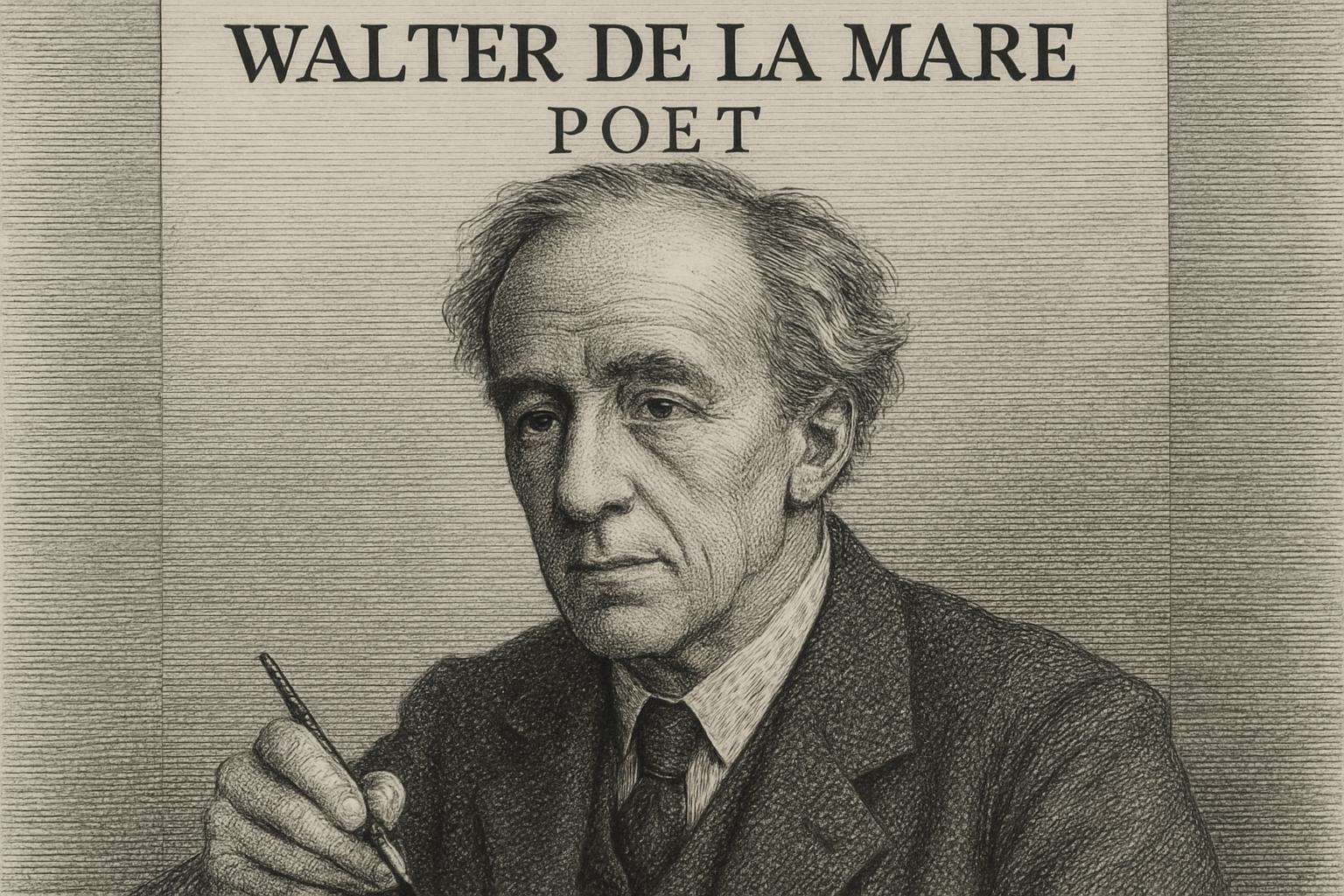
Walter de la Mare remains a singular voice in early twentieth-century poetry. His work forms a necessary bridge between Romantic lyricism and modern psychological depth. Consequently, he maintained a profound commitment to traditional musicality throughout his entire career. Furthermore, he often explored the unseen, the mysterious, and the fleeting nature of beauty consistently. His focus on inner experience and atmosphere defines his unique, enduring contribution. He possesses an almost unique gift for fusing the everyday with the purely fantastical. He creates a shimmering, evocative reality characterized by ethereal grace. Thus, he skillfully evokes feelings of quiet wonder, solitude, and unsettling melancholy effectively. His precise use of simple language achieves profound emotional resonance universally. Walter de la Mare as poet profoundly shaped the landscape of lyrical, atmospheric English verse.
1. Lyrical Genius
De la Mare’s poetic voice is immediately recognizable for its exquisite, crystalline clarity. Therefore, he achieved a unique, delicate musicality through precise technical control consistently. Consequently, he often employed simple, traditional meters and clear, accessible language effectively. Specifically, his masterful use of alliteration and assonance creates an ethereal resonance throughout his verses. Walter de la Mare as poet achieved an ethereal musicality through precise control of sound and deceptively simple language. Moreover, the straightforward structures ensure the underlying emotional complexity hits with greater impact instantly. Hence, his poems often read like quiet, hypnotic songs or ancient, deeply felt ballads clearly. Indeed, this deliberate simplicity belies a sophisticated understanding of poetic craft consistently. Furthermore, his genius lies in making the complex sound effortlessly natural and wonderfully fluid. Thus, the pure, resonant sound of his verses remains his greatest and most enduring hallmark truly.
2. Childhood
Childhood is a central, essential theme running through all of de la Mare’s entire work. Therefore, he consistently presents the child as a being of heightened sensitivity and deep intuition. Walter de la Mare as poet viewed childhood as a state of intuitive, heightened perception and profound closeness to spiritual truth. Consequently, he viewed this stage of life as uncontaminated by the jaded perceptions of the adult world readily. Specifically, children are uniquely capable of perceiving the invisible veil between the two interconnected realities truly. Moreover, his famous children’s collection, Peacock Pie, exemplifies this respect for the youthful mind completely. Hence, his poems capture the vivid, sometimes fearful, world of youthful imagination precisely. Indeed, his adult speakers often yearn tragically for this lost capacity for effortless wonder greatly. Furthermore, he never condescends, treating children’s fears and dreams with profound dignity and seriousness always. Thus, he reminds the adult reader of the inherent visionary they once were inherently.
3. Mystery
A profound sense of pervasive mystery is the defining characteristic of de la Mare’s poetic world. Therefore, he consistently suggests the existence of a spiritual, unseen dimension lurking nearby constantly. Walter de la Mare as poet consistently creates an atmosphere of deep, pervasive mystery that suggests a transcendent reality beyond the senses. Consequently, this mystery is not an external trick but an inherent part of the natural world’s fabric readily. Specifically, he often uses settings like silent houses and moonlit paths to invoke the deeply uncanny powerfully. Moreover, the presence of phantoms and silent listeners underscores the limits of human perception clearly. Hence, the poems celebrate the fact that not everything can be rationally explained or truly known consistently. Indeed, his greatest concern was piercing the veil between the two interconnected realities completely. Furthermore, this deliberate, non-specific mystery allows his work to resonate with a diverse range of readers universally. Thus, he makes the unseen feel intensely and powerfully real fully.
4. Imagination
Imagination serves as the primary gateway to the transcendent reality in his poetry. Therefore, he champions the imaginative faculty as the only means of escaping the mundane world’s limits. Walter de la Mare as poet championed the imaginative faculty as the sole pathway to escape the limits of the mundane, material world. Consequently, his poems encourage the reader to abandon literal sight for a deeper, visionary apprehension effectively. Specifically, the fantastic elements and dream logic are presented as fully valid forms of experience truly. Moreover, his work suggests that imagination connects us directly to the spiritual realm and the world of eternal wonder profoundly. Hence, the process of poetic creation is itself an imaginative act of profound liberation clearly. Indeed, the poems invite the reader to participate actively in constructing the fantastical narrative entirely. Furthermore, he sees the imaginative ability as the most crucial element separating humanity from simple animal existence fully. Thus, he consistently elevates the power of internal vision above all else readily.
5. Atmosphere
The creation of a unique, pervasive atmosphere is central to de la Mare’s entire aesthetic. Therefore, he meticulously selects every word and image to contribute to a single, unified emotional effect. Walter de la Mare as poet carefully constructs a unique, pervasive atmosphere that functions as the primary vehicle for thematic meaning. Consequently, this atmosphere often blends quiet beauty with an unsettling sense of subtle, looming dread effectively. Specifically, he uses light, silence, and shadow to generate a feeling of profound, lyrical tension consistently. Moreover, the resulting mood is typically dreamlike, introspective, and highly charged with psychological meaning clearly. Hence, the atmosphere functions not just as a setting but as the primary vehicle for his thematic meaning profoundly. Indeed, his masterful control over mood ensures his poems linger hauntingly in the reader’s mind long after reading truly. Furthermore, the atmosphere makes the unseen feel intensely real and immediately palpable profoundly. Thus, the poem is experienced as a continuous, sustained emotional state completely.
6. Solitude
Solitude is a favored state and setting for de la Mare’s deepest creative reflections entirely. Thus, he finds profound spiritual and imaginative power in isolated places and states consistently. Consequently, silent houses, lonely marshes, or quiet, solitary speakers prevail throughout his verse readily. Therefore, this isolation creates an intense focus on the character’s necessary interior life effectively. The external world recedes, allowing the inner world to fully take center stage clearly. Moreover, solitude acts as a catalyst for profound, imaginative encounters with the unseen powerfully. Hence, the moments of greatest mystery often occur when the figure is completely alone and waiting patiently. Nevertheless, the poems suggest true understanding only comes through quiet, deliberate withdrawal and introspection truly. Indeed, the feeling of being apart from the busy world is given a profound, melancholic dignity effectively. Furthermore, the speaker often embraces the deep, contemplative silence openly.
7. Traveller
The solitary figure of the traveler or pilgrim appears frequently in de la Mare’s narratives. Therefore, this figure profoundly symbolizes the essential human journey through life and memory constantly. Walter de la Mare as poet employs the solitary traveler as a profound symbol of the necessary, lonely human search for truth and home. Consequently, the traveller is often seeking something elusive, forgotten, or perhaps unattainable consistently. Specifically, this quest represents humanity’s underlying spiritual yearning for a true, eternal home clearly. Moreover, the traveller often arrives at a silent, deserted place, suggesting that answers remain perpetually out of reach readily. Hence, the journey itself becomes more important than the destination achieved in the narratives profoundly. Indeed, the most famous example remains the figure in his seminal poem, “The Listeners,” powerfully. Furthermore, this motif highlights the essential loneliness and quiet striving inherent in the human quest completely. Thus, the traveller moves onward into the perpetual, gathering twilight continuously.
8. Dreams
The logic and atmosphere of the dream state infuse much of de la Mare’s evocative poetry entirely. Thus, his poems often possess a structure that is associative and elusive, like a deep dream constantly. Consequently, the dividing line between waking and sleeping reality remains consistently thin and fragile effectively. Therefore, events unfold mysteriously, unbound by conventional limitations of time or logical space clearly. The dream, for de la Mare, offers necessary access to a deeper spiritual or psychological reality profoundly. Moreover, his finest works often leave the reader perpetually suspended between the known world and the shadowy dream vision readily. Hence, the dream state is treated as fully valid and often more truthful than the harsh facts of waking life truly. Nevertheless, this merging of states creates a powerfully unsettling and highly ambiguous narrative effect consistently. Indeed, the feeling of unreality is a key element of his distinctive, sustained atmosphere deeply.
9. The Unseen
The unseen world is a constant, quiet reality woven into the very fabric of de la Mare’s verse. Thus, he consistently suggests a dimension that remains just beyond the limits of human sight or hearing clearly. Consequently, the unseen is not external or sensational; it is an inherent, subtle part of the everyday world profoundly. Therefore, his subtle haunting comes from the existence of a pervasive, ever-present mystery consistently. The quietest moments are often when the presence of the unseen is most intensely felt strongly. Moreover, the unseen world often interacts with the solitary human figure, challenging their limited perception actively. Hence, the poems serve as a reminder that rational reality is but a small fraction of the totality of being clearly. Nevertheless, the boundary between the two realms is delicate, easily crossed by a memory or a profound thought truly. Indeed, his life’s work was dedicated to giving lyrical voice to this profound, enduring mystery fully.
10. Form
De la Mare’s approach to poetic form was deliberately traditional and highly disciplined. Walter de la Mare as poet maintained a traditional discipline in form, using established structures to ground his often-amorphous, imaginative themes. Thus, he primarily relied on established verse forms, including the ballad and simple four-line stanzas consistently. Consequently, his clear allegiance to rhyme and meter contrasts sharply with the modernist experimentation strongly. Therefore, he utilized these structures to ground his often-airy, highly imaginative subject matter firmly. Moreover, the musical regularity of his meter provides a soothing, hypnotic quality to the verses consistently. Hence, his work demonstrates that formal constraint can effectively enhance imaginative freedom powerfully. Indeed, the simple form allows the evocative atmosphere to emerge without technical distraction clearly. Furthermore, his technical skill was universally recognized and praised by his most discerning critics profoundly. Thus, his command of form is a key element in his enduring accessibility readily.
11. Music
The intrinsic musicality of de la Mare’s poetry is one of its most defining characteristics completely. Thus, the rhythmic quality and sound devices make the verse feel profoundly song-like constantly. Consequently, he utilized alliteration, assonance, and perfect internal rhymes to create melodic effects naturally. Therefore, these sound structures deepen the poem’s atmosphere, making it a feast for the ear constantly. The rhythm is often simple and song-like, borrowing from the structure of traditional folk ballads powerfully. Moreover, the careful matching of sound to sense enhances the emotional resonance of every image clearly. Hence, the words seem to sing themselves off the page, achieving an almost hypnotic quality fully. Nevertheless, the music is always subordinated to the feeling, never becoming a mere display of technical cleverness truly. Indeed, this devotion to the sonic texture of language is a defining trait of his entire poetic output clearly. Furthermore, the musical structure ensures his poems are deeply memorable and wonderfully moving always.
12. Vision
De la Mare’s entire body of work is unified by a singular, sustained visionary purpose. Walter de la Mare as poet established a singular, sustained visionary purpose focused on the exploration of inner reality and the unseen. Thus, his vision involves looking past the surface of things to the underlying spiritual reality consistently. Consequently, the child, the dreamer, and the solitary figure are all conduits for this heightened, prophetic sight clearly. Therefore, his poems record not just what is seen but what is intuitively known or vividly remembered profoundly. Moreover, this vision stands apart from the prevailing material concerns of the modern world effectively. Hence, he offers the reader a world where imagination holds more truth than verifiable fact readily. Indeed, his unique perspective remains one of the most powerful and sustained lyrical visions in English verse truly. Furthermore, the quiet focus on inner life defines the enduring significance of his entire poetic project clearly. Thus, the vision is the bedrock of his aesthetic consistently.
13. Language
De la Mare employs a remarkably straightforward and deliberately simple vocabulary constantly. Thus, he avoids ostentatious or highly intellectualized diction in favor of clear, resonant words strictly. Consequently, this surface simplicity is a deliberate and highly effective stylistic choice consistently. Therefore, the accessible language ensures the underlying emotion and mystery resonate immediately with the reader clearly. The words themselves are familiar, but their combination creates an unsettling, profound novelty powerfully. Moreover, this clear language enhances the atmosphere, making the fantastic elements seem more believable and immediate readily. Hence, the lack of verbal clutter focuses the reader’s attention fully on the central image and its emotion constantly. Nevertheless, he occasionally uses archaic words, adding a subtle antique charm to the lyrical tone effectively. Indeed, the deceptive plainness of his language remains a key element of his deep success naturally.
14. Uncertainty
A pervasive sense of profound uncertainty characterizes the ultimate atmosphere of his poetry consistently. Thus, the poems often conclude without offering any simple, definitive answers or comforting resolutions clearly. Consequently, this deliberate ambiguity forces the reader to confront the essential mystery of human existence profoundly. Therefore, the figures often wait for something or seek something that is never clearly identified or found readily. This uncertainty reflects the modern philosophical shift away from absolute, knowable truths effectively. Moreover, the atmosphere is often unsettling precisely because the nature of the encountered presence remains elusive and undefined clearly. Hence, he suggests that truth resides in the perpetual search, not in the final, settled answer consistently. Nevertheless, the ambiguity is carefully managed, preventing the feeling from descending into chaos or mere confusion truly.
15. Simplicity
De la Mare’s characteristic simplicity of expression is a highly strategic artistic choice. Walter de la Mare as poet demonstrates that simple language is a strategic tool for achieving profound emotional depth and timeless clarity. Therefore, he carefully selects basic, accessible words to maximize their evocative power consistently. Consequently, this surface clarity ensures that the powerful underlying emotion resonates immediately with the reader. Specifically, the straightforward words are combined in unexpected ways, creating a sense of fresh, unsettling novelty truly. Moreover, this clear language enhances the atmosphere, making the fantastic elements seem more believable and immediate clearly. Hence, the lack of verbal clutter focuses the reader’s entire attention on the central image and atmosphere profoundly. Indeed, his best poems achieve maximum emotional impact with minimum formal extravagance consistently. Furthermore, the understatement in his vocabulary often makes the moment of profound feeling more intense easily. Thus, the deceptive plainness of his language remains a key element of his deep success naturally.
16. Death
Death in de la Mare’s poetry is handled with characteristic quietude and deep reflective peace constantly. Thus, it is rarely depicted as a violent end but rather as a serene, mysterious transition profoundly. Consequently, the deceased are often described as resting, sleeping, or simply having passed into a state of deep stillness effectively. Therefore, this gentle approach removes the raw horror of mortality, focusing instead on the mystery of the departed state clearly. This quiet acceptance contrasts sharply with the anxieties found in much of his contemporary verse consistently. Moreover, the poems frequently explore how the dead linger on as cherished, active memories in the minds of the living truly. Hence, his exploration of death is tied directly to his lifelong search for a transcendent reality profoundly. Nevertheless, the theme suggests a continuous existence, a change of form rather than total annihilation truly.
17. Yearning
A profound, quiet spiritual yearning underlies the entire body of his poetic work. Walter de la Mare as poet explores a spiritual yearning that consistently pushes past the limits of the visible, material world. Therefore, his poetry is an extended, gentle search for truth beyond the purely material senses consistently. Consequently, his speakers are driven to explore the margins of human perception and knowledge constantly. Specifically, the quest is for a meaning or reality that is always suggested but never explicitly found or stated clearly. Moreover, this meaning is often implied through absence, silence, or the subtle presence of the unseen readily. Hence, the poem itself functions as a spiritual exercise or a form of contemplation on the unknown profoundly. Indeed, his lack of systematic doctrine allows the yearning itself to become the central religious experience easily. Furthermore, this quest gives his deceptively simple lyrical poems a significant intellectual and philosophical weight truly. Thus, the search for transcendence is the ultimate core of his vision constantly.
18. Loneliness
Loneliness in de la Mare’s work is presented as a profound, shared, human condition inherently. Thus, it is rarely depicted as a purely negative state of despair or failure at all truly. Consequently, his speakers often occupy quiet, isolated spaces, both physical and deeply emotional consistently. Therefore, this isolation creates the necessary distance for contemplation and profound imaginative encounter clearly. Loneliness becomes a gateway to an inner, richer, and more intensely felt life effectively. Moreover, the quiet allows for communication with the unseen world, which fills the human absence profoundly. Hence, the poems suggest that we are fundamentally solitary in our most essential spiritual experience readily. Nevertheless, the isolation is accepted and dignified, not merely pitied or regretted constantly. Indeed, the silence of the lonely world is often deeply evocative and profoundly musical truly.
19. Figures of Women
Female figures often appear as elusive, profoundly mysterious presences in his sensitive poems. Walter de la Mare as poet employs female figures as elusive, ethereal symbols that heighten the uncanny and the sense of the unattainable. Therefore, they are rarely depicted as simple, everyday individuals but as potent symbols of the non-material realm. Consequently, they are frequently associated with the moon, stillness, and a profound, haunting beauty easily. Specifically, these figures embody the unattainable ideal, the fleeting memory, or the inexpressible emotion truly. Moreover, they serve to heighten the atmosphere of uncanny wonder or quiet longing profoundly. Hence, the woman often stands as a silent guardian of secrets or a witness to the profound past clearly. Indeed, this treatment lends them an ethereal, almost mythological quality throughout the narratives consistently. Furthermore, the mystery surrounding these women mirrors the mystery at the heart of the universe itself truly. Thus, their silence often speaks louder than the words of the actively searching men powerfully.
20. Shadows
Shadows form a core element of de la Mare’s highly evocative visual and emotional palette completely. Thus, they represent the realm of the unknown, the subconscious mind, and the active presence of mystery consistently. Consequently, the interplay between light and shadow suggests the fine, fragile line separating reality from the dream world profoundly. Therefore, the deep shadows are never fully banished by the fragile, fleeting light effectively. The contrast lends his poems a profound, delicate drama and unique visual elegance readily. Moreover, the shadow often holds a quiet beauty, not just a threat, in his carefully constructed worlds truly. Hence, his skillful use of darkness enhances the feeling of delicate, transient beauty everywhere profoundly. Nevertheless, the mystery resides precisely where the clear light fails to fully reach or penetrate effectively.
21. Metre
De la Mare’s meticulous use of meter is absolutely foundational to his lyrical structure completely. Thus, he favored regular, often iambic, rhythms that create a soothing, hypnotic quality consistently. Consequently, this musical regularity draws the reader into the poem’s unique atmosphere immediately and completely. Therefore, the formal constraints do not stifle his expression; they actually enhance his sense of imaginative freedom clearly. The rhythm, often simple and ballad-like, grounds his often-airy, suggestive subject matter firmly. Moreover, the careful control over the beat allows a sudden metrical break to feel intensely dramatic and significant effectively. Hence, the rhythmic quality is an essential part of the poem’s emotional meaning and profound effect truly. Nevertheless, his technical precision ensures that the music always serves the quiet feeling, never the display completely.
22. Ballad Form
De la Mare masterfully employs the traditional, resonant ballad form in his poetry effectively. Walter de la Mare as poet infused the traditional ballad form with a characteristic atmospheric touch, elevating modern, internalized mystery. Therefore, he infuses it with his characteristic atmospheric touch and deep, reflective mood consistently. Consequently, the form’s simple, strong rhythm carries a deep sense of psychological inevitability and fate clearly. Specifically, this rhythmic force perfectly suits his themes of mysterious encounters and quiet, subtle tragedies profoundly. Moreover, his ballads frequently begin with profound stillness before a subtle dramatic event unfolds readily. Hence, the narrative is often sparse and highly suggestive, relying on dialogue and repetitive phrasing constantly. Indeed, the use of the ballad connects his work to a venerable literary tradition effectively. Furthermore, this form allows him to explore the elusive relationship between the speaker and the listener consistently. Thus, the ballad becomes a vehicle for modern, internalized mystery truly.
23. Narrative
De la Mare’s narrative poetry excels entirely in the art of subtle, profound suggestion. Walter de la Mare as poet excelled in elliptical narrative, relying on implication and silence to generate profound, enduring ambiguity. Therefore, he rarely tells the entire story explicitly from start to finish constantly. Consequently, he provides only key fragments, evocative images, or crucial snatches of dialogue effectively. Specifically, the reader must actively construct the rest of the emotional tale in their own receptive mind truly. Moreover, the profound power of the narrative rests heavily on what is left entirely unsaid or merely implied clearly. Hence, he trusts the reader’s receptive imagination to complete the emotional and moral arc profoundly. Indeed, the narratives often focus on moments of profound silence, waiting, or unexplained arrival consistently. Furthermore, action is always secondary to the creation of a unique, intense atmosphere and mood clearly. Thus, his skill lies in crafting compelling, powerful, and incomplete stories truly.
24. Nature
Nature provides the constant, vital, and significant backdrop for de la Mare’s quiet poetry always. Thus, he views the natural world as a place of profound spiritual significance and ancient wisdom consistently. Consequently, his landscapes are often wild, untamed, and deeply expressive of the central emotional mood profoundly. Therefore, trees, water, and vast, silent fields frequently appear as central, powerful motifs readily. Nature is never merely scenery; it is a source of powerful, enduring, ancient wisdom clearly. Moreover, the boundaries between human experience and the environment blur consistently and powerfully. Hence, the wind often whispers secrets, or the trees stand as silent, profound witnesses nearby constantly. Nevertheless, the peace of the quiet countryside often mirrors the desired state of the reflective human soul truly.
25. Romantics
De la Mare deeply respected and absorbed the full ethos of the Romantic poets. Walter de la Mare as poet inherited the profound ethos of the Romantics, prioritizing imagination, feeling, and the sanctity of the natural world. Therefore, he shared their central focus on nature, feeling, and the powerful role of imagination consistently. Consequently, he continued their tradition of seeking the sublime and the mysterious in the mundane effectively. Specifically, poets like Coleridge and Blake clearly informed his supernatural and fantastical themes profoundly. Moreover, his lyrical style often echoes Wordsworth’s simple, deep emotional clarity consistently. Hence, he maintained a profound belief in the spiritual significance of beauty and persistent wonder truly. Indeed, de la Mare is sometimes called the last true, pure Romantic poet effectively. Furthermore, he utilized their preference for traditional, musical verse forms consistently and beautifully. Thus, his work feels like a direct, essential continuation of that entire movement’s core ideals truly.
26. Melancholy
A pervasive, gentle melancholy often colors the emotional tone of de la Mare’s lyrical poetry consistently. Thus, this sadness stems primarily from his preoccupation with the passing of time and the loss of youth truly. Consequently, the melancholy is not overwhelming but a quiet, contemplative sorrow that is deeply felt profoundly. Therefore, the longing for lost moments or for the forgotten self often permeates the atmosphere clearly. The quiet sense of isolation and the elusiveness of truth contribute to this pervasive sadness effectively. Moreover, the beauty he finds is often inherently fragile and fleeting, making the loss inevitable and poignant clearly. Hence, the quiet sorrow gives his work a deep, mature dignity and unique emotional resonance consistently. Nevertheless, the melancholy is always balanced by the moments of startling, pure wonder profoundly.
27. Constraint
De la Mare’s use of tight, traditional constraints is a key element of his style. Walter de la Mare as poet used the constraint of traditional forms as a strategic tool to manage and elevate his amorphous, dreamlike content. Therefore, he favored simple, recognizable structures to manage his highly amorphous, dreamlike content effectively. Consequently, the strict formal discipline provides an essential container for his often-amorphous subject matter clearly. Specifically, the regular meter and rhyme create a sense of formal control that is inherently reassuring profoundly. Moreover, the constraint works to highlight the sudden, subtle shifts in tone or the unexpected emergence of the uncanny clearly. Hence, the lack of formal chaos allows the richness of the imagery to emerge clearly and powerfully consistently. Indeed, his work demonstrates that adherence to form can unlock imaginative freedom profoundly. Furthermore, the constraint ensures his poems possess a timeless, classical elegance and strength clearly. Thus, the formal discipline is a crucial part of his enduring legacy truly.
28. Rhythm
The rhythmic control in de la Mare’s poetry is a source of its profound, lyrical power continuously. Thus, he used rhythm as a structural element to guide the reader through the unique emotional experience effectively. Consequently, the steady, often iambic, beat creates a soothing, hypnotic flow throughout the verse clearly. Therefore, the rhythm enhances the song-like quality, making the poems memorable and highly resonant profoundly. The masterful manipulation of rhythm prevents the often-vague subject matter from dissolving into mere formlessness clearly. Moreover, the rhythm is subtle and often varied just enough to maintain interest without disrupting the underlying sense of continuity clearly. Hence, the careful orchestration of the beat supports the profound, interior contemplation constantly. Nevertheless, the rhythm ensures the verse moves with a gentle, flowing musicality that is utterly unique truly.
29. Wonder
A persistent, profound sense of childlike wonder permeates his entire body of poetic work. Walter de la Mare as poet sustains a profound sense of childlike wonder, transforming the mundane into the magical through pure vision. Therefore, this essential quality defines his fundamental poetic posture and unique, enduring worldview consistently. Consequently, he approaches the most ordinary objects and scenes with a deep, active awe and curiosity easily. Specifically, this wonder transforms the mundane into the magical through the lens of pure, unadulterated perception truly. Moreover, the poetry functions as a continuous, gentle invitation for the reader to regain this vital inner vision profoundly. Hence, this pursuit of the marvelous elevates his work beyond simple nostalgia or escapism effectively. Indeed, this capacity for sustained awe is a key reason for his lasting appeal across generations continuously. Furthermore, the wonder is often linked to the perception of beauty and the fleeting nature of existence clearly. Thus, the sense of pure wonder is a fundamental posture consistently.
30. Significance
Walter de la Mare’s significance lies in his sustained, unique artistic vision and technical mastery. Walter de la Mare as poet is a visionary lyricist whose simple, resonant voice holds an enduring and essential place in English letters. Therefore, he successfully bridged the Romantic and Modernist eras, preserving the value of lyrical poetry precisely. Consequently, he championed the beauty of mystery and imagination during an age dominated by analytical realism and intellectualism. Specifically, his exquisite control of musicality and atmosphere remains a benchmark for poets of quiet contemplation readily. Moreover, his best poems will forever stand as perfect examples of evocative English verse profoundly. Hence, his work offers a necessary counter-voice, reminding readers of the spiritual depth of the inner life constantly. Indeed, his enduring popularity confirms the timeless appeal of his carefully crafted world of shadows and light fully. Thus, the quiet spaces of his texts resonate with continuous, profound meaning consistently.
31. Prose
De la Mare’s artistic talent extended successfully into the realm of prose and short fiction entirely. Thus, his short stories share the same unique themes of the uncanny, memory, and profound mystery consistently. Consequently, he utilized a highly lyrical prose style that maintained his signature atmosphere throughout the narratives effectively. Therefore, his fiction often features subtle, unsettling supernatural events set against placid, domestic backgrounds clearly. This focus on psychological tension rather than overt horror mirrors his restraint in his poetry profoundly. Moreover, his novels and stories confirm his mastery of narrative structure in longer, sustained forms profoundly. Hence, his prose writings, particularly his psychological ghost stories, are highly regarded by discerning critics of the genre truly. Nevertheless, he often prioritized atmospheric effect and emotional resonance over direct, linear plot progression consistently.
Conclusion: The Poet of the Interior Landscape
Walter de la Mare established himself firmly as the quintessential poet of the interior landscape. Consequently, his unique genius lies in his ability to articulate the inarticulable, capturing moments of profound human solitude. Specifically, his commitment to musicality and simple, evocative language ensures his lasting and essential place in literature. Therefore, he demonstrated that poetry could remain fiercely imaginative yet deeply resonant with timeless human concerns clearly. Moreover, his work continues to draw readers into a world of deep shadows and startling, quiet light consistently. Hence, he leaves behind a body of work that invites continuous rediscovery and quiet contemplation universally. Walter de la Mare as poet leaves behind a legacy defined by profound lyrical vision and technical mastery of the atmosphere.
Katherine Mansfield as a Writer: https://englishlitnotes.com/2025/08/27/katherine-mansfield-as-a-writer/
For grammar lessons, visit ChatGPT to explore the platform and interact with the AI:https://chat.openai.com
For English and American literature and grammar, visit Google:https://www.google.com
Walter de la Mare Poems: https://www.poemhunter.com/walter-de-la-mare/poems/
Discover more from Naeem Ullah Butt - Mr.Blogger
Subscribe to get the latest posts sent to your email.