Introduction
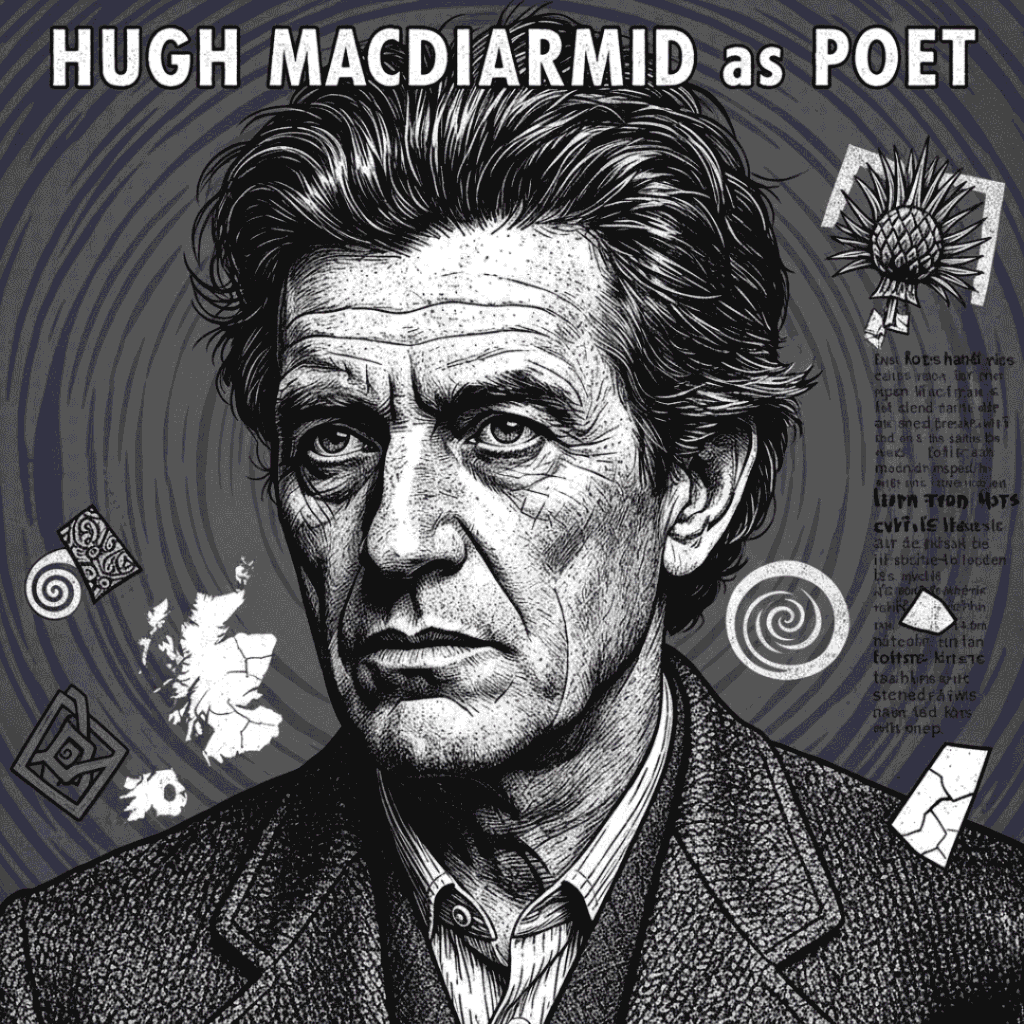
Hugh MacDiarmid as poet stands as a colossus in Scottish letters. He ignited the 20th-century Scottish Renaissance. His work redefined national identity and literary ambition. Readers find a fierce intellect and deep passion here. Thus, he broke from old traditions with bold force. He championed a new, vibrant Scots language. Consequently, his style feels revolutionary and profound. One must grasp his radical vision to know him. Indeed, he was a relentless cultural warrior. Therefore, he built a bridge between local and global thought. We see his genius in every stark, striking line. Moreover, he invites us into a complex, challenging world. Each poem functions like a manifesto for change. Finally, we must study his craft to understand Scotland. He changed the face of modern Scottish literature forever now. His work demands our full, critical attention today. We celebrate his uncompromising and very unique creative vision. He remains a symbol of pure, intellectual rebellion.
1. Lallans
Lallans was the chosen language for Hugh MacDiarmid as poet. This synthetic Scots grew from many regional dialects. Therefore, it breathed new life into old, forgotten words. This linguistic creation was central to his radical art. Consequently, his poetry sounded fresh and authentically Scottish today. Most standard English failed to capture his deepest thoughts. Thus, Lallans became a tool for national, cultural revival. Moreover, a vibrant and living tongue emerged here. As a result, his poems gained unique texture and sound. Scots proved to be capable of high, complex art. Indeed, he made Lallans a powerful literary vehicle now. Archaic terms blended well with modern, sharp expressions. Finally, his commitment to Lallans defined his early fame. Scotland gained a literary language of its own here. The voice of a brave, new nation arrived. Silence no longer held the speech of his fathers. A small tongue showed it could hold a universe. Every syllable felt like a precious, cold stone. A house for the spirit stood tall.
2. Scottish Renaissance
The Scottish Renaissance was led by Hugh MacDiarmid as poet. He spearheaded this cultural rebirth in the 1920s with a fiery passion. Therefore, he urged artists to embrace their deep heritage. This movement sought to renew a broken Scottish identity. Consequently, it challenged English cultural dominance directly and boldly. He envisioned a vibrant, modern Scotland for all. Thus, the Renaissance inspired new art and literature today. Moreover, he wrote fierce manifestos for a radical change. As a result, he galvanized a generation of young thinkers. He called for a distinctly Scottish artistic voice. Indeed, he was the true architect of this revival. He sought to connect Scotland to Europe once again. Finally, his efforts reshaped the nation’s cultural landscape. He made Scotland proud of its artistic future. The spirit of this movement lives on strongly. He proved that a small nation can lead. He fought for the soul of the north. We can say that he found the light in the dark history.
3. Nationalism
Nationalism was a driving force for Hugh MacDiarmid as poet. He passionately believed in Scottish independence during his life. Therefore, his radical politics fueled his poetic output. This commitment shaped his entire literary career in Scotland. Consequently, his work often explored themes of national character. He envisioned a vibrant, self-governing Scotland for the people. Thus, his poetry became a tool for political advocacy. Moreover, he was a founding member of the SNP. As a result, his art and politics were inseparable. He saw culture as vital to national liberation. Indeed, he used his words to awaken Scotland today. He challenged colonial attitudes and very weak wills. Finally, his unwavering nationalism defined his public persona. He spoke for a nation seeking its own voice. His spirit remains an icon for Scottish pride. He believed the thistle could grow tall and strong. He fought for the right to be free and also treated the soil as a sacred trust.
4. Marxism
Marxism profoundly influenced Hugh MacDiarmid as poet. He embraced this political philosophy in his later years. Therefore, his poems explored economic and social justice. This ideology shaped his view of history. Consequently, he saw capitalism as a destructive force. He advocated for a classless, socialist society. Thus, his verse often critiqued existing power structures. Moreover, he aligned with communist movements globally. As a result, his work became more didactic and political. He believed art should serve social revolution. Indeed, he sought radical change through his writing. He envisioned a future built on equality. Finally, his Marxist leanings diversified his poetic themes. He connected Scotland’s struggles to global ones. His later work shows a deep commitment to the poor.
5. Modernism
Modernism offered a rich canvas for Hugh MacDiarmid as poet. He rejected Victorian sentimentality and old forms. Therefore, he sought new ways to express modern life. This artistic movement valued innovation and experiment. Consequently, his poetry became complex and challenging. He engaged with global modernist trends directly. Thus, he brought Scottish literature into a new era. Moreover, he experimented with language and structure. As a result, his work stood apart from his peers. He embraced intellectual rigor and aesthetic daring. Indeed, he became a leading voice of modernism. He used sharp imagery and fragmented narratives. Finally, his modernist approach redefined Scottish poetry. He made art relevant for a changing world. His vision pushed boundaries in every line.
6. Synthetic Scots
Synthetic Scots became a key tool for the writer. He consciously constructed this language for his art. Therefore, he drew from various historical Scottish dialects. This linguistic blend was a deliberate artistic choice. Consequently, it gave his poetry a unique texture. He aimed to revive and modernize Scots. Thus, Synthetic Scots was more than mere dialect. Moreover, he infused it with archaic and technical terms. As a result, his work achieved a remarkable richness. He believed it offered a truer voice for Scotland. Indeed, he made this language his personal hallmark. He defended its use against critics fiercely. Finally, Synthetic Scots remains his enduring linguistic legacy. He built a new literary voice for his nation. His words still sing in this invented tongue.
7. Anglophobia
Anglophobia marked some of Hugh MacDiarmid as poet‘s stances. He often expressed strong anti-English sentiments. Therefore, he rejected English cultural dominance fiercely. This opposition stemmed from deep political convictions. Consequently, he saw English influence as detrimental to Scotland. He believed it suppressed Scottish identity and language. Thus, his writings often critiqued English institutions. Moreover, he called for a distinct Scottish voice. As a result, his rhetoric could be quite abrasive. He used sharp words to challenge the status quo. Indeed, his Anglophobia was part of his nationalism. He aimed to awaken Scottish self-awareness. Finally, this aspect of his personality sparked much debate. He stood firm against cultural assimilation. His words carried a powerful, often harsh truth.
8. Christopher Murray Grieve
Christopher Murray Grieve was his birth name. He used this name for his prose work during his life. Therefore, the pseudonym “Hugh MacDiarmid” was for his poetry. This distinction reflected his dual literary roles in Scotland. Consequently, Grieve wrote critical essays and political tracts. He was a journalist and essayist under his birth name. Thus, the MacDiarmid persona was strictly for the poetic arts. Moreover, the pseudonym allowed for a great creative freedom. As a result, his two identities served different purposes. He carved out a distinct artistic space for himself. Indeed, Grieve managed his literary empire very well today. He used both names to further his radical agenda. Finally, the name MacDiarmid became legendary in modern verse. He built a powerful brand around his unique poetry. This split identity reveals his complex and dual nature. He proved that one man can hold many truths. He used prose for logic and verse for spirit. We can say that he was a master of the hidden self.
9. A Drunk Man Looks at the Thistle
A Drunk Man Looks at the Thistle is his masterpiece. This long poem, published in 1926, revolutionized Scots. Therefore, it became a cornerstone of Scottish modernism. Its complex themes and structure were groundbreaking. Consequently, it cemented Hugh MacDiarmid as poet‘s reputation. He explored Scottish identity, language, and politics. Thus, the poem is a deep dive into the national soul. Moreover, its fragmented style mirrors modern thought. As a result, it challenges readers with philosophical depth. He used the thistle as a central, potent symbol. Indeed, the “Drunk Man” is a towering achievement. He combined humor, pathos, and fierce intellect. Finally, its influence on Scottish literature is immense. It remains a poetic Everest for many. This poem is a wild, brilliant, epic journey.
10. Scotland
Scotland was the singular obsession for Hugh MacDiarmid as poet. His entire body of work revolved around his nation. Therefore, his poetry became a voice for Scotland. This intense focus defined his creative output. Consequently, he explored every facet of Scottish life. He celebrated its landscapes, history, and people. Thus, his verse aimed to reawaken national pride. Moreover, he critiqued its political and cultural failings. As a result, his work served a patriotic purpose. He saw Scotland as a crucible for new ideas. Indeed, he dedicated his life to its revival. He used poetry to shape its future. Finally, his enduring legacy is tied to his homeland. He remains Scotland’s most passionate bard. His love for Scotland shines in every line.
11. Gaelic
Gaelic held deep cultural significance for the bard. He advocated for its preservation fiercely. Therefore, he saw it as vital to Scottish identity. This ancient language connected Scotland to its Celtic past. Consequently, he encouraged its study and revival. He believed Gaelic was a key to national soul. Thus, he lamented its decline in the lowlands. Moreover, he included Gaelic elements in his work. As a result, he linked modern Scotland to its roots. He recognized its unique spiritual power. Indeed, he felt Gaelic embodied true Scottishness. He saw it as a rich source of tradition. Finally, his support for Gaelic demonstrated his broad nationalism. He championed all aspects of his country’s heritage. He kept the spirit of ancient Scotland alive.
12. Encyclopedic
Encyclopedic characterized his later poetry style. He embraced vast amounts of factual knowledge. Therefore, his verse included scientific, historical, and philosophical data. This expansive approach was a deliberate choice. Consequently, his long poems became dense and challenging. He believed poetry should encompass all human thought. Thus, he drew from diverse intellectual fields. Moreover, he aimed to break traditional poetic limits. As a result, his work often resembled scientific treatises. He sought to create a “poetry of fact.” Indeed, his encyclopedic scope was unique. He included geology, biology, and cosmology. Finally, this ambitious style showcased his intellect. He expanded the very definition of poetry. His later works are vast intellectual landscapes.
13. Dialectic
Dialectic was a key element in his thought. He explored the tension between opposing ideas. Therefore, his poetry often presented contrasting viewpoints. This philosophical approach shaped his worldview. Consequently, he saw synthesis emerging from conflict. He examined the “Caledonian Antisyzygy” – Scotland’s dual nature. Thus, his verse grappled with complex contradictions. Moreover, he applied dialectic to politics and culture. As a result, his work often felt vigorous and argumentative. He sought truth through intellectual struggle. Indeed, his dialectical method was very distinct. He juxtaposed beauty with harsh reality. Finally, this approach gave his poetry intellectual depth. He challenged readers to think critically. His poems spark intense inner debate.
14. In Memoriam James Joyce
In Memoriam James Joyce is a major late work. This long poem celebrated global linguistic diversity. Therefore, it was a tribute to a fellow modernist. Its sprawling scope reflected MacDiarmid’s later style. Consequently, it explored language’s power and complexity. He admired Joyce’s experimental use of words. Thus, the poem echoed Joyce’s linguistic daring. Moreover, it delved into various cultures and tongues. As a result, it showcased his internationalist outlook. He saw Joyce as a kindred spirit in art. Indeed, this work is a monumental achievement. He connected his local Lallans to world literature. Finally, it stands as a testament to linguistic passion. He saw language as humanity’s greatest tool. It highlights his vast, intellectual curiosity.
15. Stony Limits
Stony Limits marks a significant collection. This work shows a shift towards rugged themes. Therefore, it explored geological and natural landscapes. Published in 1934, it signaled new directions. Consequently, his poetry became more stark and intellectual. He moved away from his earlier Scots lyrics. Thus, “Stony Limits” presented a tougher aesthetic. Moreover, he incorporated scientific language here. As a result, the poems felt more abstract and dense. He grappled with existential and philosophical ideas. Indeed, this collection showcased his evolving craft. He found beauty in barren, rocky terrain. Finally, it demonstrated his poetic versatility well. He continued to push his own boundaries. The poems reflect a deeper, more rugged vision.
16. Caledonian Antisyzygy
Caledonian Antisyzygy was a key concept for Hugh MacDiarmid as poet. He theorized the “dual nature” of the Scottish character. Therefore, he saw a blend of opposites in the national soul. This idea explained Scottish paradoxes. Consequently, it shaped his understanding of his homeland. He identified qualities like realism and mysticism. Thus, his poetry often explored these contrasts. Moreover, he found passion mixed with cold intellect. As a result, he used this concept to analyze Scotland. He saw it as a unique national trait. Indeed, it became a cornerstone of his thought. He used this theory to unify diverse elements. Finally, the Antisyzygy helps define his critical view. He revealed the complex heart of Scotland. This idea became a lens for his entire art.
17. Communism
Communism was a significant political affiliation for him. He embraced radical leftist politics strongly. Therefore, his art often reflected communist ideals. This commitment led to periods of expulsion from other parties. Consequently, he saw global revolution as necessary. He believed in the overthrow of capitalism. Thus, his later poetry became overtly political. Moreover, he used his writing for social change. As a result, he aimed to awaken class consciousness. He connected Scottish struggles to world movements. Indeed, his communist views were deeply held. He envisioned a future of equality. Finally, his political stance made him a controversial figure. He was an unwavering voice for the working class. His strong beliefs guided his every poem.
18. Linguistic
Linguistic matters obsessed Hugh MacDiarmid as poet throughout his life. He explored the power and history of words. Therefore, his poetry constantly experimented with language. This intense focus defined his unique style. Consequently, he believed language shaped thought and culture. He delved into etymology and dialect studies. Thus, his verse showcases vast vocabulary. Moreover, he saw language as a tool for liberation. As a result, his work is a celebration of speech. He reshaped Scots for artistic purposes. Indeed, his linguistic ambition was immense. He sought to unlock new expressive possibilities. Finally, his legacy is deeply intertwined with words. He pushed the very limits of human speech. Every syllable held a profound meaning for him.
19. Internationalism
Internationalism balanced his fierce nationalism. He sought global connections for Scottish culture. Therefore, he drew inspiration from European and Asian art. This broad perspective enriched his poetry. Consequently, he saw Scotland as part of a larger world. He engaged with thinkers from many nations. Thus, his verse often referenced diverse philosophies. Moreover, he linked Scottish issues to global struggles. As a result, his work transcended local concerns. He envisioned a “Great Scotland” contributing to humanity. Indeed, his international outlook was very wide. He championed cultural exchange and collaboration. Finally, this cosmopolitanism shaped his later phase. He showed that local and global can unite. His mind reached far beyond his own borders.
20. Scientific
Scientific themes permeated his later poetry. He incorporated complex scientific terminology into verse. Therefore, his long poems explored geology, biology, and physics. This intellectual expansion was a deliberate choice. Consequently, his work became dense and challenging for many. He believed poetry should embrace all human knowledge. Thus, he sought a “poetry of fact.” Moreover, he saw science as a source of wonder. As a result, his verse often reads like a technical treatise. He connected the natural world to human thought. Indeed, his scientific approach was revolutionary. He found poetic beauty in cold, hard data. Finally, this infusion of science broadened his appeal. He showed that art and science can intertwine. His vision was vast, encompassing all wisdom.
21. Langholm
Langholm was the birthplace of Hugh MacDiarmid as poet. This small Borders town shaped his early life. Therefore, its landscapes influenced his youthful imagination. His memories of Langholm stayed with him always. Consequently, his early poems sometimes referenced his home. He carried the spirit of the Borders with him. Thus, Langholm provided foundational experiences. Moreover, his local roots grounded his broad vision. As a result, he retained a connection to his origins. He drew strength from his humble beginnings. Indeed, Langholm was his starting point. He learned the local Scots dialect there. Finally, this small town gave birth to a giant. He transformed its quiet spirit into great art. The town’s essence lived in his powerful mind.
22. Whalsay
Whalsay was an isolated Shetland island. He lived there during a prolific writing period. Therefore, the stark landscape influenced his later poetry. This remote setting fostered deep contemplation. Consequently, his verse explored nature, science, and philosophy. He found solitude and inspiration on Whalsay. Thus, the island became a creative sanctuary. Moreover, he produced major works during this time. As a result, Whalsay is linked to his encyclopedic phase. He engaged with the elemental forces of the sea. Indeed, his time there was crucial for his development. He connected with the island’s unique culture. Finally, Whalsay shaped his intellectual and artistic growth. He turned its isolation into profound art. The island’s spirit infused his powerful verse.
23. Poetry of Fact
Poetry of Fact was a concept he championed. He believed poetry should integrate all knowledge. Therefore, he included scientific data and factual detail. This idea rejected purely emotional verse. Consequently, his later work became dense with information. He sought to expand poetry’s traditional scope. Thus, he challenged conventional artistic boundaries. Moreover, he saw truth in objective data. As a result, his poems often felt intellectual and rigorous. He blended lyricism with encyclopedic content. Indeed, this “poetry of fact” was revolutionary. He found beauty in scientific exactitude. Finally, this philosophy defined his mature style. He made poetry a vehicle for universal wisdom. Knowledge became a rich source for his art.
24. Aesthetics
Aesthetics were central to his evolving thought. He constantly refined his theories on art. Therefore, he believed poetry had a vital social role. This philosophical approach shaped his creative output. Consequently, he rejected outdated artistic forms. He sought an aesthetic that reflected modern Scotland. Thus, his early Lallans work was revolutionary. Moreover, his later encyclopedic style defined new beauty. As a result, his aesthetics were always dynamic. He saw art as a tool for transformation. Indeed, his theories guided his bold experiments. He championed innovation over tradition. Finally, his aesthetic radicalism influenced many. He challenged what art could truly be. His vision for beauty was always forward-looking.
25. The Thistle
The Thistle served as a potent symbol for Hugh MacDiarmid as poet. He used it to represent Scottish resilience. Therefore, it appeared prominently in his greatest works. This prickly plant embodied national character. Consequently, he saw it as a metaphor for defiance. He celebrated its tough, enduring nature. Thus, the thistle became a recurring motif. Moreover, it represented Scotland’s unique spirit. As a result, it linked his poetry to his homeland. He imbued the thistle with deep meaning. Indeed, it became an iconic MacDiarmid image. He transformed a simple plant into an emblem. Finally, the thistle remains synonymous with his art. It stands for a proud, unbroken Scotland. This symbol rooted his verse deeply in his nation.
26. Satire
Satire was a sharp weapon for Hugh MacDiarmid as poet. He used it to attack social and political ills. Therefore, his verse often contained biting humor. This critical approach defined his public persona. Consequently, he spared no one from his witty critiques. He targeted hypocrisy, mediocrity, and complacency. Thus, his satire was often provocative. Moreover, he used it to spark debate and change. As a result, his poems could be abrasive yet effective. He challenged readers to confront uncomfortable truths. Indeed, his satirical wit was legendary. He wielded language with devastating precision. Finally, his use of satire made him a formidable voice. He punctured pomposity with a keen mind. His sharp humor cut through all falsehoods.
27. Epic
Epic ambitions characterized his later poetry. He moved towards long, sweeping sequences. Therefore, he rejected the brevity of simple lyrics. This preference reflected his intellectual scope. Consequently, his major works became vast and comprehensive. He sought to encompass all human knowledge. Thus, his poems expanded in scale and complexity. Moreover, he aimed to create monumental statements. As a result, he produced towering literary achievements. He viewed poetry as a serious, weighty endeavor. Indeed, his epic vision was truly unique. He built vast poetic structures. Finally, his commitment to the epic redefined Scots verse. He elevated Scottish poetry to new heights. His long poems stand as massive monuments.
28. Controversy
Controversy followed Hugh MacDiarmid as poet throughout his career. His radical views often sparked conflict. Therefore, he frequently clashed with critics and politicians. This combative nature was part of his identity. Consequently, he embraced debate and intellectual sparring. He was expelled from political parties multiple times. Thus, his life was rarely peaceful. Moreover, his abrasive rhetoric offended many. As a result, he remained a polarizing figure. He never shied away from confrontation. Indeed, controversy fueled his public image. He used it to draw attention to his ideas. Finally, his willingness to provoke defined his legacy. He challenged complacency at every turn. His fierce spirit ignited many public storms.
29. First World War
The First World War deeply impacted Hugh MacDiarmid as poet. He served in the Royal Army Medical Corps. Therefore, his wartime experiences shaped his worldview. This period exposed him to immense suffering. Consequently, it hardened his political convictions. He witnessed the brutality and waste of conflict. Thus, the war fueled his later anti-imperialist stance. Moreover, it sharpened his critique of societal norms. As a result, his poetry often reflected a sense of disillusionment. He emerged a more radical and intense writer. Indeed, the war was a crucible for his thought. He saw the human cost of power. Finally, his wartime service informed his mature art. He carried the scars of that brutal conflict. The war made him question all authority.
30. Literary Criticism
Literary Criticism was a significant part of his work. He wrote extensively on Scottish literature. Therefore, he challenged existing critical paradigms. This intellectual activity supported his poetic aims. Consequently, he shaped the discourse around Scottish letters. He advocated for a modern, distinct Scottish voice. Thus, his criticism was often provocative. Moreover, he championed new talents fiercely. As a result, he became a formidable literary commentator. He used his prose to promote his vision. Indeed, his critical essays are influential. He laid the groundwork for the Scottish Renaissance. Finally, his critical voice remains highly respected. He redefined how Scotland saw its own art. His sharp insights guided many new writers.
31. Folklore
Folklore was integrated into his poetry at times. He drew from traditional Scots songs and ballads. Therefore, he sought to connect high art with popular culture. This blend enriched his linguistic palette. Consequently, his early Scots lyrics often echoed folk traditions. He found authenticity in traditional narratives. Thus, he celebrated Scotland’s oral heritage. Moreover, he aimed to elevate folk forms to new status. As a result, his work resonated with national memory. He saw folklore as a living cultural resource. Indeed, his use of folklore was deliberate. He revitalized ancient storytelling. Finally, this connection to tradition broadened his appeal. He showed the deep roots of Scottish art. The old stories whispered through his new poems.
32. Propaganda
Propaganda was a concept Hugh MacDiarmid as poet explored openly. He believed art could serve social or political causes. Therefore, he saw poetry as a tool for change. This view challenged notions of “art for art’s sake.” Consequently, his later work often had a clear message. He aimed to inspire, educate, and provoke. Thus, his verse could be overtly didactic. Moreover, he used poetry to spread his Marxist ideas. As a result, his work sometimes blurred lines. He saw no shame in purposeful art. Indeed, his embrace of propaganda was unique. He used his talent for societal good. Finally, this approach made his poetry very powerful. He wielded words with a clear, direct aim. Art served a higher purpose for his mind.
33. Cosmopolitanism
Cosmopolitanism marked his wide intellectual interests. He engaged with global philosophies and arts. Therefore, he drew inspiration from various cultures. This broad perspective enriched his poetic output. Consequently, he connected Scottish culture to world movements. He studied European literature and Asian thought. Thus, his verse often referenced diverse ideas. Moreover, he championed international solidarity. As a result, his work transcended local concerns. He envisioned a “Great Scotland” on the world stage. Indeed, his cosmopolitan outlook was expansive. He saw humanity as interconnected. Finally, this blend of local and global defined his art. He brought the world to Scotland’s doorstep. His mind embraced all corners of the earth.
34. The Penny Wheep
The Penny Wheep was an early collection by him. Published in 1926, it showcased his Scots lyrics. Therefore, it introduced readers to his new language. This volume demonstrated his mastery of verse. Consequently, it contained some of his most beloved poems. He used Lallans with great skill and flair. Thus, “The Penny Wheep” was a vital early work. Moreover, it helped establish his poetic voice. As a result, it solidified his place in modernism. He presented fresh and vibrant Scottish poetry. Indeed, this collection was a critical success. He experimented with traditional forms. Finally, “The Penny Wheep” remains a classic today. It sang with a distinctly Scottish sound. The poems sparkled with youthful genius.
35. The Lucky Bag
The Lucky Bag was another key early volume. This collection further cemented his Scots verse. Therefore, it followed the success of “The Penny Wheep.” It contained powerful lyrics and experiments. Consequently, it deepened his exploration of Lallans. He continued to push linguistic boundaries here. Thus, “The Lucky Bag” proved his versatility. Moreover, it showcased his growing poetic range. As a result, it confirmed his emergence as a major figure. He solidified his vision for Scottish poetry. Indeed, this collection was highly influential. He continued to refine his new language. Finally, “The Lucky Bag” remains an important text. It confirmed his place in the Scottish Renaissance. His early work burst with creative energy.
36. Intellectualism
Intellectualism defined the approach of Hugh MacDiarmid as poet. He demanded rigorous thought from his readers. Therefore, his poetry was often dense and challenging. This focus on intellect shaped his later style. Consequently, his work was not for the casual reader. He engaged with complex philosophical ideas. Thus, his verse often felt academic. Moreover, he integrated scientific and historical data. As a result, his poems required deep engagement. He sought to elevate poetic discourse. Indeed, his intellectual rigor was immense. He challenged readers to expand their minds. Finally, this intellectualism made his work profound. He treated poetry as a serious discipline. His mind was a vast, scholarly library.
37. Scottish National Party (SNP)
Scottish National Party (SNP) was co-founded by him. He played a key role in its early days. Therefore, his political commitment was very strong. This party championed Scottish independence. Consequently, he used his voice to support its aims. He believed in political action for change. Thus, his involvement was deeply personal. Moreover, he briefly served as a councilor. As a result, his politics and art intertwined. He saw the SNP as vital for Scotland. Indeed, his connection to the party was historic. He helped shape its founding principles. Finally, his political engagement demonstrated his passion. He fought for his nation in every arena. His legacy includes political activism and art.
38. Iconoclasm
Iconoclasm was a defining trait for Hugh MacDiarmid as poet. He loved to challenge established norms. Therefore, he attacked traditional literary and social idols. This rebellious spirit fueled his entire career. Consequently, he sought to overturn outdated ideas. He rejected Victorian aesthetics and polite verse. Thus, his work was often deliberately provocative. Moreover, he criticized complacency fiercely. As a result, he became a formidable cultural force. He aimed to clear the way for new thought. Indeed, his iconoclastic nature was legendary. He dismantled old structures with his words. Finally, his radical approach inspired many. He taught a generation to question everything. His spirit broke statues and built new dreams.
39. Visionary
Visionary describes the essence of Hugh MacDiarmid as poet. He held a grand vision for Scotland’s future. Therefore, his poetry often looked towards new horizons. This expansive outlook defined his ambition. Consequently, he imagined a culturally rich, independent nation. He envisioned Scotland contributing to world thought. Thus, his verse aimed to awaken national potential. Moreover, he saw poetry as a tool for transformation. As a result, his work feels deeply prophetic. He sought a higher consciousness for humanity. Indeed, his visionary scope was immense. He believed in the power of ideas. Finally, his enduring legacy is one of bold foresight. He painted a future for Scotland in words. His dreams were vast, reaching beyond his time.
Legacy of Hugh MacDiarmid as poet
The legacy of Hugh MacDiarmid as poet is a giant star. He showed us that a nation can be born. Therefore, he changed the way we think of Scotland. He used his pen to wake up a whole. Consequently, his influence lives in every modern and new. Moreover, he proved that the individual is a sacred. A single poem can change the world of the. Thus, he was a master of the inner soul. He did not focus on the loud rules of. Instead, he looked at the soft movements of heart. As a result, his work feels like a deep breath. He influenced every writer who came after his time. Indeed, his vision of the self is still true. Finally, the legacy of Hugh MacDiarmid as poet is gold. He taught us how to cherish our unique lives.
E.E.Cummings as Poet: https://englishlitnotes.com/2025/09/07/e-e-cummings-as-poet/
For grammar lessons, visit ChatGPT to explore the platform and interact with the AI:https://chat.openai.com
Discover more from Naeem Ullah Butt - Mr.Blogger
Subscribe to get the latest posts sent to your email.