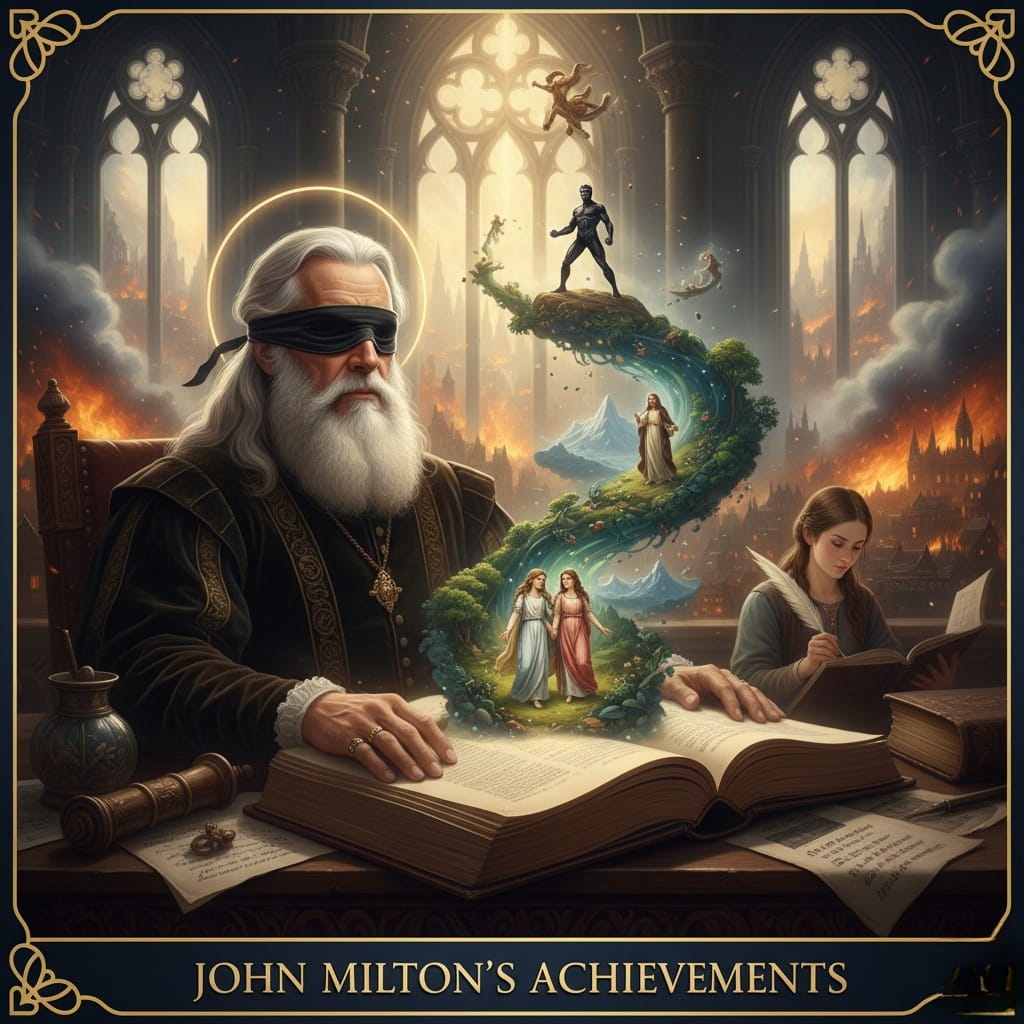
John Milton remains a towering figure of human achievement and spirit. He balanced the roles of poet, politician, and deep thinker. His dedication to liberty and truth never wavered once. Through blindness and defeat, he created worlds of light. We still learn from his courage and his genius today. He is a testament to the power of the mind. His life story incredibly inspires those who value intellectual freedom. It also inspires the pursuit of artistic excellence against all odds. He blended his classical education with his personal religious convictions masterfully. By doing so, he managed to produce a body of work that remains unparalleled in the history of English literature. His commitment to defending individual rights remains strong across the globe. Modern readers continue to resonate with his message of opposition to state tyranny. From the halls of Cambridge, he rose to the height of political power. He never lost sight of his primary mission. That mission was to educate and elevate the human soul. This enduring and multifaceted legacy is the ultimate summary of John Milton’s achievements.
1. Renaissance
Milton grew up during the late English Renaissance. This era fostered a deep love for classical learning. Scholars studied ancient Greek and Roman texts with passion. Young John absorbed these influences in his early years. He developed a rigorous intellectual foundation very quickly. Furthermore, he mastered several languages before leaving his home. This period defined his future approach to epic poetry. Consequently, he blended classical form with Christian themes perfectly. He sought to rival the greatest poets of antiquity. Therefore, his early environment provided the necessary tools for greatness. He viewed his talent as a gift from God. Moreover, he dedicated his youth to intense, private study. This preparation ensured his later works carried immense weight. We can see his Renaissance roots in every line. Thus, his journey began with a thirst for knowledge. This foundation led to many John Milton’s achievements.
2. Christ’s College
He attended Christ’s College, Cambridge, for his higher education. There, he earned the nickname “The Lady of Christ’s.” This reflected his delicate features and his moral purity. However, he often clashed with the university’s rigid authorities. He disliked the traditional scholastic methods of the time. Instead, he preferred a more independent path of learning. Additionally, he began writing sophisticated poetry in Latin and English. These years sharpened his rhetorical skills for future debates. Likewise, he formed deep friendships that lasted many years. He felt a strong calling toward a literary life. Nevertheless, he remained a diligent and highly successful student. He eventually earned his Master of Arts degree there. Consequently, Cambridge served as his primary intellectual proving ground. He left the college with a growing reputation. Indeed, his academic success paved the way for fame.
3. Polyglot
Milton became a true polyglot during his early adulthood. He mastered Latin, Greek, Hebrew, and several modern tongues. This linguistic skill allowed him to read original texts. He did not rely on poor translations for information. Furthermore, he wrote beautiful verses in several different languages. This ability impressed scholars across the entire European continent. Additionally, his fluency in Latin helped his future political career. He could communicate with foreign leaders on equal terms. Moreover, he believed languages opened doors to universal truths. He studied Italian to appreciate the works of Dante. Similarly, he learned Hebrew to study the Old Testament. This vast knowledge gave his writing a unique texture. Therefore, his linguistic prowess remains a central achievement. It allowed him to bridge many different cultural gaps. Thus, he became a voice for all of Europe. Linguistic skill is among John Milton’s achievements.
4. L’Allegro
He wrote “L’Allegro” to celebrate a joyful, social life. The poem captures the beauty of the English countryside. He uses vivid imagery to describe a bright morning. Furthermore, the speaker enjoys the simple pleasures of nature. This work shows Milton’s ability to write light verse. Additionally, it serves as a companion to “Il Penseroso.” Together, they explore two different sides of human nature. Moreover, the rhythm of the poem feels dance-like and fast. He focuses on the “cheerful man” in this piece. Consequently, readers see a softer side of the poet. He appreciates the songs of birds and rustic festivities. Therefore, “L’Allegro” remains a favorite among many poetry lovers. It demonstrates his mastery over mood and atmospheric detail. Thus, he proved he could write beyond epic themes.
5. Il Penseroso
“Il Penseroso” serves as the somber twin to “L’Allegro.” It praises the contemplative and scholarly life of man. The speaker prefers the quiet of the midnight hour. Furthermore, he seeks wisdom in lonely towers and forests. This poem highlights Milton’s deep love for serious study. Additionally, it explores the beauty found in melancholy thoughts. The tone remains slow, thoughtful, and deeply reflective throughout. Moreover, he emphasizes the importance of the inward journey. He values the “pensive nun” over the bright sun. Consequently, the work reveals his own preference for solitude. It balances the youthful energy of his earlier companion poem. Therefore, these twin poems showcase his early thematic range. He understood the dual nature of the human spirit. Early poetry highlights several of John Milton’s achievements.
6. Comus
Milton wrote “Comus” as a courtly masque in 1634. It focuses on the triumph of virtue over vice. A young lady becomes lost in a dark forest. Furthermore, the wicked sorcerer Comus tries to tempt her. She refuses his charms with a powerful moral speech. Additionally, the work emphasizes the strength of a pure mind. Milton used this format to critique contemporary social morals. Moreover, the poetry within the masque is incredibly lyrical. He successfully combined drama with high philosophical debate here. Consequently, the performance earned him great respect among aristocrats. It marked his first major success in public literature. Therefore, “Comus” stands as a landmark in his career. It defends the power of the soul against physical force. Thus, he established himself as a moral authority.
7. Lycidas
He composed “Lycidas” as a pastoral elegy for a friend. Edward King died in a tragic shipwreck in 1637. Milton uses the poem to mourn his lost classmate. Furthermore, he questions the fairness of a short life. The poem features complex shifts in tone and perspective. Additionally, he critiques the corruption within the English clergy. This political edge adds depth to the traditional mourning. Moreover, he concludes with a vision of heavenly rebirth. He masters the difficult conventions of the pastoral genre. Consequently, many critics call it the finest short poem. It transitions from deep grief to hope and resolution. Therefore, “Lycidas” represents a peak in his early period. It handles the theme of mortality with great grace. This elegy stands high among John Milton’s achievements.
8. Sonnets
Milton revitalized the English sonnet with his unique style. He moved away from the traditional themes of love. Instead, he wrote about politics, religion, and personal struggle. Furthermore, he used the Petrarchan form with great technical skill. His sonnet on his blindness is particularly moving today. Additionally, he addressed powerful leaders through these short poems. This allowed him to voice his opinions very clearly. Moreover, he achieved a grand, oratorical tone in fourteen lines. Each sonnet carries the weight of a larger work. Consequently, he influenced later poets like Wordsworth and Keats. He proved that the sonnet could handle serious subjects. Therefore, his sonnets remain essential reading for any student. They provide a window into his private, inner thoughts. Thus, he mastered the art of brevity and impact.
9. Latin Poems
He wrote a significant body of poetry in Latin. These works connected him to the broader European community. Scholars in many countries admired his classical fluency. Furthermore, these poems often explored personal and autobiographical themes. He wrote elegies and letters to his close friends. Additionally, he showed a playful side in these compositions. They demonstrate his comfort with the language of Rome. Moreover, he used Latin to engage in intellectual debates. This practice prepared him for his future diplomatic role. Consequently, his Latin corpus is vital for understanding him. It reveals his early ambitions as a world-class poet. Therefore, we should not overlook these non-English works. They highlight his status as an international man of letters. Latin verse adds to the list of John Milton’s achievements.
10. 17th Century
The 17th century was a time of massive upheaval. England faced civil war, religious conflict, and radical change. Milton lived at the very heart of these events. Furthermore, he actively participated in the shaping of history. This era demanded strong voices and even stronger convictions. Additionally, the rise of science and philosophy challenged tradition. Milton navigated these shifts with a steady, focused hand. Moreover, the social climate influenced every word he wrote. He saw the world through the lens of revolution. Consequently, his work reflects the tension of his age. He struggled against the old ways to find truth. Therefore, understanding the century is key to understanding Milton. He was both a product and a maker of history. Thus, his life defined an era of transformation.
11. English Civil War
The English Civil War changed Milton’s life forever. He chose to support the Parliament against the King. This conflict forced him to pause his poetic dreams. Furthermore, he dedicated his energy to writing political tracts. He believed the struggle was for the soul of England. Additionally, he defended the people’s right to self-governance. This period tested his courage and his intellectual resolve. Moreover, he witnessed the violent birth of a new republic. The war provided the backdrop for his radical ideas. Consequently, his prose became a weapon for the cause. He sacrificed his eyesight while working for the state. Therefore, the war defined his middle years entirely. He stood on the front lines of ideological battle. Political defense is central to John Milton’s achievements.
12. Puritanism
Milton’s faith was rooted in the principles of Puritanism. He valued individual conscience above any church hierarchy. This belief system drove his desire for radical reform. Furthermore, he sought a simpler and purer form of worship. He rejected the rituals of the Church of England. Additionally, his poetry is saturated with deep biblical themes. He saw himself as a prophet for his people. Moreover, Puritanism influenced his strict personal discipline and focus. He believed every person must answer directly to God. Consequently, his work often emphasizes personal responsibility and choice. He struggled with the paradoxes of grace and law. Therefore, his religious identity is inseparable from his art. It provided the moral framework for his epic vision. Thus, he wrote to serve a higher purpose.
13. Divorce Tracts
He published several controversial tracts on the subject of divorce. This followed his own difficult first marriage to Mary Powell. He argued that mental compatibility mattered more than physical. Furthermore, he believed that unhappy marriages harmed the soul. These writings shocked his contemporaries and caused great scandal. Additionally, he used the Bible to support his radical claims. He advocated for the freedom to end dead unions. Moreover, these tracts show his commitment to individual liberty. He did not fear social backlash or religious condemnation. Consequently, he became a target for many conservative critics. However, he refused to retract his bold, honest opinions. Therefore, the divorce tracts highlight his fearless intellectual nature. Social reform remains one of John Milton’s achievements.
14. Areopagitica
In 1644, Milton wrote “Areopagitica” to oppose government censorship. It remains one of the greatest defenses of free speech. He argued that truth emerges through open, public debate. Furthermore, he claimed that killing a book kills reason. This tract addressed the Parliament during the Civil War. Additionally, he believed that citizens must choose between good and evil. Censorship prevents people from exercising their essential free will. Moreover, the prose is famous for its powerful, soaring imagery. He compared truth to a broken body needing assembly. Consequently, this work influenced modern democratic laws and values. It is a cornerstone of the Western legal tradition. Therefore, “Areopagitica” is perhaps his most relevant prose work. It continues to inspire defenders of liberty today. Thus, he secured the right to think freely.
15. Tenure of Kings
“The Tenure of Kings and Magistrates” defended a bold idea. Milton argued that people could execute a guilty tyrant. He wrote this shortly after the execution of Charles I. Furthermore, he claimed that power resides with the people. Rulers only hold authority as a trust from them. Additionally, he used historical and legal precedents to prove this. This tract justified the actions of the new republic. Moreover, it established Milton as a leading political theorist. He did not shrink from the consequences of revolution. Consequently, he became the official voice of the Commonwealth. This work cemented his reputation as a radical thinker. Therefore, it stands as a landmark in political history. Challenging monarchy is the core of John Milton’s achievements.
16. Latin Secretary
Milton served as the Latin Secretary to the Commonwealth. His job involved drafting official letters to foreign nations. He used his linguistic skill to defend English policy. Furthermore, he became the international face of Cromwell’s government. This role required immense dedication and very long hours. Additionally, he translated state secrets and conducted diplomatic business. This work contributed significantly to his eventual total blindness. Moreover, he felt proud to serve the cause of liberty. He communicated with the greatest minds across all of Europe. Consequently, he held a position of great political influence. He was more than a poet; he was a statesman. Therefore, his service as Secretary is a major achievement. It showed his practical commitment to his political ideals. Thus, he served his country with his mind.
17. Oliver Cromwell
Milton worked closely with the Lord Protector, Oliver Cromwell. He admired Cromwell as a leader of the revolution. Furthermore, he wrote a famous sonnet praising the general. He saw Cromwell as a protector of religious liberty. Additionally, they shared a vision for a godly English republic. However, Milton also warned him against becoming a tyrant. Their relationship was built on a shared political cause. Moreover, Milton’s work gave Cromwell’s regime international intellectual legitimacy. He defended the protectorate against its many European critics. Consequently, his fate was tied to Cromwell’s political success. When Cromwell died, Milton’s world began to crumble quickly. Therefore, this partnership was central to his life’s work. This alliance is vital to John Milton’s achievements.
18. Blindness
Milton became completely blind by the year 1652. He lost his sight while serving the English republic. Many enemies claimed this was a punishment from God. Furthermore, he struggled with the darkness and the isolation. However, he did not let this disability stop him. Instead, he turned his vision inward toward spiritual things. Additionally, he began to “see” his great epic poems. He memorized lines of poetry during the long nights. Moreover, he relied on assistants to write down his verses. This period of his life was incredibly productive. Consequently, his blindness became a source of poetic inspiration. He compared himself to the blind prophets of old. Therefore, his perseverance is an inspiration to everyone today. He created light out of his own deep darkness. Thus, his spirit remained completely unyielding and bright.
19. Dictation
Because of his blindness, Milton had to use dictation. He composed his verses in his head at night. Furthermore, he waited for his “amanuensis” to arrive each morning. He would then “milk” the poetry from his mind. This process required a remarkable and powerful memory. Additionally, it changed the oral quality of his later work. His poetry sounds like a voice speaking to us. Moreover, his daughters and friends helped him record his epics. This collaborative effort was essential for his final success. Consequently, Paradise Lost exists because of this tireless method. He proved that the mind can overcome physical limits. Therefore, his process of dictation is a legendary feat. Composing while blind is one of John Milton’s achievements.
20. Restoration
The Restoration of the monarchy in 1660 was a disaster. The son of the executed king returned to power. Milton’s political dreams were shattered in a single moment. Furthermore, he went into hiding to escape certain death. Many of his colleagues were executed or fled abroad. Additionally, the new government burned his radical political books. He lost his status, his wealth, and his influence. Moreover, he faced the threat of life in prison. He felt like a lonely voice in a hostile world. Consequently, this dark period forced him back to poetry. He no longer participated in the public square. Therefore, the Restoration paradoxically led to his greatest works. He turned away from the world to the eternal. Thus, his political defeat became a literary victory.
21. Commonwealth
The Commonwealth era was the center of Milton’s political life. It was a time without a king in England. He believed this was a chance for true liberty. Furthermore, he worked tirelessly to support this new government. He wrote defenses of the English people to Europe. Additionally, he helped shape the laws of the republic. This period represented his hope for a better world. Moreover, he saw it as a step toward God’s kingdom. The failure of the Commonwealth deeply saddened his heart. Consequently, he spent his final years reflecting on this loss. He wondered why the people chose “bondage” over freedom. Therefore, the Commonwealth remains the core of his biography. His service here anchors the list of John Milton’s achievements.
22. Paradise Lost
Paradise Lost is Milton’s undisputed and greatest masterpiece. This epic poem tells the story of the Fall. It follows Satan’s rebellion and the temptation of Man. Furthermore, he wrote it to justify God’s ways. The poem is massive in scale and profound depth. Additionally, it features some of the best English ever written. He used blank verse to create a grand sound. Moreover, the character of Satan is famously complex and tragic. The poem explores themes of fate, choice, and redemption. Consequently, it established him as a world-class epic poet. It remains a cornerstone of English and world literature. Therefore, his achievement in this work is truly beyond measure. This epic is the peak of John Milton’s achievements.
23. Satan
Milton’s depiction of Satan is one of his achievements. He created a character that is both evil and compelling. Satan begins as a brilliant, charismatic, and defiant leader. Furthermore, he utters famous lines about reigning in Hell. Many readers find themselves oddly sympathizing with his struggle. Additionally, Milton shows Satan’s slow and painful moral decay. He transitions from a bright angel to a serpent. Moreover, this character reflects Milton’s own interest in rebellion. He used Satan to explore the nature of pride. Consequently, the “Miltonic Satan” influenced centuries of future writers. Romantic poets later viewed him as a tragic hero. Therefore, this character remains a subject of intense debate. He is the most vivid figure in the epic. Thus, Milton gave evil a very human face.
24. Adam and Eve
He humanized the story of Adam and Eve profoundly. They are not just symbols in his great epic. Instead, they are complex people with real, deep emotions. Furthermore, he depicts their relationship with tenderness and dignity. He shows their intellectual curiosity and their mutual love. Additionally, their fall is a moment of intense tragedy. They choose to stay together even in their sin. Moreover, Milton emphasizes their shared responsibility for their actions. He gives them a voice that resonates with us. Consequently, the poem ends on a note of hope. They walk hand in hand into the new world. Therefore, his portrayal of our first parents is masterful. Portraying human emotion is among John Milton‘s greatest achievements.
25. Epic Poetry
Milton sought to write the ultimate English epic poem. He succeeded in placing himself alongside Homer and Virgil. This genre requires a high style and vast scope. Furthermore, he broke traditional rules to find a new voice. He chose a biblical theme over a national one. Additionally, he expanded the boundaries of the English language. His work covers heaven, hell, chaos, and the earth. Moreover, he sustained this massive effort over twelve long books. He proved that English could handle the most sublime subjects. Consequently, his epic remains the standard for all others. He achieved a level of grandeur rarely seen before. Therefore, his contribution to the epic tradition is foundational. Redefining the epic form also signifies John Milton’s achievements.
26. Blank Verse
He chose to write his epic in blank verse. This means he used rhymed lines of iambic pentameter. Furthermore, he argued that rhyme was a “bondage” for poets. He wanted the freedom to flow across many lines. Additionally, he created a “grand style” that sounds like music. His sentences are long, complex, and very rhythmic indeed. This choice influenced generations of poets who followed him. Moreover, he proved that rhyme was not necessary for beauty. He relied on internal echoes and powerful, varied cadences. Consequently, his blank verse feels both natural and very formal. It allows for a wide range of emotional expression. Therefore, his technical innovation is a major literary achievement. Freeing poetry from rhyme is among John Milton’s achievements.
27. Grand Style
Milton is famous for what critics call “Grand Style.” This refers to his elevated and highly formal language. He used complex syntax and rare, beautiful vocabulary words. Furthermore, his writing has a majestic and slow-moving pace. It feels appropriate for the celestial themes he explores. Additionally, he avoids common or low language in his epics. This creates a sense of awe and great distance. Moreover, he uses long similes to expand the reader’s imagination. His style is designed to be heard out loud. Consequently, reading Milton requires deep focus and careful attention. It is a style that demands respect and thought. Therefore, his linguistic architecture is a marvel of construction. Establishing this style remains part of John Milton’s achievements.
28. Theology
His work is a deep exploration of Christian theology. Milton was not a standard or orthodox religious thinker. He held several unusual and even heretical private beliefs. Furthermore, he explored the nature of God, Son, and Spirit. He struggled with the problem of evil in the world. Additionally, his poetry serves as a form of divine teaching. He wanted to explain the plan of the universe. Moreover, he emphasized the importance of individual reason in faith. He believed that God granted humans the gift of choice. Consequently, his epics are as much philosophy as poetry. They challenge the reader to think about their soul. Therefore, his theological achievement is his intellectual courage today. Theological exploration is central to John Milton’s achievements.
29. Biblical Allusion
Milton’s writing is thick with deep and complex biblical allusions. He knew the scriptures better than almost anyone else. Every page of his work refers to sacred texts. Furthermore, he didn’t just quote; he reinterpreted the stories. He breathed new life into familiar and ancient parables. Additionally, he blended these with classical and historical references. This creates a rich and multi-layered experience for readers. Moreover, his allusions provide a sense of universal authority. He connects his story to the entire history of Man. Consequently, one must know the Bible to fully understand him. He used the past to explain the present world. Therefore, his mastery of allusion is a key achievement. This mastery shines among all of John Milton’s achievements.
30. Classical Tradition
He was a master of the classical tradition of Rome. He drew heavily from authors like Homer and Virgil. Furthermore, he adapted the structures of Greek tragedy for drama. He believed that modern poets should learn from the ancients. Additionally, his work is filled with mythological and pagan imagery. He used these figures to contrast with Christian truth. This blend of “Athens and Jerusalem” is his hallmark. Moreover, he followed the rules of classical rhetoric very closely. He wanted to achieve the same permanence as the classics. Consequently, his work bridges the gap between two worlds. He is the last great poet of the Renaissance. Therefore, his classical achievement is his synthesis of history. This synthesis is high on the list of John Milton’s achievements.
31. Moral Fall
The theme of the Fall is central to Milton. He explores how pride leads to a great ruin. This applies to both Satan and the first humans. Furthermore, he examines the psychological state of the fallen. He shows that the mind can make a hell. Additionally, he depicts the struggle to regain lost virtue. The fall is not just an event but a process. Moreover, he uses this theme to reflect on England’s politics. He felt his country had fallen from its grace. Consequently, his work is a meditation on human failure. He asks how we can rise again after sinning. Therefore, his treatment of the Fall is profoundly moving. Explaining the fall is a part of John Milton’s achievements.
32. Redemption
Despite the themes of loss, Milton emphasizes ultimate redemption. He shows that God provides a way for man. Furthermore, the “Greater Man” will restore our lost seat. He points toward the future coming of Christ. Additionally, he explores redemption through individual effort and faith. A “paradise within” is possible for every single person. Moreover, this hope balances the tragedy of the great Fall. He believes that good can emerge from terrible evil. Consequently, his work is fundamentally optimistic about the spirit. It encourages the reader to seek a higher path. Therefore, his vision of redemption is a vital achievement. Hope for redemption highlights several of John Milton’s achievements.
33. Justification
Milton famously sought to “justify the ways of God.” This means he wanted to explain divine justice. He tackled the hardest questions about suffering and evil. Furthermore, he argued that God is always fair and just. He believed that humans are responsible for their own woe. Additionally, he showed that God offers mercy to the repentant. This philosophical project drives the entire narrative of his epic. Moreover, he used reason to support his religious claims. He did not ask for blind or unthinking faith. Consequently, his work is a massive exercise in theodicy. It attempts to make sense of a chaotic universe. Therefore, this goal of justification is his most ambitious. Divine justification remains among John Milton‘s achievements.
34. Virtue
Virtue is the highest goal in Milton’s moral universe. He believed that true virtue must be tested by trial. Furthermore, he famously hated a “fugitive and cloistered” virtue. He thought people must face temptation to be truly good. Additionally, his characters often debate the meaning of right action. Virtue is a choice made in the face of evil. Moreover, he saw himself as a poet of moral instruction. He wanted to inspire his readers to live better lives. Consequently, his work is a guide for the soul’s journey. He emphasizes the strength found in a pure heart. Therefore, his focus on virtue is a lasting achievement. Promoting virtue is a key part of John Milton’s achievements.
35. Free Will
The concept of free will is vital to Milton. He believed God made man “sufficient to have stood.” However, man was also “free to fall” by choice. Furthermore, without freedom, there can be no true worship. He rejected the idea of strict and total predestination. Additionally, he showed that even Satan chose his own path. This focus on choice makes his characters very dynamic. Moreover, it places the burden of history on human shoulders. We are the masters of our own spiritual destiny. Consequently, his work celebrates the dignity of the individual. He fought for freedom in both heaven and on earth. Therefore, his defense of free will is a core achievement. This philosophical defense defines many of John Milton’s achievements.
36. Hierarchy
Milton’s world is organized into a strict, cosmic hierarchy. He believed in an ordered universe under God’s rule. Furthermore, he explored the dangers of breaking this natural order. Satan’s sin was a rebellion against his proper place. Additionally, the poem reflects the celestial ranks of the angels. This structure provides a sense of stability and great meaning. Moreover, Milton applied this idea to the human family unit. However, he also believed hierarchy must be based on merit. He rejected the false hierarchy of kings and priests. Consequently, his views on order are complex and often debated. He balanced his love for liberty with a need for order. Depicting this order is among John Milton’s achievements.
37. Providence
He believed in the guiding hand of Divine Providence. Everything that happens serves a larger and hidden purpose. Furthermore, even evil actions eventually lead to a greater good. This belief helped him endure his own personal trials. Additionally, it gives his epics a sense of divine direction. He shows that history is not just random events. Moreover, Providence ensures the ultimate victory of the good. This theme provides a strong backbone for his narratives. It allows for hope even in the darkest moments. Consequently, his work reassures the reader of a higher plan. He trusted that God was in control of everything. Therefore, his focus on Providence is a significant achievement. Trusting Providence marks several of John Milton’s achievements.
38. Individualism
Milton was a pioneer of the spirit of modern individualism. He believed the individual conscience is the highest authority. Furthermore, he stood alone against the crowds many times. He valued the “still small voice” over the loud voice. Additionally, his heroes are often solitary figures fighting for the truth. This focus on the self was very radical back then. Moreover, he encouraged readers to find their own path to God. He did not trust institutions to save the soul. Consequently, his work helped shape the modern sense of self. He celebrated the power of the lonely, thinking mind. Therefore, his contribution to individualism is a lasting achievement. This individual spirit fuels many of John Milton’s achievements.
39. Civil Liberties
He was a tireless champion for essential civil liberties. He believed that freedom of conscience was a natural right. Furthermore, he fought against the power of the state church. He advocated for the right of people to choose leaders. Additionally, he wrote against the licensing of the printed press. This made him a hero for later democratic movements. Moreover, he believed that liberty is necessary for human growth. Without it, people become mere slaves to their passions. Consequently, his political writings are still read in law schools. He provided the intellectual foundation for many modern freedoms. Therefore, his work for civil liberties is a primary achievement. This advocacy is part of the achievements made by John Milton.
40. Free Speech
Milton’s defense of free speech is his most famous legacy. He believed that suppressing ideas only harms the searcher. Furthermore, he argued that even bad ideas should be heard. Truth will always defeat a lie in a fair fight. Additionally, he saw censorship as an insult to human reason. It treats grown citizens like children who cannot choose. Moreover, he believed that books are the lifeblood of spirits. To kill a good book is to kill immortality. Consequently, his words are quoted by free speech advocates everywhere. He helped end the practice of government pre-licensing books. Therefore, “Areopagitica” remains his gift to the modern world. The defense of speech defines the major part of John Milton’s achievements.
41. Republicanism
He was a committed and vocal supporter of English republicanism. He believed that kings were not necessary for a state. Furthermore, he thought a republic was best suited to a virtuous people. He argued that hereditary rule was often a form of slavery. Additionally, he helped draft the ideological framework for the Commonwealth. He wanted a government based on merit and the law. Moreover, he saw the republic as a godly form of rule. Even after the Restoration, he did not change his mind. Consequently, he remains a key figure in political philosophy. His ideas influenced the American and French revolutionary thinkers. Therefore, his work for republicanism is a major achievement. This political vision highlights John Milton’s achievements.
42. Regicide
Milton was one of the few who defended regicide. This is the act of killing a reigning king. Furthermore, he argued that Charles I was a tyrant. He believed the people had a legal right to execute him. This position was extremely dangerous and very radical then. Additionally, he wrote several books to justify this specific act. He claimed that a king is a servant of the law. Moreover, his defense helped stabilize the new English Republic. He did not fear the “divine right” of monarchs. Consequently, his name became synonymous with the revolutionary cause. He was the intellectual force behind the King’s death. Therefore, his courage in this matter is a historical achievement. Defending justice is a part of the achievements made by Milton.
43. Censorship
He spent much of his life fighting against censorship. He believed that the state should not control human thought. Furthermore, he argued that individuals must learn to judge truth. He saw the “Imprimatur” as a mark of a tyrant. Additionally, he believed that free inquiry leads to better citizens. He fought the licensing laws of the English Parliament. Moreover, he showed that censorship only encourages the spread of lies. It makes people weak and unable to defend their faith. Consequently, his work helped pave the way for open societies. He remains the most eloquent opponent of the thought police. Therefore, his stance on censorship is a foundational achievement. Opposing censorship remains among John Milton’s achievements.
44. Religious Reform
Milton sought a deep and total reform of religion. He believed the church had become far too corrupt. Furthermore, he wanted to remove all worldly power from bishops. He advocated for a simpler, biblical form of congregational worship. Additionally, he thought that every man should be his own priest. This radical view challenged the entire religious establishment. Moreover, he believed that faith must be a personal choice. He rejected the idea of a state-mandated national religion. Consequently, his writings influenced many non-conformist and radical groups. He pushed the boundaries of what was acceptable to believe. Therefore, his work for religious reform is a major achievement. Reforming faith is part of Milton’s achievements.
45. Liberty
The word “liberty” is the heartbeat of Milton’s entire life. He sought it in politics, in religion, and personally. Furthermore, he believed that liberty is the natural state of man. It is a gift from God that no king should take. Additionally, he argued that liberty requires great personal responsibility. Only a virtuous person can truly be a free person. Moreover, his epics are songs about the loss and gain of it. He saw the fall of man as a loss of liberty. Consequently, he dedicated his life to regaining that lost freedom. He is the ultimate poet of the free human spirit. Therefore, his lifelong pursuit of liberty is his greatest achievement. This pursuit connects all of Milton’s achievements.
46. Neoclassicism
Milton helped bridge the gap to the era of Neoclassicism. His work emphasized balance, order, and classical imitation in art. Furthermore, he focused on the universal rather than the specific. He sought a timeless and objective quality in his poetry. Additionally, his influence on the 18th century was absolutely massive. Later poets like Alexander Pope studied his techniques very closely. They admired his ability to create a grand, epic scale. Moreover, he showed how to adapt ancient forms to modern ones. His work became a model for the “correct” English style. Consequently, he is a precursor to the Augustan age of letters. He defined the standards of excellence for his successors. Therefore, his contribution to Neoclassicism is a lasting achievement. This influence defines many of Milton’s achievements.
47. Humanism
His work is a late and brilliant flower of Humanism. He believed in the great potential and dignity of man. Furthermore, he combined Christian faith with a love for human reason. He thought that humans should cultivate their minds and spirits. Additionally, his poetry celebrates the range of human experience and emotion. He saw the study of the “humanities” as essential for life. Moreover, he placed man at the center of a cosmic drama. His Adam and Eve are capable of great intellectual growth. Consequently, his writing encourages the development of the whole person. He did not see a conflict between faith and learning. Therefore, his Humanist outlook is a core achievement of his. Humanism is central to Milton’s achievements.
48. Polemicist
Milton was a fierce and highly effective prose polemicist. He used his writing to attack his many political enemies. Furthermore, his prose is often biting, witty, and very aggressive. He did not hold back in his defense of truth. Additionally, he mastered the art of the persuasive and long essay. His tracts on divorce and kingship changed the public debate. Moreover, he could dismantle an opponent’s argument with surgical precision. He saw his prose as a “left hand” to his poetry. Consequently, he was feared by those who opposed his views. He was a warrior in the world of published ideas. Therefore, his skill as a polemicist is a major achievement. Polemical skill signifies a major aspect of Milton.
49. English Literature
He is a central pillar of all English literature today. His influence is visible in almost every major writer after. Furthermore, he expanded the vocabulary and the scope of the language. He proved that English could rival the beauty of Latin. Additionally, he created a standard for the epic and the elegy. His works are studied in every university around the world. Moreover, he provided a moral depth that few others matched. He transformed the way we think about stories and characters. Consequently, his name is spoken alongside that of William Shakespeare. He is a part of the cultural DNA of England. Therefore, his overall contribution to literature is a supreme achievement. Literary stature defines the core of Milton’s achievements.
50. Literary Legacy
The literary legacy of John Milton is truly vast and deep. He inspired poets from the Romantics to the modern era. Furthermore, his work shaped the way we imagine heaven and hell. Many of our common ideas about Satan come from him. Additionally, he showed how to combine art with political action. He remains a model for the writer as a public intellectual. Moreover, his technical mastery continues to challenge and delight poets. His words have been translated into dozens of different languages. Consequently, he belongs to the entire world, not just England. He created a body of work that is truly immortal. Therefore, his enduring legacy is his most significant and final achievement. This legacy crowns all Milton’s achievements.
51. Pandemonium
Milton coined the word “pandemonium” in his great epic poem. It refers to the capital city of Hell in stories. Furthermore, it literally means “all the demons” in Greek. The word has now entered the common English language forever. Additionally, it describes any scene of noisy and wild confusion. This is a perfect example of his creative linguistic power. He did not just use words; he actually invented them. Moreover, the description of the building of Pandemonium is iconic. It shows the pride and the industry of the fallen. Consequently, this invention highlights his influence on our daily speech. We use his words without even realizing their source. Therefore, this specific coinage is a fun and lasting achievement. Invention remains part of Milton’s achievements.
52. Enjoyable
He is also credited with coining the common word “enjoyable.” Before Milton, this word did not exist in our language. Furthermore, it shows his interest in the pleasures of life. He used it to describe things that bring us delight. Additionally, this is one of over six hundred words he created. He felt that English needed more tools for expressive beauty. Moreover, his coinages often filled a gap in the existing tongue. He had a natural ear for how words should sound. Consequently, he helped make the English language much more flexible. We owe much of our expressive range to his mind. Therefore, his linguistic inventions are a very practical achievement. This word is among Milton’s lasting achievements.
53. 600 Words
Scholars believe Milton introduced over six hundred words to English. This is a staggering feat for any single writer today. Furthermore, he drew from his knowledge of many other languages. He created words that were both useful and very beautiful. Additionally, his inventions cover a wide range of different subjects. He gave us “sensuous,” “complacency,” and even “outer space.” This shows his incredible range of thought and creative vision. Moreover, he enriched the texture of the language for everyone else. His impact on English is second only to William Shakespeare. Consequently, he is a primary architect of the tongue we speak. He treated the language like a living and growing thing. Therefore, this linguistic expansion is a massive, historic achievement. Language building marks Milton’s achievements.
54. Diplomatic Voice
As Latin Secretary, he was the diplomatic voice of England. He wrote to kings and queens on behalf of Cromwell. Furthermore, he defended the reputation of the English people abroad. He used his eloquence to justify the nation’s controversial actions. Additionally, he navigated the complex waters of European power politics. This role required great tact and even greater intellectual strength. Moreover, he helped establish England as a major Protestant power. His letters were read in every royal court in Europe. Consequently, he was more than just a poet in a room. He was a key player on the global political stage. Therefore, his service as a diplomat is a unique achievement. Diplomacy is a major part of Milton’s achievements.
55. Tenure of Kings
“The Tenure of Kings and Magistrates” is a political masterpiece. It argued that monarchs are subject to the people’s law. Furthermore, it claimed that tyranny justifies a lawful revolution. This work was written at a moment of great crisis. Additionally, it provided the moral courage for the new government. Milton used logic to dismantle the “divine right” of kings. Moreover, he argued that freedom is a gift from God. People have the right to take back power from tyrants. Consequently, this book helped change the course of Western history. It is a foundational text for modern democratic political thought. Therefore, its publication is a landmark and a major achievement. This book defines many of Milton’s achievements.
56. Moral Courage
Milton’s life is a masterclass in the quality of courage. He stood by his beliefs when it was most dangerous. Furthermore, he did not recant his views after the Restoration. He faced the threat of death with a steady heart. Additionally, he continued to write even after he lost sight. His internal strength was greater than any external force at all. Moreover, he defended the unpopular cause of the English people. He was a man of deep and unwavering principle, always. Consequently, his life serves as a model for all thinkers. He showed that the mind can remain free in chains. Therefore, his moral courage is his most personal achievement. This courage anchors all of Milton’s achievements.
57. Biblical Epic
He created the definitive biblical epic for the English people. He took the stories of the Bible and made art. Furthermore, he stayed true to the spirit of the scripture. He added a depth of imagination that was entirely new. Additionally, he made the ancient stories feel immediate and alive. His work serves as a bridge between faith and literature. Moreover, he used the epic form to explore divine mysteries. He showed that the Bible is a source of beauty. Consequently, his work is a treasure for both believers and poets. He honored the sacred while practicing his literary craft. Therefore, his creation of the biblical epic is historic. Sacred poetry is part of Milton’s achievements.
58. Intellectual Mastery
Milton possessed an intellectual mastery that few have ever matched. He was one of the most learned men of his age. Furthermore, he synthesized vast amounts of complex information easily. He drew from history, science, philosophy, and many different religions. Additionally, he used this knowledge to build his massive epics. His mind was a library of the entire Western world. Moreover, he never stopped learning, even in his late years. He remained curious about the world until his very end. Consequently, his work is incredibly rich and very rewarding today. It challenges the reader to grow and to think deeply. Therefore, his sheer mental power is a significant achievement. Mental mastery defines many of Milton’s achievements.
59. Eternal Fame
Milton achieved the eternal fame that he sought in youth. He is now a permanent part of our human history. Furthermore, his works will be read as long as English. He conquered the fear of being forgotten by the world. Additionally, he joined the ranks of the truly immortal poets. His name is a symbol of genius and of liberty. Moreover, he proved that great art can change the world. He left a mark that no one can ever erase. Consequently, his dream of a “lasting fame” came completely true. He is a guiding star for all who follow him. Therefore, his place in the heavens is his final achievement. This fame is the ultimate of Milton’s achievements.
Conclusion
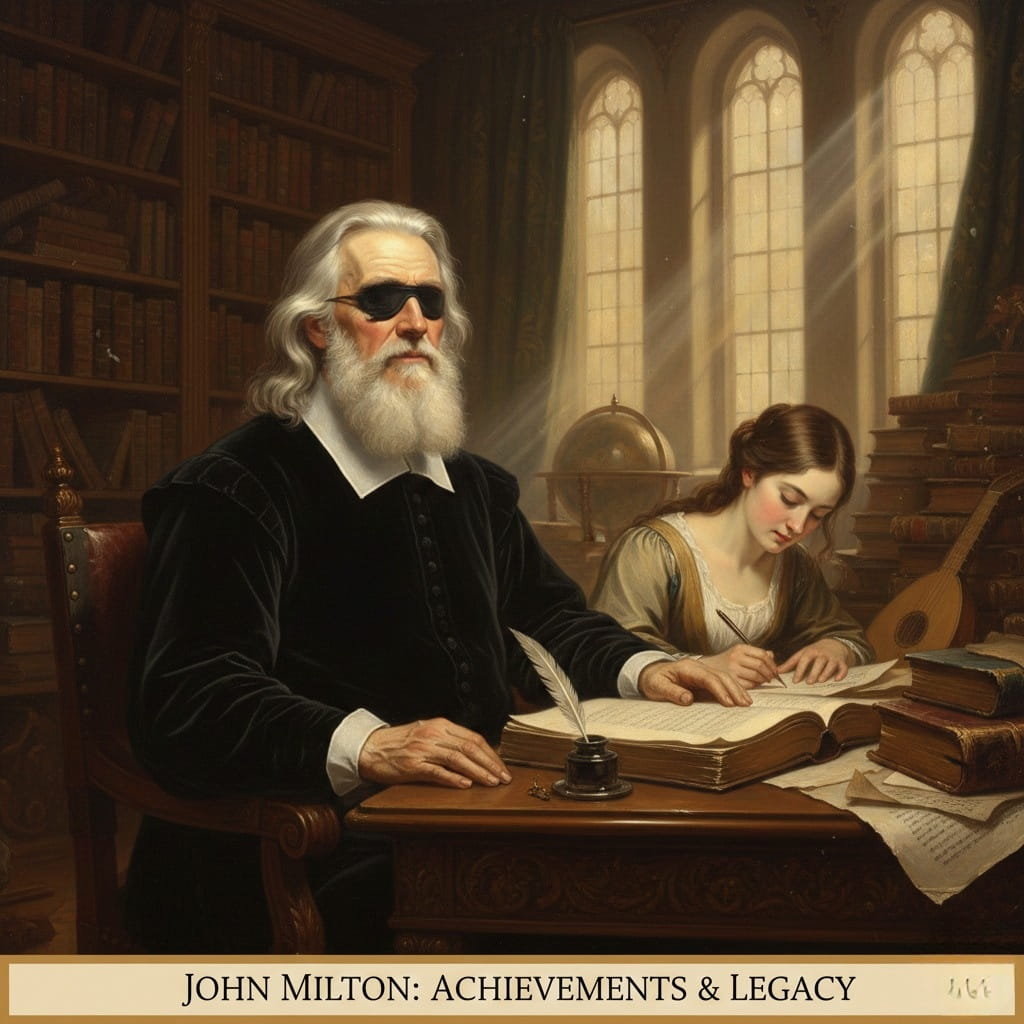
In conclusion, the enduring legacy of this literary giant proves that his impact on the world is far from over. John Milton remains a towering figure of human achievement and spirit. He achieved this by successfully balancing the roles of poet, politician, and deep thinker. Throughout his life, his dedication to liberty and truth never wavered once, even when facing political persecution. He overcame the physical darkness of blindness. Despite the emotional weight of political defeat, he created worlds of light that continue to guide us. We learn from his immense courage today. His creative genius continues to inspire us. His work transcends the boundaries of time and geography. He is a testament to the power of the mind and its ability to overcome any obstacle. By studying his life, we understand how personal conviction shapes history. It also inspires future generations to fight for their own freedoms. Ultimately, the vast collection of his writings and his steadfast moral character represent the very best of John Milton’s achievements.
———————————————————————————————————————————————————–
For the reading of Three Degrees of Love in The Form of Living by Richard Rolle, follow the link: https://englishlitnotes.com/2025/12/29/three-degrees-of-love-form-of-living-richard-rolle/
To read Canadian Literature, follow the link: http://canlitstudies.blogspot.com
Discover more from Naeem Ullah Butt - Mr.Blogger
Subscribe to get the latest posts sent to your email.