
Introduction
A Haunting Tudor Lyric
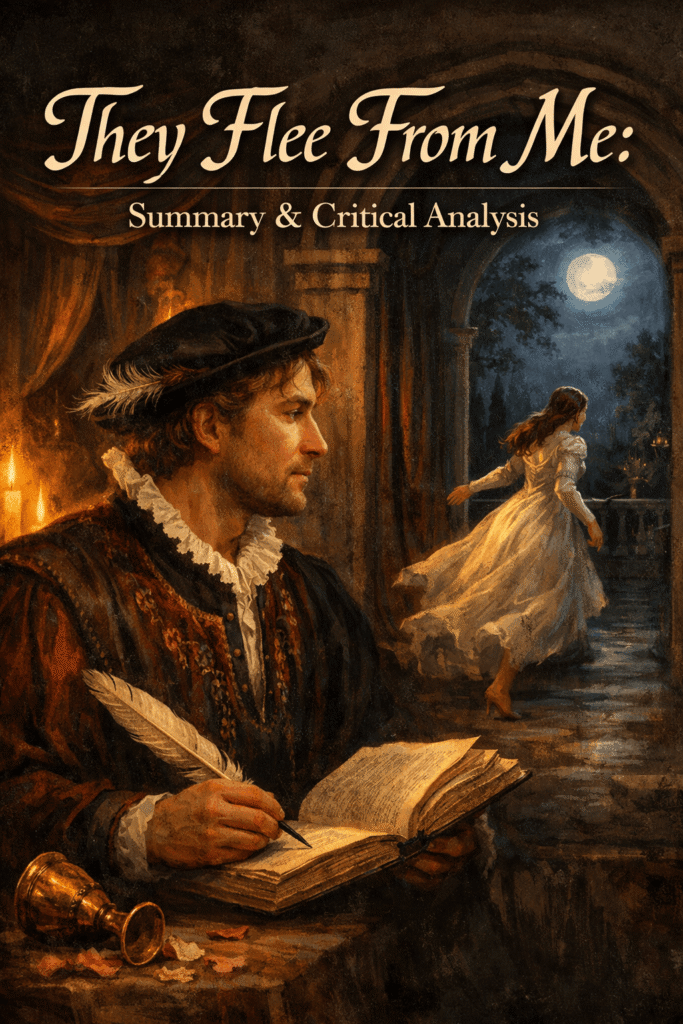
The poem They Flee From Me haunts the reader. It explores the dark Tudor world. Sir Thomas Wyatt writes with sharp wit. Initially, the verses show deep pain. Furthermore, he uses a unique rhyme scheme. This structure creates a natural, soft flow. Consequently, the speaker shares a private grief. He feels a sudden, cold social shift. Moreover, the courtly favor dies like mist. Subsequently, his “special fortune” turns to dust. Thus, we see a man in ruin. Indeed, the poem reveals a bitter truth. Therefore, it stands as a literary giant. Every word carries a heavy, hidden weight. He rejects the flowery style of others. Instead, he chooses a gritty, raw realism. Ultimately, the poem defines an entire era.
Technical Mastery of Verse
The poet masters every single line. They Flee From Me uses a rugged meter. For instance, the rhythm mimics a heartbeat. Similarly, the imagery feels very visceral. He describes a “naked foot” in detail. Accordingly, the speaker watches his own fall. He observes the fickle hearts of men. Furthermore, he lacks any false hope now. In addition, he mocks the social game. Hence, the poem feels remarkably modern. The meter echoes a man’s heavy breath. Therefore, we feel his physical exhaustion. Subsequently, the rhyme snaps like a trap. It captures the sudden nature of loss. Indeed, he builds a house of words. Thus, his skill moves the human soul. Every stanza hits with a sharp sting.
Themes of Betrayal
The poem carries a massive mental weight. They Flee From Me explores deep betrayal. Specifically, it targets the “fashion of forsaking.” Consequently, the speaker demands a cold answer. He refuses to beg for lost love. Moreover, he seeks a moral reckoning now. Nevertheless, a quiet sadness fills the air. He realizes his time has finally passed. Furthermore, he critiques the entire royal court. Subsequently, he finds power in his silence. Thus, his honesty creates a lasting legacy. He faces the ruins of his life. Indeed, he survives through his bold art. The poem serves as a dark mirror. Therefore, it remains a vital, tragic text. It captures the death of true loyalty. Ultimately, Wyatt wins through his bitter truth.
Background
The Dangerous Tudor Court
They Flee From Me reflects a dangerous world. King Henry VIII ruled with absolute power. Favor shifted like the sudden wind. Furthermore, every courtier lived in fear. Loyalty meant nothing in this royal house. Consequently, men fell from grace every day. Moreover, Sir Thomas Wyatt served the King. Similarly, he saw the rise of rivals. He lived at the heart of danger. Therefore, the poem mirrors a lived reality. Subsequently, he used art to survive pain. Indeed, the court was a bloody hunt. Thus, his verses hide a secret history. He watched the King’s many shifting moods. Every romantic bond had a high price. Ultimately, the poem records a tragic struggle. The background is a dark, royal thriller.
The Rise of Newfangleness
The Tudor court loved “newfangleness” above all. They Flee From Me critiques this craze. Specifically, people craved novelty and constant change. The court treated lovers like mere prizes. Furthermore, predation defined every social bond. Similarly, the speaker once held the favor. He was the target of desire once. Consequently, his loss feels even more sharp. In addition, the private chamber holds secrets. Hence, the background shows a cold system. Therefore, we see the cost of ambition. The world valued rank over a heart. Subsequently, the speaker warns the younger men. Indeed, he knows the forest’s hidden traps. Thus, the poem acts as a diary. He records the cruelty of the crown. Ultimately, he exposes the hard, royal truth.
A Literary Revolution
Wyatt broke the old Italian poetic rules. They Flee From Me marks a revolution. He brought a rugged English pulse forward. Furthermore, he ignored the soft, flowery style. He preferred a direct, physical type of love. Similarly, he used his own life experiences. He spent time in the dark Tower. Consequently, his irony has a sharp edge. Moreover, he built a new lyric form. Therefore, his work influenced many future poets. Subsequently, we see his shadow in Shakespeare. Indeed, he gave the language new life. Thus, his background shaped every single rhyme. He translated pain into a high art. Every line shows his deep intellectual depth. In addition, he mastered the English spirit. Ultimately, his legacy lives in this poem.
Characters
The Speaker
The Speaker serves as the central voice in They Flee From Me. He represents a man who has lost his status. Initially, he recalls a time of great success and joy. Furthermore, he describes himself as a former target of desire. Consequently, he feels the sharp sting of his current isolation. Similarly, he watches his former friends leave his side now. Therefore, he embodies the pain of a fallen courtier today. He refuses to beg for any false or hollow pity. Instead, he maintains a cold and very stoic dignity. Subsequently, he questions the moral cost of his great loss. Indeed, he remains an observer of his own tragic ruin. Thus, his voice captures the heavy weight of deep betrayal. He stands alone in his quiet and dark chamber. Ultimately, the Speaker defines the tragedy of a lost favor.
The Lovers
The Lovers represent the group that now avoids the speaker. They Flee From Me describes their sudden and cold change. Specifically, they once acted like tame and very gentle birds. They sought the speaker with a “naked foot” in private. Furthermore, they now prefer the thrill of constant and new change. Similarly, they symbolize the “newfangleness” of the entire royal court. Consequently, they act as predators rather than loyal or true friends. Moreover, they follow the scent of power and high rank. Hence, they lack any sense of lasting or deep commitment. Therefore, the speaker views them with a very bitter irony. In addition, they mirror the fickle nature of the Tudor world. Subsequently, they leave the speaker for a newer, fresher prize. Thus, they represent the “wild” side of human desire. Indeed, they move with the wind of royal favor today.
The Woman
The Woman in the loose gown is a specific memory. They Flee From Me highlights her sudden and bold intimacy. For instance, she once caught the speaker in her arms. She kissed him twenty times with a very “sweet snare.” Similarly, her presence felt like a true and bright dream. Accordingly, she represents the height of the speaker’s past social success. Furthermore, she now treats him with a cold and polite distance. In addition, she gave him his “leave” to go away now. Consequently, she embodies the “fashion of forsaking” in a sharp way. Moreover, her rejection provides the poem with its final, bitter sting. Therefore, she acts as a symbol of lost and broken trust. Subsequently, the speaker wonders about her own future and moral state. Indeed, she remains the most vivid ghost of his past. Thus, she defines the cruelty of the “special fortune.”
Summary of They Flee From Me
1. The Call of the Past
The speaker begins with a very haunting and deep memory. He recalls people who once sought his private and warm company. Initially, those individuals walked with a “naked foot” in his chamber. Furthermore, they acted like tame and very gentle birds of prey. This memory contrasts sharply with his current and lonely state of life. Similarly, the past feels like a bright and very distant dream now. Consequently, the silence of his room feels even more heavy and cold. Moreover, he notes that they once took great risks to see him. Therefore, the loss of this attention hurts his pride and soul. Subsequently, he wonders why his luck changed so very fast today. Indeed, the transition feels sudden and quite cruel to his mind. Thus, he starts his tale with a look at old joys. In addition, he sets a mood of deep and quiet longing. Every word carries the weight of a man in total ruin. Ultimately, he invites us into his dark and lonely world.
2. The Change in Nature
The once tame creatures have now become very wild and elusive. They Flee From Me with a strange and sudden speed today. Specifically, they no longer seek the comfort of his private room. Furthermore, they prefer to range in the forest of the court. Similarly, their nature shifted from gentle peace to a predatory hunt. Consequently, the speaker feels like a man who lost his pets. Moreover, he observes their new and very restless behavior with irony. Hence, the “tame” state was merely a mask for their greed. Therefore, he realizes that loyalty was never a part of them. In addition, he watches them seek newer and more powerful friends now. Subsequently, he accepts that wild things cannot stay in a cage. Thus, the poem shows the true heart of the Tudor court. Indeed, nature always returns to its original and very fierce state. Therefore, he stands back and watches their flight with bitter eyes. Ultimately, the change reveals the harsh truth of human desire.
3. The Gentle Stalking
He remembers the soft sound of feet on his floor. For instance, the visitors moved with a very careful and quiet grace. Furthermore, they showed a strange and bold kind of gentle hunger. Similarly, they sought his favor with a deep and steady focus. Accordingly, the speaker felt like a king in his own small space. Consequently, he welcomed their presence with a very open and warm heart. Moreover, he did not fear their “stalking” in the dark night. Hence, the intimacy felt real and very safe to his mind. Therefore, he cherishes the memory of their soft and tender touch. In addition, he notes how they once risked their own high rank. Subsequently, he feels the sting of their current and very loud absence. Thus, the “gentle” past makes the “wild” present feel even worse. Indeed, he misses the sound of those quiet and soft footsteps today. Therefore, he dwells on the grace they once showed to him. In this memory, They Flee From Me is a distant and painful thought. Ultimately, the stalking was a sign of a lost and deep love.
4. The Loss of Favor
The speaker admits that his luck has finally and truly died. Furthermore, he no longer holds the “special fortune” of the royal court. Similarly, the world turns its back on a man in ruin. Consequently, he finds himself alone in the shadows of the palace. Moreover, he understands that power is a very fickle and thin thing. Hence, the loss of favor means the loss of all friends. Therefore, he looks at his empty hands with a very cold gaze. In addition, he sees how the court avoids his once popular name. Subsequently, he reflects on the vanity of his past and high rank. Thus, the fall from grace is a silent and very lonely path. Indeed, he knows that “Caesar” has found a new and better toy. Therefore, he accepts his fate with a very stoic and hard heart. Furthermore, he refuses to beg for a return to the light. Specifically, They Flee From Me captures this total social collapse. Ultimately, the loss defines his new and very dark reality today.
5. The Sudden Encounter
One specific memory stands out among all the other vague ghosts. For instance, a lady once visited him in a loose gown. Furthermore, she caught him in her arms with a sudden force. Similarly, her embrace felt like a “sweet and very deadly snare.” Accordingly, the speaker was caught in a moment of pure joy. Consequently, he felt the heat of her bold and very sudden kiss. Moreover, she asked him a very soft and teasing question then. Hence, the encounter proved that his love was once very real. Therefore, he holds onto this detail like a drowning and lost man. In addition, her gown fell from her shoulders in the dim light. Subsequently, he felt the power of her strange and wild beauty. Thus, the encounter remains the peak of his past and social life. Indeed, it was not a dream but a “broad waking” truth. Therefore, he treasures the shock of her soft and warm skin. In this vivid scene, They Flee From Me transforms into a physical and intimate reality. Ultimately, the memory burns in his mind like a bright fire.
6. The Sweet Snare
The lady used her beauty to catch the speaker’s lonely heart. Furthermore, she kissed him twenty times with a very deep passion. Similarly, she held him close in a “sweet and long snare.” Consequently, he lost his sense of time and his hard reason. Moreover, she whispered soft words into his very willing and open ear. Hence, the trap was made of silk and very soft skin. Therefore, he went into her arms without a single and small fear. In addition, he felt the “special fortune” of her private and bold love. Subsequently, he believed in the lie of her constant and true loyalty. Thus, the snare was a masterpiece of Tudor and courtly craft. Indeed, she played her role with a very perfect and sweet grace. Therefore, he recalls the kiss as a moment of total and deep surrender. Furthermore, he sees the snare as a sign of his own folly. Within this trap, They Flee From Me begins its slow and painful transformation. Ultimately, the sweetness hides the bitter edge of her future and cold flight.
7. The Broad Waking
The speaker insists that he was not in a deep sleep. For instance, he says he was “broad waking” during the sweet encounter. Furthermore, he saw her face with a very clear and sharp eye. Similarly, the touch of her hand was a very solid reality. Consequently, he cannot dismiss the memory as a mere and thin dream. Moreover, the detail of the loose gown proves the physical truth. Hence, the reality of the past makes the present even more painful. Therefore, he struggles with the cold fact of his current and lonely life. In addition, he knows that he once held a very true prize. Subsequently, he rejects the idea that his mind made it all up. Thus, the “broad waking” serves as a witness to his past joy. Indeed, the memory is too vivid to be a simple or false lie. Therefore, he lives with the weight of a very real and lost love. Ultimately, the truth is the most cruel part of his whole tale.
8. The Gentle Resignation
The lady eventually gives the speaker his polite and very cold leave. Furthermore, she moves away from his arms with a smooth grace. Similarly, she treats their deep bond as a “fashion of forsaking.” Consequently, the speaker must accept his dismissal with a very quiet heart. Moreover, he does not fight or beg for her to stay. Hence, his resignation shows a high and very stoic kind of pride. Therefore, he lets her go into the “wild” world of the court. In addition, he watches her seek a “newfangleness” in other and newer men. Subsequently, he finds himself alone in the same chamber of his memories. Thus, the resignation is a slow and very painful process for him. Indeed, he bows to the will of a lady who has changed. Therefore, he finds dignity in his silence and his very deep grief. Furthermore, he knows that his time with her is truly and finally done. Within this goodbye, They Flee From Me echoes through the empty room. Ultimately, he walks into the dark with a very steady step.
9. The Newfangleness
The court thrives on a constant craving for variety and very new things. They Flee From Me because they seek this “newfangleness” in others today. Specifically, people trade old loyalties for a newer and more shiny rank. Furthermore, the speaker sees this as a deep and very modern disease. Similarly, the lady follows the trend of the fickle and royal court. Consequently, she discards the speaker like a worn and very old garment. Moreover, her heart lacks a sense of lasting or very deep truth. Hence, she hunts for a new prize in the forest of the King. Therefore, the speaker mocks her need for constant and shallow change. In addition, he observes how the world rewards those who are fickle. Subsequently, he identifies “newfangleness” as the cause of his own sudden ruin. Thus, the poem critiques a society that values the new over the old. Indeed, the craving for novelty destroys every single and honest human bond. Ultimately, he remains a relic of a more loyal and steady time.
10. The Fashion of Forsaking
Betrayal has become a popular and very common style in the court. Furthermore, the lady follows this “fashion of forsaking” with a quiet ease. Similarly, she leaves the speaker because it is the “new” thing to do. Consequently, the act of leaving is a social and very cold maneuver. Moreover, she lacks any guilt for her sudden and very harsh change. Hence, the “fashion” protects her from the weight of her own lies. Therefore, the speaker calls out this heartless and very cruel behavior. In addition, he sees how others copy her “forsaking” in their own lives. Subsequently, he feels like a victim of a very cold and grand design. Thus, the fashion turns love into a game of rank and power. Indeed, it is a way to climb higher in the eyes of the King. Therefore, he despises the shallow nature of the fashion today. Furthermore, he knows that he is not the only one left behind. Ultimately, the “forsaking” defines the cold spirit of the Tudor age.
11. The Special Fortune
The speaker once believed he possessed a very unique and rare luck. Furthermore, he called his bond with the lady a “special fortune.” Similarly, he felt chosen by the gods of love and the royal court. Consequently, he walked with a high head and a very proud heart. Moreover, the “fortune” made him blind to the danger around him. Hence, he did not see the “wildness” in the eyes of his friends. Therefore, the loss of this luck feels like a sudden and very deep blow. In addition, he realizes that “special” things are often the most fragile ones. Subsequently, he reflects on the vanity of his past and high hopes. Thus, the “fortune” was a gift that the court took back fast. Indeed, he was merely a player in a game he did not rule. Therefore, he mourns the death of his lucky and very bright star. Furthermore, he sees that favor is a loan and never a gift. In this loss, They Flee From Me becomes a harsh and cold reality. Ultimately, the special fortune was a dream that died in the light.
12. The Bitter Question
The poem ends with a very sharp and cold rhetorical question. Furthermore, the speaker asks what the lady deserves for her cold heart. Similarly, he demands a reckoning for her “fashion of forsaking” today. Consequently, he turns his grief into a very sharp and biting weapon. Moreover, he does not provide an answer to his own dark query. Hence, he leaves the judgment to the reader and the higher stars. Therefore, the question lingers in the air like a cold and deep mist. In addition, it reveals his deep intellectual and very stoic kind of anger. Subsequently, he challenges the moral state of the entire and fickle court. Thus, the “bitter question” is the final note of his tragic song. Indeed, it is a cry for justice in a world of lies. Therefore, he finds power in his ability to ask the hard truth. Furthermore, he holds her accountable for her sudden and wild flight. Through this final inquiry, They Flee From Me leaves a lasting and haunting impact. Ultimately, the question marks the end of his quiet and long pain.
13. The Shift to Wildness
The transition from a “tame” state to a “wild” one is total. Furthermore, the visitors now range in the forest of the royal court. Similarly, they have forgotten the “naked foot” and the quiet chamber. Consequently, they act with a predatory and very fierce kind of hunger. Moreover, the speaker can no longer call them back to his side. Hence, the “wildness” is a return to their true and fickle nature. Therefore, he observes their flight with a very cold and distant eye. In addition, he realizes that “tameness” was only a temporary and soft mask. Subsequently, he accepts that he cannot tame the heart of a courtier. Thus, the shift represents the chaos of the Tudor and royal world. Indeed, the “wild” things follow the scent of power and new favor. Therefore, he stays in his room while they run in the dark. Furthermore, he knows that the wildness will eventually destroy them as well. Ultimately, the shift is a lesson in the fragility of all control.
14. The Chamber of Memory
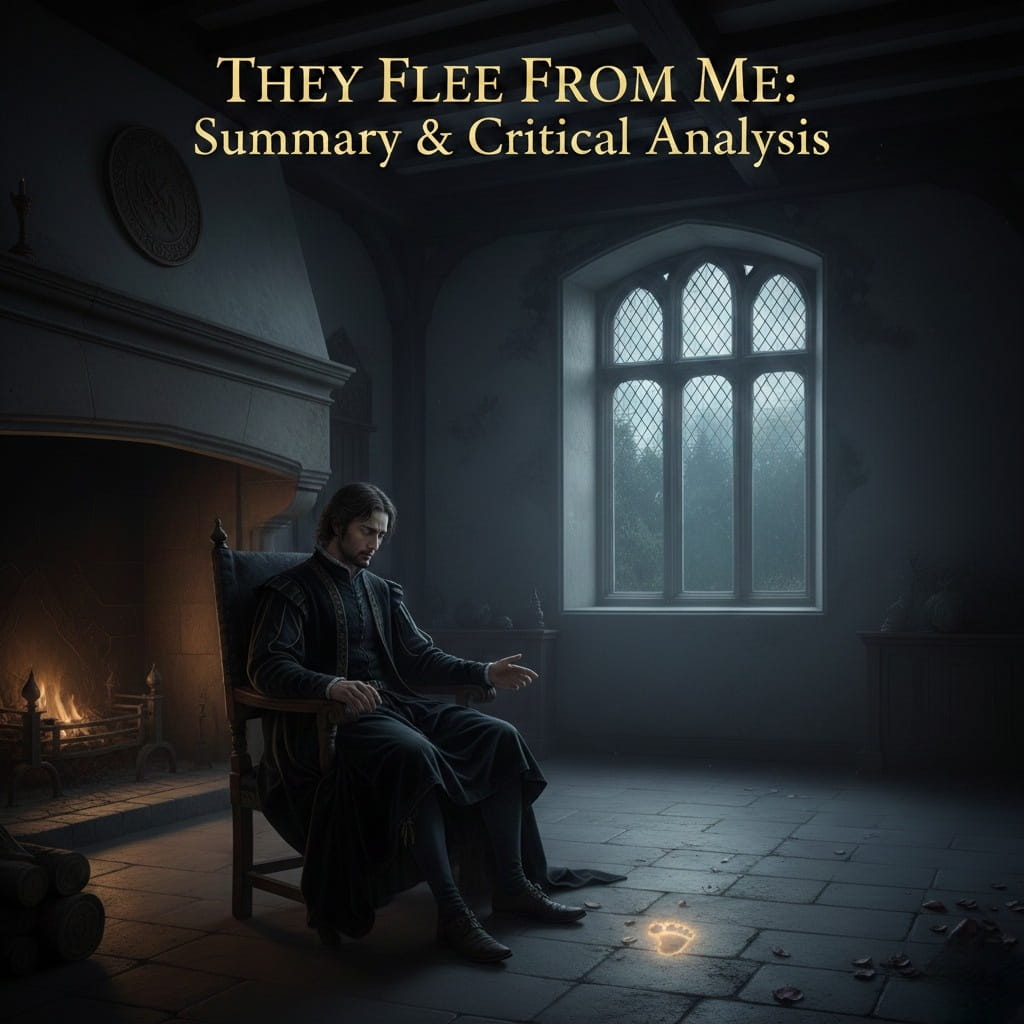
The speaker is trapped in a room filled with his old ghosts. For instance, he looks at the spot where she once stood. Furthermore, he hears the echo of her “sweet and very deadly snare.” Similarly, the chamber serves as a prison for his lonely and dark thoughts. Consequently, he cannot escape the reality of his own and sudden ruin. Moreover, every object reminds him of his lost and “special fortune.” Hence, the room is a site of both joy and very deep grief. Therefore, he lives in a cycle of memory and cold, hard reality. In addition, he watches the world move on outside his thick, stone walls. Subsequently, he finds a strange comfort in his own and quiet sorrow. Thus, the chamber is where his art and his pain meet. Indeed, he writes his verses in the silence of his lost life. Therefore, he preserves the “naked foot” in his ink and his mind. Furthermore, he remains the master of his own and dark, private space. Ultimately, the chamber holds the truth of They Flee From Me.
15. The Final Reckoning
The poem concludes with a sense of moral and intellectual closure. Furthermore, the speaker has shared his tale of betrayal and deep loss. Similarly, he has exposed the “newfangleness” of the royal and fickle court. Consequently, he stands as a witness to the cruelty of the “wild.” Moreover, he has asked the “bitter question” that haunts the lady’s path. Hence, the reckoning is a matter of the soul and the mind. Therefore, he finds peace in his own and very stoic kind of dignity. In addition, he leaves the “fashion of forsaking” to those who love the light. Subsequently, he embraces the darkness of his own and final, quiet room. Thus, the poem is a testament to the power of a broken heart. Indeed, Sir Thomas Wyatt created a masterpiece of raw and gritty truth. Therefore, the legacy of the speaker is his honesty and his deep art. Furthermore, he wins the hunt by refusing to chase the deer. Ultimately, the reckoning is a victory for the quiet and honest man.
Critical Appreciation
1. The Poetic Innovation
Sir Thomas Wyatt serves as a true pioneer of English verse. Initially, he breaks away from the simple songs of the past. Furthermore, he introduces a new depth of psychological and very real pain. This specific poem showcases his ability to move beyond mere imitation. Similarly, he adapts the European tradition to fit a rugged English pulse. Consequently, he creates a voice that feels both ancient and very modern. Moreover, his innovation lies in his rejection of a perfect rhythm. Hence, the “roughness” of the lines reflects a truly disturbed human mind. Therefore, the reader feels the weight of a lived and heavy history. In addition, he bridges the gap between the medieval and the Renaissance. Subsequently, he sets the stage for the great poets who follow him. Thus, his work marks a sharp and very bold turning point. Indeed, he gives the English language a new and serious mission. Therefore, the poem stands as a testament to his creative genius. Within this framework, They Flee From Me acts as a revolutionary text. Ultimately, Wyatt redefines the very soul of the lyric form today.
2. Mastery of Rhyme Royal
The poet chooses the stately seven-line stanza for this haunting work. Furthermore, the Rhyme Royal structure provides a perfect frame for his grief. Similarly, it allows for a narrative pace that feels like a tale. Accordingly, the $ABABBCC$ rhyme scheme creates a sense of steady, quiet tension. Consequently, the final couplet often hits with a sharp and bitter sting. Moreover, Wyatt uses the form to balance his emotion and his logic. Hence, the stanza becomes a container for his “special fortune” and loss. Therefore, he avoids the clutter of longer and more complex poetic forms. In addition, the rhythm follows the natural movement of a man’s speech. Subsequently, the poem gains a visceral and very immediate kind of power. Thus, he proves that structure can enhance the deepest of human truths. Indeed, his mastery of the stanza is a high artistic achievement. Therefore, the form serves the function of his dark and private tale. Ultimately, They Flee From Me remains a masterpiece of this specific style.
3. The Gritty Realism
Wyatt rejects the flowery and false language of the courtly tradition. For instance, he describes a “naked foot” and a “loose gown” clearly. Furthermore, he focuses on the physical reality of a cold and hard kiss. Similarly, the poem lacks the spiritual fluff of the Petrarchan style. Consequently, the reader feels the heat and the cold of the room. Moreover, this realism makes the betrayal feel much more personal and sharp. Hence, the speaker is a man of flesh and very deep bone. Therefore, his suffering is not a literary trope but a fact. In addition, the gritty tone sets him apart from his many peers. Subsequently, he anticipates the realism of the modern and very bold age. Thus, the poem serves as a raw document of human experience. Indeed, the honesty of the verse is its most striking and great quality. Therefore, he finds beauty in the dirt and the dark truth. Furthermore, the realism grounds the poem in a very tangible world. Ultimately, he speaks for the broken and the very weary heart.
4. Psychological Complexity
The speaker reveals a mind caught in a cycle of deep memory. Furthermore, he struggles with the gap between the past and the present. Similarly, he exhibits a complex mix of love, anger, and very cold irony. Consequently, the poem is a study of the human ego in ruin. Moreover, Wyatt captures the subtle shifts in a man’s private thoughts. Hence, the speaker is not a flat character but a deep person. Therefore, his reaction to the “wildness” shows a high level of self-awareness. In addition, he questions his own worth in the face of rejection. Subsequently, the poem explores the darker corners of the human and tired spirit. Thus, it moves beyond a simple complaint into a deep analysis. Indeed, the intellectual depth of the verse is quite rare and very bold. Therefore, he treats the heart as a logical and very difficult problem. Furthermore, he finds power in the middle of his own mental chaos. Ultimately, They Flee From Me is a triumph of poetic psychology.
5. Symbolism of Wildness
The animal imagery provides a sharp metaphor for human and social behavior. Initially, the visitors act like tame birds in a quiet, safe room. Furthermore, their shift to “wildness” represents the return to a predatory state. Similarly, the forest of the court is a place of constant hunt. Consequently, the “tame” state was only a brief and very false mask. Moreover, Wyatt uses nature to explain the cruelty of the royal rank. Hence, the wildness is the true condition of the fickle human heart. Therefore, the speaker remains the only one who values a steady soul. In addition, the symbols of the “net” and the “snare” add depth. Subsequently, the poem becomes a fable about the danger of the crown. Thus, the imagery bridges the gap between the wild and the civilized. Indeed, he shows that the court is more fierce than the woods. Therefore, the wildness is a sign of a society in moral decay. In this landscape, They Flee From Me highlights the savage reality of courtly life. Ultimately, the symbols capture the “fashion of forsaking” in a vivid way.
6. The Cynical Tone
A layer of sharp and cold irony covers every single and dark line. Furthermore, the speaker mocks the very world that has rejected him today. Similarly, his cynicism acts as a shield for his broken and tired heart. Consequently, he views the “newfangleness” of others with a very bitter eye. Moreover, he refuses to offer a “happy” or a false ending here. Hence, the tone is one of a man who knows the truth. Therefore, he finds a strange power in his own and deep misery. In addition, the cynicism targets the shallow nature of the Tudor court. Subsequently, he rejects the lies that the courtiers tell to each other. Thus, the poem feels honest because it refuses to be sweet. Indeed, Wyatt is the father of the cynical and very raw lyric. Therefore, his voice rings out with a clear and very harsh sound. Furthermore, he uses wit to expose the dark side of royal favor. Ultimately, the tone defines the lasting impact of his very bold work.
7. Conversational Pacing
The poem moves with the ease of a man talking to himself. For instance, the sentences vary in length and their private and soft intensity. Furthermore, the “broad waking” line breaks the flow to add a fact. Similarly, the rhythm mimics the natural pauses of a deep, human breath. Consequently, the reader feels like a witness to a private and dark confession. Moreover, Wyatt avoids the stiff and formal meter of his many peers. Hence, the pacing creates a sense of intimacy and very high stakes. Therefore, the poem is a speech delivered in a quiet and cold room. In addition, the conversational style makes the betrayal feel even more immediate. Subsequently, he brings the reader into the “chamber” of his own memories. Thus, the pacing supports the narrative and the emotional and deep themes. Indeed, he mastered the music of the plain and very direct English. Therefore, the poem is a model of effective and very sharp storytelling. Within this natural flow, They Flee From Me creates a bridge between the poet and the audience. Ultimately, the pacing ensures that every single word hits its target.
8. Use of Paradox
The speaker balances the ideas of tameness and wildness in a knot. Furthermore, he finds beauty in the “sweet snare” that once caught him. Similarly, the lady is both a gentle lover and a cold predator. Consequently, the poem thrives on these sharp and very difficult contradictions. Moreover, Wyatt explores the duality of the human and the royal spirit. Hence, the “tame wildness” is a brilliant and very deep mental puzzle. Therefore, he shows that love is a mix of joy and pain. In addition, the paradox reflects the unstable nature of the Tudor and royal court. Subsequently, the speaker accepts that his “fortune” was both a gift and a curse. Thus, the poem requires a careful and very deep mental effort from us. Indeed, the paradoxes elevate the work into a high-level and bold philosophy. Therefore, he proves that truth is never a simple or a plain thing. Furthermore, he uses the “loose gown” to hide a very tight and cold heart. In this intricate web of logic, They Flee From Me reveals the complicated nature of human desire. Ultimately, the paradox defines the complexity of his great and deep art.
9. Social Critique
Wyatt targets the rot at the heart of the royal and fickle court. Specifically, he exposes the “fashion of forsaking” as a social and cold crime. Furthermore, he shows how the pursuit of rank destroys every human bond. Similarly, the court rewards the fickle and punishes the loyal and steady. Consequently, the poem is a quiet protest against the absolute and royal power. Moreover, the speaker stands as a moral judge of a corrupt and wild world. Hence, his rejection is a sign of his own and very high integrity. Therefore, he reveals the high price of living near the Tudor crown. In addition, the “newfangleness” is a critique of a society in deep decay. Subsequently, he uses his own pain to tell a larger and very dark story. Thus, the poem is a mirror for the collective anxiety of the era. Indeed, he was a master of the hidden and the very political metaphor. Therefore, the critique remains relevant to any age of high and cold power. Ultimately, he speaks truth to the wild and the royal throne.
10. The Rhetorical End
The final question leaves the reader with a heavy and very cold burden. Furthermore, it shifts the focus from the speaker to the lady’s heart. Similarly, it demands a moral answer that the court cannot give today. Consequently, the poem does not end with a period but a hook. Moreover, the question is the ultimate weapon of the rejected and tired man. Hence, he forces the lady to face her own “fashion of forsaking.” Therefore, the rhetorical device creates a lasting and very deep impact on us. In addition, it shows the speaker’s intellectual and very stoic kind of power. Subsequently, the “bitter question” lingers long after the final and deep rhyme. Thus, the ending is a masterpiece of poetic and very sharp strategy. Indeed, he knows that silence is often the best and loudest answer. Therefore, he finds victory in his ability to ask the hard and raw truth. Furthermore, he leaves her to the judgment of the “wild” and new world. Through this masterful closing, They Flee From Me ensures the lady is held accountable in the court of public opinion. Ultimately, the ending defines the poem’s high and dark legacy.
11. Imagery of the Chamber
The private room serves as a site of both joy and ruin. For instance, it is where the “naked foot” once walked in peace. Furthermore, it now holds only the echo of a “sweet and deadly snare.” Similarly, the chamber represents the internal world of the speaker’s own mind. Consequently, the setting is both an intimate and a very cold prison. Moreover, Wyatt uses the space to highlight the shift from tame to wild. Hence, the room stays still while the world outside changes and runs. Therefore, the imagery creates a sense of claustrophobia and very deep grief. In addition, it contrasts the private truth with the public and cold lie. Subsequently, the chamber becomes a witness to the “special fortune” and its end. Thus, the setting is a key part of the poem’s dark and visceral mood. Indeed, he builds a world in a very small and quiet stone space. Therefore, the imagery grounds the poem in a very real and local place. Ultimately, the chamber holds the soul of They Flee From Me.
12. Emotional Restraint
The speaker avoids a loud or a messy display of his grief. Furthermore, he maintains a level of high and very stoic calm. Similarly, his pain is felt in the rugged meter and the irony. Consequently, the restraint makes the underlying sadness even more sharp and deep. Moreover, he refuses to beg for the return of his wild lovers. Hence, his dignity is his final and most powerful weapon today. Therefore, the poem is a study in the power of the held-back. In addition, Wyatt shows that silence can be a very loud scream. Subsequently, he channels his anger into a cold and very biting question. Thus, the emotion is controlled but it is never truly gone. Indeed, the restraint is a sign of high and royal training. Therefore, he finds a way to be vulnerable without being weak. Furthermore, he masters the art of the quiet and deep complaint. In this display of composure, They Flee From Me highlights the psychological strength of the narrator. Ultimately, the restraint is what makes the poem feel so very modern.
13. Influence on the Lyric
Wyatt’s work paved the way for the future of English poetry. Initially, he showed that the language could hold complex and deep thoughts. Furthermore, he introduced a grit that later poets would surely adopt. Similarly, his use of the bitter question became a literary standard. Consequently, we can see his shadow in the works of Donne. Moreover, he broke the ground for the Shakespearean and dark sonnet. Hence, he is the root of the modern and honest lyric. Therefore, the poem remains a vital part of the English spirit. In addition, his technical innovations are still studied in every single school. Subsequently, he proved that a man’s private life is a fit subject. Thus, he expanded the boundaries of what a poem could truly be. Indeed, he was a giant in a very dangerous and small world. Therefore, his legacy is found in every rugged and honest line. Ultimately, he changed the way we write and we feel today.
14. The Concept of Newfangleness
This Tudor term captures the heart of the poem’s dark theme. Furthermore, newfangleness is the force that drives the wildness of court. Similarly, it describes a restless and a very shallow craving. Consequently, the speaker is a victim of a society that values change. Moreover, Wyatt uses the word to target the fickleness of friends. Hence, the concept explains the sudden flight of those who left. Therefore, it is a critique of a world without a heart. In addition, the lady is a slave to this cold fashion. Subsequently, the speaker stands outside this circle of constant, hollow novelty. Thus, the poem is a meditation on the death of loyalty. Indeed, he finds the word to describe the royal rot. Therefore, newfangleness is the enemy of the special fortune and heart. Furthermore, he warns that this craze will eventually leave everyone alone. Within this critique, They Flee From Me serves as a warning against the instability of the court. Ultimately, the concept is the key to his bitter and dark tale.
15. The Eternal Truth
The poem reaches across the centuries to speak to us today. Furthermore, the themes of betrayal and forsaking are still very real. Similarly, the newfangleness of the court is seen in our world. Consequently, Wyatt’s voice remains fresh and his irony is still sharp. Moreover, he tells a story that every broken heart can understand. Hence, the poem is not a relic but a living truth. Therefore, we still face the bitter question in our private chambers. In addition, the struggle between tame and wild is never over. Subsequently, the technical beauty of the verse still moves the soul. Thus, They Flee From Me is a timeless and bold masterpiece. Indeed, Wyatt captured the essence of the human and royal condition. Therefore, his art survives the fall of kings and fashion. Furthermore, he wins the final reckoning through his honesty and wit. Ultimately, the poem remains a bright light in a dark forest.
Use of Poetic Devices
1. The Power of Metaphor
Wyatt employs the metaphor of the hunter and prey for ruin. Initially, the visitors appear as tame birds that sought his hand. Furthermore, this imagery shifts as they become wild and range away. Similarly, the transition represents the loss of royal and fickle favor. Consequently, the speaker views himself as a discarded and lonely master. Moreover, the metaphor extends to the sweet snare of the embrace. Hence, the tame state was merely a mask for predatory instinct. Therefore, the reader understands the court as a place of danger. In addition, the imagery of the naked foot contrasts with flight. Subsequently, the poem becomes a fable about the fragility of bonds. Thus, the metaphor captures the fashion of forsaking with sharp edges. Indeed, it serves as the backbone of his private, dark tale. In this context, They Flee From Me stands as a visceral hunt. Ultimately, the metaphor reveals the predatory heart of the Tudor elite.
2. The Impact of Imagery
The poet uses physical imagery to ground the poem in reality. For instance, he describes the naked foot walking softly in silence. Furthermore, the detail of the loose gown adds a bold reality. Similarly, the twenty kisses create a sense of tangible, warm intimacy. Accordingly, the imagery makes the current isolation feel even more cold. Consequently, the reader can see and feel the room’s atmosphere. Moreover, Wyatt avoids the abstract or flowery language of his peers. Hence, the rugged nature of the verse matches his raw life. Therefore, the imagery serves as a witness to his past joy. In addition, the wild forest stands in contrast to the chamber. Subsequently, visual details build a world of beauty and sudden betrayal. Thus, the imagery transforms a simple memory into a painful scene. Indeed, it hits the human soul with a very lasting sting. Consequently, They Flee From Me relies on these sharp, visual cues. Ultimately, the imagery defines the poem’s gritty and very honest legacy.
3. The Use of Irony
A layer of sharp and cold irony covers every single line. Furthermore, the speaker mocks the newfangleness that led to his ruin. Similarly, he calls his bond a special fortune during its end. Consequently, the poem is a study in gaps and dark truths. Moreover, the lady’s gentle nature is revealed to be a mask. Hence, the irony targets the shallow spirit of the royal court. Therefore, the speaker finds a stoic power in his own misery. In addition, he asks a bitter question that lacks an answer. Subsequently, the fashion of forsaking is presented as a cold trend. Thus, the irony shields his heart while he exposes royal rot. Indeed, Wyatt is a master of the double, hidden meaning. Therefore, the tone remains cynical because the truth is so harsh. Furthermore, They Flee From Me uses irony to challenge the court’s morality. Ultimately, the irony provides the poem with its deep, modern depth.
4. The Rugged Meter
Wyatt breaks the smooth flow to create a sense of stress. Furthermore, the rugged meter mimics the uneven breath of a man. Similarly, the rhythm avoids the melodic pulse of the Italian style. Consequently, the lines feel urgent and very immediate to the ear. Moreover, this technical choice reflects a disturbed and very tired mind. Hence, breaks in the meter emphasize the shock of waking up. Therefore, the poem sounds like a private and very honest talk. In addition, the Rhyme Royal structure provides a frame he tests. Subsequently, the roughness of the language adds to the raw realism. Thus, the meter is not a failure but a high tool. Indeed, it gives the English language a new and heavy pulse. Therefore, the rhythm captures the sudden nature of the royal hunt. Notably, They Flee From Me gains power through this irregular, human beat. Ultimately, the meter defines the unique and lasting music of verse.
5. The Rhetorical Question
The poem concludes with a masterpiece of strategy for the reader. Furthermore, the speaker asks what the lady deserves for her flight. Similarly, the question demands a moral reckoning that courts often hide. Consequently, the focus shifts from the speaker to the lady’s heart. Moreover, the device creates a sense of closure that is cold. Hence, he leaves the final judgment to the higher, dark stars. Therefore, the question lingers in the air like a heavy mist. In addition, it reveals the speaker’s high integrity and proud character. Subsequently, the bitter question serves as the final and most powerful weapon. Thus, it turns his silence into a clear call for truth. Indeed, the device ensures that the poem’s impact lasts very long. Therefore, he finds victory in his ability to ask facts. In closing, They Flee From Me ends on a note of defiance. Ultimately, the question marks the end of his long, deep pain.
To read Sir Thomas Wyatt as a Poet in Whoso List to Hunt, follow the link:
https://englishlitnotes.com/2026/02/10/sir-thomas-wyatt-whoso-list-to-hunt/
For the reading of Post-Confederation Poetry: Defining the Canadian Soul, follow the link: https://canlitstudies.blogspot.com/2026/02/post-confederation-era-in-canadian-poetry.html
To read The Quaternions by Anne Bradstreet: A Complete Guide, follow the link:
https://americanlit.englishlitnotes.com/the-quaternions-by-anne-bradstreet-four-of-fours-guide/
Discover more from Naeem Ullah Butt - Mr.Blogger
Subscribe to get the latest posts sent to your email.