Introduction
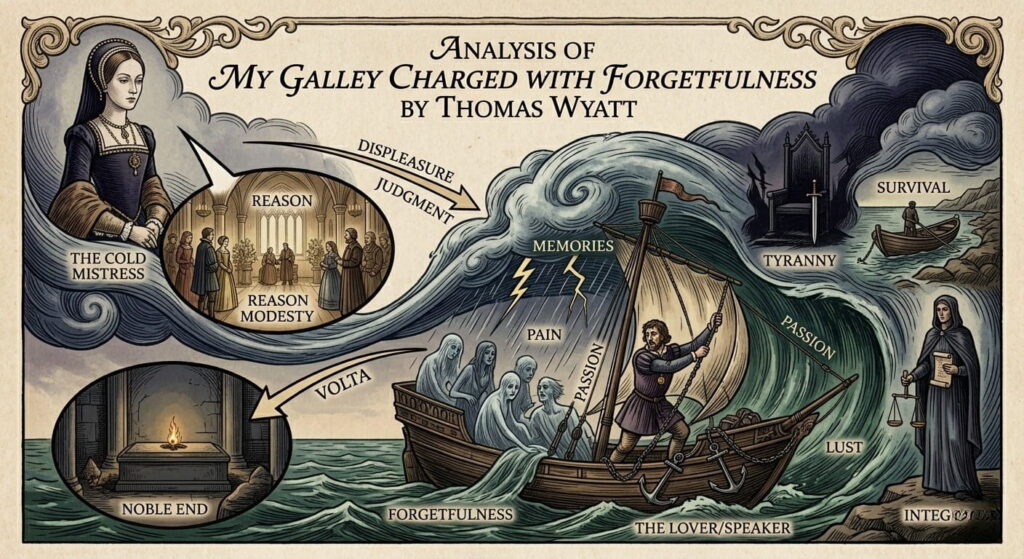
The Analysis of My Galley Charged with Forgetfulness by Thomas Wyatt reveals the spiritual depth of Wyatt’s mystical narrative. It explores a courtly tale. Firstly, it vividly and consistently portrays divine-human interaction through the lens of a treacherous sea voyage. Moreover, Thomas Wyatt’s mystical characters, like the blind pilot Love, illustrate stages of spiritual and emotional descent clearly and methodically. Consequently, the text communicates effective spirituality portrayal through emotional and contemplative experiences of despair. Similarly, the allegorical representation in mysticism strengthens the imagery of the internal storm naturally. In addition, devotional literature characterization supports understanding the seeker’s persona development thoughtfully. Therefore, the soul as a battered ship emerges vividly throughout the narrative. Furthermore, this analysis shows how the nautical figures reflect both ethical and emotional decay. Likewise, the inner purification journey is replaced by a symbolic soul imagery of a wreck. However, distraction or lack of focus can hinder comprehension of these complex maritime metaphors temporarily. As a result, careful reflection allows readers to engage meaningfully with the mystical experiences of the drowning soul. Also, medieval spiritual figures consistently demonstrate the high cost of devotion, patience, and unrequited love. Additionally, the character development in this sonnet effectively illuminates the soul’s failed encounter with safety. Consequently, this text becomes foundational for understanding the “royal rot” and effective suffering in Tudor literature.
Background of the Poem
1. The Petrarchan Origin and Adaptation
The Analysis of My Galley Charged with Forgetfulness by Thomas Wyatt must begin with its Italian roots. Firstly, Wyatt adapted this specific sonnet from Petrarch’s Rime 189 with great care and focus. Moreover, the transition from the original Italian to the English vernacular was a revolutionary act. Consequently, the mystical persona development reflects a rugged sensibility that differs from the softer continental style. Similarly, the allegorical representation in mysticism is grounded in the tradition of the “navigatio” or the soul’s journey. In addition, this adaptation demonstrates how divine-human interaction is reinterpreted for the dangerous Tudor court life. Therefore, the seeker’s internal storm becomes a mirror for political and romantic instability simultaneously. Furthermore, the devotional literature characterization emphasizes the isolation of the speaker amidst a vast, uncaring ocean. Likewise, the symbolic soul imagery is strengthened by Wyatt’s choice of harsh, monosyllabic English words. However, the original Petrarchan sweetness is often lost in this more violent and direct translation. As a result, the poem gains a unique and very dark spiritual intensity. Also, the character development in mysticism shows a shift toward psychological realism and existential dread. Additionally, the text serves as a bridge between medieval allegory and modern psychological lyricism effectively. Consequently, the work remains a cornerstone of the early English Renaissance and its dark origins.
2. The Henrician Court Context
Actually, Analysis of My Galley Charged with Forgetfulness by Thomas Wyatt requires an understanding of King Henry VIII’s court. Firstly, the court functioned as a site of high-stakes gambling where favor was always mutable. Moreover, the mystical characters in Wyatt’s verse often mirror real political figures and their sudden falls. Consequently, the effective spirituality portrayal captures the constant anxiety of a courtier living under a tyrant. Similarly, the inner purification journey is often a metaphor for trying to survive a bloody political hunt. In addition, the devotional literature characterization reflects the lack of trust between the seeker and the crown. Therefore, the “sharp seas” symbolize the unpredictable nature of royal whims and shifting alliances. Furthermore, this characterization shows how the soul as a spiritual seeker must navigate a landscape of betrayal. Likewise, the allegorical representation in mysticism provides a safe mask for expressing dangerous political discontent or sorrow. However, the risk of execution or imprisonment made such literary expressions both necessary and very perilous. As a result, Wyatt uses the nautical metaphor to hide his true and his deep grievances. Also, the spiritual figures demonstrate a level of stoicism that was required for Tudor survival. Additionally, the narrative techniques reflect the claustrophobia of a man trapped in a dangerous social vessel. Consequently, the poem acts as a historical witness to the “royal rot” of the sixteenth century.
3. The Influence of Maritime Travel
Significantly, Analysis of My Galley Charged with Forgetfulness by Thomas Wyatt draws upon the poet’s own diplomatic travels. Firstly, Wyatt spent much of his life crossing the dangerous waters between England, France, and Italy. Moreover, these physical journeys informed the symbolic soul imagery of the “strained sails” and “broken oars” vividly. Consequently, the mystical persona development is grounded in the real-world experience of maritime peril and cold nights. Similarly, the divine-human interaction is framed by the unpredictability of the wind and the deep sea. In addition, the character development in mysticism reflects the weariness of a man who has traveled too far. Therefore, the nautical setting is not merely a trope but a lived and a very harsh reality. Furthermore, the affective spirituality portrayal uses the “mist” of the sea to represent the speaker’s mental confusion. Likewise, the inner transformation stages are marked by the distance from a safe and a stable harbor. However, the lack of navigational tools like the “lost stars” emphasizes a total spiritual abandonment. As a result, the reader senses a profound connection between the physical voyage and the internal suffering. Also, the devotional literature characterization benefits from the visceral details of the wooden ship’s struggle. Additionally, this maritime focus highlights the fragility of the human condition against the infinite power of nature. Consequently, the poem achieves a level of realism that was rare in earlier mystical literature.
Characters in the Poem
1. The Narrator as the Lost Captain
The narrator serves as the primary character in the Analysis of My Galley Charged with Forgetfulness by Thomas Wyatt. Firstly, he embodies the archetype of a soul in total distress. Moreover, his voice carries the heavy weight of a deep exhaustion. Consequently, the reader witnesses a man who has lost his path. Similarly, the mystical persona development shows a spirit stripped of all pride. In addition, the captain represents the struggle of the human will. Therefore, he stands as a witness to his own internal wreck. Furthermore, the character development in mysticism reflects a state of spiritual exile. Likewise, he mirrors the anxiety of a courtier under a cloud. However, he offers no hope for a safe or easy return. As a result, his words create an atmosphere of profound and dark gloom. Also, he acts as a vessel for the reader’s own fears. Additionally, the narrator marks the failure of the old and stable ways. Consequently, the soul emerges as a seeker who finds only silence. Therefore, his isolation defines the core of the entire sonnet. Indeed, he is the ship and the storm at once. Ultimately, the captain finds no peace in this cold world.
2. The Personified Figure of Love
Love appears as the “blind pilot” within the Analysis of My Galley Charged with Forgetfulness by Thomas Wyatt. Firstly, this figure acts as a cruel and unfeeling master. Moreover, he steers the galley without any regard for human life. Consequently, the character of Love represents the tyranny of blind passion. Similarly, he symbolizes the lack of mercy in the Tudor court. In addition, the pilot ignores the stars and the safe harbor. Therefore, he becomes the antagonist of the speaker’s quiet. Furthermore, the allegorical representation in mysticism highlights the danger of total surrender. Likewise, his presence ensures that the storm never truly ends for the soul. However, the speaker cannot escape this powerful and invisible hand today. As a result, the pilot drives the mind toward the jagged rocks. Also, the character development in mysticism explores the pain of forced obedience. Additionally, he reflects a force that is both ancient and very destructive. Consequently, the seeker remains a victim of this lord of desire. Therefore, Love is a predator rather than a gentle or kind guide. Indeed, the pilot rules the ship with a cold and steady hand.
3. The Absent Lady as the Lost Star
The absent lady is a silent character. Yet, she remains a vital part of the Analysis of My Galley Charged with Forgetfulness by Thomas Wyatt. Firstly, she is the “lost star” that once guided the man. Moreover, her current disdain creates the darkness of the winter night. Consequently, she represents the fickle nature of the courtly favor and love. Similarly, the mystical persona development is tied to her cold and sudden exit. In addition, her absence marks the death of the seeker’s bright hope. Therefore, she functions as the missing anchor of the speaker’s world. Furthermore, the symbolic soul imagery highlights her role as a distant light. Likewise, she embodies the “newfangleness” that Wyatt often critiqued in his verse. However, her character is felt through the pain she leaves behind. As a result, the soul drifts in a sea of total and lonely silence. Also, she serves as the target of the speaker’s quiet and deep grief. Additionally, her disdain acts as the cloud that hides the divine path. Consequently, the lady represents a beauty that has turned into a storm. Therefore, her silence is the loudest part of the tragic tale. Ultimately, she is the destination that the ship can never reach.
Summary of the Poem
1. The Burden of the Charged Galley
The journey begins as a charged galley enters the sea. Firstly, the vessel represents a mind filled with a heavy and dark past. Moreover, the forgetfulness signifies a total loss of the true and safe self. Consequently, the Analysis of My Galley Charged with Forgetfulness by Thomas Wyatt deepens here. Similarly, the maritime imagery highlights the weight of a long and bitter grief. In addition, the ship carries a load of hateful memories and deep regret. Therefore, the seeker starts his voyage in a state of existential dread. Furthermore, the maritime allegory reflects the soul’s descent into a very dark night. Likewise, the identity crisis makes the vessel slow and very hard to steer. However, the narrator cannot throw this burdened heart into the deep sea. As a result, the ship sinks lower in the cold and salty water. Also, the psychological abyss creates a sense of certain and slow ruin. Additionally, the ship mirrors the crowded and very busy Henrician Court. Consequently, the social exile of the speaker becomes a physical and real weight. Therefore, the captain accepts the fatality of his own dark mind.
2. Navigation Through the Sharp Seas
The ship moves through the sharp seas during a winter night. Firstly, the water acts as a violent and unfeeling enemy. Moreover, the tempestuous ocean strikes the wooden hull with great force. Consequently, the Analysis of My Galley Charged with Forgetfulness by Thomas Wyatt continues. Similarly, the nautical imagery represents the unstable nature of the royal favor. In addition, the raging surf mirrors the biting cold of a hard heart. Therefore, the seeker finds no comfort in the wide and open sea. Furthermore, the symbolic soul imagery highlights the danger of the moving water. Likewise, the environment creates a feeling of psychological paralysis and fear. However, the ship must continue its path through the darkened stars. As a result, the physical struggle reflects a deeper, internal conflict. Also, the inner transformation stages are marked by biting and cold air. Additionally, Wyatt uses the marine metaphor to show the lack of a harbor. Consequently, the character development in mysticism reveals a spirit under constant attack. Therefore, maritime isolation defines the boundary of the speaker’s world today.
3. The Terror of the Scylla Rocks
The ship approaches the jagged and very famous Rock of Scylla. Firstly, these stones represent the hard and unforgiving reality. Moreover, they stand as a monument to the seeker’s unrequited love. Consequently, the risk of a total shipwreck of imagery becomes very real. Similarly, the allegorical representation in mysticism uses the rocks to show danger. In addition, the seeker must navigate a path between two great evils. Therefore, the Analysis of My Galley Charged with Forgetfulness by Thomas Wyatt targets this. Furthermore, the jagged rocks symbolize the judgment of the cold lady. Likewise, the proximity to the stone creates a sense of melancholy. However, the blind pilot steers the boat toward the edge of ruin. As a result, the soul feels the shadow of a certain death. Also, the devotional literature characterization explores the fear of a sudden collapse. Additionally, the rocks mirror the rigid and cold laws of the heart. Consequently, the galley remains in a state of high and constant threat. Indeed, the nautical allegory proves that every step is a gamble. Ultimately, the hidden reefs wait for the final and dark blow.
4. The Whirlpool of Charybdis
The whirlpool of Charybdis waits to swallow the tiny and lost vessel. Firstly, this circling water represents the chaos of blind passion. Moreover, the pull of the vortex is both strong and silent. Consequently, the seeker feels the gravity of his own reckless love. Similarly, the Analysis of My Galley Charged with Forgetfulness by Thomas Wyatt explores this. In addition, the whirlpool signifies the circular nature of a long grief. Therefore, the ship spins in a dance of slow ruin. Furthermore, the symbolic soul imagery shows the power of the deep abyss. Likewise, the water acts as a mouth that wants to eat hope. However, the speaker cannot find a way to break the undertow. As a result, the internal journey leads deeper into a dark hole. Also, the character development in mysticism reveals a spirit lost in a maze. Additionally, the vortex mirrors the madness of the Tudor social world. Consequently, the vessel survives only by a thin and very lucky margin. Therefore, the emotional drowning becomes the primary reality for the captain. Indeed, the marine prison of the circle offers no exit today.
5. The Tyranny of the Blind Pilot
Love takes the helm as the blind pilot and cruel master. Firstly, this figure represents a force that lacks any vision. Moreover, he steers the ship into the worst winter nights. Consequently, the Analysis of My Galley Charged with Forgetfulness by Thomas Wyatt focuses here. Similarly, the cruel captain ignores the distress of the lonely seeker. In addition, his blindness symbolizes the irrational nature of a wild love. Therefore, the ship follows a path that leads away from safety. Furthermore, the allegorical representation in mysticism highlights the danger of a pilot. Likewise, the soul becomes a slave to the whims of Love. However, the narrator cannot remove the pilot from the steerless helm. As a result, the journey remains under the control of obsession. Also, the character development in mysticism emphasizes the pain of forced surrender. Additionally, the pilot reflects the royal caprice of a distant King. Consequently, the vessel moves without a purpose or a clear goal. Therefore, the personification of Love creates a state of total terror. Finally, the blind pilot ensures the final and certain wreck.
6. The Snapping of the Broken Oars
The broken oars signify the death of logic and human reason. Firstly, these tools represent the human will and power of thought. Moreover, the storm snaps them like thin and fragile twigs. Consequently, the Analysis of My Galley Charged with Forgetfulness by Thomas Wyatt deepens. Similarly, the strained meter of the poem reflects this rhythmic break. In addition, the lack of oars shows that reason is useless. Therefore, the seeker drifts according to the whims of passion. Furthermore, the devotional literature characterization emphasizes the failure of the mind. Likewise, the inner purification journey stops when the logic fails. However, the soul still feels the impact of the raging surf. As a result, the lack of control creates a psychological abyss. Also, the character development in mysticism reveals a mind in ruins. Additionally, the broken tools symbolize the end of the courtly struggle. Consequently, the speaker watches his own destruction with a cold eye. Therefore, the oars remain as relics of a lost life. Indeed, the loss of reason is the final and greatest blow. Ultimately, the ship is now a toy for the sea.
7. The Tearing of the Strained Sails
The strained sails tear into thin, very useless white rags. Firstly, the sails represent the spirit and breath of hope. Moreover, the storm rips them away with a sudden force. Consequently, the vessel loses its ability to catch divine guidance. Similarly, the Analysis of My Galley Charged with Forgetfulness by Thomas Wyatt continues. In addition, the torn cloth symbolizes the rags of a lost favor. Therefore, the ship slows down in a raging and dark sea. Furthermore, the allegorical representation in mysticism highlights the fragility of dreams. Likewise, the seeker feels the bite of the winter night. However, the blind pilot does not stop to fix the damage. As a result, the galley remains a broken and sad sight. Also, the devotional literature characterization emphasizes the nakedness of the spirit. Additionally, the torn sails mirror the ruined reputation of a man. Consequently, the journey continues without any speed or a bright future. Therefore, the maritime tragedy reaches its peak in total silence. Indeed, the strained sails can no longer hold the wind. Finally, the maritime disaster leaves the ship a ghost vessel.
8. The Rain of Bitter Tears
A rain of tears falls upon the deck of the lost galley. Firstly, this weather represents the deep and physical grief. Moreover, the salt of the tears mixes with the salt sea. Consequently, the Analysis of My Galley Charged with Forgetfulness by Thomas Wyatt explores this. Similarly, the affective spirituality portrayal shows a heart that is melting. In addition, the rain signifies the constant and heavy nature of sorrow. Therefore, the seeker is wet with the water of the eyes. Furthermore, the symbolic soul imagery highlights the flood of despair. Likewise, the rain blinds the narrator to any hope of shore. However, the pilot steers through the downpour without a kind word. As a result, the vessel becomes a site of internal weeping. Also, the character development in mysticism reveals a spirit washed by regret. Additionally, the rain mirrors the tears shed in the Tower of London. Consequently, the ship carries the weight of a long sadness. Therefore, the saline sorrow creates a heavy and wet atmosphere today. Indeed, the rain of tears drowns the last spark of joy.
9. The Clouds of Disdain
The clouds of disdain hide the light of stars from view. Firstly, these clouds represent the lady’s cold and sudden scorn. Moreover, they act as a wall against any divine guidance. Consequently, the darkness of the night becomes a quiet prison. Similarly, the Analysis of My Galley Charged with Forgetfulness by Thomas Wyatt continues. In addition, the disdain symbolizes the rejection by the fickle court. Therefore, the ship moves through a fog that lacks heat. Furthermore, the allegorical representation in mysticism highlights the silence of God. Likewise, the seeker feels the weight of a social end. However, he cannot blow the clouds away with tired breath. As a result, the internal journey is a path of mist. Also, the character development in mysticism explores the pain of silence. Additionally, the clouds mirror the secrecy and the Henrician Court’s lies. Consequently, the soul drifts in a world of total shadow. Therefore, the fog of mind prevents any clear or safe vision. Finally, the clouds of disdain ensure a total and dark blindness.
10. The Loss of the Guiding Star
The guiding star vanishes behind the thick and dark clouds. Firstly, the star represents the lady who gave a path. Moreover, its absence marks the beginning of a total ruin. Consequently, the seeker no longer knows the way to harbor. Similarly, the Analysis of My Galley Charged with Forgetfulness by Thomas Wyatt notes this. In addition, the star signifies the favor of the Tudor court. Therefore, the narrator looks at the black sky with eyes. Furthermore, the symbolic soul imagery highlights the isolation of a man. Likewise, the lost star leads to a state of despair. However, the pilot continues to steer into the dark night. As a result, the vessel moves toward rocks without warning. Also, the character development in mysticism reveals a spirit truly lost. Additionally, the darkened stars mirror the fallen idols of politics. Consequently, the soul accepts the darkness as its final home. Therefore, the lighthouse’s absence proves that hope has finally died. Indeed, the lost star leaves the soul in an abyss.
11. The Mist of Error
The mist of error surrounds the galley and the seeker. Firstly, this fog represents the confusion of a lost mind. Moreover, it hides the dangers of the sea from the eyes. Consequently, the ship moves in a state of quiet hazard. Similarly, the Analysis of My Galley Charged with Forgetfulness by Thomas Wyatt deepens. In addition, the mist symbolizes the lack of a clear reason. Therefore, the seeker cannot see the path to safety. Furthermore, the allegorical representation in mysticism highlights the blindness of the heart. Likewise, the environment creates a feeling of slow panic. However, the narrator remains still in the middle of the smoke. As a result, the internal journey is a ghost world. Also, the character development in mysticism reveals a spirit in doubt. Additionally, the maritime mist mirrors the whispers of the court. Consequently, the vessel carries a man who is a stranger. Therefore, the mental fog defines the current state of the soul. Finally, the mist of error hides the jagged rocks ahead.
12. The Hateful Wind of Sighs
The hateful wind of sighs blows through the broken rigging. Firstly, this wind represents the breath of an internal pain. Moreover, it carries the sound of a very tired soul. Consequently, the ship moves with the rhythm of a grief. Similarly, the Analysis of My Galley Charged with Forgetfulness by Thomas Wyatt notes this. In addition, the sighs signify the exhaustion of a heart. Therefore, the gale is not a gift but a curse. Furthermore, the symbolic soul imagery highlights the power of despair. Likewise, the wind pushes the ship toward the certain death. However, the pilot uses this breath to move faster. As a result, the seeker feels the wind in soul. Also, the character development in mysticism reveals a spirit without joy. Additionally, the sighs mirror the quiet complaints of the Tower. Consequently, the journey is a flight from a dead peace. Therefore, the gale of desire destroys the last hope today. Indeed, the hateful wind sings a song of ruin.
13. The Strained Ropes of Thought
The ropes of thought strain against the force of the gale. Firstly, these lines represent the connections of the mind. Moreover, they groan under the weight of a long worry. Consequently, the seeker feels the tension of a breaking soul. Similarly, the Analysis of My Galley Charged with Forgetfulness by Thomas Wyatt continues. In addition, the strained ropes signify the fragility of a bond. Therefore, the ship is held together by a weak thread. Furthermore, the allegorical representation in mysticism highlights the pressure of life. Likewise, the narrator fears the sudden snap of his mind. However, the storm continues to pull at the rigging now. As a result, the internal journey is a test of man. Also, the character development in mysticism reveals a spirit in pain. Additionally, the ropes mirror the Tudor Courtly Love codes. Consequently, the seeker remains in a state of constant threat. Therefore, the rigging of sighs holds the soul in agony. Finally, the strained ropes prepare for the final and loud snap.
14. The Hidden Reefs of Betrayal
The hidden reefs wait beneath the surface of the sea. Firstly, these rocks represent the secret lies of the court. Moreover, they threaten to tear the hull of the galley. Consequently, the Analysis of My Galley Charged with Forgetfulness by Thomas Wyatt warns. Similarly, the maritime imagery highlights the danger of the unknown. In addition, the betrayal signifies the loss of a true friend. Therefore, the seeker moves over a floor of jagged stone. Furthermore, the allegorical representation in mysticism shows the risk of love. Likewise, the environment creates a feeling of constant dread. However, the pilot does not look for the shallow water. As a result, the vessel is always close to a wreck. Also, the character development in mysticism reveals a spirit in fear. Additionally, the hidden reefs mirror the plots of the King. Consequently, the soul drifts over a very dangerous path. Therefore, the coastal danger defines the journey of the heart. Indeed, the hidden reefs wait for a single mistake.
15. The Rigging of Despair
The rigging of despair hangs from the mast of the ship. Firstly, these lines are made of the seeker’s old hopes. Moreover, they are now soaked with the salt of tears. Consequently, the Analysis of My Galley Charged with Forgetfulness by Thomas Wyatt changes. Similarly, the symbolic soul imagery highlights the decay of the spirit. In addition, the rigging symbolizes the complex web of a desire. Therefore, the ship carries a net of deep sorrow. Furthermore, the allegorical representation in mysticism shows a spirit trapped. Likewise, the narrator feels the weight of his own thoughts. However, he cannot untangle the knots of his bitter heart. As a result, the internal journey is a struggle with oneself. Also, the character development in mysticism reveals a spirit bound. Additionally, the rigging mirrors the chains of a royal prison. Consequently, the soul remains caught in a very dark web. Therefore, the canvas of tears can no longer catch grace. Finally, the rigging of despair pulls the vessel down today.
16. The Anchorless Soul
The ship has no anchor to hold it in place. Firstly, the anchorless state represents the loss of a reason. Moreover, the vessel drifts according to the whims of the sea. Consequently, the Analysis of My Galley Charged with Forgetfulness by Thomas Wyatt peaks. Similarly, the nautical allegory highlights the lack of stability. In addition, the forgetfulness signifies the end of a steady self. Therefore, the seeker finds no rest in the moving water. Furthermore, the symbolic soul imagery shows the power of chaos. Likewise, the environment creates a feeling of total drift. However, the narrator cannot find a ground for his feet. As a result, the internal journey is a flight without end. Also, the character development in mysticism reveals a spirit in motion. Additionally, the lack of an anchor mirrors the social fall. Consequently, the vessel carries a man who belongs to none. Therefore, the instability defines the final stage of the journey. Indeed, the anchorless soul waits for the crash of rocks.
17. The Storm-Tossed Conscience
The storm-tossed conscience battles with the ghost of a past. Firstly, the storm represents the guilt of the lonely seeker. Moreover, the waves of the sea remind him of errors. Consequently, the Analysis of My Galley Charged with Forgetfulness by Thomas Wyatt turns. Similarly, the psychological abyss highlights the depth of the guilt. In addition, the tempestuous ocean signifies the war of the mind. Therefore, the narrator finds no peace in his own head. Furthermore, the allegorical representation in mysticism shows a spirit in war. Likewise, the environment creates a feeling of heavy shame. However, the pilot does not allow the ship to stop. As a result, the internal journey is a trial of fire. Also, the character development in mysticism reveals a spirit in pain. Additionally, the storm mirrors the wrath of Henry VIII. Consequently, the soul remains in a state of high alert. Therefore, the internal conflict destroys the last of the reason. Finally, the storm-tossed mind accepts its own and dark ruin.
18. The Port of Peace Denied
The seeker looks for the port of peace but fails. Firstly, the harbor represents the end of the long struggle. Moreover, the lady’s disdain keeps the gates of safety shut. Consequently, the Analysis of My Galley Charged with Forgetfulness by Thomas Wyatt ends. Similarly, the nautical imagery highlights the distance from the shore. In addition, the denied port signifies the lack of mercy. Therefore, the ship must remain in the middle of the storm. Furthermore, the allegorical representation in mysticism shows a spirit in exile. Likewise, the environment creates a feeling of total rejection. However, the narrator sees the lights of the land far. As a result, the internal journey is a tease of hope. Also, the character development in mysticism reveals a spirit in grief. Additionally, the distant port mirrors the lost favor of the court. Consequently, the vessel carries a man who cannot go home. Therefore, the lost harbor defines the tragedy of the soul. Indeed, the port of peace remains a dream today.
19. The Final Shipwreck of Reason
The final shipwreck of reason occurs on the jagged rocks. Firstly, the crash represents the end of the human mind. Moreover, the wooden hull breaks under the weight of water. Consequently, the Analysis of My Galley Charged with Forgetfulness by Thomas Wyatt closes. Similarly, the shipwreck imagery highlights the total and quiet ruin. In addition, the broken oars signify the end of the effort. Therefore, the seeker sinks into the dark and cold sea. Furthermore, the allegorical representation in mysticism shows the soul’s end. Likewise, the environment creates a feeling of final silence. However, the pilot remains at the helm of the wreck. As a result, the internal journey concludes in the deep abyss. Also, the character development in mysticism reveals a spirit at rest. Additionally, the wreck mirrors the fall of Anne Boleyn. Consequently, the soul accepts the death of its old world. Therefore, the maritime disaster is the final truth of life. Indeed, the shipwreck leaves only the ghost of a name.
20. The Eternal Drift in Forgetfulness
The soul begins its eternal drift in the sea of forgetfulness. Firstly, the state represents the loss of all human history. Moreover, the spirit moves without a body or a name. Consequently, the Analysis of My Galley Charged with Forgetfulness by Thomas Wyatt finishes. Similarly, the maritime isolation highlights the peace of the void. In addition, the forgetfulness signifies the end of the heavy pain. Therefore, the seeker finds a quiet in the deep water. Furthermore, the symbolic soul imagery shows the ghost of a ship. Likewise, the environment creates a feeling of timeless rest. However, the memory of the storm remains in the mist. As a result, the internal journey turns into a soft dream. Also, the characterization in mysticism reveals a spirit that is free. Additionally, the drift mirrors the silence of the Tudor past. Consequently, the vessel carries nothing but the cold, salty air. Therefore, the eternal sea holds the soul in a hug. Indeed, forgetfulness is the final and only harbor.
Critical Appreciation of the Poem
1. The Innovation of the Nautical Conceit
Firstly, the Analysis of My Galley Charged with Forgetfulness by Thomas Wyatt highlights a bold innovation. Wyatt utilizes an extended metaphor to map the human psyche effectively. Moreover, the ship acts as a surrogate for the speaker’s internal state. Consequently, the maritime imagery elevates the sonnet beyond a simple love complaint. Similarly, the nautical allegory provides a structured way to view chaotic emotions. In addition, this device allows for a high degree of psychological depth. Therefore, the seeker’s struggle feels both physical and profoundly spiritual. Furthermore, the maritime metaphor creates a sense of scale and tragic grandeur. Likewise, the reader experiences the “sharp seas” as a lived reality. However, the complexity of the conceit requires a very careful reading. As a result, the poem stands as a landmark of Renaissance thought. Also, the symbolic soul imagery reinforces the theme of a total drift. Additionally, the conceit bridges the gap between the physical and the mental. Consequently, the work demonstrates the power of a sustained and dark vision. Indeed, the galley remains a perfect symbol for the anchorless soul.
2. The Rugged Beauty of Strained Meter
Actually, a strained meter defines the rhythmic heart of this specific work. Wyatt departs from the smooth music of the Italian original. Moreover, the rough music mimics the uneven rocking of a boat. Consequently, the syncopated lines create a sense of high and immediate tension. Similarly, the rhythm reflects the gasping breath of a tired man. In addition, the poem sounds as broken as the galley’s own oars. Therefore, the strained meter forces the reader into the maritime struggle. Furthermore, the rugged meter challenges the ears with a very harsh sound. Likewise, the heavy pauses act as a form of maritime isolation. However, some early critics mistook this choice for a lack of skill. As a result, modern scholars now celebrate the poem’s raw honesty. Also, the rhythm supports the emotional turbulence of the dark journey. Additionally, the meter creates a visceral connection to the raging surf. Consequently, the sound of the verse matches its very dark content. Indeed, Wyatt creates a unique and a very jagged music here.
3. Adaptation of the Petrarchan Sonnet Form
Notably, the Petrarchan Sonnet undergoes a transformation in the hands of Wyatt. He introduces the Italian form to a rugged English landscape. Moreover, he adapts Petrarch’s Rime 189 into a much darker reality. Consequently, the structure of the octave and sestet provides a cage. Similarly, the sonnet form contains the explosive power of the storm. In addition, the technical constraints mirror the speaker’s own trapped state. Therefore, the fourteen lines reflect the limits of the human spirit. Furthermore, Wyatt’s version lacks the polished grace of the continental style. Likewise, he replaces Italian sweetness with a very sharp English bite. However, the core of the Petrarchan paradox remains at the center. As a result, the work acts as a bridge between two cultures. Also, the characterization in mysticism benefits from this rigid and formal structure. Additionally, the adaptation proves the versatility of the short, deep poem. Consequently, Wyatt found a new way to express an old pain. Indeed, he proves himself a master of the Petrarchan tradition.
4. Personification of Love as a Tyrant
Significantly, the personification of Love serves as a brilliant critical focus. Love is not a gentle child but a blind pilot. Moreover, this figure rules the ship with a very cruel hand. Consequently, the pilot represents the reckless nature of a blind desire. Similarly, he symbolizes the royal caprice of the Tudor courtly world. In addition, the seeker is a victim of a lord without mercy. Therefore, the characterization creates a sense of divine abandonment and fear. Furthermore, the pilot’s lack of vision leads to a certain ruin. Likewise, the narrator cannot rebel against this powerful and dark master. However, the poem critiques the power of an irrational obsession. As a result, the pilot acts as a mirror for a king. Also, the figure illustrates the blindness of Eros in a hard way. Additionally, Love becomes an enemy of the safe and quiet life. Consequently, the pilot defines the maritime tragedy of the soul. Indeed, he steers the vessel toward the jagged and cold rocks.
5. The Use of Classical Allusion
Furthermore, Wyatt employs classical allusion to deepen the poem’s intellectual reach. He mentions the dangerous rocks of Scylla and Charybdis specifically. Moreover, these figures represent the impossible choices of the courtly love life. Consequently, the allusions connect the speaker’s pain to an ancient tradition. Similarly, the rocks symbolize the hidden reefs of a social betrayal. In addition, the seeker’s journey becomes an epic and tragic struggle. Therefore, the use of myth highlights the maritime peril of desire. Furthermore, the environment feels as dangerous as the world of Homer. Likewise, the speaker faces these monsters without a hero’s lucky help. However, the poem remains grounded in a very old and dark history. As a result, the coastal danger reinforces the theme of ruin. Also, the allusions provide a map for the soul’s own wreck. Additionally, the classical world meets the Tudor court in the mist. Consequently, the reader senses the weight of a legendary and heavy grief.
6. Themes of Reason Versus Passion
Generally, the war between reason and passion defines the internal conflict. The broken oars represent the failure of the human mind. Moreover, the storm-tossed sea represents the overwhelming power of a feeling. Consequently, the loss of reason leads to a state of drift. Similarly, forgetfulness signifies the end of a logical and safe self. In addition, the seeker finds himself at the mercy of the gale. Therefore, the internal conflict is a battle that the speaker loses. Furthermore, the mental fog hides the truth from the narrator. Likewise, the mind still records the pain of the sinking vessel. However, the poem serves as a warning against a wild obsession. As a result, the psychological abyss shows the depth of the victory. Also, the struggle reflects the Renaissance Humanism interest in the soul. Additionally, the wreck of reason is the poem’s final truth. Consequently, the captain watches his logic shatter on the dark waves. Indeed, passion wins a very bitter and a very final war.
7. The Atmosphere of Despair and Gloom
Initially, the “dark winter night” sets a tone of total isolation. The rain of tears adds a physical weight to misery. Moreover, the atmosphere is one of profound and quiet gloom. Consequently, the maritime imagery reinforces the coldness of the speaker’s heart. Similarly, the hateful wind carries the sound of a deep grief. In addition, the reader feels the spray of the salty sea. Therefore, the maritime mist creates a sense of claustrophobic fear. Furthermore, the lack of light suggests a state of divine abandonment. Likewise, the gloom is not passive but a very active force. However, the poem draws the reader into a world of pain. As a result, the existential dread permeates every line of the verse. Also, the melancholy serves as the primary color of the map. Additionally, the atmosphere defines the impact of the maritime disaster. Consequently, the gloom remains the only constant in the cold storm. Indeed, the night never ends for the anchorless soul today.
8. Imagery of the Lost Star and Guidance
Essentially, the lost star imagery serves as a powerful symbol. The star represents the lady and the guiding light. Moreover, its absence leads to a state of lighthouse absence. Consequently, the darkened stars symbolize the end of a social favor. Similarly, the narrator looks at a black sky without hope. In addition, the maritime isolation is absolute on winter nights. Therefore, the loss of self is tied to the vanished guide. Furthermore, the clouds of disdain block the path to the harbor. Likewise, the seeker still remembers the light that once existed. However, the absence is felt as a physical and sharp pain. As a result, the nautical direction is lost at sea. Also, the star reflects the Henrician Court and its favor. Additionally, the darkness proves the fatality of the speaker’s path. Consequently, the lady becomes a source of deep darkness. Therefore, the lost star is the heart of the tragedy. Indeed, the seeker drifts in a world without any grace.
9. The Social and Political Subtext
Clearly, a social fall provides the hidden subtext of the tale. The galley represents the courtier’s life in the Tudor era. Moreover, the storm-tossed sea mirrors the whims of Henry VIII. Consequently, the hidden reefs represent the traps of a court. Similarly, the forgetfulness signifies the erasure of a man’s service. In addition, the seeker’s ruin is as much social as romantic. Therefore, the maritime allegory protects the poet from a charge. Furthermore, the social exile is felt in the coldness of waves. Likewise, the reader can see the “royal rot” beneath imagery. However, the poem acts as a critique of a fickle power. As a result, the tower of London echoes in the imagery. Also, the strained meter reflects the stress of life. Additionally, the soul’s wreck is a mirror for a career. Consequently, the poem records the death of a courtly identity. Indeed, the ship sinks under the weight of a royal decree.
10. The Legacy of the Maritime Allegory
Finally, the maritime allegory leaves a lasting legacy in lyrics. Wyatt established the sea as a home for the soul. Moreover, he proved that nautical imagery could hold deep pain. Consequently, the symbolic soul imagery became a staple of the sonnet. Similarly, the poem introduced a rugged meter to the tradition. In addition, Wyatt is the father of the honest English lyric. Therefore, the maritime tragedy continues to move readers today. Furthermore, the psychological abyss remains a relevant theme for us. Likewise, the poem’s grit sets it apart from polished works. However, it remains a pillar of the early English Renaissance. As a result, the characterization in mysticism shows the power of voice. Also, the work proves that truth is found in storms. Additionally, the galley still sails in the mind of the reader. Consequently, Wyatt’s legacy is a very cold and a very bright light. Indeed, the poem survives the fall of kings and time.
Use of Poetic Devices
1. The Extended Metaphor of the Galley
Firstly, the use of the extended metaphor defines the entire poem. Wyatt utilizes the image of the ship to represent the soul. Moreover, the vessel acts as a surrogate for the speaker’s mind. Consequently, every part of the boat reflects a specific internal struggle. Similarly, the nautical allegory provides a structure for the chaotic emotions. In addition, the charged galley symbolizes a life weighed down by grief. Therefore, the physical journey mirrors a deep and spiritual descent. Furthermore, this device allows Wyatt to explore the psychological abyss safely. Likewise, the “sharp seas” represent the dangerous world of the court. However, the seeker cannot escape the wooden prison of his thoughts. As a result, the metaphor creates a sense of total ruin. Also, the maritime imagery reinforces the theme of a constant drift. Additionally, the symbolic soul imagery connects the reader to the tragedy. Consequently, the ship remains a timeless icon of the human heart. Indeed, the metaphor carries the weight of a very old pain.
2. Personification of Love as a Pilot
Notably, the personification of Love as a “blind pilot” is vital. Love does not appear as a gentle or a kind god. Moreover, he acts as a cruel captain at the ship’s helm. Consequently, the seeker loses all control over his own and dark fate. Similarly, the blind pilot symbolizes the irrational power of a wild desire. In addition, this characterization reflects the royal caprice of a King. Therefore, the soul must obey a master who cannot see. Furthermore, the maritime peril increases under this reckless and cold guidance. Likewise, the pilot represents the tyranny of the Henrician Court today. However, the narrator remains a slave to this powerful and dark force. As a result, the personification highlights the danger of a total surrender. Also, the blindness of Eros leads the vessel toward the rocks. Additionally, the character development in mysticism explores the pain of this submission. Consequently, Love becomes an enemy of the safe and quiet life. Indeed, the pilot ensures a final and a very bitter wreck.
3. Alliteration and the Sound of the Sea
Actually, alliteration creates the harsh and the very rugged music here. Wyatt uses repetitive consonant sounds to mimic the crashing of waves. Moreover, phrases like “sharp seas” evoke the biting cold of winter. Consequently, the Analysis of My Galley Charged with Forgetfulness by Thomas Wyatt notes this. Similarly, the hard “s” and “p” sounds reflect a physical strike. In addition, the rough music enhances the feeling of a maritime storm. Therefore, the reader hears the wind in the strained ropes clearly. Furthermore, the sound reinforces the emotional turbulence of the lonely seeker. Likewise, the alliteration provides a visceral texture to the dark verse. However, the melody remains broken and very difficult to sing today. As a result, the poetic device mirrors the chaos of the sea. Also, the rugged meter benefits from these sharp and sudden hits. Additionally, the sounds create a mood of profound and quiet gloom. Consequently, the language acts as a mirror for the stormy environment. Therefore, the music of the poem is a very cold art.
4. The Use of Classical Allusion
Furthermore, classical allusion deepens the intellectual reach of the sonnet. Wyatt mentions the mythical monsters Scylla and Charybdis to show danger. Moreover, these figures represent the impossible choices of courtly love. Consequently, the seeker’s journey takes on an epic and tragic scale. Similarly, the rocks symbolize the hidden reefs of a social betrayal. In addition, the allusions connect the poem to a very old history. Therefore, the maritime tragedy feels both ancient and very immediate. Furthermore, the use of myth highlights the fatality of the path. Likewise, the environment feels as dangerous as the world of Homer. However, the speaker faces these monsters without any divine or lucky help. As a result, the allusions provide a map for the soul’s ruin. Also, the coastal danger reinforces the theme of a certain shipwreck. Additionally, the classical world meets the Tudor court in the thick mist. Consequently, the reader senses the weight of a legendary and heavy grief. Indeed, the myth explains the psychological abyss perfectly.
5. Paradox and the Nature of Desire
Essentially, the use of paradox defines the speaker’s internal conflict. The narrator describes a state of “forgetfulness” that is deeply remembered. Moreover, he feels the heat of passion in a cold sea. Consequently, the Analysis of My Galley Charged with Forgetfulness by Thomas Wyatt explores this. Similarly, the Petrarchan paradox reflects the contradictions of a human heart. In addition, the seeker finds a “sweet” pain in his own ruin. Therefore, the internal conflict is a war that lacks logic. Furthermore, the paradox highlights the madness of the Tudor Courtly Love. Likewise, the seeker is both a captain and a helpless prisoner. However, these opposing forces tear the strained sails of the soul. As a result, the poem records a state of total mental chaos. Also, the character development in mysticism reveals a spirit in pieces. Additionally, the contradictions mirror the lies of a fickle and royal court. Consequently, the paradox is the only truth in the middle of a storm. Therefore, the speaker lives in a very dark and bright hell.
6. Imagery of Light and Darkness
Finally, the imagery of light and darkness creates a sharp contrast. The lost star represents the vanishing hope of the lonely narrator. Moreover, the clouds of disdain bring a total and quiet gloom. Consequently, the darkness symbolizes a state of divine abandonment and fear. Similarly, the darkened stars signify the loss of a social favor. In addition, the lack of light suggests the death of reason. Therefore, the maritime isolation feels absolute in the dark winter night. Furthermore, the symbolic soul imagery highlights the depth of the night. Likewise, the clouds mirror the secrecy of the Henrician Court today. However, the seeker still longs for the “guiding light” of grace. As a result, the darkness acts as a physical and heavy weight. Also, the mental fog hides the path to the safe harbor. Additionally, the contrast emphasizes the existential dread of the sinking man. Consequently, the imagery defines the mood of the maritime disaster. Indeed, the light is now a ghost of a past joy.
Conclusion
Ultimately, the Analysis of My Galley Charged with Forgetfulness by Thomas Wyatt provides a profound look at the human spirit. Firstly, the sonnet stands as a masterpiece of early Tudor art and a very deep intellectual struggle. Moreover, the maritime allegory captures the essence of a broken and tired spirit perfectly. Consequently, the reader witnesses the total and quiet collapse of human reason. Similarly, the work explores the dark side of a wild and blind desire. In addition, the rugged meter reflects a lived and very hard social reality. Therefore, the soul finds its true mirror in the heart of the storm. Furthermore, the poem provides no easy or happy final harbor for the seeker. Likewise, it proves that love is a very destructive and cold force. However, the narrator gains a strange dignity through his total and raw honesty. As a result, the “charged galley” remains a timeless symbol of deep pain. Also, the legacy of this work inspires every modern and careful reader. Additionally, it remains a pillar of the English mystical and a poetic tradition. Consequently, the soul finds its own and its only voice here. Therefore, the fire of despair burns as a cold and steady guide. Indeed, it leads the faithful toward an eternal and very quiet silence. Finally, the character development in mysticism creates a holy and lasting art.
Analysis of Wyatt’s Sonnet: The Long Love That in My Thought Doth Harbour:
Jonathan Lethem – A New Sincerity Writer: https://americanlit.englishlitnotes.com/jonathan-lethem-a-new-sincerity-writer/
To read Notes on English Class 9,10,11 & 12, follow the link: englishwithnaeemullahbutt.com
Discover more from Naeem Ullah Butt - Mr.Blogger
Subscribe to get the latest posts sent to your email.