Introduction to the Petrarchan Paradox
I Find No Peace, and All My War Is Done by Thomas Wyatt is a landmark of English Renaissance poetry. This poem stands out in the literary world for its significance. Sir Thomas Wyatt translated this specific work from Petrarch’s Rima 134 during the early sixteenth century. Initially, the poem introduces the concept of the “lover’s paradox” to the royal court of King Henry VIII. Furthermore, it explores the intense emotional contradictions that define unrequited romantic desire. Therefore, the speaker describes a state of internal warfare where peace remains entirely elusive. Meanwhile, the text reflects the transition from medieval courtly love to the more individualistic Renaissance style. Because Wyatt lived a life of political danger, his voice carries a unique grit. In addition, the short and punchy sentences emphasize the psychological weight of the burden. Consequently, the reader feels the immediate tension between cold fear and burning passion. Nevertheless, the poem maintains a high level of academic grace and structural integrity. Truly, this work provided the foundation for the future of the English sonnet. Subsequently, poets like Shakespeare adopted these same themes of internal conflict. Surely, Wyatt’s innovation changed the landscape of British literature forever. Ultimately, the sonnet captures the timeless struggle of the human heart.
The Historical and Literary Background
The background of I Find No Peace, and All My War Is Done by Thomas Wyatt has its roots in the Italian Renaissance. It is deeply rooted in this era. During his diplomatic travels, Wyatt discovered the works of Francesco Petrarch in Italy. Initially, English poetry lacked the emotional depth found in these continental models. Furthermore, Wyatt sought to modernize the English language by adapting these sophisticated Italian structures. Therefore, he chose Rima 134 because its themes of contradiction resonated with his own life. Meanwhile, the poem reflects the influence of Humanism on the Tudor intellectual circle. Because Wyatt was a pioneer, he had to invent new ways to express complex feelings. In addition, the translation process allowed him to experiment with early iambic pentameter. Consequently, the poem serves as a bridge between two great cultural eras. Nevertheless, he added a uniquely English ruggedness to the smooth Italian lines. Specifically, he transformed Petrarch’s spiritual longing into a more physical and urgent distress. Thus, the background reveals a deliberate effort to elevate British art. Truly, the poem represents the birth of a new literary tradition in England.
Secondly, the personal life of the author is crucial. It provides essential context for I Find No Peace, and All My War Is Done by Thomas Wyatt. Wyatt served as a high-ranking courtier and diplomat under the volatile King Henry VIII. Initially, his proximity to power brought both great wealth and extreme danger. Furthermore, many scholars believe his poems reflect his rumored affair with Anne Boleyn. Therefore, the “war” mentioned in the title likely refers to actual political survival. Meanwhile, the constant fear of execution created a sense of internal instability. Because the court was a place of masks, the poet found truth in paradox. In addition, his multiple imprisonments in the Tower of London influenced his dark tone. Consequently, the speaker’s lack of liberty mirrors Wyatt’s own historical experiences. Nevertheless, he masked these political realities behind the conventions of courtly love. Specifically, the lady’s rejection serves as a metaphor for the King’s fickle favor. Thus, the background is inseparable from the anxieties of Tudor politics. Surely, the poem captures the exhaustion of a man living on the edge.
Finally, the literary background of I Find No Peace, and All My War Is Done by Thomas Wyatt involves the evolution of the sonnet. Before Wyatt, the English lyric was often simple and repetitive in its themes. Initially, the introduction of the Petrarchan “conceit” allowed for much greater intellectual depth. Furthermore, the use of oxymoron became a standard tool for exploring the human psyche. Therefore, Wyatt’s work paved the way for the Elizabethan “Golden Age” of poetry. Meanwhile, the poem circulated in manuscripts like the Egerton MS before being printed. Because it appeared in Tottel’s Miscellany, it reached a wide and influential audience. In addition, the poem’s focus on the “self” anticipated the modern lyrical voice. Consequently, it remains a primary text for students of the Renaissance period. Nevertheless, its technical flaws reflect the experimental nature of early Tudor verse. Specifically, the rugged meter shows a poet struggling with a new language. Thus, the background highlights a moment of profound creative transformation. Truly, Wyatt’s legacy is defined by this brave and innovative spirit.
Characters in the Sonnet
The Paradoxical Speaker
The first character in the poem is the Paradoxical Speaker. He embodies the total exhaustion of a lover caught in a cycle of pain. Initially, he experiences both freezing cold and burning heat at once. Furthermore, he feels like a prisoner who also possesses the entire world. Therefore, he represents the divided nature of the human soul under stress. Meanwhile, his voice is direct, rugged, and full of honest desperation. Because he cannot find a middle ground, he suffers in extremes. In addition, his loyalty to his own pain defines his integrity. Consequently, he becomes a symbol of the “unhappy lover” archetype. Nevertheless, he finds a strange sense of identity in his suffering. Specifically, he uses contradiction to explain his reality. Thus, I Find No Peace, and All My War Is Done by Thomas Wyatt focuses on his internal state. Subsequently, the reader sees a man who is both alive and dead. Likewise, he prefers his misery over a false sense of peace. Truly, the speaker captures the spirit of the Renaissance individual. Ultimately, he proves that love is a form of beautiful madness.
The Distant and Cruel Mistress
The second character is the Distant and Cruel Mistress. Although she does not speak, her presence dictates every line of the work. Initially, she acts as the jailer who keeps the speaker in chains. Furthermore, she refuses to offer either life or death to her servant. Therefore, she represents the absolute power of the beloved over the lover. Meanwhile, her silence serves as a cold weapon of emotional torture. Because she is unattainable, she drives the speaker to his limits. In addition, she embodies the strict moral and social codes of the court. Consequently, her rejection creates the “war” that the speaker mentions. Nevertheless, she remains the sole object of his intense and burning desire. Specifically, her lack of mercy defines the tone of the sonnet. Thus, I Find No Peace, and All My War Is Done by Thomas Wyatt explores her influence. Subsequently, she proves that a lady can rule a man’s soul completely. Likewise, her character reflects the divine and untouchable Laura of Petrarch. Truly, she stands as the unmoving center of his chaotic universe.
Summary of the Poem
1. The State of Internal Conflict
Initially, the speaker confesses that he cannot find any mental rest. Furthermore, he declares that his external battles have finally ended. Therefore, his struggle has moved entirely into his private mind. Meanwhile, he remains caught between hope and deep despair. Because he is a lover, he experiences life as a war. Consequently, he describes a world without any balance. Thus, the poem establishes a tone of high tension. Specifically, the opening lines set the stage for the paradoxes. Subsequently, the reader understands the gravity of his burden. Likewise, his spirit feels the weight of unrequited love. Truly, he finds himself in a very difficult position. Moreover, his words reflect a soul in transition. Similarly, he searches for a peace that does not exist. Surely, his honesty is both refreshing and quite painful. Ultimately, the war continues within his own heart.
2. The Paradox of Fire and Ice
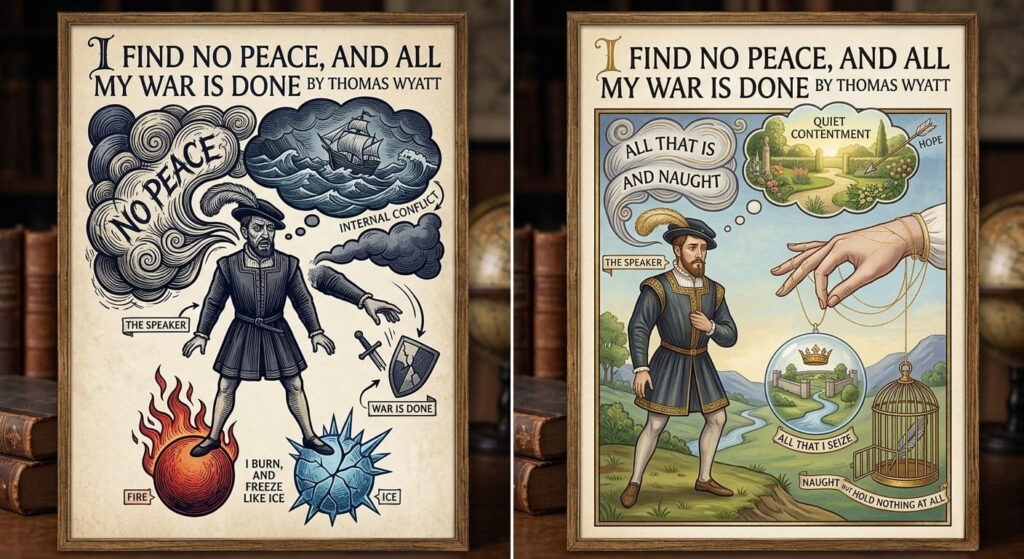
The speaker notes that he both burns and freezes. Initially, this sensory contradiction represents his intense emotional state. Furthermore, he feels the heat of passion and the cold of rejection. Therefore, he cannot find a comfortable temperature for his soul. Meanwhile, this oxymoron highlights the irrational nature of love. Because desire is chaotic, it defies all logic. In addition, the contrast creates a vivid mental image. Consequently, the reader feels the physical toll of his feelings. Thus, I Find No Peace, and All My War Is Done by Thomas Wyatt uses this imagery. Subsequently, the poet explores the limits of human endurance. Likewise, the fire of lust meets the ice of indifference. Truly, this internal weather defines his daily existence. Moreover, he remains a victim of these opposing forces. Similarly, his body mirrors the agony of his mind. Surely, this paradox is the core of the work.
3. Flying Without Wings
The lover claims that he flies above the wind. Initially, he feels a sense of spiritual height. Furthermore, he admits that he cannot even arise from the ground. Therefore, he is simultaneously elevated and completely trapped. Meanwhile, this imagery suggests a lack of control over his path. Because he loves, he feels both powerful and very weak. In addition, the metaphor captures the dizzying nature of romance. Consequently, he remains suspended in a state of flux. Thus, he exists in a place between heaven and earth. Specifically, his dreams lift him while reality holds him down. Subsequently, the reader sees the frustration of his condition. Likewise, he reaches for the stars while stuck in the mud. Truly, this duality defines the Renaissance experience. Moreover, he cannot escape the gravity of his mistress. Similarly, his wings are made of fleeting hope. Ultimately, he stays exactly where he started.
4. Owning Nothing and Everything
The speaker asserts that he grasps the whole world. Initially, his love gives him a sense of universal connection. Furthermore, he realizes that he actually holds nothing at all. Therefore, his riches are entirely mental and quite hollow. Meanwhile, this paradox reflects the poverty of unrequited desire. Because he has no lady, he has no true wealth. In addition, the contrast emphasizes his profound sense of loss. Consequently, he remains a beggar in a kingdom of dreams. Thus, he explores the illusion of romantic possession. Specifically, his heart is full, but his hands are empty. Subsequently, the reader feels the irony of his situation. Likewise, he owns the pain but not the person. Truly, this state of being is very difficult to bear. Moreover, he finds himself lost in his own abundance. Similarly, his world is vast yet completely lonely. Surely, he is a king without a throne.
5. The Prison of Love
The mistress locks the speaker in a private jail. Initially, he describes her heart as a fortress of ice. Furthermore, she does not shut the door or let him go. Therefore, he is a prisoner who is technically free. Meanwhile, this lack of boundaries creates a psychological trap. Because he cannot leave, he remains her loyal servant. In addition, the prison represents his obsession with her beauty. Consequently, he finds himself unable to breathe or move. Thus, I Find No Peace, and All My War Is Done by Thomas Wyatt notes this captivity. Specifically, the lady’s lack of mercy is his cell. Subsequently, the reader sees the cruelty of her silence. Likewise, he is bound by his own devotion to her. Truly, this cage is made of his own thoughts. Moreover, he accepts his chains with a heavy heart. Similarly, he wanders in a maze of his own making. Ultimately, he is a slave to a silent master.
6. Life Without Death
The lover complains that he cannot live or die. Initially, he exists in a state of emotional limbo. Furthermore, his mistress refuses to end his long suffering. Therefore, he remains caught in a perpetual “dying” state. Meanwhile, this paradox highlights the stamina of human pain. Because he loves, he cannot find a final exit. In addition, the lady holds the keys to his mortality. Consequently, he suffers without the hope of a conclusion. Thus, he describes a life that feels like a ghost. Specifically, his spirit is broken but his pulse continues. Subsequently, the reader understands the exhaustion of his soul. Likewise, he prays for an end that never arrives. Truly, this condition is the ultimate form of torture. Moreover, he finds himself tired of the sun. Similarly, his heart beats only to feel the ache. Surely, he is trapped in a loop of misery. Ultimately, he is a man without a finish line.
7. Vision Without Eyes
The speaker claims that he sees without eyes. Initially, his internal vision is focused on the beloved. Furthermore, he cries out without having a voice. Therefore, his communication is entirely silent and quite deep. Meanwhile, this imagery suggests a profound psychological depth. Because his senses are overwhelmed, they cease to function. In addition, the paradox emphasizes the power of the imagination. Consequently, he remains a witness to his own destruction. Thus, he observes his heart breaking in the mirror. Specifically, he knows his fate without needing any proof. Subsequently, the reader feels the intensity of his focus. Likewise, he watches the lady from across the room. Truly, his silence speaks louder than any loud words. Moreover, he finds truth in the darkness of his soul. Similarly, his mind creates images that his eyes cannot. Surely, he is a seer in a blind world.
8. Desiring Destruction
The lover admits that he desires his own fall. Initially, he seeks an end to his chaotic feelings. Furthermore, he asks for health while he loves his disease. Therefore, he is a man who actively hates himself. Meanwhile, this self-loathing is a classic mark of desire. Because he cannot have the lady, he wants nothing. In addition, the contradiction reveals his mental instability. Consequently, he remains an enemy to his own peace. Thus, I Find No Peace, and All My War Is Done by Thomas Wyatt illustrates this. Specifically, his passion is a poison that he drinks. Subsequently, the reader sees the tragedy of his choice. Likewise, he finds a strange comfort in his ruin. Truly, he is the architect of his own sorrow. Moreover, he refuses to seek a real cure. Similarly, his heart is a battlefield of self-harm. Surely, he is a victim of his own mind. Ultimately, he chooses the pain every single day.
9. Loving Another More Than Self
The speaker states that he loves another person dearly. Initially, this devotion is the cause of all trouble. Furthermore, he admits that he hates himself because of it. Therefore, his identity is entirely lost in the mistress. Meanwhile, this self-sacrifice is the ultimate courtly ideal. Because he is a servant, he has no ego. In addition, the contrast highlights his lack of balance. Consequently, he remains a shadow of a real man. Thus, he explores the cost of absolute romantic loyalty. Specifically, his worth is defined by her cold opinion. Subsequently, the reader feels the weight of his submission. Likewise, he gives everything and receives nothing back. Truly, this relationship is entirely one-sided and cruel. Moreover, he finds himself vanishing in her bright light. Similarly, his heart belongs to a person who hides. Surely, he is a martyr for a lost cause. Ultimately, he is a stranger to his own soul.
10. Feeding on Sorrow
The lover notes that he feeds upon his tears. Initially, his sadness provides the only food for thought. Furthermore, he laughs while he experiences great pain. Therefore, his emotions are completely inverted and quite strange. Meanwhile, this imagery suggests a dark and heavy irony. Because he is miserable, he finds a bitter food. In addition, the paradox emphasizes his total emotional isolation. Consequently, he remains a guest at a sad feast. Thus, he describes a life of constant internal sorrow. Specifically, his joy is a mask for his weeping. Subsequently, the reader sees the toll of his mask. Likewise, he finds nourishment in the salt of grief. Truly, this diet is not healthy for the mind. Moreover, he refuses the sweetness of a normal life. Similarly, his heart is a kitchen of deep despair. Surely, he is a man who loves his chains. Ultimately, he dines alone in the dark.
11. Displeasure with Life and Death
The speaker feels great displeasure with his life. Initially, he finds no joy in the daily world. Furthermore, he admits that death is also very hateful. Therefore, he has no place to rest his head. Meanwhile, this dual rejection highlights his extreme displacement. Because he is a lover, he fits nowhere. In addition, the contradiction reveals his total lack of hope. Consequently, he remains a wanderer in a gray land. Thus, I Find No Peace, and All My War Is Done by Thomas Wyatt notes this. Specifically, his soul is tired of both states. Subsequently, the reader understands his complete and total exhaustion. Likewise, he searches for a third option that exists. Truly, this condition is a mark of high tragedy. Moreover, he finds himself bored with his own pulse. Similarly, his mind is a desert of dry thoughts. Surely, he is a man without a home. Ultimately, he waits for a change that never comes.
12. The Cause of All Trouble
The lover identifies the mistress as his primary source. Initially, she is the reason for his many tears. Furthermore, she is the cause of his sudden laughter. Therefore, she controls the weather of his internal world. Meanwhile, this absolute power is both beautiful and scary. Because she is the master, he is the tool. In addition, the lady represents the center of his life. Consequently, he remains a satellite orbiting her bright sun. Thus, he explores the nature of emotional and deep dependency. Specifically, his happiness depends on her fleeting and cold mood. Subsequently, the reader feels the danger of his position. Likewise, he is a ship guided by a star. Truly, this devotion is both noble and very foolish. Moreover, he finds himself trapped in her heavy gravity. Similarly, his heart is a mirror of her face. Surely, she is the queen of his fate. Ultimately, he is a man in her hand.
13. The Final Resolution of Pain
The speaker concludes that his state is a choice. Initially, he accepts his pain as a badge. Furthermore, he realizes that he cannot escape his mistress. Therefore, he decides to live within the many paradoxes. Meanwhile, this acceptance brings a strange kind of peace. Because he knows the rules, he can play. In addition, the resolution emphasizes his deep and steady loyalty. Consequently, he remains a hero of his own story. Thus, he finds a way to exist in war. Specifically, his integrity is found in his quiet suffering. Subsequently, the reader sees the strength of his spirit. Likewise, he finds a noble end in his defeat. Truly, this conclusion provides a sense of final closure. Moreover, he finds himself at peace with the chaos. Similarly, his heart is a steady flame in the wind. Surely, he is a man of great character. Ultimately, he stands tall in his heavy chains.
14. Structural Closing and Moral Tone
The poem ends with a sense of definitive closure. Initially, the final lines summarize the lover’s long plight. Furthermore, the tone remains somber, academic, and very direct. Therefore, the reader understands the total cost of desire. Meanwhile, the structure reinforces the themes of high tension. Because Wyatt was a master, he used form. In addition, the finality suggests a lack of easy escape. Consequently, the lover stays in his paradoxical and dark world. Thus, I Find No Peace, and All My War Is Done by Thomas Wyatt concludes. Specifically, the moral is found in the steady endurance. Subsequently, the audience reflects on the nature of human love. Likewise, the sonnet leaves a lasting and deep impression. Truly, it is a work of high artistic merit. Moreover, it captures the spirit of the Tudor age. Similarly, it speaks to the modern heart with truth. Surely, the end is a new beginning for readers.
15. The Legacy of the Paradox
The poem leaves a lasting legacy in English letters. Initially, it established the paradox as a key tool. Furthermore, it paved the way for the great Elizabethans. Therefore, Wyatt remains a giant of the Renaissance period. Meanwhile, the work continues to inspire students and scholars. Because it is honest, it stays relevant and fresh. In addition, the technical innovations provided a new framework. Consequently, we see the influence in every modern lyric. Thus, the summary highlights the importance of this specific work. Specifically, the “lover’s war” is a universal human theme. Subsequently, the reader appreciates the poet’s brave and new voice. Likewise, the sonnet stands as a pillar of art. Truly, Wyatt’s genius is found in these tight lines. Moreover, he transformed the English language with his pen. Similarly, his heart continues to beat in his verses. Surely, he is a master of the human condition. Ultimately, the war is done, but the art lives.
Critical Appreciation of the Poem
1. The Mastery of the Oxymoron
Analysis of the poem reveals a brilliant use of oxymoron. Initially, Wyatt uses opposing words to create a sharp tension. Furthermore, phrases like “burn and freeze” illustrate the internal war. Therefore, the language mirrors the chaotic state of the lover. Meanwhile, this technique adds a layer of intellectual depth. Because the soul is divided, the words must be. In addition, the contrast forces the reader to think deeply. Consequently, the poem moves beyond simple romantic and sweet clichés. Thus, I Find No Peace, and All My War Is Done by Thomas Wyatt is unique. Specifically, the poet explores the limits of the English language. Subsequently, the reader sees the toll of unrequited and cold love. Likewise, the oxymoron captures the spirit of the early Renaissance. Truly, it is a tool for expressing the impossible. Ultimately, Wyatt proves that logic fails when the heart speaks.
2. The Evolution of the Petrarchan Sonnet
The poem marks a major step in literary evolution. Initially, Wyatt took an Italian form and made it English. Furthermore, he adjusted the meter to fit the native tongue. Therefore, he created a new vessel for complex and dark emotions. Meanwhile, the structure maintains the classic fourteen-line and tight frame. Because he was an innovator, he changed the rhythm. In addition, the translation process allowed for creative and new growth. Consequently, the English sonnet was born from this specific effort. Thus, we appreciate the technical skill of the royal diplomat. Specifically, he introduced the concept of the final rhyming couplet. Subsequently, the form became a staple of British high art. Likewise, the poem reflects the influence of the Italian Renaissance. Truly, Wyatt was a bridge between two great cultural eras. Moreover, his work paved the way for William Shakespeare. Ultimately, he transformed the landscape of English lyrical and deep poetry.
3. The Theme of Psychological Imprisonment
A primary theme of the work is psychological and deep captivity. Initially, the speaker describes himself as a prisoner of desire. Furthermore, the mistress holds the keys to his mental cage. Therefore, he cannot escape his own thoughts and heavy feelings. Meanwhile, this imprisonment is voluntary and quite noble in nature. Because he is loyal, he refuses to leave her. In addition, the metaphor highlights the power of an obsession. Consequently, the lover stays in a world of limited walls. Thus, I Find No Peace, and All My War Is Done by Thomas Wyatt explores this. Specifically, the jail is made of his own internal devotion. Subsequently, the reader feels the weight of his mental chains. Likewise, the theme reflects the rigid codes of the court. Truly, it is a study of the human mind under stress. Moreover, the poem captures the exhaustion of a loyal servant. Similarly, the prison is a place of growth and pain. Ultimately, he finds his identity within these very dark walls.
4. The Influence of Tudor Courtly Politics
The poem is inseparable from the world of Tudor politics. Initially, the court of Henry VIII was a dangerous place. Furthermore, loyalty was a matter of life or sudden death. Therefore, the “war” in the poem has a political layer. Meanwhile, the speaker’s insecurity mirrors the life of a courtier. Because the King was fickle, no one felt safe. In addition, the mistress represents the absolute power of the throne. Consequently, the lover’s paradox reflects the courtier’s daily and hard struggle. Thus, we appreciate the poem as a historical and social document. Specifically, Wyatt used romance to mask his political and deep anxieties. Subsequently, the reader sees the toll of living near a tyrant. Likewise, the diction reflects the grit of a man in danger. Truly, the sonnet is a product of its stressful time. Moreover, it shows the emotional cost of royal and high service. Similarly, the “war” is both internal and very external. Ultimately, Wyatt speaks for an entire generation of stressed men.
5. The Directness of the Rugged Style
Wyatt’s style is famous for being rugged, direct, and forceful. Initially, he avoids the sweet and soft language of Italy. Furthermore, he uses strong verbs to drive the emotional action. Therefore, the poem has a sense of raw and real energy. Meanwhile, the short sentences create an atmosphere of high urgency. Because his life was hard, his voice is very honest. In addition, the lack of decoration highlights the primary conflict. Consequently, the reader focuses on the speaker’s internal and deep pain. Thus, I Find No Peace, and All My War Is Done by Thomas Wyatt stands out. Specifically, the poet prefers truth over a false sense of grace. Subsequently, the style reflects the masculine spirit of the court. Likewise, the rugged meter adds a uniquely English and deep pulse. Truly, it is a pleasure to read his direct words. Moreover, he captures the grit of the early Renaissance period. Similarly, his voice remains fresh for the modern and curious reader. Ultimately, his ruggedness is his greatest artistic strength.
6. The Use of Sensory Imagery
The poem utilizes intense sensory imagery to convey his pain. Initially, the contrast of heat and cold is physical. Furthermore, the act of “flying” suggests a spatial and high height. Therefore, the lover’s feelings are grounded in the human body. Meanwhile, the lack of “eyes” or “voice” suggests a sensory loss. Because love is overwhelming, it blinds the soul completely. In addition, the imagery creates a vivid and dark mental landscape. Consequently, the reader experiences the poem as a physical thing. Thus, we appreciate the visceral nature of Wyatt’s creative work. Specifically, he maps out the geography of a broken heart. Subsequently, the imagery reinforces the themes of high and internal tension. Likewise, the sensory details add a layer of realism to love. Truly, it is a masterclass in using the body as art. Moreover, the poet proves that feelings have a physical and heavy weight. Similarly, the imagery connects the mind to the external world. Ultimately, the lover’s body is a canvas of his soul.
7. The Philosophy of the Individual Soul
The sonnet reflects the Renaissance focus on the individual soul. Initially, the speaker explores his own private and deep feelings. Furthermore, he rejects the communal voice of medieval and old poetry. Therefore, the poem marks the birth of the modern “I.” Meanwhile, the internal struggle is a subject of high study. Because the individual matters, his pain is worth a poem. In addition, the work highlights the complexity of the human psyche. Consequently, the reader sees a man who is self-aware. Thus, I Find No Peace, and All My War Is Done by Thomas Wyatt is modern. Specifically, the poet focuses on the “self” as a battlefield. Subsequently, we appreciate the depth of his psychological insight. Likewise, the poem anticipates the modern interest in the internal mind. Truly, it is a milestone in the history of human thought. Moreover, it captures the spirit of self-discovery and high adventure. Similarly, the speaker is a pioneer of the internal and deep life. Ultimately, he finds truth in his own private and dark world.
8. The Aesthetic of Universal Human Suffering
The poem achieves a sense of universal and high suffering. Initially, the specific lady is not named in the text. Furthermore, the circumstances are generalized for a wider and deeper audience. Therefore, any lover can find themselves in these tight lines. Meanwhile, the paradoxes speak to the common human and deep condition. Because life is full of contradictions, the poem stays true. In addition, the emotional honesty transcends the Tudor and the old court. Consequently, it remains a classic piece of world literature. Thus, we appreciate the timeless quality of Wyatt’s creative work. Specifically, he captures the essence of unrequited and deep desire. Subsequently, the reader connects with the speaker’s long and hard struggle. Likewise, the aesthetic of pain is presented with great grace. Truly, it is a work that belongs to every single age. Moreover, it proves that the human heart does not change. Similarly, the war is a part of the human and deep spirit. Ultimately, the poem is a gift to the suffering world.
9. Technical Innovation in Rhyme and Meter
The poem is a study of technical and high innovation. Initially, Wyatt experimented with the English rhyme and deep scheme. Furthermore, he introduced the couplet to provide a final and sharp end. Therefore, he created a structure that fits the English tongue. Meanwhile, the meter reflects the tension of the internal and hard war. Because he was an academic, he studied the Italian and old form. In addition, his choices reveal a mind that is very sharp. Consequently, the poem has a professional and very high finish. Thus, I Find No Peace, and All My War Is Done by Thomas Wyatt is a model. Specifically, he balanced the octave and the sestet with great care. Subsequently, the reader appreciates the structural and deep integrity of the work. Likewise, the rhyme reinforces the themes of paradox and sharp tension. Truly, it is a masterclass in the craft of poetic and high verse. Moreover, he proved that English could be as refined as any language. Similarly, his technical skill remains a subject of modern and deep study. Ultimately, he is a craftsman of the highest and best order.
10. The Resolution of Moral Integrity
The poem concludes with a sense of moral and high integrity. Initially, the speaker does not beg for a quick and easy escape. Furthermore, he accepts his fate with a sense of noble and deep duty. Therefore, he finds honor in his quiet and long suffering. Meanwhile, this resolution highlights the virtue of steadfast and deep devotion. Because he is a knight, he stays at his difficult post. In addition, the conclusion provides a sense of spiritual and deep peace. Consequently, the lover achieves a victory over his own and dark chaos. Thus, we appreciate the poem as a lesson in human and high character. Specifically, integrity is found in the consistency of the internal and deep soul. Subsequently, the reader sees the strength of the Tudor and old spirit. Likewise, the finality of the couplet reinforces the moral and deep tone. Truly, it is a work that celebrates the endurance of the heart. Moreover, Wyatt proves that defeat can be a form of high and noble glory. Ultimately, the speaker finds himself in his own and deep misery.
Use of Poetic Devices
1. Oxymoron
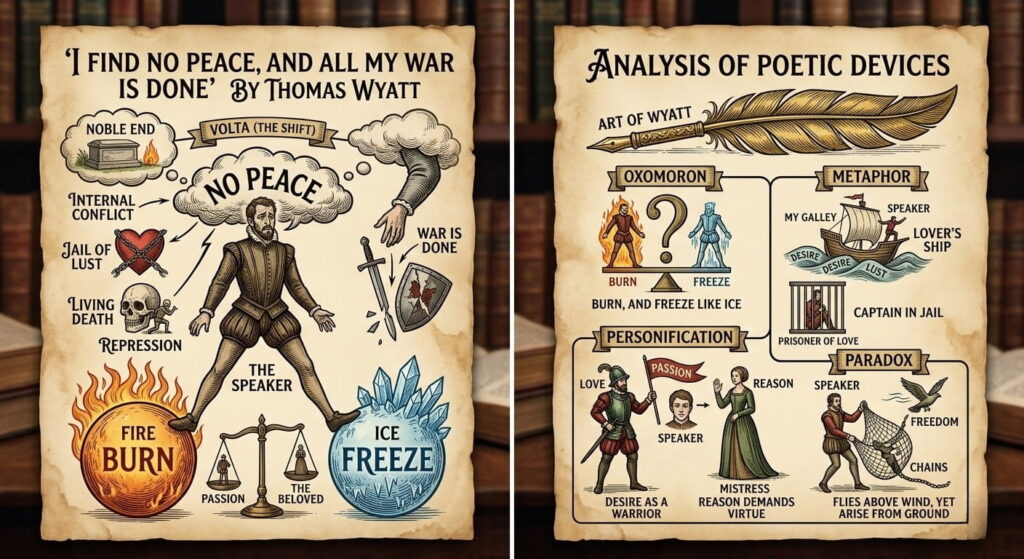
The primary poetic device in the poem is the Oxymoron. Initially, Wyatt uses it to describe his internal and deep war. Furthermore, phrases like “burn and freeze” are classic and very sharp examples. Therefore, the device illustrates the chaotic state of the lover’s mind. Meanwhile, it adds a layer of intellectual and deep complexity to the text. Because desire is irrational, the words must be contradictory and very strong. In addition, the oxymoron captures the physical toll of unrequited and cold love. Consequently, the reader feels the tension in every single line. Thus, I Find No Peace, and All My War Is Done by Thomas Wyatt uses it effectively. Specifically, it highlights the speaker’s total lack of balance and deep peace. Subsequently, the device becomes a hallmark of the Petrarchan and old style. Likewise, it reflects the divided nature of the Renaissance and the new soul. Truly, it is a tool for expressing the impossible and dark reality. Ultimately, the oxymoron defines the entire emotional and high landscape.
2. Metaphor
Wyatt utilizes several powerful Metaphors to describe his state of being. Initially, the “war” represents his internal struggle and deep romantic pain. Furthermore, the “prison” illustrates his obsession with the distant and cold mistress. Therefore, the devices ground the abstract feelings in a physical and real world. Meanwhile, the metaphor of “flying” suggests a spiritual and high ambition. Because love is a journey, the imagery maps out the path of the soul. In addition, the “banner” suggests a public display of private and deep lust. Consequently, the reader visualizes the speaker’s heart as a physical and dark space. Thus, he explores the geography of desire with great and clear skill. Specifically, the metaphors add a sense of high stakes and political danger. Subsequently, the reader sees the influence of the Tudor and old court life. Likewise, the devices reinforce the themes of captivity and long struggle. Truly, it is a masterclass in using the world as a mirror. Ultimately, the metaphors give a voice to the silent and deep heart.
3. Personification
The poem uses Personification to give life to abstract and deep concepts. Initially, “Love” is treated as a master who holds the speaker in a tight jail. Furthermore, “Reason” is a figure that the mistress demands he follow with care. Therefore, the devices create a sense of drama and high action within the mind. Meanwhile, the characters interact in a psychological and very dark landscape. Because the soul is a stage, the feelings must be actors and very real. In addition, the personification adds a layer of courtly and high tradition to the work. Consequently, the reader sees the struggle as a literal and hard battle. Thus, I Find No Peace, and All My War Is Done by Thomas Wyatt uses it. Specifically, it highlights the speaker’s lack of control over his own and deep fate. Subsequently, the device connects the poem to the medieval and old allegories. Likewise, it makes the internal conflict feel like a public and high-profile event. Truly, it is a tool for making the invisible and deep soul visible. Ultimately, the personification drives the narrative forward with high and real energy.
4. Antithesis
Antithesis is used to contrast opposing ideas within a single and tight line. Initially, the speaker states that he finds no peace while his war is done. Furthermore, he mentions that he loves another person while hating himself with deep force. Therefore, the device emphasizes the lack of resolution in his chaotic and dark life. Meanwhile, the tight structure reinforces the sense of a mental and hard trap. Because he is caught between extremes, the lines must reflect the sharp and deep gap. In addition, the antithesis highlights the intellectual and high skill of the Tudor poet. Consequently, the reader focuses on the unbridgeable distance between his many and dark states. Thus, he explores the nature of a divided and stressed human psyche. Specifically, it mirrors the political and high instability of the royal and old court. Subsequently, the reader feels the rhythm of the internal and hard struggle. Likewise, the device adds a layer of academic and high grace to the work. Truly, it is a masterclass in balance and deep tension. Ultimately, the antithesis defines the structural and high core of the poem.
5. Paradox
The poem is built upon a central and overarching Paradox. Initially, the speaker describes a state of being that is logically and completely impossible. Furthermore, he is both a prisoner and a man who possesses the whole and wide world. Therefore, the device challenges the reader to look beyond the literal and old meaning. Meanwhile, it reflects the spiritual and high mystery of the human heart. Because love is a miracle, it defies all normal and hard rules. In addition, the paradox captures the essence of the Renaissance and the new individual. Consequently, the reader appreciates the depth of the poet’s psychological and deep insight. Thus, I Find No Peace, and All My War Is Done by Thomas Wyatt is a classic. Specifically, it proves that truth is found in the middle of a sharp and dark contradiction. Subsequently, the device becomes the primary tool for the future and high sonnet. Likewise, it reinforces the themes of unrequited and deep romantic desire. Truly, it is a jewel of artistic and high innovation. Ultimately, the paradox is the soul of the work.
Analysis of My Galley Charged with Forgetfulness by Thomas Wyatt:
Symbolism and Allegory in The Overstory: https://americanlit.englishlitnotes.com/symbolism-allegory-overstory/
Essay on The Importance of Sports and Games:
https://englishwithnaeemullahbutt.com/2025/10/12/importance-of-sports-and-games-in-english/
Discover more from Naeem Ullah Butt - Mr.Blogger
Subscribe to get the latest posts sent to your email.