1. Introduction
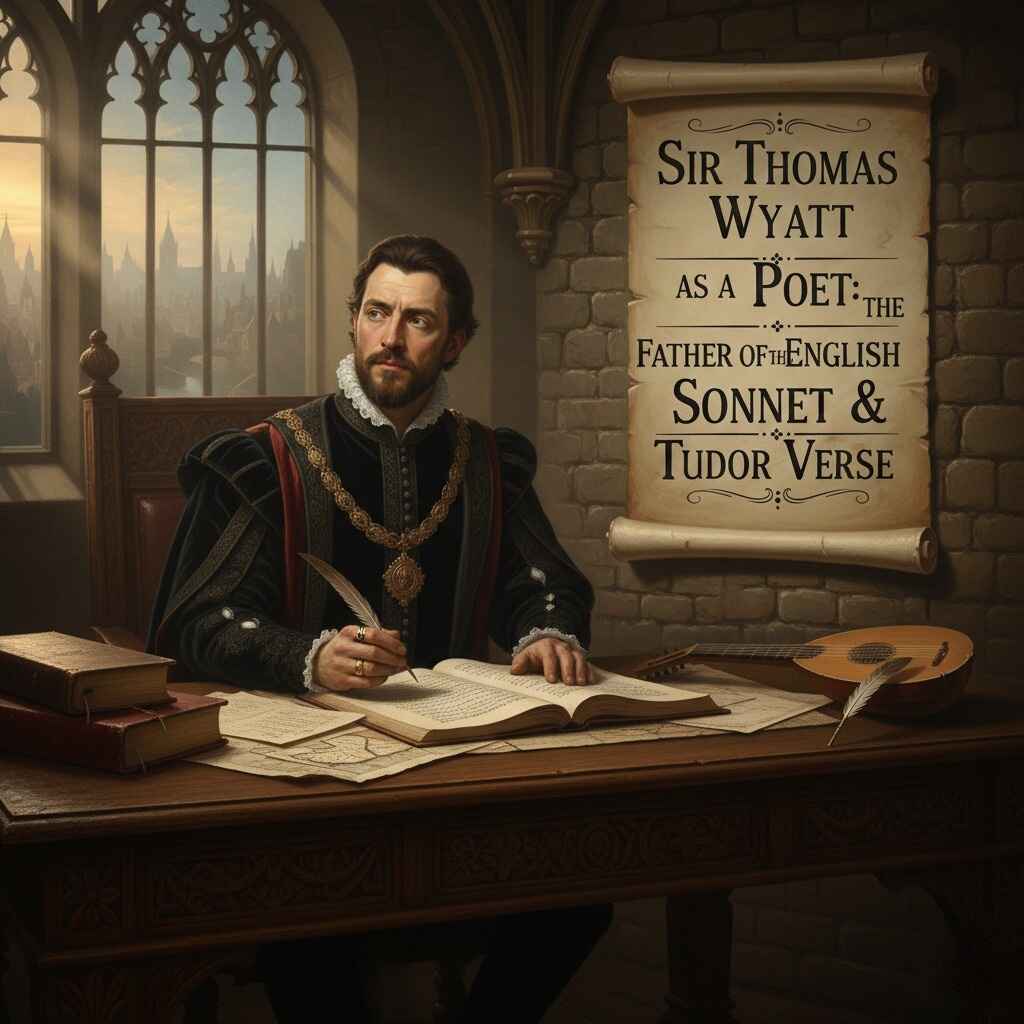
This article explores the career of Sir Thomas Wyatt as a poet. He transformed English verse during the Tudor era. He brought continental style to a developing language. Transitioning from medieval forms, he pioneered the sonnet. Consequently, he remains a giant of literary history. He served King Henry VIII with great skill. Yet, his heart belonged to the art of verse. Moreover, his lyrics capture the danger of the court. Hence, we study his work with deep respect today. He balanced a diplomat’s life with creative passion. Therefore, his influence reached far beyond his own time. Subsequently, he laid the foundation for future English masters. We see his genius in every jagged line. Indeed, his voice echoes through the centuries. Thus, we begin our deep analysis of his craft. He changed how we think about love and language. Finally, let us examine his incredible literary journey.
2. Petrarchan Sonnet
Wyatt introduced the Petrarchan sonnet to the English language. This form utilizes fourteen lines of intense emotion. Originally, Francesco Petrarch created this structured style in Italy. Wyatt adapted it for a rougher English tongue. Furthermore, he changed the traditional ending of the poem. He added a final couplet for extra impact. Similarly, he focused on the theme of unrequited love. This contribution defined Sir Thomas Wyatt as a poet. Therefore, he became the father of the English sonnet. Every later writer owes him a great debt. However, he maintained a unique, rugged voice throughout. Consequently, his translations feel like original English works. He captured the essence of the Italian Renaissance perfectly. In addition, he paved the way for Shakespeare’s success. His structural innovations were truly groundbreaking for the time. Thus, the sonnet became an English staple.
3. Octave
The octave consists of the first eight lines. These lines usually present a specific problem or situation. Furthermore, they establish the premise of the entire poem. Wyatt used the octave to build dramatic tension. Similarly, he followed strict rhyme schemes in these lines. Consequently, the reader feels the weight of the conflict. Moreover, the octave serves as a solid foundation. It sets the stage for the later resolution. Therefore, Wyatt mastered this crucial structural element with ease. However, he often infused it with personal courtly grief. Hence, the octave became a vehicle for Tudor anxiety. In addition, it allowed for complex metaphorical development. Subsequently, he balanced the octave against the concluding sestet. This balance proves the skill of Sir Thomas Wyatt as a poet. Indeed, his octaves remain models of classical precision. He used them to trap the reader’s interest.
4. Sestet
The sestet follows the octave in a sonnet. It contains the final six lines of the work. Furthermore, it provides a response to the initial problem. Wyatt used the sestet to offer a conclusion. Similarly, he often shifted the tone during these lines. Consequently, the poem reaches a moment of clarity. Moreover, the sestet resolves the tension built earlier. Therefore, it requires a delicate touch and sharp wit. However, Wyatt often added a couplet at the end. Hence, his sestets differ from the original Italian model. In addition, they highlight his creative independence and flair. Subsequently, the sestet reveals his ultimate philosophical stance. This mastery defines Sir Thomas Wyatt as a poet today. Indeed, his sestets are punchy and memorable. He used them to leave a lasting impression. Thus, the sestet completes the emotional journey effectively.
5. Volta
The volta represents a sudden turn in the poem. It usually appears between the octave and sestet. Furthermore, it signals a shift in the speaker’s perspective. Wyatt utilized the volta to surprise his loyal audience. Similarly, it marks a transition from problem to solution. Consequently, the volta provides a necessary intellectual spark. Moreover, it prevents the poem from becoming stagnant. Therefore, the volta is the heart of sonnet logic. However, Wyatt’s turns are often quite sharp and bitter. Hence, they reflect the unpredictability of his own life. In addition, the volta showcases his deep psychological insight. Subsequently, it keeps the reader engaged with the text. This technique highlights Sir Thomas Wyatt as a poet‘s genius. Indeed, he mastered the art of the pivot. He used it to challenge traditional romantic tropes. Thus, the volta remains his most dynamic tool.
6. Final Couplet
The final couplet is a signature of Wyatt’s style. It consists of two rhyming lines at the end. Furthermore, it provides a sharp, epigrammatic summary of themes. Wyatt broke from Petrarch by using this specific ending. Similarly, it adds a sense of finality and resolution. Consequently, the couplet often delivers a stinging moral lesson. Moreover, it emphasizes the poet’s ultimate message or wit. Therefore, the couplet became a hallmark of English verse. However, it requires concise thought and perfect rhythmic timing. Hence, Wyatt excelled at crafting these brief, powerful closures. In addition, the couplet influenced the later Shakespearean sonnet structure. Subsequently, it allowed him to exit the poem gracefully. This innovation marks Sir Thomas Wyatt as a poet‘s legacy. Indeed, his couplets ring with truth and ironical bite. He used them to seal his poetic arguments.
7. Iambic Pentameter
Iambic pentameter serves as the heartbeat of English poetry. Wyatt was one of its earliest and boldest explorers. Furthermore, he struggled to fit English words into Italian rhythms. This struggle created a unique and fascinating poetic tension. Similarly, he paved the way for blank verse development. Consequently, his rhythmic experiments changed English literature forever. Moreover, he helped standardize the five-beat line for others. Therefore, his efforts provided a blueprint for future generations. However, his meter often sounds irregular to modern ears. Hence, scholars debate the intentionality of his rhythmic pauses. In addition, he used stress to emphasize emotional distress. Subsequently, his work feels more human and less mechanical. This rhythmic quest defines Sir Thomas Wyatt as a poet. Indeed, he wrestled with the language to find beauty. He transformed a rough dialect into a sophisticated art.
8. Rhyme Scheme
The rhyme scheme provides the musical framework of Wyatt’s art. He often employed the ABBA ABBA CDDC EE pattern. Furthermore, this structure allowed for complex intellectual layering. Wyatt used rhyme to link disparate ideas together tightly. Similarly, he found resonance in the sounds of Tudor English. Consequently, his poems possess a haunting and melodic quality. Moreover, the rhyme scheme enforces a sense of order. Therefore, it contrasts with the chaotic emotions he describes. However, he sometimes forced rhymes to fit his specific needs. Hence, we see the raw effort behind his creative process. In addition, his rhymes reflect the sophisticated tastes of the court. Subsequently, he proved that English could rhyme as beautifully as French. This technical focus showcases Sir Thomas Wyatt as a poet. Indeed, his rhymes echo the sophistication of the Renaissance. He used sound to reinforce his deep meanings.
9. Blank Verse
Blank verse consists of unrhymed lines in iambic pentameter. While Surrey perfected it, Wyatt began the early exploration. Furthermore, he realized that rhyme was not always necessary. This realization opened new doors for dramatic and epic expression. Similarly, he experimented with the natural flow of speech. Consequently, his work often sounds surprisingly modern and direct. Moreover, blank verse allowed for more expansive philosophical thought. Therefore, it became the foundation for later Elizabethan drama. However, Wyatt mostly stuck to rhymed lyrics for his court. Hence, his blank verse attempts remain rare and precious finds. In addition, they demonstrate his willingness to break tradition. Subsequently, he influenced the next generation of bold English writers. This experimental spirit marks Sir Thomas Wyatt as a poet. Indeed, he was never afraid to try new forms. He pushed the boundaries of what English could do.
10. Rhythm
Rhythm in Wyatt’s poetry is often described as “jagged.” This lack of smoothness was actually a deliberate choice. Furthermore, it reflects the internal turmoil of his speakers. Wyatt used rhythm to mimic the feeling of heartbreak. Similarly, his pauses create a sense of breathlessness and anxiety. Consequently, the reader experiences the poet’s pain more deeply. Moreover, the rhythm breaks the monotony of traditional verse. Therefore, it adds a layer of realism to his lyrics. However, many early critics misunderstood this rugged rhythmic style. Hence, they accused him of being an unskilled writer. In addition, modern scholars now celebrate his rhythmic complexity. Subsequently, his style is seen as a badge of authenticity. This unique pulse defines Sir Thomas Wyatt as a poet. Indeed, he prioritized emotion over simple, melodic sweetness. He crafted a rhythm that matched his difficult life.
11. Unrequited Love
Unrequited love serves as the central engine of Wyatt’s verse. His speakers often pine for women who remain distant. Furthermore, he moved away from purely spiritual or holy longing. He focused on the raw pain of physical rejection instead. Similarly, his poems describe love as a form of torture. Consequently, the reader feels the heavy weight of his despair. Moreover, this theme allowed him to explore psychological depths. Therefore, he became the voice of the frustrated Tudor lover. However, he rarely presented himself as a passive victim. Hence, his poems often contain a sharp edge of anger. In addition, he used unrequited love to mirror political frustration. Subsequently, the lady’s coldness represents the king’s fickle favor. This emotional complexity defines Sir Thomas Wyatt as a poet. Indeed, he captured the agony of wanting the unreachable. He turned personal rejection into universal art.
12. Cruel Mistress
The trope of the cruel mistress dominates Wyatt’s romantic lyrics. She is often depicted as heartless, fickle, and predatory. Furthermore, she possesses a power that destabilizes the male speaker. Wyatt used this figure to challenge traditional courtly ideals. Similarly, her cruelty justifies the speaker’s bitterness and sharp wit. Consequently, the poems often feel like accusations rather than praises. Moreover, the cruel mistress reflects the dangers of Tudor courtships. Therefore, love becomes a game with high and deadly stakes. However, Wyatt’s mistresses are rarely just one-dimensional literary villains. Hence, they often seem like real women with agency. In addition, their “cruelty” is sometimes just a quest for survival. Subsequently, the power dynamic remains a constant source of tension. This realistic portrayal marks Thomas Wyatt as a poet. Indeed, he wrote about love as a battlefield of wills.
13. Eroticism
Eroticism in Wyatt’s poetry is often subtle but deeply felt. He moves beyond the abstract to hint at physical desire. Furthermore, he uses sensory language to evoke a palpable intimacy. Wyatt grounded his poems in the reality of the body. Similarly, he explored the tension between lust and social duty. Consequently, his work possesses a heat missing from medieval verse. Moreover, he uses domestic settings to heightens the erotic charge. Therefore, the bedroom becomes as significant as the royal court. However, this desire is often tinged with fear or guilt. Hence, the eroticism feels both dangerous and highly irresistible. In addition, he used physical metaphors to describe spiritual or political states. Subsequently, he expanded the vocabulary of English romantic expression. This bold approach defines Sir Thomas Wyatt as a poet. Indeed, he brought a new physical intensity to literature.
14. Petrarchan Conceit
The Petrarchan conceit is an elaborate and extended poetic metaphor. Wyatt used these to compare love to unlikely things. Furthermore, he compared his heart to a besieged fortress often. This technique allowed for deep intellectual exploration of emotion. Similarly, he utilized the contrast between fire and cold ice. Consequently, the conceit bridges the gap between thought and feeling. Moreover, it rewards the reader for their careful mental attention. Therefore, it became a standard tool for later English poets. However, Wyatt often twisted these conceits to fit his cynicism. Hence, his metaphors feel more grounded than their Italian sources. In addition, they demonstrate his mastery of complex rhetorical structures. Subsequently, the conceit became a hallmark of the English Renaissance. This intellectualism highlights Sir Thomas Wyatt as a poet. Indeed, he used imagery to solve complicated emotional puzzles.
15. Idealization
Idealization involves portraying a subject as perfect or divine. While many poets did this, Wyatt often actively resisted it. Furthermore, he preferred to show the flaws of his subjects. He understood that perfection was a lie of the court. Similarly, he grounded his praise in realistic and human observations. Consequently, his poems feel more honest than traditional romantic lyrics. Moreover, he questioned why men idealize women who hurt them. Therefore, he brought a sense of skepticism to English poetry. However, he could still write with great and tender beauty. Hence, his occasional moments of idealization feel earned and sincere. In addition, he used idealization to critique the superficiality of status. Subsequently, he taught readers to look beneath the polished surface. This honesty defines Sir Thomas Wyatt as a poet. Indeed, he preferred the truth over comfortable poetic lies.
16. Betrayal
Betrayal is a recurring wound in the body of Wyatt’s work. He writes of lovers who break their sacred vows. Furthermore, he speaks of friends who turn into deadly enemies. This theme reflects the volatile nature of the Tudor court. Similarly, betrayal is presented as an inevitable part of life. Consequently, a deep sense of paranoia haunts his best lines. Moreover, he explores the shame and anger that follow betrayal. Therefore, his poems serve as warnings to the naive heart. However, he also examines his own capacity for being unfaithful. Hence, the theme becomes a complex study of human frailty. In addition, betrayal in love mirrors betrayal in royal service. Subsequently, the speaker finds no safe harbor in his world. This dark perspective highlights Sir Thomas Wyatt as a poet. Indeed, he captured the sting of the broken promise.
17. Infidelity
Infidelity is treated with a mixture of sadness and cynicism. Wyatt often focuses on the “newfangledness” of his many lovers. Furthermore, he laments the lack of loyalty in modern times. He describes a world where hearts are easily bought. Similarly, infidelity is portrayed as a symptom of courtly decay. Consequently, the speaker often feels isolated by his own faithfulness. Moreover, he uses infidelity to explore the theme of mutability. Therefore, love is seen as a fleeting and unreliable state. However, he sometimes accepts infidelity with a weary, knowing shrug. Hence, he adopts the persona of the experienced, worldly courtier. In addition, his poems provide a glimpse into Tudor social scandals. Subsequently, he turned scandalous gossip into enduring and high literature. This gritty realism defines Thomas Wyatt as a poet. Indeed, he knew that love was rarely a straight path.
18. Male Vulnerability
Wyatt was a pioneer in expressing raw male vulnerability. His speakers are not always strong or stoic heroes. Furthermore, they admit to weeping and feeling quite broken. This honesty was a departure from the chivalric tradition. Similarly, he showed that men suffer deeply in romantic games. Consequently, his poetry has a modern and relatable emotional core. Moreover, vulnerability is presented as a consequence of true love. Therefore, he allowed his male readers to feel their pain. However, this softness is often masked by a cynical exterior. Hence, the poems reveal a struggle between pride and grief. In addition, vulnerability is used to critique the court’s cruelty. Subsequently, he humanized the figure of the Renaissance courtly lover. This emotional depth marks Thomas Wyatt as a poet. Indeed, he found great strength in admitting his weakness.
19. Yearning
Yearning is the quiet, constant pulse beneath his best poems. It is the feeling of reaching for something lost. Furthermore, it often focuses on a past state of grace. Wyatt used yearning to evoke a sense of deep nostalgia. Similarly, he yearns for a time of simple, honest love. Consequently, his work is filled with a haunting “what if.” Moreover, yearning connects the physical world to the spiritual realm. Therefore, his desire for a woman becomes a divine quest. However, this yearning is usually met with a cold silence. Hence, it leads to a state of permanent dissatisfaction. In addition, he yearns for political stability and a quiet life. Subsequently, his poems capture the restlessness of the human spirit. This pervasive mood defines Thomas Wyatt as a poet. Indeed, he was a master of the unfulfilled heart.
20. Sexual Politics
Sexual politics refers to the power struggle between the genders. Wyatt understood that love was never just about the heart. Furthermore, he saw it as a matter of social standing. He wrote about the “price” and “value” of a lover. Similarly, his poems reflect the gender hierarchies of his time. Consequently, love is often described in terms of legal contracts. Moreover, he suggests that women use sex to gain power. Therefore, the bedroom becomes a site of intense political negotiation. However, he also recognizes the limited options available to women. Hence, he provides a nuanced view of the gender war. In addition, his work explores how the king controls sexuality. Subsequently, love is never truly private in a royal court. This social insight defines Sir Thomas Wyatt as a poet. Indeed, he knew that every kiss had a consequence.
21. King Henry VIII
King Henry VIII was the sun around which Wyatt’s world revolved. As a courtier, Wyatt’s life and career depended on royal favor. Furthermore, the King’s volatile temperament created a permanent state of anxiety. Wyatt had to balance his creative expression with absolute political loyalty. Similarly, many of his poems act as veiled pleas for mercy. Consequently, the King becomes an invisible but felt presence in the verse. Moreover, the royal authority dictated the themes of Wyatt’s early lyrics. Therefore, his art was a tool for survival in a lethal era. However, the King’s own marital scandals deeply impacted Wyatt’s personal life. Hence, the poetry reflects the tension of serving a temperamental tyrant. In addition, the King’s influence forced Wyatt to develop a coded style. Subsequently, his work became a masterclass in reading between the lines. This proximity to power defines Sir Thomas Wyatt as a poet.
22. Anne Boleyn
Anne Boleyn remains the most haunting figure in Wyatt’s literary universe. Most scholars believe she is the “hind” in his famous sonnet. Furthermore, their rumored romantic history made him a target for enemies. Wyatt used his verse to express a dangerous, forbidden obsession. Similarly, her rise and fall mirrored the fragility of his luck. Consequently, his poems about her are filled with fear and bitterness. Moreover, she represents the ultimate “cruel mistress” within a political framework. Therefore, his descriptions of her are both intimate and strangely distant. However, he had to hide his true feelings behind complex allegories. Hence, the poetry serves as a secret diary of their relationship. In addition, her execution left a permanent mark on his creative soul. Subsequently, he wrote about the “bloody days” of the Tudor court. This tragic connection highlights Sir Thomas Wyatt as a poet.
23. Political Intrigue
Political intrigue was the very air that Thomas Wyatt breathed daily. The Tudor court was a hive of spies and secrets. Furthermore, a single misplaced word could lead to the execution block. Wyatt used his poetry to navigate these treacherous social waters. Similarly, his lines often possess a double or triple meaning. Consequently, the reader must look for clues hidden within the text. Moreover, intrigue turns every romantic encounter into a potential political trap. Therefore, his work is characterized by a deep sense of caution. However, he also enjoyed the thrill of the intellectual game. Hence, his poems are as much about strategy as emotion. In addition, he used verse to outmaneuver his rivals at court. Subsequently, his poetry became a sophisticated weapon for a skilled diplomat. This sharp awareness marks Sir Thomas Wyatt as a poet.
24. The Tower of London
The Tower of London was a physical manifestation of Wyatt’s failures. He was imprisoned there twice during his turbulent life at court. Furthermore, he watched his friends die from behind its stone walls. This traumatic experience stripped away his youthful idealism and courtly grace. Similarly, his “Tower poems” are among his most raw and honest. Consequently, they provide a chilling look at the reality of power. Moreover, the threat of death forced him to find spiritual strength. Therefore, the Tower became a place of profound poetic transformation. However, his survival was a miracle of timing and royal luck. Hence, his verse after imprisonment is filled with a new gravity. In addition, he used the experience to critique the vanity of ambition. Subsequently, his work shifted toward more philosophical and religious themes. This dark period defines Sir Thomas Wyatt as a poet.
25. Diplomacy
Diplomacy was Wyatt’s official profession and his greatest source of stress. He traveled across Europe to negotiate for the English crown. Furthermore, his exposure to foreign cultures enriched his own poetic style. Wyatt brought back the Italian sonnet as a diplomatic souvenir. Similarly, his professional life required a constant and careful performance. Consequently, his poems reflect the exhaustion of a man wearing masks. Moreover, diplomacy taught him the art of persuasion and subtle rhetoric. Therefore, his verse is technically precise and logically sound throughout. However, he often longed for the simplicity of a quiet life. Hence, he wrote about the burdens of serving the state. In addition, his travels provided him with a broad, international perspective. Subsequently, he helped move English literature toward a more cosmopolitan future. This global experience marks Sir Thomas Wyatt as a poet.
26. Surveillance
Surveillance was a constant reality for anyone close to the King. Every letter Wyatt wrote was subject to careful royal inspection. Furthermore, even his most private poems could be used as evidence. Wyatt adapted to this by using “safe” but complex metaphors. Similarly, he explored the psychological weight of being watched by others. Consequently, his speakers often feel trapped in a public theater. Moreover, surveillance forced him to master the art of the subtext. Therefore, his poetry is a puzzle of intended and hidden meanings. However, this pressure also pushed him toward a new literary depth. Hence, he became the first truly “psychological” poet in the English language. In addition, he used his work to comment on the lack of privacy. Subsequently, the “eye of the court” is a recurring, terrifying motif. This sense of scrutiny defines Sir Thomas Wyatt as a poet.
27. Favoritism
Favoritism was the unpredictable engine that drove the Tudor social hierarchy. Wyatt saw men rise to glory and fall to ruin. Furthermore, he understood that talent mattered less than the King’s whim. He wrote about the “fickle world” that rewarded the unworthy. Similarly, favoritism made every social position feel temporary and very fragile. Consequently, a deep sense of insecurity runs through his courtly verse. Moreover, he explored the envy and resentment that favoritism always creates. Therefore, his poems serve as a critique of the court’s unfairness. However, he also benefitted from royal favor during his long career. Hence, his perspective is that of a complex and compromised insider. In addition, he used verse to reflect on the nature of luck. Subsequently, he warned others not to trust in the smiles of kings. This cynical insight marks Thomas Wyatt as a poet.
28. Courtier
The role of the courtier was Wyatt’s primary social identity. He had to be a soldier, scholar, and a singer. Furthermore, he was expected to participate in elaborate and expensive games. Wyatt used his poetry to document the performative nature of court. Similarly, he mastered the “sprezzatura” or studied nonchalance of the era. Consequently, his poems often seem effortless despite their deep complexity. Moreover, being a courtier meant living in a state of performance. Therefore, his work explores the tension between the public and private. However, he grew weary of the shallow rituals of the court. Hence, his later poems seek a more authentic and solitary existence. In addition, he used his verse to mock the flatterers around him. Subsequently, he defined what it meant to be a Renaissance intellectual. This social role defines Thomas Wyatt as a poet.
29. Espionage
Espionage was a dark but necessary part of Wyatt’s diplomatic duties. He lived in a world of intercepted letters and hidden daggers. Furthermore, he likely participated in gathering intelligence for the English crown. Wyatt used the language of spies to describe his romantic life. Similarly, he treated the heart as a secret to be unlocked. Consequently, his poems are filled with imagery of locks and keys. Moreover, espionage taught him to value silence and careful, deliberate speech. Therefore, his verse is remarkably concise and avoids any unnecessary flourish. However, the moral cost of spying weighed heavily on his mind. Hence, his work often grapples with the concept of personal integrity. In addition, he explored the betrayal inherent in a life of secrets. Subsequently, he turned the craft of a spy into high art. This tactical mindset marks Sir Thomas Wyatt as a poet.
30. Fortune’s Wheel
Fortune’s Wheel was the dominant metaphor for the volatility of life. Wyatt saw himself at the top and the bottom of it. Furthermore, the wheel represented the terrifying speed of political and social change. He used this classical image to ground his personal Tudor experiences. Similarly, the wheel reminds the reader that no success is permanent. Consequently, his poetry is filled with a sense of impending doom. Moreover, it encourages a stoic detachment from the rewards of the world. Therefore, he sought comfort in the things that do not change. However, he could not fully escape the pull of the wheel. Hence, his work captures the dizzying highs and lows of power. In addition, he used the metaphor to explain his sudden imprisonments. Subsequently, he became a philosopher of the unexpected and the tragic. This fatalism defines Thomas Wyatt as a poet.
31. Mutability
Mutability refers to the constant state of change and human flux. Wyatt observed the shifting sands of the Tudor court every day. Furthermore, he realized that neither love nor power could truly last. He used his poetry to lament the fleeting nature of happiness. Similarly, he focused on how time destroys even the strongest bonds. Consequently, a deep sense of transience haunts his most famous lyrics. Moreover, mutability serves as a warning against the vanity of pride. Therefore, he encouraged his readers to seek a more stable reality. However, he remained fascinated by the beauty of the passing moment. Hence, his poems capture a specific and painful sense of loss. In addition, he linked physical decay to the corruption of the soul. Subsequently, he became a master of the poetry of passing time. This awareness of change defines Thomas Wyatt as a poet.
32. Stoicism
Stoicism provided Wyatt with a mental shield against his many enemies. He sought to remain indifferent to the whims of cruel fortune. Furthermore, he used his verse to practice a form of self-control. Wyatt believed that internal peace was the only true human victory. Similarly, his lines often advocate for a quiet and reserved life. Consequently, his poetry has a calm and measured intellectual core. Moreover, stoicism allowed him to endure the horrors of the Tower. Therefore, he turned his suffering into a source of moral strength. However, his natural passion often broke through his stoic cold exterior. Hence, the poems reflect a struggle between emotion and pure reason. In addition, he drew inspiration from classical Roman and Greek philosophers. Subsequently, he introduced a new intellectual gravity to English lyrical verse. This philosophical depth marks Thomas Wyatt as a poet.
33. Cynicism
Cynicism was the natural byproduct of a life spent in court. Wyatt saw through the polite lies of the royal circle. Furthermore, he often expressed a dark view of human social motives. He believed that most people were driven by pure self-interest. Similarly, his poems frequently mock the concept of “true” romantic love. Consequently, a sharp and biting wit characterizes his most famous lines. Moreover, cynicism acted as a form of protection against deep hurt. Therefore, he laughed at the very things that once caused pain. However, his cynicism was often a mask for his deep disappointment. Hence, the reader can feel the sadness beneath his mocking tone. In addition, he used his cynical voice to expose political corruption. Subsequently, he became the first great satirist of the English Renaissance. This realistic edge defines Thomas Wyatt as a poet.
34. Disdain
Disdain is a recurring emotional state in Wyatt’s most bitter lyrics. He often describes the cold rejection he received from powerful lovers. Furthermore, he uses the word to represent a total social dismissal. Wyatt expressed the sting of being looked down upon by others. Similarly, his speakers often return this disdain with their own pride. Consequently, the poems become a battleground of mutual and icy contempt. Moreover, disdain highlights the rigid class hierarchies of the Tudor era. Therefore, the emotional struggle is also a fight for personal dignity. However, he struggled to remain unaffected by the lady’s cruel gaze. Hence, his lines capture the tension of a wounded ego. In addition, he used disdain to critique the superficiality of the court. Subsequently, he turned social rejection into a powerful literary theme. This emotional honesty marks Thomas Wyatt as a poet.
35. Melancholy
Melancholy was considered a sign of deep intellect during the Renaissance. Wyatt embraced this mood as a reflection of his own soul. Furthermore, his poetry is saturated with a sense of quiet sorrow. He wrote best when he was feeling isolated and deeply alone. Similarly, melancholy allowed him to explore the “darker” side of human love. Consequently, his verses possess a haunting and very atmospheric quality. Moreover, he used his sadness to connect with a wider audience. Therefore, his personal grief became a shared and universal human experience. However, he avoided the trap of becoming overly sentimental or weak. Hence, his melancholy is always tempered by his sharp, analytical mind. In addition, he associated this mood with the physical landscape of England. Subsequently, he created a new aesthetic of sorrow for future poets. This pervasive tone defines Thomas Wyatt as a poet.
36. Weariness
Weariness defines the later years of Wyatt’s short and busy life. He was tired of the endless “hunting” for royal favor. Furthermore, he longed for the peace of his Kentish home. He used his poetry to express a deep, spiritual exhaustion. Similarly, he felt the weight of years spent in deceptive diplomacy. Consequently, his later works focus on the desire for total rest. Moreover, weariness is presented as the inevitable end of worldly ambition. Therefore, he sought comfort in the simple truths of the heart. However, he could never fully escape the demands of the King. Hence, his poems capture a man trapped by his own success. In addition, he used this weariness to justify his withdrawal from court. Subsequently, his voice became more contemplative and less focused on romance. This honest fatigue marks Sir Thomas Wyatt as a poet.
37. Bitterness
Bitterness is the sharpest spice in the poetry of Thomas Wyatt. He felt the sting of betrayal more deeply than most. Furthermore, he did not hide his anger behind polite courtly masks. He used his verse to strike back at those who hurt him. Similarly, his lines are often filled with a cold, righteous fury. Consequently, the reader feels the heat of his unresolved personal conflicts. Moreover, bitterness allowed him to break away from the “sweet” sonnet. Therefore, he created a more realistic and aggressive style of English. However, this anger was often directed at the entire social system. Hence, the poems serve as a critique of the Tudor world. In addition, his bitterness makes his rare moments of joy seem brighter. Subsequently, he proved that negative emotions could produce great and lasting art. This raw power defines Thomas Wyatt as a poet.
38. Inconstancy
Inconstancy is the great enemy of the speaker in Wyatt’s verse. He laments the “newfangledness” of the women and men he knew. Furthermore, he describes a world where nothing stays the same long. Wyatt valued loyalty in an age of constant and lethal betrayal. Similarly, his poems reflect the frustration of a man seeking truth. Consequently, he often presents himself as the only constant person remaining. Moreover, inconstancy is linked to the broader theme of worldly mutability. Therefore, it becomes a symptom of a deeper and spiritual sickness. However, he admits that he too has felt the pull of change. Hence, the theme is explored with a sense of shared guilt. In addition, he used inconstancy to explain his own sudden political falls. Subsequently, he became a poet of the shifting and unstable heart. This thematic focus marks Thomas Wyatt as a poet.
39. Self-Reflection
Self-reflection allowed Wyatt to look inward with a very critical eye. He was not just a poet of the external court. Furthermore, he was an explorer of his own complex mental states. Wyatt used his verse to question his motives and his desires. Similarly, he sought to understand the roots of his own suffering. Consequently, his poetry has a deep and “modern” psychological resonance. Moreover, self-reflection led him to a state of greater moral clarity. Therefore, he became a more mature and thoughtful writer over time. However, this process was often painful and filled with deep regret. Hence, the poems capture a man wrestling with his own shadow. In addition, he encouraged his readers to look into their own hearts. Subsequently, he helped invent the “confessional” mode in English literature. This introspective habit defines Sir Thomas Wyatt as a poet.
40. Escapism
Escapism was a necessary survival tactic for the stressed Thomas Wyatt. He often dreamed of leaving the court for the country. Furthermore, his poetry provided a mental retreat from the King’s demands. He used the “pastoral” tradition to imagine a simpler and better life. Similarly, his verses are filled with longings for ancient, quiet places. Consequently, the reader feels his desperate need for peace and solitude. Moreover, escapism allowed him to express ideas that were too dangerous. Therefore, he hid his true political opinions in “fanciful” rural stories. However, he knew that a true escape was likely never possible. Hence, his escapism is always tinged with a sense of reality. In addition, he found a form of escape in the act of writing. Subsequently, his art became his most reliable and safe sanctuary. This imaginative drive marks Sir Thomas Wyatt as a poet.
41. The Hunt
The hunt serves as a powerful metaphor for the pursuit of love. Wyatt famously utilized this imagery in his masterpiece, “Whoso List to Hunt.” Furthermore, he compared the elusive lady to a wild and “fair” hind. This comparison highlights the predatory nature of the Tudor social scene. Similarly, the speaker is depicted as a weary and failing hunter. Consequently, the act of loving becomes a dangerous and exhausting physical sport. Moreover, the hunt reflects the power dynamics between the king and courtier. Therefore, the lady is not just a lover but royal property. However, Wyatt subverts the trope by admitting his own total defeat. Hence, the poem becomes a warning to other ambitious young men. In addition, the “neck” of the deer represents a site of ownership. Subsequently, he turned a common pastime into a profound political allegory. This mastery defines Sir Thomas Wyatt as a poet.
42. The Galley
The galley represents the lover as a ship lost in a storm. Wyatt adapted this classical conceit to show his internal mental state. Furthermore, he described his heart as a vessel without a steady pilot. This imagery evokes a sense of total helplessness and profound despair. Similarly, the “stars” represent the lady’s eyes that have ceased to guide. Consequently, the speaker is tossed by waves of sighs and fierce winds. Moreover, the galley metaphor emphasizes the lack of control in his life. Therefore, love is seen as a voyage into a dark abyss. However, Wyatt’s technical precision keeps the metaphor from becoming too chaotic. Hence, the reader admires the craft even while feeling the terror. In addition, he used the sea to represent the fickleness of fortune. Subsequently, he created a vivid landscape of the tortured and restless mind. This imagery marks Sir Thomas Wyatt as a poet.
43. The Lute
The lute was Wyatt’s favorite companion and a symbol of his art. He often addressed the instrument directly in his musical, lyrical poems. Furthermore, he used the lute to voice his complaints against his lovers. Wyatt believed that music could convey what words alone often could not. Similarly, the lute represents the harmony he sought in a discordant court. Consequently, his “Lute poems” are among his most melodic and rhythmic works. Moreover, he blamed the instrument for the “noise” of his great grief. Therefore, the lute acts as a psychological mirror for the speaker’s pain. However, he often threatened to break the lute when love failed him. Hence, it represents the fragility of the creative and romantic life. In addition, it highlights his role as a performer for the King. Subsequently, he blended the roles of the musician and the philosopher. This artistic fusion defines Sir Thomas Wyatt as a poet.
44. Alliteration
Alliteration provided Wyatt with a tool to emphasize his most bitter points. He used repeating consonant sounds to create a sense of internal tension. Furthermore, alliteration adds a percussive and “jagged” quality to his English verse. Wyatt found that hard sounds could mimic the feeling of sharp pain. Similarly, he used it to link key thematic words within a line. Consequently, his poetry possesses a physical weight that is hard to ignore. Moreover, alliteration makes his epigrams more memorable and much more punchy. Therefore, he mastered the “s-sounds” to represent the whispers of courtly spies. However, he avoided using it in a way that felt forced. Hence, the technique feels like a natural extension of his rugged voice. In addition, he used it to ground his translations in Anglo-Saxon grit. Subsequently, he created a uniquely English music for the Italian sonnet. This style marks Sir Thomas Wyatt as a poet.
45. Caesura
The caesura is a deliberate pause or break within a poetic line. Wyatt used this technique to mimic the hesitation of a speaker. Furthermore, it creates a sense of gasping for breath during emotional distress. This break disrupts the smooth flow of the iambic pentameter line. Similarly, it highlights the intellectual “turn” within a single sentence or phrase. Consequently, the reader is forced to slow down and consider each word. Moreover, the caesura adds a layer of realism to his courtly lyrics. Therefore, his poems sound like a man speaking rather than singing. However, this jaggedness was often misunderstood by later and more melodic poets. Hence, Wyatt’s use of the pause is a sign of his authenticity. In addition, it allows for a sudden shift in tone or perspective. Subsequently, he used silence as effectively as he used his complex words. This technique defines Sir Thomas Wyatt as a poet.
46. Imitation
Imitation was a central pillar of Renaissance creativity and high scholarly achievement. Wyatt did not just copy Petrarch but “Englishly” reinvented his work. Furthermore, he transformed Italian metaphors into something much more raw and dangerous. This process of imitation allowed him to learn from the masters. Similarly, he used foreign models to elevate the status of his tongue. Consequently, his “translations” are often considered original and groundbreaking English poems. Moreover, imitation provided a safe mask for his own personal grievances. Therefore, he could speak of Anne Boleyn through the words of others. However, he always added a unique and cynical Tudor twist to it. Hence, his work feels both anciently classical and shockingly modern today. In addition, he encouraged other courtiers to look toward the European continent. Subsequently, he catalyzed a massive shift in English literary and cultural history. This vision marks Sir Thomas Wyatt as a poet.
47. Metaphor
Metaphor allowed Wyatt to express the “unexpressible” danger of his life. He saw the world through a lens of complex, overlapping symbols. Furthermore, his metaphors were often architectural or legal in their primary nature. He described love as a prison or a debt to be paid. Similarly, he used nature to represent the cold indifference of the crown. Consequently, his poetry requires a high degree of active reader interpretation. Moreover, metaphor provided a layer of protection in an age of spies. Therefore, his “coded” language was a matter of life and death. However, his metaphors always remained grounded in real and physical sensations. Hence, the reader “feels” the cold and “sees” the sharp daggers. In addition, he expanded the metaphorical range of the English lyric significantly. Subsequently, he taught future poets how to think in multiple layers. This complexity defines Sir Thomas Wyatt as a poet.
48. Paradox
Paradox is the expression of two contradictory truths held at once. Wyatt excelled at describing the “burning ice” of the romantic heart. Furthermore, he used paradox to capture the absurdity of the Tudor court. He found that love was both a blessing and a curse. Similarly, he described himself as “free” only when he was imprisoned. Consequently, his poetry reflects the confusing and unstable nature of his era. Moreover, paradox highlights the limits of logic in the face of passion. Therefore, it became a favorite tool for his most philosophical and intense works. However, he used it to show that truth is often quite messy. Hence, his poems avoid simple answers to the great questions of life. In addition, paradox allowed him to explore the duality of the human soul. Subsequently, he influenced the later Metaphysical poets with his intellectual wit. This insight marks Sir Thomas Wyatt as a poet.
49. Vernacular
The vernacular refers to the common and everyday language of the people. Wyatt chose to write in English rather than just in Latin. Furthermore, he proved that English was capable of expressing high art. This was a radical act during a time of linguistic transition. Similarly, he elevated the “rough” sounds of his native tongue to glory. Consequently, he paved the way for the great Elizabethans who followed. Moreover, the vernacular allowed him to reach a wider and more personal audience. Therefore, his poetry feels more direct and honest than his peers’ work. However, he still struggled to refine the chaotic grammar of his time. Hence, his verse has a charming and primitive strength to it. In addition, he used the vernacular to ground his poems in reality. Subsequently, he became a champion for the future of the English language. This commitment defines Sir Thomas Wyatt as a poet.
50. Enjambment
Enjambment occurs when a sentence runs over the end of a line. Wyatt used this to create a sense of relentless and flowing energy. Furthermore, it prevents the poem from sounding too “sing-song” or overly simple. This technique mirrors the rambling and anxious thoughts of his speakers. Similarly, it builds a dramatic momentum that leads to a sharp conclusion. Consequently, his sonnets often feel like a single and urgent breath. Moreover, enjambment allows for more complex and nuanced sentence structures in verse. Therefore, he moved away from the “end-stopped” lines of the Middle Ages. However, he used it sparingly to ensure his rhymes still landed well. Hence, he balanced a modern flow with a traditional and stable form. In addition, it highlights the conversational tone of his most intimate lyrics. Subsequently, he gave English poetry a new and more flexible rhythm. This skill marks Sir Thomas Wyatt as a poet.
The Legacy of Sir Thomas Wyatt as a Poet
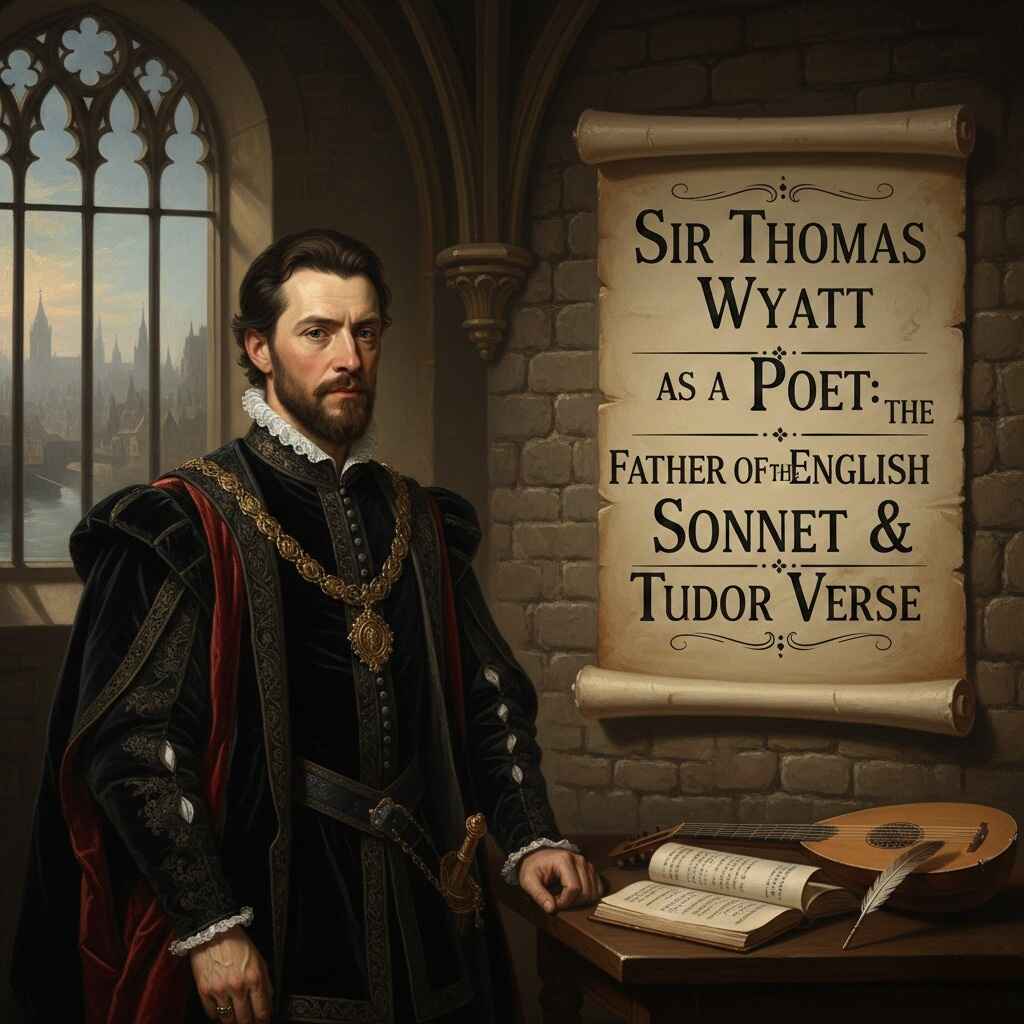
The enduring legacy of Sir Thomas Wyatt as a poet is unmatched. He provided the initial spark for the English Renaissance of literature. Furthermore, he showed that the English language could match the continent’s grace. He gave us the sonnet and a new way to feel. Similarly, his influence can be seen in the work of Shakespeare. Consequently, we must view him as the father of modern English. Moreover, his life story reminds us of the cost of creative truth. Therefore, his poems remain as relevant today as in the past. However, he was more than just a translator of old ideas. Hence, his rugged and honest voice still speaks to our hearts. In addition, he taught us to find beauty in the jagged edges. Subsequently, we celebrate his courage and his incredible technical and lyrical skill. Indeed, he was a giant in a dangerous and beautiful age. Thus, his name will forever lead the list of greats.
For the reading of John Milton and His Achievements, follow the link: https://englishlitnotes.com/2026/02/09/john-miltons-achievements-legacy/
To read Errors in the Use of Nouns, follow the link: https://grammarpuzzlesolved.englishlitnotes.com/common-noun-usage-mistakes-guide/
To read The Development in Canadian Prose in the Confederation Period, follow the link: https://canlitstudies.blogspot.com/2026/02/the-development-of-canadian-prose-confederation-period-1860-1900.html
Discover more from Naeem Ullah Butt - Mr.Blogger
Subscribe to get the latest posts sent to your email.