Introduction
This article explores Sir Thomas Wyatt as a poet in Whoso List to Hunt. This work marks a pivotal moment in English literature. Wyatt adapted a famous sonnet by the Italian Petrarch. However, he infused it with a dangerous Tudor edge. Consequently, the poem reflects the volatile atmosphere of the court. The speaker describes a weary hunt for a deer. This deer represents a woman who belongs to the King. Therefore, the hunt serves as a brilliant political metaphor. Wyatt uses jagged rhythms to show his deep exhaustion. Moreover, he introduces the sonnet form to a new audience. His words capture the pain of an unattainable love. Hence, we see his mastery of complex emotional states. Transitioning from translation to creation, he finds his voice. Indeed, he remains a giant among early English writers. Subsequently, we must analyze the poem with great care. Thus, let us begin our journey into this text. It defines his historical legacy as a writer today.
Background of the Poem
The Dangerous Tudor Court
The poem emerged from the dangerous court of Henry VIII. During this era, royal favor shifted like the wind. Furthermore, Sir Thomas Wyatt as a poet in Whoso List to Hunt navigated risks. He served as a loyal diplomat for the King. Similarly, he observed the rise of the Boleyn family. Consequently, he found himself in a very difficult position. He allegedly loved Anne Boleyn before the King did. Moreover, this personal history adds a layer of reality. Therefore, the “hunt” feels more like a lived experience. However, he had to hide his feelings in metaphor. Hence, he chose the image of the wild deer. In addition, the court demanded total loyalty to the crown. Subsequently, any romantic rivalry with the King meant death. This pressure shaped every line of his early verse. Indeed, the background is as dramatic as the poem. Thus, we see the stakes of Tudor creative life. He balanced art with survival daily.
Petrarchan Influence and Subversion
Wyatt drew inspiration from Petrarch’s famous Rima 190. In the original, the deer is a spiritual vision. Furthermore, Petrarch focuses on divine beauty and pure grace. Sir Thomas Wyatt as a poet in Whoso List to Hunt changes this tone. He moves the setting to a literal, bloody chase. Similarly, he replaces spiritual peace with a weary cynicism. Consequently, the poem becomes a critique of courtly life. Moreover, he emphasizes the futility of chasing the deer. Therefore, the English version feels much more grounded. However, he retains the core structure of the sonnet. Hence, he bridges two different cultural and literary worlds. In addition, he proves that English can hold complex ideas. Subsequently, his imitation becomes a completely original work. Indeed, he redefined what a translation could actually achieve. Thus, the background reveals his clever and bold mind. He transformed a vision into a warning for others. Every word serves a specific and hidden purpose.
Royal Property and Political Allegory
The historical context involves the concept of royal property. During the Tudor period, the King owned all. Furthermore, Sir Thomas Wyatt as a poet in Whoso List to Hunt understood this. The deer in the forest belongs to the monarch. Similarly, the women at court were subject to power. Consequently, this sonnet acts as a political statement. Moreover, the diamond collar signifies a permanent legal bond. Therefore, the hunter must stop his pursuit or perish. However, the speaker cannot easily forget his old obsession. Hence, the poem captures a moment of forced resignation. In addition, it reflects the heartbreak of a commoner. Subsequently, the poem serves as a secret courtly diary. Indeed, it whispers of scandals that the King ignored. Thus, we must read the background as a thriller. It explains the bitterness in every rhyming couplet. He wrote for survival in a house of spies. He knew the King watched every single move.
Characters in the Poem
The Hunter
The Hunter represents the persona of the poet himself. He is weary, exhausted, and ready to quit. Furthermore, he warns others about the dangers of the chase. He admits that he is the farthest behind. Similarly, he cannot draw his mind from the deer. Consequently, he suffers from a deep and obsessive love. Moreover, he acts as a guide for younger courtiers. Therefore, he reveals the high cost of royal ambition. Indeed, he is a man broken by the hunt. This role shows Sir Thomas Wyatt as a poet in Whoso List to Hunt.
The Hind
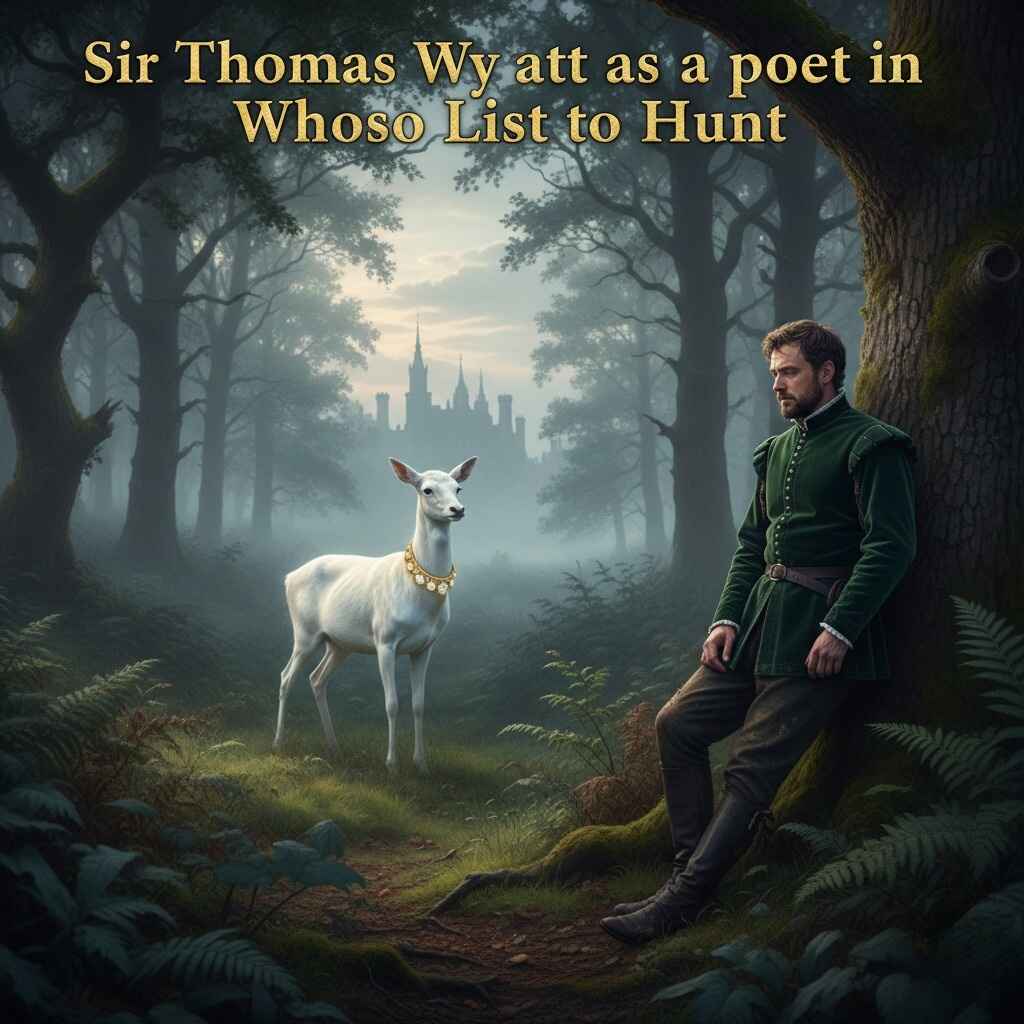
The Hind represents a beautiful and elusive noble woman. Most scholars identify her as the tragic Anne Boleyn. Furthermore, she seems tame but is actually quite wild. She wears a collar that signifies her royal owner. Similarly, she flees from the men who chase her. Consequently, she remains an unattainable prize for the speaker. Moreover, she is the catalyst for the entire poem. Therefore, she embodies the danger of the King’s favor. Indeed, she is both a victim and a temptress in this world.
Caesar
Caesar is the invisible but powerful owner of the deer. He represents the absolute authority of King Henry VIII. Furthermore, he places his mark upon the desired woman. This mark warns all other men to stay away. Similarly, he turns a romantic pursuit into a crime. Consequently, his presence creates a mood of total fear. Moreover, he wins the hunt without even running. Therefore, he represents the finality of the law. Indeed, he is the master of the Tudor world. He commands total respect.
Summary of the Poem
1. The Open Invitation
The speaker addresses anyone who wishes to hunt. Furthermore, he knows where a specific deer resides. He offers a path for those seeking a prize. However, he speaks with a very heavy heart. Similarly, he invites others to share his great burden. Consequently, the hunt appears as an open social challenge. Moreover, he emphasizes the lure of the elusive prey. Therefore, the invitation hides a very dark and bitter truth. Indeed, the hunt is more than a simple game. Transitioning from peace to action, he starts the chase. Hence, he beckons the young men to follow him. Subsequently, he sets the scene in the royal forest. In addition, he highlights the beauty of the wild hind. Thus, the summary begins with this bold public call. Furthermore, he uses his experience to lead the way. He knows the woods better than any other man. This skill defines Sir Thomas Wyatt as a poet in Whoso List to Hunt. He leads the group.
2. Personal Exhaustion
The speaker admits that he is extremely tired. Furthermore, he can no longer endure the long chase. He feels the weight of his many failures. Similarly, he describes his body as a broken tool. Consequently, his fatigue reaches a very deep level now. Moreover, he lacks the spirit to continue the race. Therefore, he stops to catch his laboring breath. Indeed, he finds no joy in the difficult pursuit. Transitioning from vigor to weakness, he reveals his pain. Hence, the hunt drains his soul and his mind. Subsequently, he acknowledges that his time has finally passed. In addition, he feels the cold reality of his age. Thus, the exhaustion defines his current and lonely state. Furthermore, he admits that he cannot win the prize. He watches the others pass him in the woods. Indeed, his legs fail him at the worst moment. This struggle marks Sir Thomas Wyatt as a poet in Whoso List to Hunt. He suffers.
3. The Farthest Behind
He describes his position in the line of hunters. Furthermore, he is the last one in the group. He lacks the strength to catch the lead. Similarly, he watches the deer disappear into the distance. Consequently, he occupies the most humble and distant place. Moreover, he accepts his status as a failing runner. Therefore, he trails behind the younger and faster men. Indeed, his distance from the prey causes him grief. Transitioning from hope to reality, he finds his spot. Hence, he remains the farthest behind in this chase. Subsequently, he reflects on his slow and steady decline. In addition, he sees the vanity of his old speed. Thus, the gap between him and the deer grows. Furthermore, he admits that he will never close it. He stands alone in the shadows of the trees. Indeed, the race leaves him in the dust today. This lag defines Sir Thomas Wyatt as a poet in Whoso List to Hunt.
4. The Futile Effort
He compares his work to catching wind in nets. Furthermore, he knows the task is completely impossible. He wastes his time on a lost cause. Similarly, his labor yields nothing but a deep frustration. Consequently, he mocks his own useless and empty actions. Moreover, he sees the madness of his chosen path. Therefore, he uses the net to symbolize his failure. Indeed, the wind escapes his every and desperate reach. Transitioning from toil to truth, he stops the work. Hence, he admits that the net is too thin. Subsequently, he views his past as a series of errors. In addition, he highlights the folly of the stubborn mind. Thus, the effort remains a source of silent shame. Furthermore, he tells others to avoid his specific path. He knows the wind cannot be held by men. Indeed, the imagery captures his total and complete defeat. This vanity marks Sir Thomas Wyatt as a poet in Whoso List to Hunt.
5. The Obsessive Mind
His thoughts remain fixed on the elusive deer. Furthermore, he cannot turn his head away from her. The obsession drives him to the edge daily. Similarly, his mind refuses to grant him any peace. Consequently, he thinks of the deer even in sleep. Moreover, he finds no escape from her fair image. Therefore, his internal world is a cage of desire. Indeed, he lives for a chase that never ends. Transitioning from reason to madness, he loses his way. Hence, the obsession burns like a fire in him. Subsequently, he acknowledges that his thoughts are his enemies. In addition, he dwells on the curve of her neck. Thus, the mental hunt continues despite his physical fatigue. Furthermore, he admits that he is a slave to her. He follows her ghost through the dark, cold woods. Indeed, the mind creates a reality he cannot break. This focus marks Sir Thomas Wyatt as a poet in Whoso List to Hunt.
6. The Fainting Heart
The physical toll of the hunt is too great. Furthermore, his heart faints as the deer flees. He reaches a point of total physical collapse. Similarly, his spirit breaks under the weight of loss. Consequently, he feels a sharp and sudden internal pain. Moreover, the fainting heart signals the end of hope. Therefore, he sinks to the ground in the forest. Indeed, his body can no longer sustain the chase. Transitioning from pulse to silence, he finds a limit. Hence, the heart stops its heavy and rhythmic beating. Subsequently, he surrenders to the darkness of his failure. In addition, he feels the cold wind on his face. Thus, the collapse marks the death of his ambition. Furthermore, he admits that the hunt has finally won. He lies still while the world moves past him. Indeed, the heart knows the truth of the end. This agony defines Sir Thomas Wyatt as a poet in Whoso List to Hunt.
7. The Act of Withdrawal
He decides to leave the hunt for good. Furthermore, he tells others to go on without him. He seeks a way to find peace now. Similarly, he steps away from the loud, busy chase. Consequently, he chooses to walk a different and quiet path. Moreover, he abandons the hope of catching the hind. Therefore, his withdrawal is a brave and final act. Indeed, he finds strength in the moment of quitting. Transitioning from pursuit to stillness, he changes his life. Hence, he leaves the bloody forest of the court. Subsequently, he turns his back on the elusive deer. In addition, he seeks a life away from royal games. Thus, the withdrawal marks a shift in his soul. Furthermore, he admits that the race is for others. He finds a clearing where he can finally breathe. Indeed, the exit is his only and true path. This choice marks Sir Thomas Wyatt as a poet in Whoso List to Hunt.
8. The Futility of Nets
He repeats the image of the net and water. Furthermore, he emphasizes the madness of his past actions. He sees his own folly quite clearly now. Similarly, he understands that his tools were always wrong. Consequently, he mocks the thinness of his own spirit. Moreover, the water slips through the holes of logic. Therefore, the net represents the failure of human craft. Indeed, he caught nothing but cold and empty air. Transitioning from work to wisdom, he drops the net. Hence, he admits that he was a fool once. Subsequently, he views the sea as a vast rival. In addition, he highlights the scale of his great loss. Thus, the repetition reinforces the theme of total futility. Furthermore, he warns that the net will never hold. He watches the water return to the deep sea. Indeed, the device is as useless as his love. This insight marks Sir Thomas Wyatt as a poet in Whoso List to Hunt.
9. A Warning to Others
He speaks to those who follow his path. Furthermore, he warns them of the same bitter end. He wants to save them from his pain. Similarly, he shares the hard lessons of the forest. Consequently, his voice carries the weight of many years. Moreover, he advises the young to turn back now. Therefore, the warning is a final act of mercy. Indeed, he knows the forest hides many sharp thorns. Transitioning from hunter to teacher, he speaks his truth. Hence, he tells them that the deer is gone. Subsequently, he reveals the high price of the pursuit. In addition, he points to the marks on his skin. Thus, the warning serves as a shield for others. Furthermore, he admits that he was once like them. He sees their hope and feels a deep pity. Indeed, the words are meant to break their hearts. This role defines Sir Thomas Wyatt as a poet in Whoso List to Hunt.
10. The Discovery of the Mark
He approaches the deer and sees a collar. Furthermore, it sits around her fair and white neck. This discovery changes the entire chase for him. Similarly, he sees the hidden sign of her master. Consequently, the collar glitters in the dim forest light. Moreover, it reveals the secret status of the hind. Therefore, the discovery marks the end of his dream. Indeed, he sees the truth written in cold metal. Transitioning from desire to knowledge, he looks closer now. Hence, the collar acts as a lock on her. Subsequently, he understands why she fled from his reach. In addition, he sees the mark of the great King. Thus, the discovery is both a shock and relief. Furthermore, he admits that he was blind before today. He touches the cold gold with his tired eyes. Indeed, the mark tells a story of absolute power. This moment highlights Sir Thomas Wyatt as a poet in Whoso List to Hunt.
11. The Writing in Diamonds
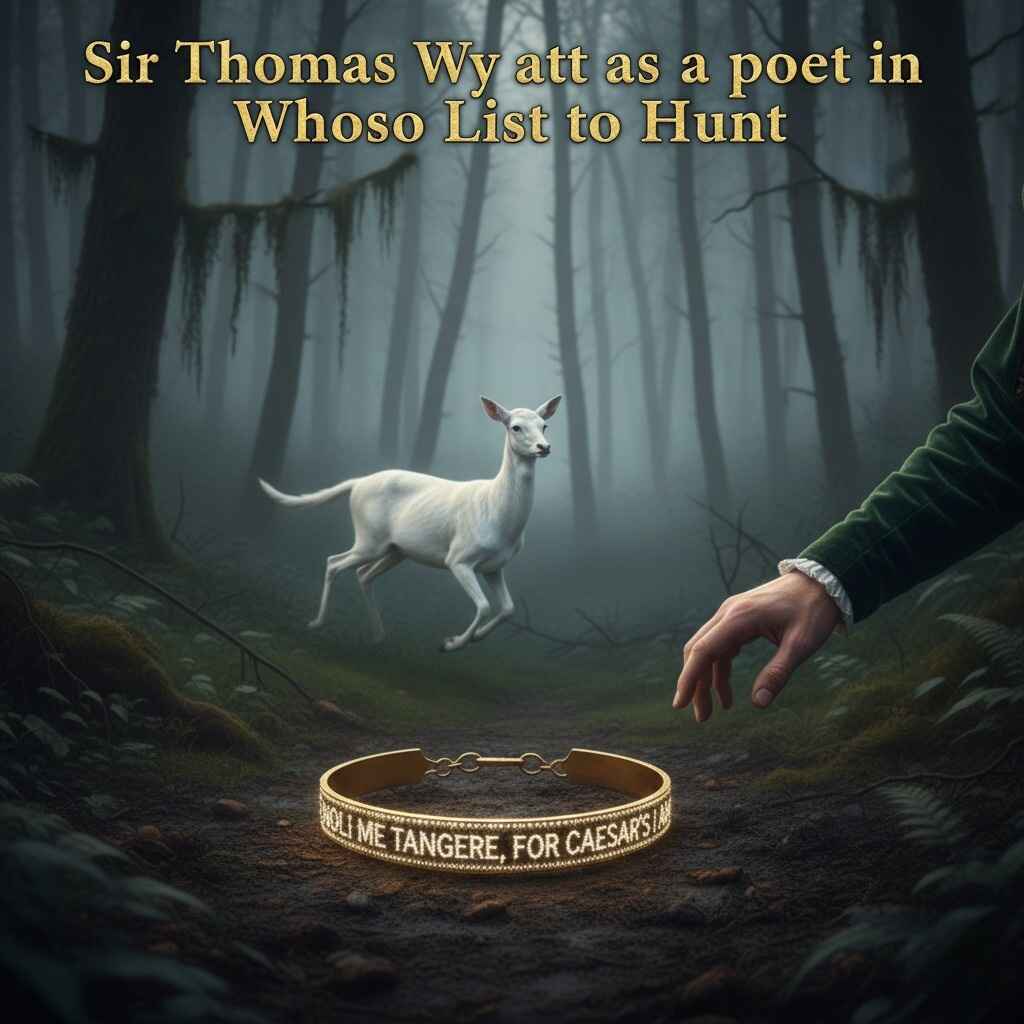
The collar features a message written in diamonds. Furthermore, the letters shine with a hard, clear light. This text reveals the hidden truth of law. Similarly, the diamonds suggest a permanent and cold bond. Consequently, the writing cannot be erased by any man. Moreover, the gems sparkle with a cruel and royal beauty. Therefore, the text establishes a clear and final ownership. Indeed, he reads the words with a shaking heart. Transitioning from beauty to law, he finds the text. Hence, the diamonds serve as a warning to thieves. Subsequently, he realizes that the hind is a treasure. In addition, he sees the value placed on her life. Thus, the writing defines her role in the court. Furthermore, he admits that the diamonds are quite hard. He sees his own reflection in the shining stones. Indeed, the message is a wall between him and her. This skill marks Sir Thomas Wyatt as a poet in Whoso List to Hunt.
12. The Command of Noli Me Tangere
The Latin phrase tells hunters to stay away. Furthermore, it establishes a boundary that no man crosses. It signals a divine or royal protection clearly. Similarly, the words “Touch me not” echo in woods. Consequently, the command carries the weight of a decree. Moreover, it protects the deer from any common hand. Therefore, the hunter must obey the sacred royal law. Indeed, he feels the power of the ancient words. Transitioning from hope to fear, he reads the command. Hence, the phrase acts as a shield for she. Subsequently, he acknowledges the distance between him and Caesar. In addition, he sees the spiritual weight of the text. Thus, the command is a final and absolute barrier. Furthermore, he admits that he cannot touch the hind. He pulls his hand back from her white neck. Indeed, the law is written in the very air. This theme highlights Sir Thomas Wyatt as a poet in Whoso List to Hunt.
13. The Ownership of Caesar
The text declares that she belongs to Caesar. Furthermore, this name represents the highest power on earth. No courtier can challenge this specific royal owner. Similarly, the name Caesar brings a chill to hearts. Consequently, the hind is a piece of royal property. Moreover, her life is tied to the great King. Therefore, the speaker must acknowledge his master’s total claim. Indeed, he sees the King’s shadow in the gems. Transitioning from personal to political, he finds the owner. Hence, the hunt was always a crime against Caesar. Subsequently, he realizes the danger of his past actions. In addition, he feels the eyes of the King. Thus, the ownership is a fact he cannot change. Furthermore, he admits that Caesar wins every single hunt. He bows his head before the royal name today. Indeed, the power of Caesar is a massive force. This reality defines Sir Thomas Wyatt as a poet in Whoso List to Hunt.
14. The Paradox of Wildness
She appears tame to those who watch her. Furthermore, she is actually wild to hold or catch. This contradiction defines her complex and dangerous nature. Similarly, she lives between two different and clashing worlds. Consequently, her beauty hides a very sharp and wild spirit. Moreover, she mimics the peace of the royal garden. Therefore, she deceives the hunters who seek to tame. Indeed, her wildness is a form of secret power. Transitioning from appearance to reality, he sees the truth. Hence, she remains a wild beast at the heart. Subsequently, he acknowledges the trickery of the fair hind. In addition, he sees the fire in her quiet eyes. Thus, the paradox captures her true and elusive soul. Furthermore, he admits that she can never be held. He watches her move with a wild, free grace. Indeed, the wildness is her only true and safe home. This marks Sir Thomas Wyatt as a poet in Whoso List to Hunt.
15. The Final Resignation
The speaker accepts that he has truly lost. Furthermore, he stops his chase and accepts his fate. The hunt ends in a cold, silent air. Similarly, he finds peace in the act of giving. Consequently, he lets go of the rope of desire. Moreover, he walks away from the forest and King. Therefore, his resignation is a quiet and final victory. Indeed, he survives the hunt by leaving the field. Transitioning from runner to walker, he finds his pace. Hence, the deer disappears into the thick, dark green. Subsequently, he closes his eyes and finds a rest. In addition, he knows that the race is finally done. Thus, the resignation marks the end of the poem. Furthermore, he admits that he is finally a free. He breathes the air of a man who quit. Indeed, the end is a new and quiet start. This finale defines Sir Thomas Wyatt as a poet in Whoso List to Hunt.
Critical Appreciation
1. Subversion of Petrarchan Ideals
Wyatt changes the spiritual deer into a political one. Furthermore, he rejects the idea of a holy love. Similarly, he focuses on the harsh reality of power. Consequently, the poem feels more modern and very bitter. Moreover, he uses his sharp and cynical wit daily. Therefore, he creates a new kind of English verse. Transitioning from the Italian source, he finds a voice. Hence, he brings the sonnet down to the earth. Subsequently, he replaces divine light with a cold diamond. In addition, he emphasizes the physical pain of the hunt. Thus, the speaker is a man, not a saint. Furthermore, the love is a crime, not a prayer. Indeed, he proves that English can hold dark truths. This innovation defines Sir Thomas Wyatt as a poet in Whoso List to Hunt. He changed literature forever with one single poem. Consequently, he paved the way for the great Elizabethans. Furthermore, he taught us to see the court’s teeth.
2. Masculine Vulnerability and Failure
He admits his failure and physical pain openly today. Furthermore, he does not hide behind a hero’s mask. He shows the exhaustion of a true courtier now. Similarly, his weakness makes the poem relatable to us. Consequently, he breaks the tradition of the perfect knight. Moreover, he explores the psychological weight of rejection clearly. Therefore, he allows himself to be seen as broken. Indeed, he faints while others continue to run fast. Transitioning from pride to shame, he speaks his truth. Hence, the poem becomes a confession of human limits. Subsequently, he invites us to feel his deep fatigue. In addition, he highlights the cruelty of the social chase. Thus, we see a man who is truly finished. Furthermore, his vulnerability is his greatest strength as writer. This depth marks Sir Thomas Wyatt as a poet in Whoso List to Hunt. He found beauty in the act of quitting. Indeed, he gave a voice to the losers. He spoke for the weak.
3. The Politics of Royal Desire
Love acts as a royal property game here today. Furthermore, the King’s shadow looms over the forest now. The desired woman is not a free agent. Similarly, she exists under the total control of Caesar. Consequently, the hunt represents a dangerous political maneuver always. Moreover, it exposes the dark side of absolute power. Therefore, the speaker must bow to the royal collar. Indeed, the diamonds represent the hardness of the crown. Transitioning from romance to law, he reveals the truth. Hence, the lady is a prize in a game. Subsequently, the King wins without even entering the chase. In addition, the poem serves as a secret warning. Thus, we see the danger of the royal court. Furthermore, every kiss is a matter of state security. Indeed, he knew that the King owned the deer. This insight highlights Sir Thomas Wyatt as a poet in Whoso List to Hunt. He wrote about the price of desire. He knew the risk.
4. Rugged Meter and Disturbed Mind
The jagged rhythm shows a deeply disturbed mind today. Furthermore, Wyatt avoids a perfectly smooth and easy beat. He uses “rough” English to show real stress. Similarly, the meter echoes the hunter’s heavy breath now. Consequently, the poem feels urgent and very immediate. Moreover, it departs from the melodic Italian original style. Therefore, the reader feels the speaker’s physical exhaustion clearly. Indeed, the lines break just like his tired heart. Transitioning from song to speech, he finds a rhythm. Hence, the meter captures the uneven pace of running. Subsequently, he proves that beauty exists in the jagged. In addition, he challenges the ears of the courtly audience. Thus, the sound reflects the chaos of the hunt. Furthermore, his technical choices serve the emotional theme perfectly. Indeed, he mastered the music of the weary spirit. This skill marks Sir Thomas Wyatt as a poet in Whoso List to Hunt. He gave English a new pulse. He broke the old rules.
5. Metaphorical Mastery of the Court
The hunt represents the Tudor court perfectly well today. Furthermore, the forest is a place of predation now. Every hunter is a rival for royal favor daily. Similarly, the deer is the center of the game. Consequently, we see the competitive nature of Wyatt’s world. Moreover, he proves that art can be a mirror. Therefore, the chase is a struggle for social rank. Indeed, he knows the forest holds many hidden traps. Transitioning from sport to politics, he explores the system. Hence, the deer represents the elusive and dangerous favor. Subsequently, he shows how men destroy themselves for power. In addition, the poem captures the cruelty of the chase. Thus, we understand the stakes of the Tudor court. Furthermore, he uses nature to explain the human beast. Indeed, he was a master of the extended metaphor. This aids Sir Thomas Wyatt as a poet in Whoso List to Hunt. He decoded the royal world. He knew every single tree.
6. Cynical Realism and Bitter Truth
He avoids the “happy” endings of old romantic verse. Furthermore, he offers no hope for the future. He tells the truth about his own defeat. Similarly, he warns that love is often a trap. Consequently, his cynicism feels refreshing and quite honest today. Moreover, he rejects the lie of easy courtly success. Therefore, the speaker remains alone in his dark forest. Indeed, he knows that the game is truly rigged. Transitioning from idealism to reality, he finds a voice. Hence, he speaks for those who have lost everything. Subsequently, he reveals the coldness of the lady’s heart. In addition, he shows the vanity of human chasing. Thus, we see the world as it really is. Furthermore, he refuses to sugarcoat the pain of rejection. Indeed, his bitterness is a form of artistic integrity. This grounds Sir Thomas Wyatt as a poet in Whoso List to Hunt. He preferred the cold, hard fact. He saw through the royal masks.
7. Social Hierarchy and Royal Absolute
The poem reflects the massive power of the King. Furthermore, it defines the limits of a commoner’s reach. Every social rank has its specific boundaries here. Similarly, the diamond collar serves as a legal fence. Consequently, the speaker must acknowledge his lower status now. Moreover, he bows to the will of Caesar today. Therefore, the hierarchy determines the outcome of the heart. Indeed, the King owns the forest and the deer. Transitioning from individual to subject, he accepts the law. Hence, the poem is a lesson in royal obedience. Subsequently, he shows the futility of rebelling against rank. In addition, the collar is a sign of state control. Thus, we see the weight of the Tudor crown. Furthermore, he warns that ambition has a ceiling today. Indeed, he knew his place in the royal line. This humble Sir Thomas Wyatt as a poet in Whoso List to Hunt. He understood the crown. He knew the absolute power.
8. Intellectual Depth and Complex Paradox
He uses complex paradoxes to tell a difficult truth. Furthermore, he finds meaning in the hunter’s failure. The deer is both a prize and poison. Similarly, he explores the duality of human obsession daily. Consequently, his poem requires a very careful mental effort. Moreover, he elevates the status of English thought processes. Therefore, the reader must think as they feel today. Indeed, the “tame wildness” is a brilliant mental puzzle. Transitioning from emotion to intellect, he builds a structure. Hence, he proves that love is a logical problem. Subsequently, he uses the sonnet to solve human riddles. In addition, he finds a balance between heart and head. Thus, the poem is a work of high philosophy. Furthermore, he challenges the reader to look deeper always. Indeed, he was a master of the witty line. This enriches Sir Thomas Wyatt as a poet in Whoso List to Hunt. He was a thinker. He mastered the mental hunt.
9. Structural Innovation of the Sonnet
He builds toward a sharp and final point today. Furthermore, he adapts the octave and sestet structure now. The “turn” in the poem happens with precision. Similarly, he experiments with the final rhyming couplet daily. Consequently, he paved the way for the Shakespearean form. Moreover, his structure supports the weight of his theme. Therefore, the form mirrors the movement of the hunt. Indeed, he controlled the flow of the English language. Transitioning from the Italian model, he builds a house. Hence, he gives the sonnet a new and solid floor. Subsequently, he proves that structure can enhance the meaning. In addition, he uses the rhyme to snap the trap. Thus, the final lines provide a cold, clear end. Furthermore, he mastered the architecture of the short lyric. Indeed, he was a builder of the English spirit. This guides Sir Thomas Wyatt as a poet in Whoso List to Hunt. He built a lasting legacy.
10. Legacy of Honest Speech to Power
He speaks truth to an absolute and deadly power. Furthermore, he uses allegory to protect his neck today. His courage as a writer is truly immense always. Similarly, he established the poet as a social critic. Consequently, his work remains a pillar of the Renaissance. Moreover, he defined the voice of the English lyric. Therefore, we still read his warnings in the modern world. Indeed, he showed that the pen is a shield. Transitioning from courtier to icon, he leaves a mark. Hence, his words survived the axes and the towers. Subsequently, he taught us how to speak from shadows. In addition, he remains a hero of the written word. Thus, the legacy is one of truth and art. Furthermore, he proved that a sonnet can change everything. Indeed, he was a giant of the Tudor age. This crowns Sir Thomas Wyatt as a poet in Whoso List to Hunt. He survived the courtly shadows.
Use of Poetic Devices
Extended Metaphor
The hunt serves as a metaphor for love. Wyatt famously utilizes this imagery in his major works. Furthermore, he compared the lady to a wild hind. This comparison highlights the predatory nature of the court. Similarly, the speaker is depicted as a failing hunter. Consequently, loving becomes a dangerous and exhausting physical sport. Moreover, the hunt reflects dynamics between king and courtier. Therefore, the lady is seen as royal property. Sir Thomas Wyatt as a poet in Whoso List to Hunt shines here. However, Wyatt subverts the trope by admitting defeat. Hence, the poem becomes a warning to ambitious men. In addition, the deer represents a site of ownership. Subsequently, he turned pastimes into profound political allegory. Indeed, his metaphors require deep and careful reading today. Thus, he gave English poetry a new visual language. He captured the elusive nature of desire and power. Every chase tells a hidden story of the crown.
Alliteration
Alliteration provided Wyatt with a tool for emphasis. He used repeating sounds to create internal tension. Furthermore, alliteration adds a percussive quality to verse. Sir Thomas Wyatt as a poet in Whoso List to Hunt excels. Similarly, he used hard sounds to mimic sharp pain. Consequently, his poetry possesses a physical weight for readers. Moreover, alliteration makes his lines much more memorable. Therefore, he mastered sounds to represent courtly secrets. However, he avoided using it in a forced way. Hence, the technique feels like a natural extension. In addition, he used it to ground his translations. Subsequently, he created a uniquely English music for sonnets. Indeed, the repeating letters pull the reader into despair. Thus, we hear the “f” in “farthest” and “fainting.” This choice shows his careful attention to sonic detail. Finally, he used sound to echo the hunter’s breath. He used the “s” to show the secret whispers.
Paradox
Paradox is the expression of two contradictory truths. Wyatt excelled at describing the “burning ice” of hearts. Furthermore, he used paradox to capture courtly absurdity. Sir Thomas Wyatt as a poet in Whoso List to Hunt thrives. Similarly, he found that love was a curse. Consequently, his poetry reflects the unstable nature of time. Moreover, paradox highlights the limits of human logic. Therefore, it became a favorite tool for his work. However, he used it to show the messy truth. Hence, his poems avoid simple answers to life. In addition, paradox allowed him to explore dual souls. Subsequently, he influenced later poets with his sharp wit. Indeed, the deer is both tame and wild. This specific paradox explains the danger to the woman. Thus, we see his skill in managing opposites. Finally, he proves that truth exists in the tension. He balanced the cold metal with the warm skin.
Caesura
The caesura is a deliberate pause within a line. Wyatt used this to mimic the speaker’s hesitation. Furthermore, it creates a sense of gasping for breath. Sir Thomas Wyatt as a poet in Whoso List to Hunt is masterful. Similarly, this break disrupts the smooth flow of meter. Consequently, the reader is forced to slow down often. Moreover, the caesura adds realism to his courtly lyrics. Therefore, his poems sound like a man speaking. However, this jaggedness was misunderstood by later melodic poets. Hence, Wyatt’s use of the pause shows authenticity. In addition, it allows for a sudden shift in tone. Subsequently, he used silence as effectively as complex words. Indeed, the pause highlights the hunter’s total physical exhaustion. Thus, the rhythm breaks just as his heart fails. Finally, he used the gap to build dramatic tension. He allowed the silence to speak for his tired soul.
Symbolism
The golden collar represents a symbol of absolute ownership. Wyatt utilized this image to define royal power boundaries. Furthermore, the collar marks the deer as Caesar’s property. Sir Thomas Wyatt as a poet in Whoso List to Hunt is clear. Similarly, the diamonds symbolize the hard and cold law. Consequently, the symbols turn a romance into a trial. Moreover, the net represents the futility of human desire. Therefore, he warns that chasing dreams often leads to traps. However, the symbols remain grounded in real courtly life. Hence, the reader understands the physical cost of failure. In addition, he used nature to symbolise social structures. Subsequently, he expanded the symbolic range of English lyrics. Indeed, every object in the poem holds a weight. Thus, the collar is a shackle for the heart. Finally, he used symbols to protect his own life. He turned a diamond into a sharp political warning.
Enjambment
Enjambment occurs when a sentence runs over the line. Wyatt used this to create relentless and flowing energy. Furthermore, it prevents the poem from sounding too simple. Sir Thomas Wyatt as a poet in Whoso List to Hunt succeeds. Similarly, this technique mirrors the speaker’s anxious thoughts. Consequently, his sonnets feel like a single urgent breath. Moreover, enjambment allows for complex sentence structures in verse. Therefore, he moved away from old medieval styles. However, he used it sparingly to ensure rhymes landed. Hence, he balanced modern flow with traditional stable forms. In addition, it highlights the conversational tone of lyrics. Subsequently, he gave English poetry a new flexible rhythm. Indeed, the sentences chase the deer across the page. Thus, we feel the momentum of the failing hunt. Finally, he used the flow to show obsession. He allowed the words to spill into the dark woods.
Iambic Pentameter
Iambic pentameter provides the steady heartbeat of the sonnet. Wyatt introduced this rhythm to the English poetic tradition. Furthermore, he often broke the meter to show stress. Sir Thomas Wyatt as a poet in Whoso List to Hunt is iconic. Similarly, the ten-syllable line provides a formal structure. Consequently, the poem feels organized despite the emotional chaos. Moreover, he adapted the Italian beat to English sounds. Therefore, he established the foundation for all future poets. However, his meter is often rugged and quite difficult. Hence, it requires a careful and rhythmic reading style. In addition, he used the beat to emphasize key words. Subsequently, he transformed the sound of the English language. Indeed, the rhythm mirrors the steady pace of hunting. Thus, we hear the footsteps of the tired speaker. Finally, he mastered the music of the Tudor court. He gave a new life to the old English tongue.
Imagery
Visual imagery brings the world of the hunt alive. Wyatt used sensory details to place us in forests. Furthermore, he described the “fair” neck of the deer. Sir Thomas Wyatt as a poet in Whoso List to Hunt works well. Similarly, we see the “diamond” letters on the collar. Consequently, the imagery creates a vivid and cinematic experience. Moreover, he uses cold colors to show emotional distance. Therefore, the reader feels the chill of the rejection. However, the imagery serves a deeper and symbolic purpose. Hence, it is never just decorative or purely aesthetic. In addition, he linked the landscape to the speaker’s soul. Subsequently, he created a landscape of the troubled mind. Indeed, we smell the sweat of the failing chase. Thus, his words paint a picture of courtly doom. Finally, he used sight to reveal hidden truths. He used the white neck to show the purity of the prize.
Word Choice (Diction)
Wyatt selected words with a very sharp and cutting edge. He avoided the soft language of traditional romantic verse. Furthermore, he used terms like “travail” and “weariness” often. Sir Thomas Wyatt as a poet in Whoso List to Hunt is precise. Similarly, his diction reflects the harsh reality of court. Consequently, the poem feels more honest and less artificial. Moreover, he chose words that suggest legal and property. Therefore, love becomes a matter of contracts and ownership. However, he still managed to maintain a lyrical beauty. Hence, his vocabulary bridges the common and the royal. In addition, he utilized Latin phrases for a global weight. Subsequently, he proved English was a flexible and deep. Indeed, every word serves the theme of the hunt. Thus, his diction is a weapon of the mind. Finally, he mastered the art of concise speech. He used the diamond to show the cold law.
Conclusion
The enduring legacy of Sir Thomas Wyatt as a poet in Whoso List to Hunt is unmatched. He provided the initial spark for the English Renaissance. Furthermore, he showed that English could match continental grace. He gave us the sonnet and new feelings. Similarly, his influence appears in the work of Shakespeare. Consequently, we must view him as a literary father. Moreover, his story reminds us of creative truth’s cost. Therefore, his poems remain as relevant today as before. However, he was more than just a translator. Hence, his rugged and honest voice speaks to us. In addition, he taught us to find beauty. Subsequently, we celebrate his courage and his technical skill. Indeed, he was a giant in a dangerous age. Thus, his name will forever lead the greats. Finally, his work ensures his voice will never fade. He remains the father of the English sonnet forever. Indeed, he won the race of history.
For the reading of Thomas Wyatt as a Poet, follow the link: https://englishlitnotes.com/2026/02/10/sir-thomas-wyatt-as-a-poet-the-tudor-pioneer-of-sonnet/
To read The Canadian Novel of the Confederation Period, follow the link: https://canlitstudies.blogspot.com/2026/02/novels-of-the-confederation-period-1860-1900-canada.html
Discover more from Naeem Ullah Butt - Mr.Blogger
Subscribe to get the latest posts sent to your email.