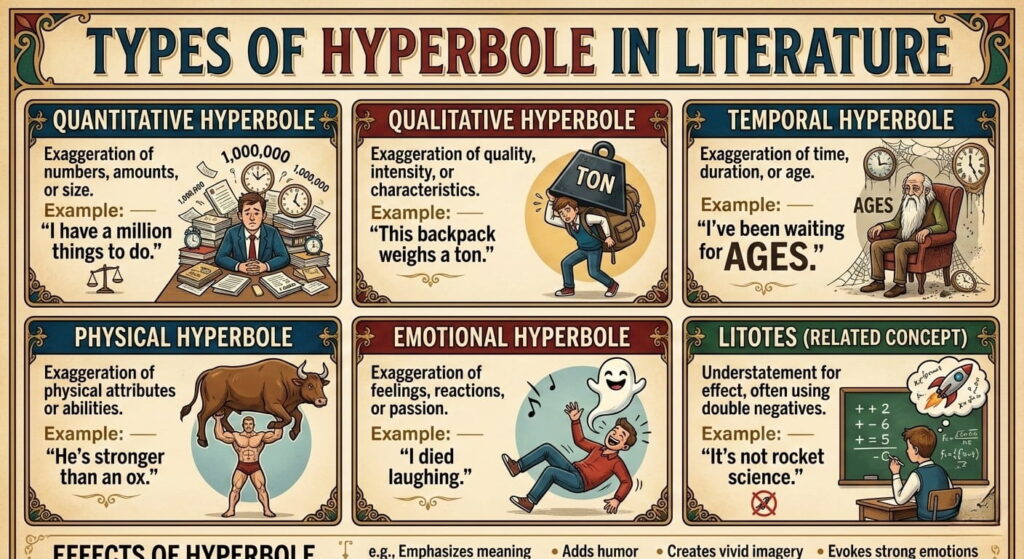
The exploration of the various Types of Hyperbole in Literature allows readers to understand the depth of human emotion. Hyperbole is not merely a lie or a simple exaggeration. It is a deliberate tool used by authors to magnify reality. Consequently, this magnification helps to highlight a specific truth. Literal language often fails to capture such intense feelings. In this detailed study, we examine how these devices function. We see how they appear across many different genres. Moreover, we dive deep into the mechanics of exaggeration. We appreciate why poets love this specific tool. Indeed, playwrights and novelists also use it very often. Therefore, the device remains a favorite for all writers. It turns a boring sentence into a powerful statement. Similarly, it creates a vivid image in the reader’s mind. Thus, we see the true power of creative writing. Additionally, writers use it to build very strong connections. They want the reader to feel every single emotion. Hence, the text becomes much more alive and engaging. We must look at the roots of this device. It has served humanity for thousands of years. It defines our greatest stories and our deepest myths. Furthermore, it gives our language a unique and bright color. It allows us to speak about feelings with immense power.
Defining the Device
To begin, one must define the device itself clearly. We categorize these tools for academic clarity. The word hyperbole comes from a Greek root word. It specifically means the act of throwing beyond. Therefore, it represents a statement that is technically impossible. Authors do not use it to deceive the reader. Instead, they want to evoke a very strong reaction. They often add a touch of humor to scenes. In contrast to a lie, hyperbole is very honest. This is because Types of Hyperbole in Literature show emotional truth. They rely on the reader to see the exaggeration. Truly, it is a secret agreement between two parties. The writer and the audience see a bigger reality. Furthermore, this tool makes the prose feel very energetic. Likewise, it prevents the text from sounding too dry. Consequently, every student should learn to identify these markers. We see them in every era of writing history. Additionally, they help to clarify the intent of the author. Thus, the definition serves as our firm academic foundation. We use it to build our understanding of art. It allows us to speak about feelings with power. We see it in the market and the school. It makes our daily speech much more vivid.
Essential Keywords for Identification
Identifying the Types of Hyperbole in Literature requires a sharp eye. You must look for specific and strong linguistic markers. These keywords act as signals for the curious reader. They show when the author leaves literal prose behind. By mastering these terms, students categorize text very easily. They find these signals in many famous old books. These markers often involve words that show massive scale. Likewise, they use frequency and very extreme comparisons. Therefore, we should look for the following common indicators:
- Mountain: Used for piles of objects or burdens.
- Ocean: Used for vast distances or deep emotions.
- Ton: Used to emphasize huge effort or pressure.
- Million: Numerical extremes for uncountable quantities.
Consequently, these words transform a small object into a monument. Moreover, the author creates a sense of total wonder. Similarly, they use these words to highlight major stakes. Therefore, keywords are vital for any deep literary analysis. Thus, we see how language grows through creative excess. We find these words in poems and in plays. They give our language its unique and bright color. These signals provide a roadmap for every careful researcher. They allow us to decode the hidden layers of meaning.
Keywords of Time and Intensity
Temporal distortion is a hallmark of many literary works. We see this often in Types of Hyperbole in Literature. By stretching a second, authors show subjective time. Key indicators include words that suggest an infinite duration. Furthermore, intensity provides the necessary punch for effective prose. Writers use specific terms to amplify basic bodily sensations. We find these markers in every major genre today. Consider these frequent examples found in classic texts:
- Forever: Suggesting an infinite duration for a task.
- Eternity: Emphasizing impatience or the weight of moments.
- Starving: Amplifying basic sensations of hunger or need.
- Absolute: Reinforcing the total nature of a claim.
Consequently, these tools alter our perception of the plot. They show how a character feels about their wait. Indeed, time becomes a tool for the skilled writer. They manipulate the clock to suit their own narrative. Similarly, this creates a feeling of endless struggle or joy. Therefore, the reader feels the slow crawl of time. Likewise, it adds a layer of drama to prose. Thus, we appreciate the flexibility of the English language. Additionally, it shows the power of a single word. Time is not a fixed thing in great books. It expands or shrinks to match our human hearts.
The Primary Categories of Hyperbole
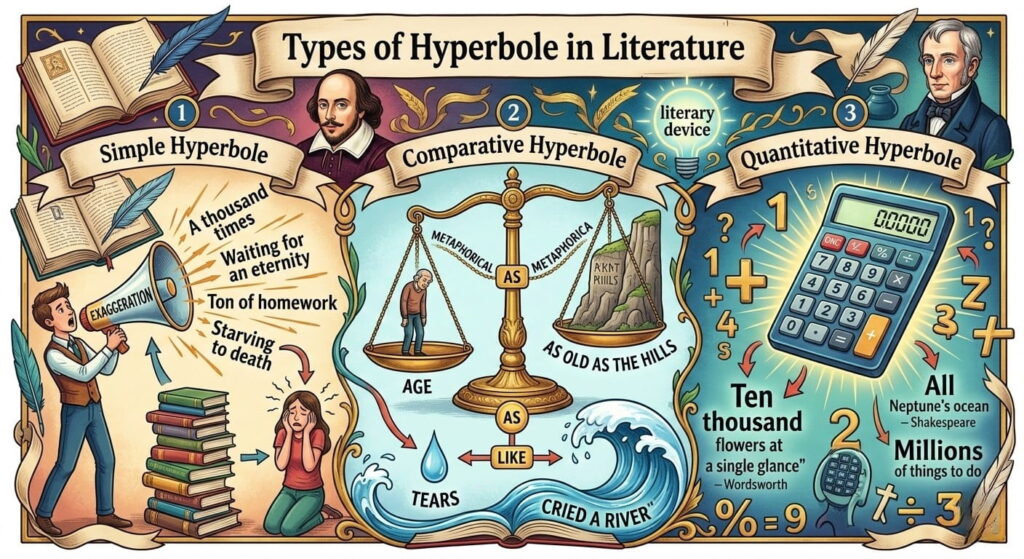
When we classify the Types of Hyperbole in Literature, we find branches. Each branch serves a very specific and unique purpose. It depends on the context of the long poem. Understanding these categories allows for a much better analysis. Writers manipulate reality to suit their own creative needs. We generally divide these into three distinct groups:
- Simple Hyperbole: A direct phrase like “a thousand times.”
- Comparative Hyperbole: Using similes like “as old as hills.”
- Quantitative Hyperbole: Focusing on exact numbers and measurements.
Consequently, these categories allow for a much better analysis. Thus, it is the most common form for drama. Dialogue-heavy prose uses this simple style very frequently. Its strength lies in its very short length. Moreover, it mimics the natural outbursts of real people. Similarly, it keeps the pace of the story moving. Therefore, simple hyperbole is an essential tool for authors. Consequently, it creates a very relatable and human voice. Indeed, the reader recognizes these patterns from daily life. We hear them in the market and the school. They make our daily speech much more vivid. Every category adds a new layer to the text. We see the craft of the writer in every line. We learn to appreciate the structure of great art.
Deep Dive into Shakespeare and Wordsworth
To truly master the Types of Hyperbole in Literature, look at masters. Literature is filled with instances where exaggeration defines a character. We look at the plays of the Elizabethan theater. We also examine the pages of many modern novels. Hyperbole has been used to build entire worlds for us. It allows authors to speak about very difficult topics easily. We see this in the following major literary examples:
- Macbeth: Claiming Neptune’s ocean cannot wash his hands.
- Daffodils: Seeing ten thousand flowers at a single glance.
- A Modest Proposal: Suggesting the consumption of small children.
Consequently, the reader feels a sense of deep horror. This horror leads to a demand for social justice. Therefore, hyperbole becomes a very sharp and heavy weapon. Likewise, it exposes the cold heart of the ruling class. Swift knew that literal facts often fail to move. Thus, he used the extreme to wake the world up. Additionally, it proves that art can change our society. We see the power of words to fight evil. The hyperbole cuts deeper than any regular political speech. It forces the reader to face the hard truth. Furthermore, it shows that humor can be very serious. Hence, satire relies on hyperbole to show our true face. It breaks the silence of a very cold world. We find the same patterns in every major language.
Enhancing Character and Distinct Voices
Furthermore, these devices help in developing very distinct voices. Each character uses the Types of Hyperbole in Literature differently. A dramatic character might exaggerate every single small thing. Conversely, a hero might use it to show bravery. As a result, the choice of words defines the person. It tells us about their background and their heart. We see their education and their current mental state. We can categorize characters based on their speech:
- The Romantic: Uses nature to describe internal beauty.
- The Tragic Hero: Uses cosmic scale to show guilt.
- The Satirist: Uses cruelty to highlight social flaws.
Therefore, these rhetorical tools act as a mirror for us. They reflect the soul of the person speaking them. Likewise, they create a sense of realism in fiction. Even an impossible claim feels real in the moment. Thus, we trust the voice of the talented writer. Additionally, it allows for a lot of creative variety. No two characters sound the same when they brag. One might use numbers while another uses metaphors. Consequently, the world of the book feels very rich. Every page offers a new way to see truth. We learn to listen to the subtext of words. Furthermore, it helps to build a very consistent world. The reader knows what to expect from each character. Hence, characterization grows through the use of hyperbole. It makes every person in the story feel very alive.
Conclusion
In conclusion, the study of the Types of Hyperbole in Literature reveals creativity. By utilizing keywords, authors transform simple and plain sentences. They create powerful statements that live in our hearts. Whether through simple or comparative means, they remain vital. We continue to appreciate how they shape our world. We continue to analyze many great works of art and must appreciate how these tools shape our truth. They impact our perception of every single human emotion. Furthermore, they remind us that language is a living thing. It grows and expands to fit our own large hearts. Therefore, we should not fear the use of excess. It is the very soul of our greatest stories. Likewise, it connects us to the ancient poets and writers. Thus, we see the continuity of the human spirit. Additionally, it invites us to use our own imagination more. We can see a world that is bigger than facts. Hence, hyperbole remains a light in the dark for us. It guides us to the center of the human experience. We find truth in the biggest and loudest of claims. Every student of literature must master this specific craft. It is the key to a very rich world. We find the infinite in a single bold word.
Difference between Simile and Metaphor: https://englishlitnotes.com/2025/06/17/difference-between-simile-and-metaphor/
Characterization in The Overstory by Richard Powers: https://americanlit.englishlitnotes.com/characterization-in-overstory/
Discover more from Naeem Ullah Butt - Mr.Blogger
Subscribe to get the latest posts sent to your email.