
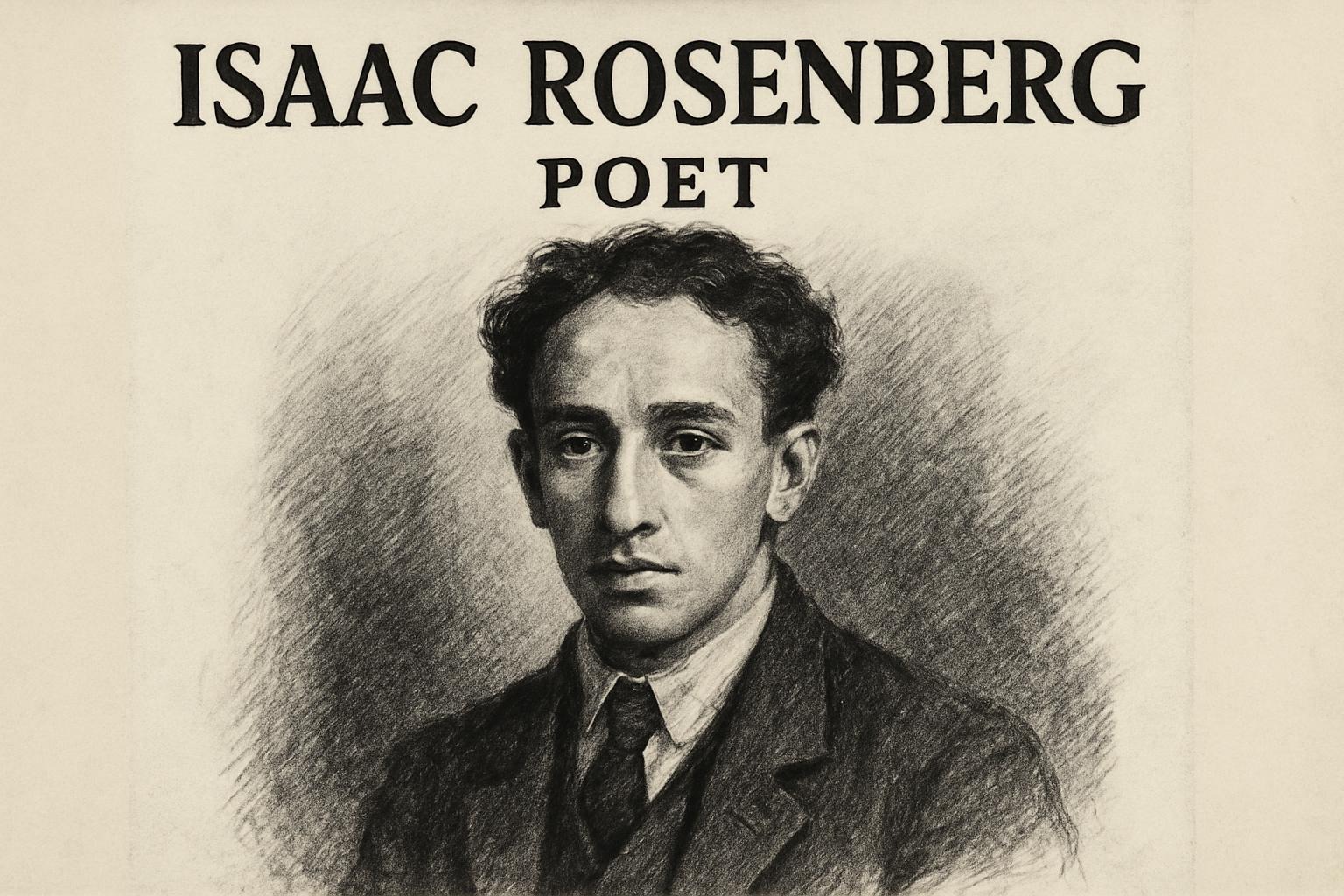
Introduction to Isaac Rosenberg as Poet
Isaac Rosenberg, therefore, stands as a tragically pivotal figure whose poetic work, though superficially rooted in the early Georgian poetic voice, decisively transcended the sentimental confines often associated with the era’s wartime verse. Consequently, his unique and immensely influential contribution was to inject an essential, uncompromising Modernist edge into the prevailing literary landscape, thus anticipating the structural and aesthetic ruptures that would come to define the succeeding decades. Furthermore, his brief but impactful career was wholly defined by his unflinching observation and absolute commitment to raw Trench realism, therefore making his poetry a stark, necessary rejection of the comfortable patriotic narratives and heroic clichés favored by home-front poets and critics. Moreover, Isaac Rosenberg as Poet uniquely fused the raw, terrifying soldier-poet perspective with an astonishing technical skill, evident in his meticulous lyric precision and a disturbing, profound visionary intensity. In addition, his poetry is marked by a raw, compelling brutal honesty that directly confronts the specific, visceral reality of human suffering without any form of evasion or sugar-coating. Therefore, he channeled his acute sense of outsider cultural identity and intense personal artistic struggle into verses characterized by haunting, powerful stark symbolism and overwhelming emotional rawness. Thus, his work is fundamentally less about traditional heroism and more about documenting the chaotic, fragmented experience and psychological disintegration caused by modern, industrialized conflict. Consequently, his radical style and intellectual depth ensure his enduring critical relevance, long after his death. Moreover, his challenging experimental diction remains a key, vital component of his legacy. Furthermore, his deep psychological depth elevates his specific war poems to universal statements on the human spirit’s endurance under extreme pressure. In conclusion, he remains one of the most important, original, and morally serious voices of his generation.
1. Defining the Georgian poetic voice
The Georgian poetic voice, therefore, initially served as the aesthetic framework for Rosenberg’s earliest, more traditional work, although he quickly began to strain dramatically against its lyrical and thematic limitations. Consequently, this stylistic adherence initially provided him with a necessary formal structure and accessibility, thus offering a foundation upon which he could later build his radical and challenging lyric precision. Furthermore, the period’s standard emphasis on vivid sensory detail, particularly of nature, was a poetic trait he internalized, but rather transformed it into something new and terrible through his uncompromising commitment to trench realism. Moreover, the pastoral and idyllic elements of the Georgian tradition were brutally subverted in his work, thereby turning conventional nature themes into bleak harsh natural imagery that vividly reflected the shattered, desecrated landscape of the battlefield. In addition, he utilized established, familiar forms and meters, but furthermore infused them with an unprecedented level of emotional rawness and pervasive rhythmic tension that disrupted their smoothness. Therefore, Isaac Rosenberg as Poet inherited the conventional voice of his time, but then shattered its limitations through content and form, thus forging a new, painful path toward his powerful modernist edge. Consequently, the profound stylistic tension between the traditional voice and his radical content is central to his unique aesthetic achievement. Moreover, this stylistic conflict ensured his rapid and highly original development. In conclusion, his earliest influences provided only a temporary starting point for his own revolution.
2. The Power of War imagery
Rosenberg’s poetry derives immense and deeply unsettling power from his harrowing War imagery. Consequently, he made a deliberate and ethical choice to discard the prevailing euphemism and heroic abstraction, instead presenting scenes of graphic immediacy that violently immerse the reader in the chaos and physical horror of the trenches. Therefore, his searing imagery is deeply and intelligently saturated with stark symbolism, thus transforming mundane, dreadful objects like mud, rusted wire, and poison gas into profound, resonant metaphors for spiritual entrapment, existential decay, and civilizational collapse. Furthermore, this searing imagery is directly and inextricably connected to his commitment to unflinching observation, lending it undeniable documentary authority and force. Moreover, it transmits the brutal reality of human suffering with unprecedented, direct visceral force, demanding an immediate and honest emotional response from the reader. In addition, his most powerful images often juxtapose the mechanical, impersonal brutality of modern war with moments of genuine visionary intensity and profound mythic scope. Therefore, he achieved a difficult, haunting balance between the immediate, physical reality he recorded and the sublime, tragic moral meaning of the conflict. Thus, Isaac Rosenberg as Poet created indelible, haunting images that are impossible to forget or dismiss. Consequently, the raw, enduring power of his verse is rooted in its unquestionable truth. Moreover, his images were both deeply personal and universally resonant with tragic import. In conclusion, his imagery is the primary vehicle for his message.
3. Commitment to Trench realism
His defining and unwavering commitment was to absolute Trench realism. Consequently, Isaac Rosenberg as Poet utterly refused to sanitize, minimize, or romanticize the conflict for any reason, instead documenting the daily, monotonous, and grinding horror experienced directly by the soldier-poet perspective. Therefore, this radical realism is deeply rooted in his absolute brutal honesty, thus rejecting the comforting patriotic idealism that permeated popular culture and much of the early, conventional war poetry. Furthermore, he employed copious, specific vivid sensory detail—the texture of the mud, the stench of decay, the metallic taste of fear—to convey the specific, tangible, and destructive environment of the front line. Moreover, this ethical commitment was absolutely essential for accurately capturing the debilitating fragmented experience of modern, industrialized warfare on the individual mind and body. In addition, this uncompromising form of trench realism required immense poetic courage to defy both established literary conventions and powerful social pressures of the time. Therefore, his work stands today as a primary, authoritative document of the war’s psychological and physical toll, far surpassing simple reportage. Thus, his realism gives his poetry an undeniable, harrowing authority and legitimacy. Consequently, he was determined to portray the unvarnished, awful truth of the conflict. Moreover, this ethical commitment became his aesthetic and moral signature.
4. Elements of Visionary intensity
Despite his grounding in harsh Trench realism, Rosenberg’s poetry is consistently infused with a profound Visionary intensity. Consequently, he perceived the war not merely as a local or temporary military event, but rather as a profound, archetypal, and mythic tragedy of civilization itself in collapse. Therefore, his sharp and penetrating stark symbolism often elevates the specific plight of the soldiers to a universal, near-apocalyptic scale, carrying the weight of Biblical echoes. Furthermore, this inherent intensity allows him to blend his immediate, physical realism with unexpected moments of profound, spiritual insight and startling aesthetic beauty, defying the mundane. Moreover, it is directly tied to his emotional rawness and his radical, difficult experimental diction, which seeks to express the inexpressible. In addition, this compelling visionary element distinguished him sharply from his more prosaic, purely descriptive Georgian contemporaries, whose scope was often more limited. Therefore, Isaac Rosenberg as Poet successfully created a verse that is simultaneously grounded in immediate physical fact and powerfully transcendent in its moral and spiritual scope. Thus, his intensity adds crucial layers of deep, lasting, and universal meaning to his work. Consequently, his poetry explores profound, universal existential questions about life, fate, and the meaning of suffering. Moreover, this elevated vision greatly enhanced his unique lyricism.
5. The Technique of Stark symbolism
Rosenberg utilized the sophisticated technique of Stark symbolism with powerful and often devastating effect throughout his major war poems. Consequently, simple but dreadful images such as “the wire,” “the eternal mud,” or “the wheels of God” function not just as harrowing war imagery, but rather as precise, concise metaphors for spiritual entrapment, existential futility, and unstoppable, impersonal decay. Therefore, this potent symbolism contributes significantly to his overall visionary intensity, thus concentrating vast, complex philosophical ideas into single, forceful, and deeply memorable images. Furthermore, the symbolism often deliberately carries resonant Biblical echoes, lending the contemporary, mechanical conflict a deep, timeless moral and spiritual resonance that connects it to ancient tragedy. Moreover, this technique was artistically necessary as it allowed him to convey the generalized, immense human suffering of the trenches without ever resorting to sentimentality or unnecessary explanation. In addition, his effective symbolism required both his meticulous lyric precision and profound psychological depth to function seamlessly and powerfully. Therefore, his symbols are economical, intellectually precise, and devastatingly effective in their immediate emotional impact. Thus, Isaac Rosenberg as Poet made complexity and moral urgency legible to his readership. Consequently, the sheer starkness of his symbolism gave his emotional verse its intellectual authority and clarity. Moreover, this technique became an indispensable aspect of his unique Modernist style.
6. Focus on Human suffering
The relentless, central focus on Human suffering defines the moral and thematic core of all of Rosenberg’s war poetry. Consequently, he bore direct and explicit witness to the physical, psychological, and spiritual degradation of the front line soldier, thus making his entire body of work a profound testament to brutal honesty. Therefore, his stark, direct portrayal of trench realism is his way of demanding moral accountability and necessary empathy from his civilian readers who were far from the fighting. Furthermore, this intense focus is often captured through his highly selective and impactful vivid sensory detail that makes the pain, cold, and decay palpable and immediate for the reader. Moreover, confronting this difficult subject matter necessitated an absolutely firm anti-romantic tone, thus rejecting any possibility of glorification, whether patriotic or personal, of sacrifice or heroism. In addition, his deep, innate broad sympathy is consistently evident in his nuanced and compassionate exploration of conflict psychology among his fellow soldiers. Therefore, Isaac Rosenberg as Poet ensured that the immediate and lasting human cost of the modern war would never be softened, minimized, or forgotten by the historical record or literary memory. Thus, his focus on suffering becomes his most potent, universal, and enduring theme. Consequently, his profound moral purpose was evident and unshakeable in every single line he wrote.
7. Mastery of Lyric precision
Despite the chaotic and fragmented nature of his subject matter, Rosenberg achieved an astonishing mastery of Lyric precision. Consequently, his remarkable control over rhythm, meter, and the sonic properties of language allowed him to concentrate his immense emotional rawness into highly controlled, formally dense, and powerfully memorable structures. Therefore, this technical precision gives his unique dark lyricism its sharp, intellectual cutting edge, thus providing a necessary structural and aesthetic balance to the intensity and horror of his war imagery. Furthermore, this formal control was absolutely crucial for the effective, economical use of his powerful stark symbolism, which depends on compact language. Moreover, this technical mastery decisively distinguished his work from that of merely writing highly detailed, unstructured, or overly sentimental war reports. In addition, lyric precision allowed him to subtly underscore the unsettling fragmented experience and inner disarray of the soldier’s chaotic existence, often through unexpected enjambment or rhythmic breaks. Therefore, Isaac Rosenberg as Poet successfully fused advanced formal skill, inherited but modified from the Georgian tradition, with the radical, uncompromising content of modern warfare. Thus, his technical control is a highlight of his genius and artistic maturity. Consequently, precision dramatically intensified the moral weight of his visionary impact. In conclusion, his formal skill provided the necessary, disciplined vessel for his difficult truths.
8. The Impact of Modernist edge
Rosenberg introduced a necessary and defining Modernist edge to the literature emerging from World War I, ensuring his future relevance. Consequently, his conscious rejection of established lyrical conventions and his bold adoption of disruptive experimental diction marked a decisive, aesthetic break from the predictable, conventional Georgian poetic voice. Therefore, this sophisticated modernist edge is conspicuously visible in his formal exploration of fragmented experience, thus directly mirroring the structural and aesthetic concerns of the contemporary European avant-garde poets and artists. Furthermore, his deep psychological depth and commitment to unflinching observation further align him closely with the formal innovations of high modernism, which explored internal states, ensuring his critical longevity. Moreover, this experimental quality ensures his enduring relevance beyond the immediate, specific context of the Great War itself, making him a poet for all time. In addition, his radical, challenging style demonstrated immense poetic courage in the face of conservative critical expectation and popular taste, which favored simpler poems. Therefore, Isaac Rosenberg as Poet stands as a figure who, though tragically overlooked during his short life, successfully pushed the formal boundaries of English poetry decisively into the twentieth century. Thus, his modernity is a key, defining feature of his enduring place in the literary canon. Consequently, he was aesthetically far ahead of his contemporaries in the trenches.
9. The Force of Emotional rawness
The distinctive, compelling force of Rosenberg’s writing is its powerful Emotional rawness, which gives his work its immediate impact. Consequently, his verses convey the immediate, unmediated shock, fear, and sheer psychological exhaustion of the trenches, thus skillfully avoiding the filtered, mediated reflection typical of the poet observing from a distance. Therefore, this pervasive emotional rawness is absolutely essential to the visceral authenticity of his trench realism, giving his war imagery an immediate, physical presence and authority. Furthermore, this deep emotional honesty required considerable poetic integrity to maintain in the face of official optimism and censorship. Moreover, it is inextricably linked to his brutal honesty in portraying the physical and moral degradation of human suffering he witnessed every day. In addition, this quality creates a strong, confrontational sense of graphic immediacy, thus drawing the reader directly into the soldier’s chaotic, fragmented experience and internal trauma. Therefore, Isaac Rosenberg as Poet succeeded in giving compelling voice to the true, unvarnished inner turmoil, fear, and sheer psychological pain of the combatant. Thus, his sheer intensity is uniquely and tragically compelling in its immediacy. Consequently, this powerful rawness ensures his lasting and necessary emotional impact on generations of readers.
10. Exploring Experimental diction
Rosenberg’s bold and innovative use of Experimental diction is perhaps the most explicit and challenging sign of his Modernist edge. Consequently, he employed unusual, densely compressed syntax. He took surprising grammatical liberties and created strikingly original metaphors. This forced the English language to grapple with the unprecedented and previously indescribable reality of modern industrial war. Therefore, this deliberate linguistic break from convention was absolutely necessary. It captured the fragmented experience and the overwhelming emotional rawness he witnessed and felt daily in the trenches. Furthermore, it significantly enhanced his powerful stark symbolism, giving his key images a sharp, condensed intellectual and aesthetic impact. Moreover, this consistent experimentation required profound poetic courage. It also demanded the painful endurance of significant artistic struggle against rejection and neglect. In addition, the rhythmic difficulty involved in this challenging diction created palpable tension. This tension mirrored the chaos, unease, and structural breakdown of his subject. Therefore, Rosenberg expanded the expressive capacity of English verse. He also expanded its formal possibilities for the succeeding generation of poets. Thus, his linguistic innovation remains a key, defining feature of his artistic vision. Consequently, his diction is one of the most intellectually stimulating aspects of his work.
11. The Influence of Biblical echoes
The deep-seated Biblical echoes within Rosenberg’s poetry richly augment its thematic scope, moral weight, and visionary intensity. Consequently, these powerful allusions often transform the immediate, local conflict into a universal, profound parable of sacrifice, judgment, and pervasive human suffering, thus lending his verse an enormous spiritual resonance. Therefore, this religious influence is crucial for understanding the moral framework surrounding his profound treatment of war and death, placing them in a universal context. Furthermore, it connects his Jewish cultural identity and heritage to the broader, tragic narrative of Western civilization and its spiritual failures during the war. Moreover, the weight and authority of scriptural language significantly amplifies the impact and solemnity of his stark symbolism. In addition, the ethical seriousness inherent in these resonant forms gives his pervasive anti-romantic tone a powerful, deeply moral and undeniable authority that goes beyond mere opinion. Therefore, Isaac Rosenberg as Poet utilized ancient wisdom and morality to mount a powerful and necessary critique of modern, industrialized horror and spiritual decay. Thus, his poetry achieves a powerful, enduring moral resonance that is unique among his contemporaries. Consequently, his cultural background deeply and profoundly informs his apocalyptic vision.
12. Questions of Cultural identity
Rosenberg’s work is profoundly informed by complex questions of Cultural identity and his sense of marginalization. Consequently, as a working-class Jewish artist in a predominantly gentile literary world, he felt a unique sense of exclusion. This world was often class-conscious. His creative isolation deeply shaped his authentic soldier-poet perspective. Therefore, his intense artistic struggle was often a multi-fronted battle. He fought for recognition and acceptance within a dominant, frequently indifferent, literary culture. Furthermore, this marginalized identity is subtly reflected in his pervasive use of solemn Biblical echoes. It also shows in his critique of uncritical nationalistic fervor. Moreover, his sharp unflinching observation of hypocrisy, class disparity, and social neglect is sharp and unflinching. It often stems from his status as a perpetual outsider. In addition, this distinct perspective provided him with a uniquely critical lens. It gave him a clear view of the moral cost of war. He also perceived the universality of human suffering. Therefore, Isaac Rosenberg as Poet approached the conflict with a rare, double-layered consciousness—both a loyal soldier and a critical outsider. Thus, his identity fundamentally fuels his unique, critical, and penetrating vision. Consequently, his cultural background is essential to fully appreciate the profound depth of his thematic concerns.
13. The Reality of Artistic struggle
The overwhelming and often devastating Artistic struggle absolutely defined Rosenberg’s short life and his intense creative output. Consequently, he battled against constant, grinding poverty. He faced pervasive critical neglect. He also encountered the immense logistical challenge of writing radically original verse at the front line. This directly fueled the intense emotional rawness found in his poems. Therefore, his aesthetic commitment to a demanding modernist edge was realized in profound isolation. This further compounded his pre-existing creative isolation. Furthermore, this material and critical struggle enhanced his poetic integrity intensely. He wrote only what he believed was absolutely true. He did this regardless of acceptance or financial reward. Moreover, his short, intense career is a tragic testament to the sheer power of artistic will. It stood against overwhelming, practical odds. It also defied despair. In addition, his heartbreaking letters home detail the constant, debilitating conflict. They describe the clash between the mundane, dehumanizing demands of army life. These demands conflicted with the urgent, spiritual imperatives of his demanding art. Therefore, Isaac Rosenberg as Poet offers a model that is both tragic and compelling. It showcases unwavering artistic commitment. This commitment persisted in the face of total adversity. Thus, his biographical reality profoundly informs the deepest, most resilient themes in his poetry. Consequently, his suffering was both intensely physical and deeply artistic, making his work deeply resonant.
14. The Ethos of Poetic integrity
Rosenberg’s absolute artistic bedrock was his unyielding Poetic integrity. Consequently, this profound ethos demanded an absolute, uncompromising fidelity to the observed truth. He insisted on experiencing and expressing it honestly. This made his brutal honesty an aesthetic and moral necessity in every single line he composed. Therefore, he consistently and courageously refused to write comforting lies. He rejected facile patriotic propaganda. Instead, he insisted on presenting the raw, often horrifying trench realism exactly as he experienced and observed it. Furthermore, this integrity underpinned his necessary anti-romantic tone, which rejected all forms of heroic sentimentality and false idealism. Moreover, sustaining this honest stance required immense poetic courage. He needed to resist the tremendous pressures of the popular war narrative. Official censorship added to these challenges. In addition, this absolute commitment fueled his ongoing artistic struggle. He chose difficult and uncommercial forms of expression. He challenged himself over popular success. Therefore, Isaac Rosenberg as Poet stands as a rare and vital example of critical and creative purity and dedication in a time of mass societal delusion and propaganda. Thus, his internal moral compass directly and unerringly guided his uncompromising pen. Consequently, his honesty and integrity are the ultimate source of his artistic and ethical strength, ensuring his lasting value.
15. The Soldier-poet perspective
The distinctive and authoritative Soldier-poet perspective grants Rosenberg’s work an unparalleled, harrowing authority and legitimacy. Consequently, he writes directly from the very heart of the conflict’s chaos. Violence and confusion pervade his work, grounding his visceral war imagery and stark trench realism in immediate, verifiable, lived experience. Therefore, this unique perspective grants his voice a compelling emotional rawness. It also provides a terrifying graphic immediacy unmatched by poets observing the conflict from relative safety or a distance. Furthermore, this close-range viewpoint allowed him to explore conflict psychology’s immediate, shattering effects. He did this with piercing accuracy. He also showed clinical compassion. Moreover, his unflinching observation intensely focused on the grim reality of human suffering. It highlighted the specific details of physical and moral decay. In addition, this dual identity—artist and combatant—is the inescapable source of his profound fragmented experience and internal discord. Therefore, Isaac Rosenberg as Poet speaks with the raw, uncompromising voice of the front line itself, demanding to be acknowledged. Thus, his unique perspective is the ultimate validation of his truth and his enduring place in the canon. Consequently, he remains the most essential, direct, and unsparing witness to the war’s psychological reality.
16. The Necessity of Brutal honesty
Brutal honesty was fundamentally a moral and aesthetic necessity for Rosenberg, not merely a choice of style or tone. Consequently, he felt an absolute ethical obligation to report the war faithfully. He wanted to depict it exactly as it truly was. Thus, this ensured his trench realism was total and uncompromising. Therefore, this stark honesty is clearly reflected in his pervasive anti-romantic tone. It actively resists any impulse toward sanitization. It also resists false heroism and false comfort. Furthermore, it required immense poetic courage to sustain this perspective against the comfortable, self-serving narratives of the home front and the pressures of his editors. Moreover, this quality ensured the enduring, horrifying power and integrity of his war imagery and its documentation of human suffering. In addition, it is inextricably linked to his core poetic integrity and his raw, unsentimental portrayal of physical and psychological decay. Therefore, Isaac Rosenberg as Poet created work that is difficult, essential, and stands as one of the great moral and artistic achievements of the twentieth century. Thus, his absolute honesty remains perpetually challenging, vital, and necessary for understanding the war. Consequently, it defines his unique and lasting critical value and artistic position.
17. Utilizing Vivid sensory detail
Rosenberg used vivid sensory detail as a crucial tool. It was not mere poetic decoration. This technique conveyed the total physical immersion of the soldier’s experience. Consequently, his poetry is rich with immediate sensory data. These include the smells of mud, blood, and gas, the pervasive cold, and the sound of shells. His trench realism is thus harrowing and has a palpable physical presence. Therefore, this precise detail is crucial for establishing graphic immediacy and conveying the intense, sudden onset of emotional rawness and terror. Furthermore, this unblinking focus on the immediate sensation is a hallmark of his sustained unflinching observation and dedication to truth. Moreover, this detail allows him to transform the abstract, distant concept of war into a visceral reality. It becomes an inescapable physical presence for the reader. This breaks down the barrier of the page. In addition, he used this technique with great effect to intensify his powerful harsh natural imagery, making the broken landscape feel actively malevolent and hostile. Therefore, Isaac Rosenberg as Poet attacks the reader’s senses directly and without mercy to convey the full experience. Thus, his use of detail is remarkably effective and deeply authentic. Consequently, his writing is powerfully physical and emotionally resonant in its honesty.
18. Analysis of Conflict psychology
His poetry offers a sophisticated and pioneering analysis of Conflict psychology, marking him as an early Modernist mind. Consequently, he explored the immediate effects of fear. He examined spiritual trauma and dehumanization on the soldier’s internal state. This exploration lent his verse a profound and necessary psychological depth. Therefore, this internal focus is crucial for understanding the fragmented experience. It is also essential for grasping the overwhelming emotional rawness he portrays with such authority and intimacy. Furthermore, this analysis moves decisively beyond the mere physical devastation, thus engaging with the war’s deep internal, spiritual, and permanent cost to the human soul and identity. Moreover, his unflinching observation was instrumental. His immense poetic courage was necessary. Together, they documented this harrowing internal struggle. He also described the subsequent mental breakdown. In addition, this subtle, complex analysis sets him apart from numerous earlier war narratives. These earlier narratives were simpler. They focused only on outward, heroic actions. Therefore, Isaac Rosenberg as Poet was a literary explorer at an essential and early stage. He explored the invisible, psychic wounds of war trauma and stress. Thus, his psychological insights are enduringly modern, relevant, and vital for understanding military trauma. Consequently, this unique depth is highly valued by scholars and readers today.
19. Achieving Graphic immediacy
Rosenberg achieved startling and often brutal Graphic immediacy in his verse, a powerful stylistic choice. Consequently, his poems often feel less like remembered events. They feel more like the immediate, terrifying moment of crisis itself. This powerfully amplifies his emotional rawness and the reader’s fear. Therefore, this pervasive immediacy is skillfully generated through his sharp vivid sensory detail. It is also produced by the sheer force of his concentrated war imagery. Furthermore, it results directly from his authentic soldier-poet perspective. He writes in the line of fire and death. Moreover, this technique ensures that the immense human suffering he describes feels visceral and present. It is morally impossible to ignore or sentimentalize. His writing demands immediate attention. In addition, this quality required him to use experimental diction. He employed sharp, modern phrasing. This phrasing deliberately rejects smooth, traditional continuity. Therefore, Isaac Rosenberg demands a visceral and instantaneous response from his reader. The reader must be morally engaged. He breaks down the separation between reader and soldier. Thus, his technique is artistically confrontational and ethically imperative. Consequently, his work is artistically unforgettable for its urgency and terror.
20. Demonstrating Poetic courage
His entire body of work is a profound testament to immense Poetic courage. Consequently, Isaac Rosenberg as Poet knowingly defied the prevailing literary and social expectations of his time by committing to radical trench realism and an uncompromising anti-romantic tone. Therefore, this essential courage allowed him to explore the morally difficult truths of conflict psychology and deep human suffering with absolute brutal honesty. Furthermore, it was absolutely required for his demanding use of experimental diction and disruptive rhythmic tension, which critics often found jarring. Moreover, he maintained his complete poetic integrity despite the significant risk of official and critical alienation and neglect for his difficult work. In addition, his courage is the ultimate source of his unflinching observation and his refusal to look away from the most harrowing details of the front. Therefore, his bravery was not merely physical in battle, but fundamentally artistic and moral in its uncompromising expression. Thus, his art is a profound, courageous act of aesthetic and ethical defiance against convention. Consequently, this virtue defines his enduring, moral legacy and poetic stature.
21. The Adoption of Anti-romantic tone
Rosenberg’s considered adoption of an uncompromising Anti-romantic tone was a crucial aesthetic and ethical choice. Consequently, he decisively rejected the traditional literary elevation of martial valor. He turned away from the glorification of glorious sacrifice and patriotic destiny. Instead, he focused exclusively on the chaotic, miserable degradation inherent in trench realism. Therefore, this austere tone provided the necessary ethical detachment. It supplied the artistic separation needed to convey brutal honesty. This approach avoided descending into sentimentality or false pathos. Furthermore, his severe stark symbolism is essential for objective power. It greatly contributes to intellectual effectiveness. It rejects any form of comforting illusion. Moreover, this anti-romantic stance arises from his unflinching observation. He rejects all easy, conventional sentimentality regarding war. In addition, the anti-romantic tone provided a clear illustration of the war’s complex psychological depth. It showed the internal disintegration of the individual soldier without distraction. Therefore, Isaac Rosenberg as Poet created a sustained and powerful critique. He challenged the official, sanitized narrative of the war. The public was being presented with this narrative. Thus, his objective, unvarnished voice grants his poetry profound moral authority and lasting relevance. Consequently, this defining tone establishes his work firmly within the Modernist tradition.
22. The Depth of Psychological depth
The profound Psychological depth of Rosenberg’s poetry marks a key aspect of his sophisticated Modernist edge. Consequently, he meticulously examined internal fractures, trauma, and fear. He also delved into pervasive conflict psychology that modern warfare inflicts upon the individual’s consciousness and soul. Therefore, this internal focus is clearly evident in his compelling depiction of fragmented experience. He portrays overwhelming emotional rawness with such authority and intimacy. Furthermore, this deep psychological analysis often uses bleak harsh natural imagery. It includes the mud and the shattered earth. These elements powerfully mirror the mind’s internal disorder. They also reflect spiritual decay caused by trauma. Moreover, his analysis moves decisively beyond the mere physical horror. It engages directly with the war’s deep internal, spiritual, and permanent cost to the human soul. In addition, both his challenging experimental diction and his meticulous lyric precision were essential. These elements helped convey internal states. They also allowed for sudden, jarring shifts in thought. Therefore, Isaac Rosenberg as Poet provided a complex and pioneering insight. He explored the soldier’s inner soul and the nature of trauma. His work anticipated later analysis. Thus, his poetry endures as a profound and essential piece of psychological analysis and documentation. Consequently, this unique depth is highly valued by scholars and contemporary readers today.
23. Capturing Fragmented experience
Rosenberg’s style was uniquely and deliberately suited to capturing Fragmented experience in the modern age. Consequently, the chaos, terror, and relentless pressure of the trenches broke down the possibility of continuous narratives. They dismantled unified consciousness. This breakdown demanded a new, non-linear, and fractured form of expression. Therefore, his innovative use of experimental diction and sharp, dislocated lines and stanzas effectively mirrored this mental and narrative breaking point directly. Furthermore, this pervasive structural fragmentation is a key, defining aspect of his modernist edge, connecting him to Pound and Eliot. Moreover, it is inextricably tied to his sophisticated analysis of conflict psychology. This analysis shows the profound internal rupture. It is caused by external, mechanical events. In addition, his poetry does not follow a traditional, seamless flow. Instead, it offers disconnected, shocking vivid sensory detail. It also includes sudden, jarring emotional shifts that mimic trauma. Therefore, Isaac Rosenberg as Poet created a compelling poetics of rupture, disconnection, and psychological breakdown. Thus, his revolutionary form perfectly reflects the chaotic, traumatic content of modern war. Consequently, this advanced technique makes his work structurally innovative and deeply authentic to the subject.
24. Use of Harsh natural imagery
Rosenberg’s imagery is pervasive and harsh. It decisively subverts the comfortable, idyllic, pastoral nature themes common to the earlier Georgian poetic voice. Consequently, he transformed the natural elements into symbols of waste. Mud, rain, shattered trees, and raw, churned earth became resonant of spiritual degradation. They also reflect the body’s eventual decay. Therefore, this terrifying imagery is crucial for the authenticity of his trench realism. It gives the battlefield a malignant and active quality. This quality is hostile. The imagery mirrors human hostility. Furthermore, it enhances his stark symbolism. It transforms the land into a harrowing image. This image is a permanent depiction of pervasive human suffering and destruction. Moreover, this technique is a powerful example of his rigorous unflinching observation and his categorical refusal to romanticize the environment. In addition, the broken, shell-scarred landscape often reflects the fragmented experience of the soldiers. It shows the internal turmoil of those forced to inhabit it. Therefore, Isaac Rosenberg as Poet used nature as a relentless, unforgiving metaphor to emphasize the profound tragedy of the war. Thus, his imagery remains deeply pessimistic, aesthetically powerful, and morally serious. Consequently, this technique is highly effective in conveying the ultimate environmental horror of the conflict.
25. The Burden of Creative isolation
The heavy Burden of Creative isolation intensely exacerbated Rosenberg’s already immense artistic struggle throughout his life. Consequently, his radical modernist edge presented challenges. His commitment to experimental diction meant he lacked a supportive literary community. He also missed out on mentorship or critical attention, especially at the front. Therefore, his complex, radical work was often misunderstood. It was often outright neglected during his lifetime. This severely intensified his feelings of emotional rawness and deep solitude. Furthermore, this intellectual and social isolation forced him to rely almost entirely on his absolute poetic integrity. He depended largely on his fierce inner conviction about his own worth. Moreover, his unique soldier-poet perspective was culturally distinctive. It was also class-wise distinct from that of the privileged officer-poets. These officer-poets received more attention and support. In addition, the isolation was personally agonizing. However, it ultimately led to a rare, powerful originality. His work remained untouched and uncompromised by contemporary literary trends or pressure. Therefore, Isaac Rosenberg as Poet created his major, revolutionary work in profound and necessary solitude, against all odds. Thus, his unique genius emerged fiercely and independently of the established literary world. Consequently, his original vision is intensely personal, unique, and profoundly powerful.
26. The Effect of Rhythmic tension
Rosenberg masterfully created a profound Rhythmic tension in his verse, deliberately disrupting traditional expectations for aesthetic effect. Consequently, he frequently employed irregular metre, unexpected caesuras, fragmented line breaks, and difficult syntax, thus powerfully conveying the jagged, unsettled energy and pervasive instability of the war experience. Therefore, this formal tension is absolutely essential for depicting the fragmented experience and the sudden, unpredictable nature of conflict psychology among the troops under fire. Furthermore, it immediately distinguishes his work from the smoother, conventional, and more predictable rhythms of the earlier Georgian poetic voice, asserting its modernity. Moreover, this technical tension is closely linked to his bold use of experimental diction, where the stress falls on unusual or unexpected words, increasing the sense of unease and difficulty. In addition, the tension works directly alongside his dark lyricism to create a feeling of sustained, underlying spiritual and psychological unrest throughout the entire poem. Therefore, Isaac Rosenberg as Poet deliberately employed form and rhythm to mirror the trauma and chaos of his subject matter, making the form expressive of the content. Thus, his rhythm is not merely decorative, but is deliberately unsettling, purposeful, and highly innovative. Consequently, his technique is one of the most radically modern aspects of his entire style.
27. The Quality of Dark lyricism
The unique quality of Rosenberg’s Dark lyricism is its astonishing capacity to find moments of haunting, austere beauty and profound sadness amidst the unrelieved horror and degradation. Consequently, this powerful lyricism is achieved through his precise, meticulous control over lyric precision and the emotional restraint inherent in his rhythm. Therefore, this intense tone allows him to treat difficult subjects like human suffering and bleak harsh natural imagery with a deep, almost tragic aestheticism that is never sentimental or facile. Furthermore, it is vitally distinct from mere sentimental lamentation, thus ensuring that he perfectly maintains his necessary anti-romantic tone throughout his work. Moreover, this lyricism often carries the solemn, moral weight of his Biblical echoes, giving the soldier’s pain a universal, spiritual context and significance. In addition, this quality makes his poetry intensely moving and formally unforgettable, even in its most shocking and difficult passages. Therefore, Isaac Rosenberg as Poet channeled his immense personal grief and trauma into controlled, beautiful, and devastating forms of art. Thus, his beauty is always sorrowful, complex, and morally earned by his trench realism. Consequently, his unique lyricism is profoundly affecting, technically brilliant, and enduringly resonant.
28. The Practice of Unflinching observation
The absolute foundation of Rosenberg’s artistic method is his relentless Unflinching observation. Consequently, he recorded the events, conditions, and internal emotions of the trenches with total fidelity. He did this without compromise. This effort made his trench realism a matter of ethical and artistic record. Therefore, this consistent, sustained observation required immense poetic courage. It demanded absolute brutal honesty in every detail he selected to record and present. Furthermore, this careful observation leads to abundant vivid sensory detail. This approach creates the overall graphic immediacy that saturates and defines his work. Moreover, this unblinking practice ensured that his poetry avoids subjective self-pity. It focuses on the objective, terrifying reality of human suffering and psychological breakdown. In addition, this sustained, intense attention to detail allowed for his deep and pioneering analysis of conflict psychology and the moral cost of the war. Therefore, Isaac Rosenberg as Poet gave testimony that is both historically factual and profoundly spiritually resonant. Thus, his integrity and moral authority are rooted entirely in the clarity and severity of his sight. Consequently, his vision remains clear, harsh, and utterly truthful, a vital legacy.
29. The Use of Allusive Compression
Rosenberg frequently used Allusive Compression, a technique highly characteristic of his advanced Modernist edge. Consequently, he meticulously packed multiple layers of meaning, often incorporating powerful Biblical echoes and complex psychological depth, into remarkably brief, dense phrases and concise lines. Therefore, this extreme compression was not merely stylistic, but rather a necessary artistic response to his fragmented experience and the acute scarcity of time and space in the trenches for sustained composition. Furthermore, it contributes directly to his powerful rhythmic tension and the resonant impact of his severe stark symbolism. Moreover, this technique forces the reader to actively engage with the density and complexity of his verse, demanding multiple readings and close attention to language. In addition, Isaac Rosenberg as Poet consistently avoided expansive description, but rather opted for powerful, condensed moments of visionary intensity and emotional truth. Therefore, his characteristically short, dense lines often carry immense intellectual and profound emotional weight, maximizing the impact of his limited output. Thus, his economy of language is a clear sign of his poetic genius and technical control. Consequently, this challenging technique is central to understanding the unique complexity of his enduring work.
30. Isaac Rosenberg as Poet and his Legacy
Isaac Rosenberg as Poet occupies a singular and revered place within the history of twentieth-century verse. He holds an intensely influential position despite his tragic early death. Consequently, his profound fusion of uncompromising Trench realism with a radical Modernist edge had a decisive impact. It redefined the poetry emerging from the Great War. Therefore, his deep Psychological depth conveys a timeless, harrowing testament. His visceral Emotional rawness underscores the dignity and tragedy of Human suffering. Furthermore, his mastery of Stark symbolism was outstanding. His controlled Lyric precision ensured that his intense, chaotic vision was conveyed with exceptional artistry. The artistry is enduring. Moreover, his unwavering Poetic integrity set a high moral benchmark. His absolute Brutal honesty revolutionized war literature and journalism. In addition, his innovative use of Experimental diction and disruptive Rhythmic tension demonstrated a rare and essential Poetic courage in challenging aesthetic norms. Therefore, he remains the most direct, necessary, and powerful voice of the Soldier-poet perspective. Thus, his brief, tragically curtailed career yielded an essential, powerful, and enduring legacy of artistic truth. Consequently, he is rightfully recognized as a foundational figure in modern literature whose influence continues today.
Robert Graves as Poet: https://englishlitnotes.com/2025/09/01/robert-graves-as-poet/
For more educational resources and study material, visit Ilmkidunya. It offers guides, notes, and updates for students. https://www.ilmkidunya.com/
Discover more from Naeem Ullah Butt - Mr.Blogger
Subscribe to get the latest posts sent to your email.