Introduction
Cornelia by Thomas Kyd represents a significant departure from the blood-soaked action of his earlier revenge tragedies. It leans heavily into the refined world of Senecan closet drama. Consequently, this work serves as a vital bridge between French neoclassical traditions and the developing English stage. Although Kyd is famous for his violent plots, he adopts a more stoic tone here. He uses a rhetorical approach to explore the profound grief of the Roman elite. Therefore, the play focuses on the internal agony of its titular heroine rather than external spectacle. Moreover, Kyd masterfully translates Robert Garnier’s French original into English blank verse to capture the philosophical weight of civil ruin. Similarly, the text provides a scathing critique of political ambition and the inevitable fall of great empires. Because of its intense focus on moral endurance, the drama remains a cornerstone for scholars studying Elizabethan intellectual history. Ultimately, this play proves that Kyd possessed a versatile literary range far beyond the simple mechanics of stage murder.
1. Background of the Drama
1.1 The Origins of the Translation
Thomas Kyd translated this work from Robert Garnier’s French play Cornélie during a period of intense personal and professional transition. The creation of Cornelia by Thomas Kyd shows the growing Elizabethan interest in neoclassical aesthetics. It also reflects a fascination with continental literature. Furthermore, Kyd dedicated the piece to the Countess of Sussex. This dedication suggests he wanted to secure patronage within high-ranking literary circles. Kyd aimed to seek financial stability. He chose this specific source material because its themes of political instability mirrored the anxieties of late sixteenth-century England. As a result, the translation serves both as a linguistic exercise and a timely commentary on the dangers of factionalism. Subsequently, the playwright moved away from the popular “University Wits” style to embrace a more disciplined, academic structure. Thus, the background of this text reveals Kyd’s deep commitment to elevating the status of English drama through classical imitation.
1.2 Neoclassical Influence and Patronage
The literary climate of the 1590s heavily favored the imitation of Roman models. This trend directly influenced the production of Cornelia by Thomas Kyd. Specifically, the Countess of Pembroke’s circle encouraged writers to move toward closet dramas that prioritized poetic excellence over theatrical performance. Kyd operated within this intellectual environment. He focused his energy on preserving the sententiae and moral gravity of the original French verse. Likewise, he employed a sophisticated vocabulary to ensure the English version maintained the dignity of a Roman tragedy. Nevertheless, he infused the dialogue with a certain rhythmic energy that distinguished it from mere literal translation. Meanwhile, the play functioned as a vehicle for Kyd to demonstrate his mastery of the humanist tradition. By aligning himself with Garnier’s neoclassical vision, Kyd successfully positioned himself as a scholar-poet. Eventually, this scholarly approach helped redefine how English audiences perceived the intersection of history and dramatic poetry.
1.3 Historical Context of the Roman Civil War
The narrative of Cornelia by Thomas Kyd unfolds with the Roman Civil War as its grim backdrop. The war is between Julius Caesar and the forces of the Republic. Notably, the story begins after the Battle of Thapsus, where the Republican cause suffered a devastating blow. Since the play focuses on the aftermath of Pompey’s death, the atmosphere remains consistently somber and elegiac. Furthermore, the characters frequently lament the loss of traditional Roman liberties under the rising tide of Caesar’s autocracy. In the same way, the drama highlights the cyclical nature of violence that destroys families and states alike. Accordingly, Kyd utilizes this historical setting to warn his contemporary audience about the fragility of national peace. Although the play depicts ancient Rome, the emotional core of the story resonates. It resonates with any society facing the threat of internal collapse. The historical background provides more than just a setting. It offers a profound moral lesson. The lesson is about the consequences of unbridled power.
2. Character Profiles
2.1 The Heroine Cornelia
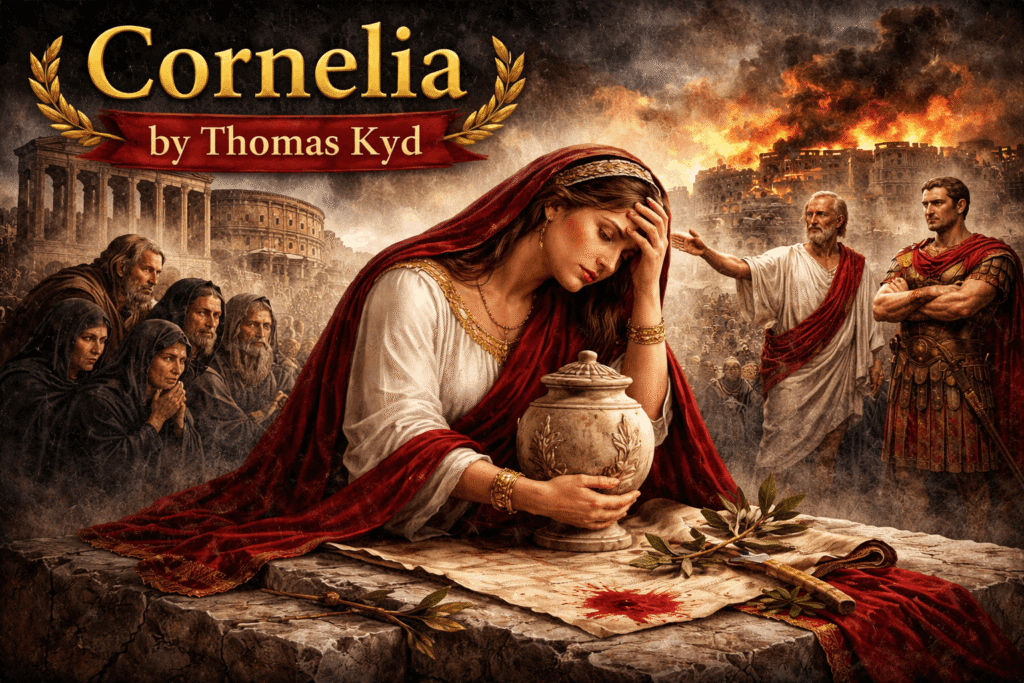
As the emotional anchor of the drama, the titular character in Cornelia by Thomas Kyd plays a crucial role. She embodies the profound agony of a grieving widow. Her role does not change significantly. She delivers long, rhetorical laments about the death of her husband, Pompey the Great. Although she does not engage in physical combat, she shows psychological endurance. This represents a form of stoic resistance against the rising tyranny of Caesar. Therefore, her suffering serves as a mirror for the collective pain of the dying Roman Republic. Furthermore, she consistently interacts with the Chorus to emphasize the moral gravity of her personal loss. She carries the ashes of her husband throughout the play. Her actions make her a physical symbol of a vanishing political era. Similarly, her character highlights the domestic consequences of grand political ambitions that tear families apart. Ultimately, Kyd portrays her as a “universal widow” whose individual sorrow transcends the specific boundaries of ancient Roman history.
2.2 Marcus Tullius Cicero
The character of Cicero provides a philosophical and intellectual counterbalance to the raw emotion found in Cornelia by Thomas Kyd. Specifically, he represents the voice of the Republican elite who watch their democratic institutions crumble under military force. For this reason, his speeches often focus on the cyclical nature of human fortune and the inevitability of political decay. Moreover, he offers counsel to the mourning heroine by encouraging a stoic acceptance of fate and divine will. He is not just a mentor. He also witnesses the historical transition from liberty to autocracy. Nevertheless, his wisdom cannot stop Caesar’s victory from progressing. This adds a layer of tragic irony to his eloquent observations. Thus, he functions as the play’s moral conscience while illustrating the helplessness of the intellectual class during a violent revolution. Subsequently, his presence elevates the play from a simple lament to a sophisticated debate on political ethics.
2.3 Julius Caesar and Mark Antony
In Cornelia by Thomas Kyd, Julius Caesar showcases the formidable power. His loyal companion Mark Antony adds to the controversial nature of the new imperial order. Caesar appears as a conqueror. Kyd portrays him with a complex mixture of military pride. He has sudden moments of clemency. Furthermore, Antony serves as the supportive foil who encourages Caesar’s ambition while celebrating their shared triumphs over the Republican rebels. These characters stand in direct opposition to the grieving Cornelia. They embody the harsh reality of political survival. They also represent dominance. Likewise, their dialogue focuses on the consolidation of power rather than the preservation of old Roman traditions. Accordingly, the tension between Caesar’s authority and the Republican ideals creates a constant sense of impending doom. The remaining survivors feel this impending doom. The play focuses on the victims. However, these military leaders ensure that the political stakes remain high throughout the five acts. Therefore, they symbolize the unstoppable force of history that crushes the old world.
3. Comprehensive Plot Summary
3.1 Act One: The Chorus of Roman Ruin
The play opens with a deeply emotional and reflective Chorus that immediately sets a tragic tone. The speakers mourn the collapse of Rome, presenting it not as an external defeat but as a self-inflicted destruction. They emphasize that internal greed, ambition, and rivalry have turned citizens against one another. Brothers now raise swords against brothers, and loyalty to the state has been replaced by personal desire. Consequently, Rome appears as a fractured society heading toward inevitable ruin.
This opening establishes a powerful atmosphere of despair and foreboding. The tragedy in Cornelia by Thomas Kyd is therefore not only personal but also national in scope. The Chorus reflects on the lost glory of ancient Rome. They recall a time when liberty, honor, and unity defined the Republic. However, these virtues have now faded, replaced by corruption and moral decay. As a result, the state stands on the brink of total collapse.
Moreover, the speakers criticize the vanity and ambition of powerful leaders whose desire for control has destroyed political stability. They suggest that human pride blinds individuals to the consequences of their actions. In the same way, the loss of civic responsibility contributes to the downfall of the Republic. Because of this chaos, the people feel helpless and abandoned.
The Chorus also introduces a philosophical dimension by questioning the nature of fate and human weakness. They imply that Rome’s downfall may be both a result of destiny and human error. Thus, the audience is invited to reflect on the broader moral implications of the events. This opening gradually builds a heavy emotional weight. It prepares the audience for the unfolding tragedy. Personal suffering mirrors the destruction of an entire civilization.
3.2 Act Two: Cicero and the Stoic Mind
In the second act, Cicero appears as a voice of intellect and philosophical reflection. He delivers a long and thoughtful speech about the unpredictable nature of Fortune. According to him, those who rise to great heights are often the ones who fall the hardest. This idea reinforces the instability of political power and highlights the dangers of ambition.
Through his words, the narrative gains greater depth and complexity. Cicero advises a life based on moderation, wisdom, and inner peace rather than public glory. He promotes Stoic ideals, encouraging individuals to remain calm and virtuous even in times of crisis. However, his philosophy seems powerless against the rapidly changing political reality.
Furthermore, Cicero criticizes the arrogance of military leaders who seek fame through conquest. Although he recognizes Caesar’s growing power, he views it with concern rather than admiration. His cautious tone reflects the anxiety of those who support the Republic but feel unable to stop its decline. Therefore, his wisdom offers insight but not solutions.
In addition, this act connects the play to classical philosophical traditions. It explores the limits of reason when faced with political chaos. Cicero becomes a symbol of intellectual resistance, yet he remains largely passive. Because the world around him is shifting so rapidly, he can only observe rather than act.
As the act progresses, attention gradually shifts from political discussion to personal suffering. The focus moves toward Cornelia, whose emotional struggle represents the human cost of political conflict. The act reinforces the theme of endurance. It shows that mental strength is often the only refuge in times of loss. Ultimately, the audience begins to understand. They realize that the fall of the Republic is not just a political event. It is also a deeply human tragedy.
3.3 Act Three: The Ghost and the Vision
The third act introduces a supernatural element that intensifies the emotional and dramatic tension. Cornelia recounts a terrifying dream in which the ghost of her husband, Pompey, appears before her. He is covered in blood and dust, symbolizing the violence and suffering of war. His haunting presence reflects both her grief and the unresolved chaos of Rome.
This moment adds a powerful dimension to Cornelia by Thomas Kyd, blending psychological distress with supernatural imagery. The ghost demands proper burial rites, emphasizing the importance of honor and respect for the dead. As a result, Cornelia feels a renewed sense of duty toward her husband, even in death.
Moreover, the vision raises questions about divine justice. Cornelia wonders whether the gods are punishing Rome or simply indifferent to human suffering. Her doubts reflect a broader uncertainty about morality and fate in a world filled with violence. At the same time, her isolation becomes more apparent as she struggles to find meaning in her loss.
Because of this haunting experience, Cornelia expresses a desire for death as a form of escape. However, her father intervenes, urging her to remain strong and endure her suffering. This contrast between despair and resilience highlights the central conflict within her character.
The Chorus also comments on the significance of such dark omens, warning that they often signal further disaster. Their reflections deepen the sense of impending doom. As the act moves forward, the audience gains insight into Cornelia’s emotional state. It is marked by grief. Cornelia also exhibits fear and determination.
Ultimately, the dream serves as a symbolic warning of the destruction that lies ahead. It reinforces the tragic tone and prepares the audience for the final stages of the play.
3.4 Act Four: The Hubris of the Conqueror
In the fourth act, the focus shifts to Julius Caesar and Mark Antony, representing the forces of victory and power. Caesar celebrates his triumph over the Republican forces, speaking with confidence and authority. He presents himself as a leader chosen by destiny, which makes his character appear both powerful and dangerous.
This portrayal of Cornelia highlights the theme of hubris, or excessive pride. Caesar believes in his own greatness, and this belief shapes his actions and decisions. Antony supports him enthusiastically, praising his military success and leadership. Together, they represent the rise of a new political order.
However, Caesar is not entirely without complexity. At moments, he shows mercy toward his defeated enemies, suggesting that he is capable of compassion. This duality makes his character more nuanced and difficult to judge. Nevertheless, his growing confidence hints at the potential for tyranny.
Furthermore, the act emphasizes the shift from a Republic to an imperial system. The discussions between Caesar and Antony reveal their plans for consolidating power. In contrast, the earlier scenes of mourning and loss highlight the human cost of their success.
Because of his pride, Caesar seems unaware of the dangers that surround him. His sense of invincibility blinds him to potential threats. Thus, the act reflects the classical structure of tragedy, where a powerful figure moves toward downfall due to personal flaws.
As the tension builds, the audience senses that victory does not bring peace but rather new forms of conflict. The atmosphere remains uneasy, suggesting that the consequences of ambition are far from over.
3.5 Act Five: The Final Messenger of Death
The final act delivers the full weight of tragedy through the arrival of a messenger. He brings devastating news of the complete defeat of the Republican forces. His report is vivid and detailed, describing the violence and suffering experienced on the battlefield. This moment marks the окончing collapse of all hope.
In Cornelia by Thomas Kyd, this act represents the ultimate destruction of both personal and political worlds. Scipio, unwilling to live in defeat, chooses death over dishonor. His decision reflects the values of loyalty and pride that defined the Republican cause.
Cornelia receives the ashes of her loved ones, symbolizing the loss of her family and her former life. Her grief reaches its peak as she mourns not only individuals but an entire way of life. She realizes that Caesar now holds absolute power, and there is no possibility of restoring the Republic.
Because all her protectors are gone, Cornelia stands alone in a transformed world. Despite her suffering, she commits herself to preserving the memory of the fallen. This act of remembrance becomes her final form of resistance.
The Chorus concludes the play with a moral reflection, emphasizing the lessons of ambition, pride, and loss. They remind the audience that power is temporary and that human actions have lasting consequences.
Ultimately, the tragedy ends without resolution or comfort. The fall of the Republic is complete, and the emotional impact remains heavy. The story leaves a lasting impression of sorrow, dignity, and the enduring strength of memory.
4. Critical Appreciation
4.1 The Theme of Stoic Endurance
The primary theme in Cornelia by Thomas Kyd involves the power of stoic endurance. Specifically, the heroine faces her immense grief with quiet dignity. She rejects the easy path of madness or instant suicide. Consequently, her mental strength serves as a silent form of protest. Moreover, she represents the ideal of the classical Roman matron. Therefore, her character highlights the value of inner peace. In addition, the text explores the limits of human suffering. Similarly, the dialogue focuses on the discipline of the mind. Because of her pain, she becomes a universal symbol. Thus, Kyd moves away from the typical revenge motive. Subsequently, the play elevates the concept of passive resistance. Furthermore, the moral weight of the drama rests on her. Accordingly, the audience witnesses a battle of the soul. Eventually, the theme of fortitude defines the entire work.
4.2 Political Allegory and Civil Ruin
The drama offers a sharp critique of political ambition and ruin. Notably, the fall of Rome mirrors the fears of Elizabethan England. For this reason, Cornelia by Thomas Kyd carries a heavy political message. Furthermore, the playwright warns against the dangers of internal strife. In the same way, the text depicts the death of liberty. However, Caesar represents the inevitable rise of a powerful dictator. Therefore, the Republican cause remains a lost and tragic dream. In addition, the imagery focuses on blood and broken walls. Similarly, the characters lament the destruction of their ancient laws. Because of this chaos, the state loses its moral compass. Thus, the play functions as a timeless warning for all. Subsequently, the historical setting provides a safe mask for critique. Accordingly, the ruin of the family symbolizes the national collapse. Eventually, the narrative warns that pride destroys every great empire.
4.3 The Evolution of Kyd’s Dramatic Style
This work marks a significant shift in the career of Kyd. Specifically, he leaves behind the sensational violence of his youth. Instead, he embraces the refined structures of the neoclassical tradition. Consequently, the style in Cornelia by Thomas Kyd appears very academic. Moreover, he proves his mastery of the formal blank verse. Therefore, the play appeals to a more elite and educated audience. In addition, his use of the Chorus shows great maturity. Similarly, he balances emotional depth with high rhetorical precision. Because of this shift, Kyd gains a new literary reputation. Thus, the translation demonstrates his versatility as a professional writer. Subsequently, he moves closer to the circle of the University Wits. Furthermore, the disciplined tone reflects his growth as a poet. Accordingly, the drama represents a peak in his scholarly output. Eventually, the play bridges the gap between two different eras.
5. Dramatic Devices
5.1 The Function of the Chorus
The Chorus serves as a vital moral and structural device. Specifically, the group provides a commentary on the tragic events. They reflect the collective voice of the suffering Roman people. Consequently, the presence of the Chorus defines Cornelia by Thomas Kyd. Moreover, they lament the loss of peace and national unity. Therefore, the songs break the long speeches of the elite. In addition, they warn against the dangers of human pride. Similarly, the rhythmic lines emphasize the cycle of political ruin. Because of their wisdom, the audience gains a wider perspective. Thus, the device connects the personal grief to the state. Subsequently, the text gains a sense of classical and high dignity. Furthermore, Kyd uses the group to signal the act divisions. Accordingly, the moral weight of Rome rests on their shoulders. Eventually, the Chorus leaves a lasting impression of communal sorrow.
5.2 The Use of Stichomythia
Stichomythia creates a sharp and rapid verbal tension between characters. Notably, this device involves a quick exchange of single lines. It highlights the intellectual conflict between the grieving and the powerful. For this reason, Cornelia by Thomas Kyd gains a unique energy. Furthermore, the technique mimics the style of the Roman poet Seneca. In the same way, the dialogue reveals the sharp wit of Cicero. However, the brevity of the lines emphasizes the emotional stress. Therefore, the pace of the drama quickens during these moments. In addition, the verbal sparring adds a layer of theatrical drama. Similarly, the characters use the device to debate moral truths. Because of the fast rhythm, the audience stays very engaged. Thus, the playwright demonstrates his mastery of the rhetorical form. Subsequently, the style contrasts with the long and heavy laments. Accordingly, the device sharpens the focus on the political arguments.
5.3 Sententiae and Moral Maxims
The play relies heavily on sententiae to convey universal truths. Specifically, these are short and pithy sayings about human life. They offer a concentrated form of wisdom and ethical guidance. Consequently, the language in Cornelia by Thomas Kyd feels very dense. Moreover, these maxims reinforce the stoic themes of the narrative. Therefore, the characters sound like philosophers during their long orations. In addition, the device helps the reader memorize the key lessons. Similarly, the text reflects the humanist education of the era. Because Kyd translates these carefully, the English retains Roman gravity. Thus, the play functions as a treasury of moral thought. Subsequently, the dialogue moves beyond the specific plot of the war. Furthermore, the playwright uses these sayings to build his authority. Accordingly, the drama educates the mind while it moves the heart. Eventually, the sententiae provide a framework for understanding the tragedy.
5.4 Blank Verse and Neoclassical Poetics
Kyd employs a sophisticated blank verse to elevate the dialogue. Notably, he avoids the simple rhymes of the popular stage. He seeks a more dignified and academic tone for translation. For this reason, the meter in Cornelia by Thomas Kyd excels. Furthermore, the unrhymed iambic pentameter allows for complex and deep thought. In the same way, the rhythm supports the slow and mournful atmosphere. However, the verse remains flexible enough for intense emotional outbursts. Therefore, the technical quality of the poetry marks a high achievement. In addition, the style aligns with the tastes of the elite. Similarly, the playwright bridges the gap between French and English. Because of this formal choice, the work stands as literature. Thus, the blank verse highlights Kyd’s growth as a poet. Subsequently, the language mirrors the nobility of the ancient Roman characters. Accordingly, the play sets a standard for neoclassical closet drama.
Ghost in The Spanish Tragedy: https://englishlitnotes.com/2026/03/19/ghost-in-the-spanish-tragedy-supernatural-justice-and-dramatic-function/
Mark Twain: https://americanlit.englishlitnotes.com/mark-twain/
Discover more from Naeem Ullah Butt - Mr.Blogger
Subscribe to get the latest posts sent to your email.