Introduction
Thomas Kyd’s Cornelia is a drama rich in symbolic meaning operating at multiple dramatic levels. Furthermore, Kyd constructs a world in which characters, events, and images all carry philosophical significance. Therefore, Symbolism in Cornelia is one of the most rewarding and intellectually productive areas of scholarly analysis. Additionally, symbols in the drama function at personal, political, and philosophical levels simultaneously. Consequently, understanding symbolic meaning deepens every aspect of the reader’s engagement with the play. Moreover, Kyd draws on classical Roman history, Senecan theatrical tradition, and Renaissance humanist culture. Thus, symbols in Cornelia reflect a rich cultural heritage of enormous literary and philosophical depth. Meanwhile, the drama’s most powerful symbols include Rome itself, Pompey’s absence, and Cornelia’s grief. For an exploration of Cornelia’s symbolic role as a mourning figure, readers should consult Cornelia as a symbol of grief. However, symbolism in Kyd’s drama is never heavy-handed or artificially imposed on the material. Furthermore, symbolic meaning emerges naturally from historical events and philosophical dramatic construction. Therefore, this article provides a complete and systematic analysis of symbolism across all major dimensions. Overall, Kyd’s symbolic achievement gives Cornelia its most enduring literary and philosophical significance.
1. Symbolism in Cornelia by Thomas Kyd
The Symbolism in Cornelia by Thomas Kyd operates through a carefully constructed system of historical and philosophical meanings. Furthermore, every major figure, event, and setting in the drama carries symbolic weight beyond its literal significance. Therefore, Kyd constructs a drama in which surface narrative and deeper symbolic meaning work inseparably together. Additionally, symbols in the play function at personal, political, civilizational, and philosophical dramatic levels. Consequently, the drama rewards close reading that attends simultaneously to narrative and symbolic dimensions. Moreover, symbolic meaning in Cornelia reflects the Renaissance humanist tradition of reading history as moral lesson. Thus, Roman historical events become symbols for universal truths about fortune, virtue, and human suffering. Meanwhile, Kyd’s symbolic construction connects the drama to both classical and Renaissance literary traditions. However, symbolism in the drama is always philosophically grounded rather than merely decorative or aesthetic. Furthermore, every symbol serves the drama’s central concern with fate, virtue, and stoic endurance. Therefore, understanding symbolic meaning is essential to appreciating the drama’s full literary achievement. Overall, symbolism gives Cornelia its most enduring philosophical depth and cultural significance.
2. Rome as Symbol in Cornelia
Rome functions as the drama’s most powerful and historically resonant symbol throughout every act. Furthermore, Rome symbolizes the ideal of republican governance, collective virtue, and constitutional political order. Therefore, Rome’s destruction by Caesar carries symbolic weight far beyond its historical dramatic significance. Additionally, the fall of Rome symbolizes the defeat of virtue itself by fortune’s arbitrary and cruel power. Consequently, every character’s suffering connects to this larger symbolic collapse of political and moral order. Moreover, Rome as symbol also reflects Renaissance humanist admiration for classical republican political ideals. Thus, Elizabethan readers understood Rome’s symbolic significance through their own cultural and political concerns. Meanwhile, Rome as symbol operates simultaneously at historical, political, and philosophical dramatic levels. However, Rome’s symbolic meaning is never reduced to simple political allegory or moral illustration. Furthermore, Kyd treats Rome’s symbolic collapse with genuine philosophical complexity and historical nuance. Therefore, Rome as symbol gives the drama its broadest and most historically resonant thematic dimension. Overall, Rome is the drama’s greatest and most philosophically productive symbolic construct throughout.
3. Pompey as Symbol of Republican Virtue
Pompey the Great functions as the drama’s most powerful symbol of republican Roman virtue. Furthermore, he embodies military greatness, political honour, civic duty, and personal integrity simultaneously. Therefore, Pompey as symbol represents everything that Caesar’s triumph over Rome has destroyed. Additionally, his absence from the stage amplifies rather than diminishes his symbolic power throughout. Consequently, Pompey’s symbolic significance operates through the grief and admiration his memory generates. Moreover, Pompey as symbol of republican virtue reflects Renaissance humanist admiration for classical political ideals. Thus, his destruction symbolizes the catastrophic defeat of legitimate political order by autocratic force. Meanwhile, Pompey’s symbolic role connects directly to the drama’s broader meditation on fortune and fate. For a complete analysis of Pompey’s dramatic and symbolic significance, readers should consult Pompey the Great in Cornelia. However, Pompey as symbol is never simplistically idealized or philosophically naive in his characterization. Furthermore, his historical complexity gives his symbolic role genuine philosophical depth and cultural authority. Therefore, Pompey as symbol of republican virtue gives the drama its most politically resonant symbolic dimension. Overall, his symbolic presence is the moral standard against which all other characters are implicitly measured.
4. Caesar as Symbol of Tyranny and Ambition
Caesar functions as the drama’s most powerful symbol of political ambition and autocratic power. Furthermore, his dominance over Rome symbolizes the triumph of force over virtue and constitutional order. Therefore, Caesar as a symbol carries philosophical and political meaning far beyond his individual dramatic role. Additionally, Caesar symbolizes fortune’s indifference to moral merit and republican political legitimacy. Consequently, his victory represents the catastrophic failure of justice in a world governed by fortune. Moreover, Caesar as symbol also reflects Renaissance humanist anxieties about political ambition and tyranny. Thus, Roman historical tyranny provided a culturally safe vehicle for exploring dangerous political concerns. Meanwhile, Caesar’s symbolic function operates largely through his structural absence from direct dramatic confrontation. For a comprehensive analysis of Caesar’s symbolic and dramatic role, readers should see the role of Caesar in Cornelia. However, Caesar as a symbol is never straightforwardly evil or one-dimensionally negative in the drama. Furthermore, his historical greatness complicates any simple symbolic reduction to mere tyranny. Therefore, Caesar as a symbol of ambition, gives the drama its most politically complex and philosophically challenging dimension. Overall, his symbolic function makes him one of Renaissance drama’s most intellectually demanding symbolic presences.
5. Cornelia as Symbol of Grief and Endurance
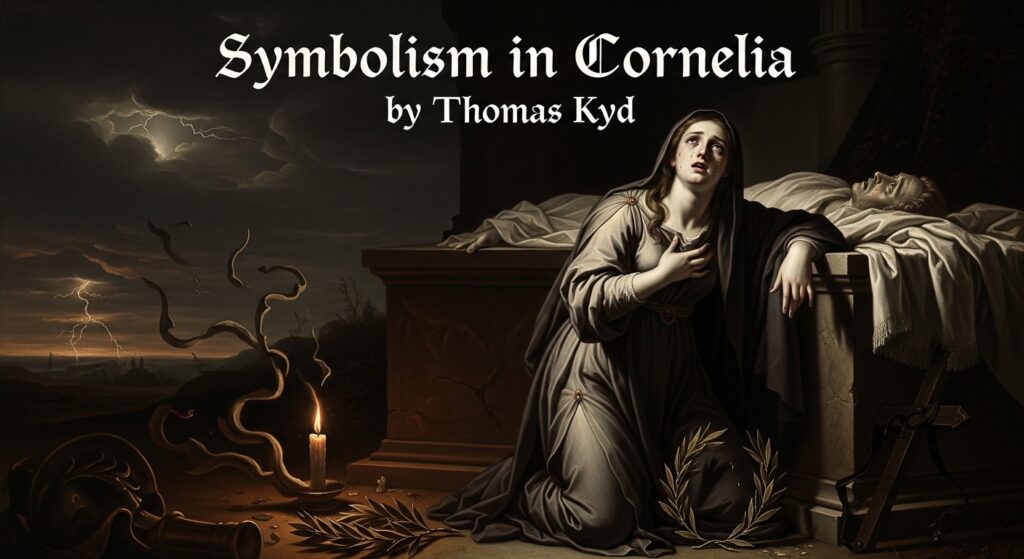
Cornelia herself is the most important and philosophically richest symbol in the entire drama. Furthermore, she symbolizes stoic endurance, Roman virtue, and the moral dignity of principled suffering. Therefore, Symbolism in Cornelia reaches its most powerful expression through Cornelia’s own symbolic dramatic function. Additionally, Cornelia symbolizes the survival of moral order even when political order has been completely destroyed. Consequently, her stoic philosophical response to fortune’s cruelty represents genuine human moral greatness. Moreover, Cornelia as a symbol also reflects the broader Renaissance ideal of virtuous womanhood under extreme pressure. Thus, her symbolic function operates at personal, political, and universal philosophical levels simultaneously. Meanwhile, Cornelia symbolizes the collective grief of Rome for its lost republican political tradition. However, Cornelia as a symbol is never merely allegorical or philosophically abstract in her characterization. Furthermore, her grief is as personally authentic and emotionally powerful as it is symbolically significant. Therefore, Cornelia, as a symbol of grief and endurance, gives the drama its most moving and memorable dimension. Overall, her symbolic function makes her one of Renaissance drama’s most enduring and philosophically serious figures.
6. Lamentation as Symbolic Action
Lamentation in Cornelia functions as a form of symbolic action replacing conventional theatrical conflict. Furthermore, grief speeches in the drama carry symbolic meaning far beyond their immediate emotional expression. Therefore, lamentation symbolizes the moral response of virtue to fortune’s overwhelming and destructive power. Additionally, formal lamentation symbolizes the survival of Roman cultural and philosophical values under political collapse. Consequently, how Cornelia laments symbolizes what she fundamentally values and philosophically believes. Moreover, lamentation as symbolic action also reflects the Senecan tradition’s emphasis on rhetorical expression. Thus, formal and eloquent grief is a symbol of philosophical virtue and moral dignity throughout. Meanwhile, lamentation also symbolizes the collective mourning of an entire civilization for its lost values. However, lamentation as symbolic action is never merely theatrical or emotionally excessive in the drama. Furthermore, its formal discipline gives it philosophical weight and symbolic authority throughout every scene. Therefore, lamentation as symbolic action is one of the most important dimensions of symbolism in the drama. Overall, grief becomes in Kyd’s hands a genuinely symbolic form of moral and philosophical dramatic action.
7. Fortune’s Wheel as Symbol
Fortune’s wheel is one of the most powerful and culturally familiar symbols in Cornelia’s dramatic world. Furthermore, this classical image conveys fortune’s constant motion and complete indifference to human merit. Therefore, fortune’s wheel as a symbol explains the sudden and devastating reversals that drive the tragic action. Additionally, Pompey’s fall from greatness fits the classic pattern of fortune’s wheel turning downward. Consequently, fortune’s wheel as a symbol gives the drama’s tragic events a philosophically recognizable framework. Moreover, fortune’s wheel also symbolizes the philosophical lesson that no external achievement is permanently secure. Thus, even Caesar’s greatest triumph remains subject to fortune’s inevitable and unpredictable turning. Meanwhile, fortune’s wheel as a symbol also connects the drama to both classical and medieval literary traditions. However, fortune’s wheel as a symbol in Cornelia is treated with philosophical seriousness rather than mere convention. Furthermore, Kyd uses this familiar symbol to illuminate genuinely difficult philosophical questions about justice. Therefore, fortune’s wheel as symbol gives the drama’s meditation on fate its most vivid and culturally resonant dimension. Overall, this symbol connects Cornelia to the richest traditions of Western philosophical and literary culture.
8. Pompey’s Death as Symbol of Political Collapse
Pompey’s death functions as the drama’s most historically and symbolically significant dramatic event. Furthermore, his death symbolizes the decisive end of Roman republican governance and constitutional order. Therefore, Pompey’s death as a symbol carries civilizational rather than merely personal dramatic significance. Additionally, the death reported by the messenger symbolizes fortune’s most devastating and irreversible dramatic intervention. Consequently, the messenger’s report transforms a historical event into a philosophical symbolic statement. Moreover, Pompey’s death also symbolizes the Senecan truth that even the greatest virtue cannot resist fortune. Thus, his death teaches the philosophical lesson that external greatness provides no genuine protection. Meanwhile, Pompey’s death as a symbol also illuminates Cornelia’s subsequent stoic philosophical response. However, Pompey’s death as a symbol is never merely abstract or historically remote in its dramatic impact. Furthermore, Cornelia’s grief gives the symbolic death its full personal, emotional and human weight. Therefore, Pompey’s death as a symbol gives the drama its most historically resonant and philosophically instructive moment. Overall, this symbolic event drives every subsequent scene, speech, and philosophical reflection in Cornelia.
9. Silence and Absence as Symbolic Devices
Silence and absence function as some of the most powerful symbolic devices in Kyd’s drama. Furthermore, both Pompey and Caesar are symbolically powerful precisely because they remain dramatically absent. Therefore, silence and absence as symbolic devices give Cornelia its most distinctive and philosophically productive quality. Additionally, what is not seen or heard often carries more symbolic weight than what is directly present. Consequently, Pompey’s complete absence from the stage amplifies his symbolic significance enormously. Moreover, silence and absence also symbolize the impossibility of confronting or resisting fortune’s overwhelming power. Thus, what cannot be seen cannot be fought, and what cannot be fought cannot be overcome. Meanwhile, silence and absence as symbolic devices also reflect the Senecan theatrical convention of offstage events. However, these devices are never merely formal conventions but always philosophically meaningful dramatic choices. Furthermore, absence in the drama consistently symbolizes irreplaceable loss rather than mere theatrical limitation. Therefore, silence and absence as symbolic devices give the drama its most philosophically serious and distinctive quality. Overall, Kyd transforms dramatic absence into one of his most powerful and resonant symbolic tools.
10. The Chorus as Symbol of Collective Conscience
The chorus functions as a powerful symbol of Rome’s collective moral conscience throughout the drama. Furthermore, choral interludes between acts symbolize the philosophical wisdom of the community responding to catastrophe. Therefore, the chorus as a symbol transforms individual suffering into a universal philosophical statement and meditation. Additionally, choral commentary symbolizes the survival of moral reflection even as political order collapses entirely. Consequently, the chorus represents the voice of reason, stoic philosophy, and collective human dignity. Moreover, the chorus as a symbol also reflects the Senecan theatrical tradition’s use of choral commentary. Thus, the chorus carries both classical theatrical authority and specific philosophical symbolic meaning. Meanwhile, choral commentary also symbolizes the persistence of philosophical inquiry under the most extreme conditions. However, the chorus as a symbol is never merely decorative or structurally redundant in its function. Furthermore, each choral interlude deepens the symbolic meaning of the preceding dramatic action specifically. Therefore, the chorus as a symbol of collective conscience gives the drama its most formally resonant symbolic dimension. Overall, choral commentary transforms the drama’s private grief into a universally symbolic philosophical meditation.
11. Blood and Violence as Symbolic Language
Blood and violence function as powerful symbolic languages operating entirely through rhetorical description. Furthermore, all violent events in the drama are reported rather than staged following Senecan convention. Therefore, blood and violence as symbolic language operate through imagination rather than theatrical spectacle. Additionally, reported violence symbolizes the catastrophic and irreversible nature of fortune’s destructive power. Consequently, the messenger’s rhetorical descriptions transform literal violence into philosophically resonant symbolic events. Moreover, blood as a symbol also carries classical associations with sacrifice, political corruption, and civilizational collapse. Thus, Pompey’s blood symbolizes the sacrifice of republican virtue on the altar of Caesar’s ambition. Meanwhile, violence as symbolic language also reflects the broader Renaissance theatrical tradition of offstage horror. For a deeper understanding of how language operates symbolically in the drama, readers should explore blank verse in Cornelia. However, blood and violence as symbolic language are never gratuitously sensational or merely theatrical. Furthermore, their symbolic function always serves the drama’s deeper philosophical and moral concerns. Therefore, blood and violence as symbolic language give the drama its most dramatically intense symbolic dimension. Overall, Kyd transforms rhetorical violence into one of the most powerful symbolic tools in his dramatic arsenal.
12. Rome’s Fall as Universal Symbol
Rome’s fall functions as a universal symbol of political and moral catastrophe in Kyd’s drama. Furthermore, the collapse of the Roman Republic symbolizes the defeat of collective virtue by individual ambition. Therefore, Rome’s fall as a universal symbol gives the drama its widest and most philosophically resonant dimension. Additionally, Elizabethan readers recognized Rome’s symbolic significance through their own political and cultural concerns. Consequently, Roman historical collapse functioned as a mirror for contemporary anxieties about political stability. Moreover, Rome’s fall also symbolizes the broader philosophical truth that no human institution is permanent. Thus, even the greatest civilizational achievements remain permanently subject to fortune’s turning wheel. Meanwhile, Rome’s fall as a symbol also reflects Renaissance humanist engagement with classical historical tradition. However, Rome’s fall as a universal symbol in the drama is treated with philosophical restraint throughout. Furthermore, Kyd avoids making Rome’s collapse into a simple political allegory or contemporary commentary. Therefore, Rome’s fall as a universal symbol gives the drama its most historically and culturally significant symbolic dimension. Overall, Rome’s symbolic collapse elevates Cornelia from historical drama to universal philosophical tragedy.
13. Stoic Endurance as Moral Symbol
Stoic endurance functions as the drama’s most important and philosophically significant moral symbol. Furthermore, Cornelia’s stoic philosophical response to suffering symbolizes the highest form of human moral dignity. Therefore, stoic endurance as a moral symbol represents the only genuine victory available against fortune’s power. Additionally, stoicism symbolizes the philosophical truth that inner freedom survives even when outer freedom is destroyed. Consequently, Cornelia’s endurance symbolizes the survival of moral order within political and personal catastrophe. Moreover, stoic endurance as a moral symbol also reflects the Senecan philosophical tradition’s deepest values. Thus, accepting fortune’s power with dignity is symbolically presented as greater than any military triumph. Meanwhile, stoic endurance as a moral symbol also explains why Cornelia refuses to seek revenge for Pompey’s death. However, stoic endurance as a moral symbol is never cold or emotionally detached from genuine human suffering. Furthermore, grief and stoic dignity coexist in Cornelia’s symbolic character with remarkable human depth. Therefore, stoic endurance as a moral symbol gives the drama its most powerful and enduring moral dimension. Overall, Kyd presents stoic endurance as the supreme symbolic response to fortune’s overwhelming and cruel power.
14. The Messenger as Symbol of Fate
The messenger functions as a powerful symbol of fate’s inevitable and inescapable operation throughout. Furthermore, the messenger’s arrival consistently symbolizes the moment when fortune’s decisions become known and undeniable. Therefore, the messenger as a symbol of fate transforms a theatrical convention into a philosophically meaningful dramatic presence. Additionally, the messenger symbolizes the gap between historical events and human knowledge of their consequences. Consequently, his arrival always marks a new and irreversible stage in the drama’s tragic unfolding. Moreover, the messenger as a symbol of fate also reflects the Senecan theatrical tradition’s treatment of offstage events. Thus, fate’s operation becomes visible through the messenger’s rhetorical account rather than through direct action. Meanwhile, the messenger also symbolizes the helplessness of human beings before fortune’s arbitrary decisions. However, the messenger as a symbol of fate is never merely mechanical or dramatically functional in isolation. Furthermore, his rhetorical skill in reporting terrible events gives him genuine symbolic dignity and authority. Therefore, the messenger as a symbol of fate gives the drama its most structurally important symbolic presence. Overall, the messenger transforms theatrical convention into one of the drama’s most philosophically resonant symbols.
15. Political Power as Corrupting Symbol
Political power functions as a consistently corrupting symbol throughout the entire dramatic action. Furthermore, Caesar’s dominance over Rome symbolizes the moral corruption that unchecked ambition inevitably produces. Therefore, political power as a corrupting symbol reflects Renaissance humanist anxieties about tyranny and political legitimacy. Additionally, political power symbolizes the triumph of fortune over virtue in the drama’s philosophical framework. Consequently, Caesar’s political triumph is presented as morally questionable despite its historical inevitability. Moreover, political power as a corrupting symbol also illuminates the contrast between Caesar and Pompey throughout. Thus, legitimate republican power symbolizes virtue while Caesar’s autocratic dominance symbolizes moral corruption. Meanwhile, political power as a corrupting symbol also reflects the Senecan philosophical tradition’s treatment of worldly authority. However, political power as a symbol in Cornelia is never reduced to simple moral condemnation or political allegory. Furthermore, Kyd presents political power with genuine philosophical complexity and historical nuance throughout. Therefore, political power as a corrupting symbol gives the drama its most historically and politically significant symbolic dimension. Overall, Kyd uses political power symbolically to explore the deepest questions of moral and political philosophy.
16. Darkness and Light as Symbolic Imagery
Darkness and light function as recurring symbolic images throughout Kyd’s rhetorical construction. Furthermore, darkness symbolizes political collapse, moral corruption, and fortune’s destructive power. Therefore, darkness and light as symbolic imagery give the drama’s rhetorical landscape its most vivid visual dimension. Additionally, light symbolizes republican virtue, philosophical wisdom, and Cornelia’s stoic moral dignity. Consequently, the movement from light to darkness in the drama symbolizes the triumph of Caesar’s power. Moreover, darkness and light as symbolic imagery also reflect the broader classical tradition of moral allegory. Thus, classical associations between light, reason, and virtue deepen the symbolic meaning throughout. Meanwhile, darkness and light as symbolic imagery operate primarily through the drama’s rhetorical rather than theatrical means. However, these symbolic images are never heavy-handedly imposed on the dramatic material. Furthermore, darkness and light emerge naturally from the drama’s philosophical and rhetorical construction. Therefore, darkness and light as symbolic imagery give the drama’s philosophical themes their most vivid and memorable expression. Overall, Kyd uses these classical symbolic images to illuminate the drama’s deepest moral and philosophical concerns.
17. Virtue and Vice as Symbolic Opposites
Virtue and vice function as the drama’s most fundamental symbolic opposition throughout. Furthermore, Pompey embodies virtue while Caesar embodies the triumph of vice-adjacent political ambition. Therefore, virtue and vice as symbolic opposites give the drama its clearest and most culturally familiar moral framework. Additionally, this symbolic opposition reflects the Renaissance humanist tradition of reading history as moral exemplum. Consequently, Roman historical figures become symbols for universal moral principles and philosophical lessons. Moreover, virtue and vice as symbolic opposites also illuminate the drama’s treatment of fortune’s operation. Thus, fortune’s indifference to virtue deepens the symbolic opposition by making it philosophically unresolved. Meanwhile, virtue and vice as symbolic opposites are central to understanding Symbolism in Cornelia at its deepest moral level. However, virtue and vice as symbolic opposites in Cornelia are never naively simple or philosophically comfortable. Furthermore, the drama shows that virtue does not receive its deserved reward in a world governed by fortune. Therefore, virtue and vice as symbolic opposites give the drama its most morally challenging and intellectually honest dimension. Overall, Kyd uses this fundamental symbolic opposition to explore the most difficult questions of moral philosophy.
18. Tears and Weeping as Symbolic Expression
Tears and weeping function as powerful symbolic expressions of moral consciousness and philosophical depth. Furthermore, in Senecan tradition, formal lamentation symbolizes the highest form of human emotional and philosophical response. Therefore, tears and weeping as a symbolic expression give grief its full moral and philosophical significance. Additionally, Cornelia’s tears symbolize both personal loss and the broader mourning of Rome’s republican tradition. Consequently, weeping becomes a symbolic act of testimony to the values that Caesar’s power has destroyed. Moreover, tears and weeping as symbolic expressions also reflect Renaissance humanist admiration for classical rhetorical tradition. Thus, formal and eloquent grief is always a symbol of philosophical virtue and moral seriousness. Meanwhile, tears and weeping also symbolize the impossibility of passive acceptance of fortune’s cruelty. However, tears and weeping as symbolic expressions in Cornelia are never theatrically excessive or emotionally indulgent. Furthermore, grief is always formally disciplined and philosophically structured throughout the drama. Therefore, tears and weeping as a symbolic expression give the drama its most personally moving and humanly authentic dimension. Overall, Kyd transforms formal weeping into one of the most symbolically rich elements of the drama.
19. The Senate and Republican Institutions as Symbols
The Senate and republican institutions function as powerful symbols of legitimate political order throughout. Furthermore, these institutions symbolize the collective governance, constitutional authority, and civic virtue of Rome. Therefore, their destruction by Caesar carries enormous symbolic weight in the drama’s political framework. Additionally, the Senate as a symbol represents the ideal of collective political wisdom over individual ambition. Consequently, Caesar’s triumph over republican institutions symbolizes the catastrophic defeat of legitimate authority. Moreover, the Senate and republican institutions also reflect Renaissance humanist admiration for classical political models. Thus, their symbolic significance resonated deeply with Elizabethan readers’ own political concerns and anxieties. Meanwhile, republican institutions as symbols also illuminate the contrast between Pompey and Caesar throughout. However, the Senate and republican institutions as symbols are treated with philosophical restraint in the drama. Furthermore, Kyd avoids making their symbolic significance into direct contemporary political commentary. Therefore, the Senate and republican institutions as symbols give the drama its most politically resonant symbolic dimension. Overall, these symbols connect Cornelia’s personal grief to the collapse of Rome’s greatest political achievements.
20. Fate and Destiny as Symbolic Forces
Fate and destiny function as the drama’s most fundamental and philosophically serious symbolic forces. Furthermore, fate as symbol represents the absolute cosmic power that governs all human events and outcomes. Therefore, fate and destiny as symbolic forces give every tragic event in the drama its philosophical significance. Additionally, fate symbolizes the philosophical truth that human agency cannot ultimately alter predetermined cosmic outcomes. Consequently, characters are symbolically defined by how they respond to fate’s inescapable operation. Moreover, fate and destiny as symbolic forces also reflect the Senecan philosophical tradition’s deepest insights. Thus, stoic acceptance of fate’s power is symbolically presented as the only genuinely wise response. Meanwhile, fate and destiny as symbolic forces also operate through the drama’s structural and formal dimensions. However, fate and destiny as symbolic forces are never presented as simply pessimistic or philosophically nihilistic. Furthermore, the drama consistently shows that inner dignity survives even fate’s most devastating interventions. Therefore, fate and destiny as symbolic forces give the drama its most philosophically challenging and intellectually serious dimension. Overall, fate as symbol gives Cornelia its characteristic atmosphere of dignified and philosophically inevitable tragedy.
21. Language and Rhetoric as Symbolic Power
Language and rhetoric function as symbols of philosophical power and moral authority throughout. Furthermore, eloquent speech in Cornelia symbolizes the highest form of human dignity and philosophical virtue. Therefore, language and rhetoric as symbolic power give the drama’s literary texture its deepest moral significance. Additionally, characters who speak with rhetorical eloquence symbolically demonstrate their philosophical seriousness. Consequently, how characters use language symbolizes their moral values and philosophical commitments. Moreover, language and rhetoric as symbolic power also reflect the Senecan theatrical tradition’s emphasis on speech. Thus, rhetorical excellence is symbolically presented as evidence of genuine philosophical wisdom. Meanwhile, language and rhetoric as symbolic power also give the drama its most immediately recognizable literary quality. For a deeper understanding of how language and style operate symbolically in the drama, readers should explore blank verse in Cornelia. However, language and rhetoric as symbolic power are never merely ornamental or aesthetically self-indulgent. Furthermore, rhetorical excellence always serves specific philosophical and moral dramatic purposes. Therefore, language and rhetoric as symbolic power give the drama its most distinctively literary and philosophically serious dimension. Overall, Kyd makes language itself the supreme symbol of human moral dignity in Cornelia.
22. History as Symbolic Mirror
Roman history functions as a symbolic mirror reflecting universal truths about human nature and fortune. Furthermore, historical events in Cornelia are always simultaneously literal and symbolically instructive. Therefore, history as symbolic mirror gives the drama its most culturally authoritative and philosophically resonant dimension. Additionally, Renaissance humanists consistently read classical history as a source of moral and philosophical wisdom. Consequently, Roman historical figures and events naturally carried symbolic meaning for Elizabethan readers. Moreover, history as symbolic mirror also reflects the Renaissance tradition of reading classical texts as moral exempla. Thus, Pompey’s fate symbolically illustrates the philosophical lesson that virtue cannot protect against fortune. Meanwhile, history as symbolic mirror also gives the drama its most immediate cultural and political resonance. However, history as symbolic mirror in Cornelia is treated with genuine philosophical seriousness rather than mere allegory. Furthermore, Kyd refuses to reduce historical complexity to simple moral illustration throughout the drama. Therefore, history as symbolic mirror gives symbolism in Cornelia its most culturally significant and philosophically productive dimension. Overall, Roman history becomes in Kyd’s hands a profoundly rich symbolic resource for universal philosophical reflection.
23. Death and Mortality as Symbolic Themes
Death and mortality function as pervasive symbolic themes connecting every aspect of the dramatic action. Furthermore, Pompey’s death symbolizes the mortality of all human greatness in the face of fortune’s power. Therefore, death and mortality as symbolic themes give the drama its most universally resonant philosophical dimension. Additionally, mortality symbolizes the philosophical truth that all external achievements are ultimately temporary and fragile. Consequently, death as a symbol reinforces the Stoic philosophical lesson about the proper attitude toward worldly goods. Moreover, death and mortality as symbolic themes also reflect the classical tradition’s philosophical engagement with human finitude. Thus, contemplating death is symbolically presented as the path to genuine philosophical wisdom and virtue. Meanwhile, death and mortality as symbolic themes also connect the drama to the Senecan tradition’s deepest concerns. However, death and mortality as symbolic themes in Cornelia are never morbid or theatrically sensational. Furthermore, they are always treated with philosophical dignity and serious intellectual engagement throughout. Therefore, death and mortality as symbolic themes give the drama its most universally significant and philosophically instructive dimension. Overall, Kyd uses death symbolically to illuminate the most fundamental truths of Stoic philosophical tradition.
24. Exile and Loss as Symbolic Conditions
Exile and loss function as powerful symbolic conditions defining every major character’s dramatic situation. Furthermore, Cornelia experiences a form of symbolic exile from the political and personal world she valued. Therefore, exile and loss as symbolic conditions give the drama its most personally moving and humanly authentic dimension. Additionally, loss symbolizes the broader philosophical truth that fortune systematically destroys everything humans most value. Consequently, exile and loss as symbolic conditions also reflect the Senecan tradition’s treatment of human vulnerability. Moreover, exile and loss also symbolize the impossibility of return to a world that fortune has permanently destroyed. Thus, Cornelia cannot recover Pompey or the republican Rome he represented through any dramatic action. Meanwhile, exile and loss as symbolic conditions also connect the drama to the broadest human experiences. For comprehensive resources on symbolism and loss across the English literary tradition, readers can visit history of English literature. However, exile and loss as symbolic conditions are treated with philosophical restraint rather than theatrical sentimentality. Furthermore, Kyd ensures that symbolic loss retains its full philosophical weight without becoming merely emotionally indulgent. Therefore, exile and loss as symbolic conditions give the drama its most universally resonant and philosophically serious dimension. Overall, loss becomes in Kyd’s hands one of the most symbolically rich and philosophically productive dramatic conditions.
25. Nature and the Cosmos as Symbolic Background
Nature and the cosmos function as a symbolic background reflecting the drama’s philosophical concerns. Furthermore, references to natural forces in Cornelia symbolize the larger cosmic order within which human events occur. Therefore, nature and the cosmos as a symbolic background give the drama’s philosophical themes their broadest possible resonance. Additionally, natural imagery symbolizes fortune’s power as a cosmic rather than merely political force. Consequently, storms, darkness, and natural catastrophes symbolize the overwhelming power of fate over human affairs. Moreover, nature and the cosmos as a symbolic background also reflect the classical tradition’s philosophical engagement with cosmology. Thus, Stoic philosophy consistently used natural imagery to illustrate philosophical truths about fate and virtue. Meanwhile, nature and the cosmos as a symbolic background also give the chorus its most philosophically expansive symbolic dimension. However, nature and the cosmos as a symbolic background in Cornelia are treated with rhetorical rather than theatrical means. Furthermore, natural symbolism operates through language rather than through theatrical staging or spectacle. Therefore, nature and the cosmos as symbolic background give the drama’s philosophical themes their most cosmically resonant dimension. Overall, Kyd uses natural and cosmic imagery to situate Cornelia’s suffering within the largest possible philosophical framework.
26. Classical Mythology as Symbolic Reference
Classical mythology functions as a rich symbolic reference system throughout Kyd’s drama. Furthermore, mythological allusions give the drama’s philosophical themes additional cultural depth and literary authority. Therefore, classical mythology as a symbolic reference connects Cornelia to the broadest traditions of Western literary culture. Additionally, mythological references symbolize the universal dimensions of fate, fortune, and human suffering. Consequently, classical myths give individual dramatic events their most culturally resonant symbolic meanings. Moreover, classical mythology as a symbolic reference also reflects Renaissance humanist engagement with classical literary tradition. Thus, mythological allusions would have been immediately recognizable and symbolically meaningful to educated Elizabethan readers. Meanwhile, classical mythology as a symbolic reference also deepens the drama’s philosophical engagement with fate and virtue. For broader literary context on classical mythological symbolism in English literature, readers can explore American literature for comparative symbolic tradition analysis. However, classical mythology as a symbolic reference in Cornelia is never merely decorative or culturally self-indulgent. Furthermore, mythological allusions always serve specific philosophical and dramatic purposes within the overall design. Therefore, classical mythology as a symbolic reference gives symbolism in Cornelia its most culturally authoritative and literarily resonant dimension. Overall, Kyd uses classical mythology to give his drama’s philosophical concerns their deepest cultural and literary authority.
27. Legacy of Symbolism in Cornelia
The legacy of Symbolism in Cornelia extends far beyond the drama’s immediate historical and cultural moment. Furthermore, Kyd’s symbolic achievement established important precedents for serious philosophical dramatic symbolism. Therefore, the legacy of symbolism in the drama includes both immediate literary impact and longer cultural significance. Additionally, Cornelia demonstrates how classical symbolism can be adapted to English dramatic culture effectively. Consequently, the drama’s symbolic achievement reflects the finest possibilities of Renaissance humanist dramatic tradition. Moreover, the legacy of symbolism in Cornelia also includes its contribution to serious English tragic writing. Thus, Kyd’s symbolic drama helped establish the philosophical seriousness that later English tragedy aspired to. Meanwhile, the legacy of symbolism in the drama also reflects the enduring cultural prestige of classical tradition. For comprehensive literary resources on symbolism and dramatic tradition, readers should visit English literature notes. However, the legacy of Kyd’s symbolic achievement is not merely historical but genuinely living. Furthermore, the symbols Kyd constructs continue to resonate with readers engaged with philosophical dramatic literature. Therefore, the legacy of symbolism in Cornelia confirms the drama as a genuine masterwork of English Renaissance literature. Overall, Kyd’s symbolic achievement gives Cornelia its most enduring and philosophically significant literary legacy.
Conclusion
The Symbolism in Cornelia by Thomas Kyd is one of the richest and most philosophically rewarding areas of scholarly analysis. Furthermore, Kyd constructs a complete symbolic system operating at personal, political, and philosophical dramatic levels. Therefore, symbols in the drama illuminate every aspect of its meaning, structure, and thematic concern. Additionally, Rome, Pompey, Caesar, fortune’s wheel, and Cornelia’s grief all carry profound symbolic significance. Consequently, understanding symbolic meaning is essential to appreciating the drama’s full literary achievement. Moreover, Kyd’s symbolic construction reflects his deep engagement with Senecan theatrical and philosophical tradition. Thus, symbolism gives Cornelia its most enduring cultural authority and philosophical literary significance. Meanwhile, every symbol in the drama serves the central concern with fate, virtue, and stoic endurance. However, Kyd’s symbolism is never heavy-handed or artificially imposed on the dramatic material. Furthermore, symbolic meaning always emerges naturally from historical events and philosophical construction. Therefore, Symbolism in Cornelia confirms Kyd’s drama as a masterwork of English Renaissance dramatic literature. For related reading, explore Cornelia as a symbol of grief and Pompey the Great in Cornelia. Overall, symbolism gives Cornelia its most enduring philosophical depth and lasting literary significance.
Discover more from Naeem Ullah Butt - Mr.Blogger
Subscribe to get the latest posts sent to your email.