Introduction
Thomas Wyatt stands among the greatest English Renaissance poets. He brought the Italian sonnet form to English literature. Furthermore, he translated and transformed Petrarchan conventions brilliantly. His poems explore power, ambition, love, and courtly danger. Stand Whoso List Upon the Slipper Top by Wyatt is one such masterwork. It warns against the dangerous pursuit of worldly ambition. The poem speaks directly to the Tudor court’s deadly realities. Furthermore, it draws heavily from the classical tradition of Stoicism. Consequently, the poem carries both personal and universal significance. Wyatt wrote from painful experience at Henry VIII’s court. He witnessed the fall of great men around him. Additionally, he himself faced imprisonment and the threat of execution. Therefore, the poem’s warning against ambition was not merely philosophical. It was urgent, lived, and deeply personal. Moreover, the poem engages with Seneca’s famous ode on contentment. Wyatt adapted classical wisdom to his own dangerous world. Consequently, Stand Whoso List Upon the Slipper Top by Wyatt transcends its moment. It speaks to every age that has known the corruption of power. This guide offers a complete and thorough exploration of the poem.
1. Thomas Wyatt: Life and Historical Context
Thomas Wyatt was born around 1503 in Kent, England. He served at the court of King Henry VIII. Furthermore, he was a diplomat, poet, and courtier of great distinction. Consequently, he moved in the most dangerous circles of Tudor power. He witnessed the rise and fall of many courtiers. Additionally, he was closely associated with Anne Boleyn personally. Some historians believe they shared a romantic connection. Therefore, Anne Boleyn’s arrest in 1536 placed Wyatt in grave danger. He was imprisoned in the Tower of London that same year. Moreover, he watched from his cell as Anne Boleyn’s alleged lovers were executed. This experience marked him deeply and permanently. Furthermore, Wyatt survived and was eventually released from the Tower. He returned to court and continued his diplomatic service. Additionally, he was imprisoned again in 1541 on charges of treason. Consequently, his life was a constant negotiation with power and survival. His poetry reflects this dangerous existence throughout. Therefore, understanding his biography is essential to reading his poems. Stand Whoso List Upon the Slipper Top by Wyatt gains its urgency from this lived experience. The poem is not abstract philosophy but hard-won personal wisdom.
2. Wyatt as a Renaissance Sonneteer
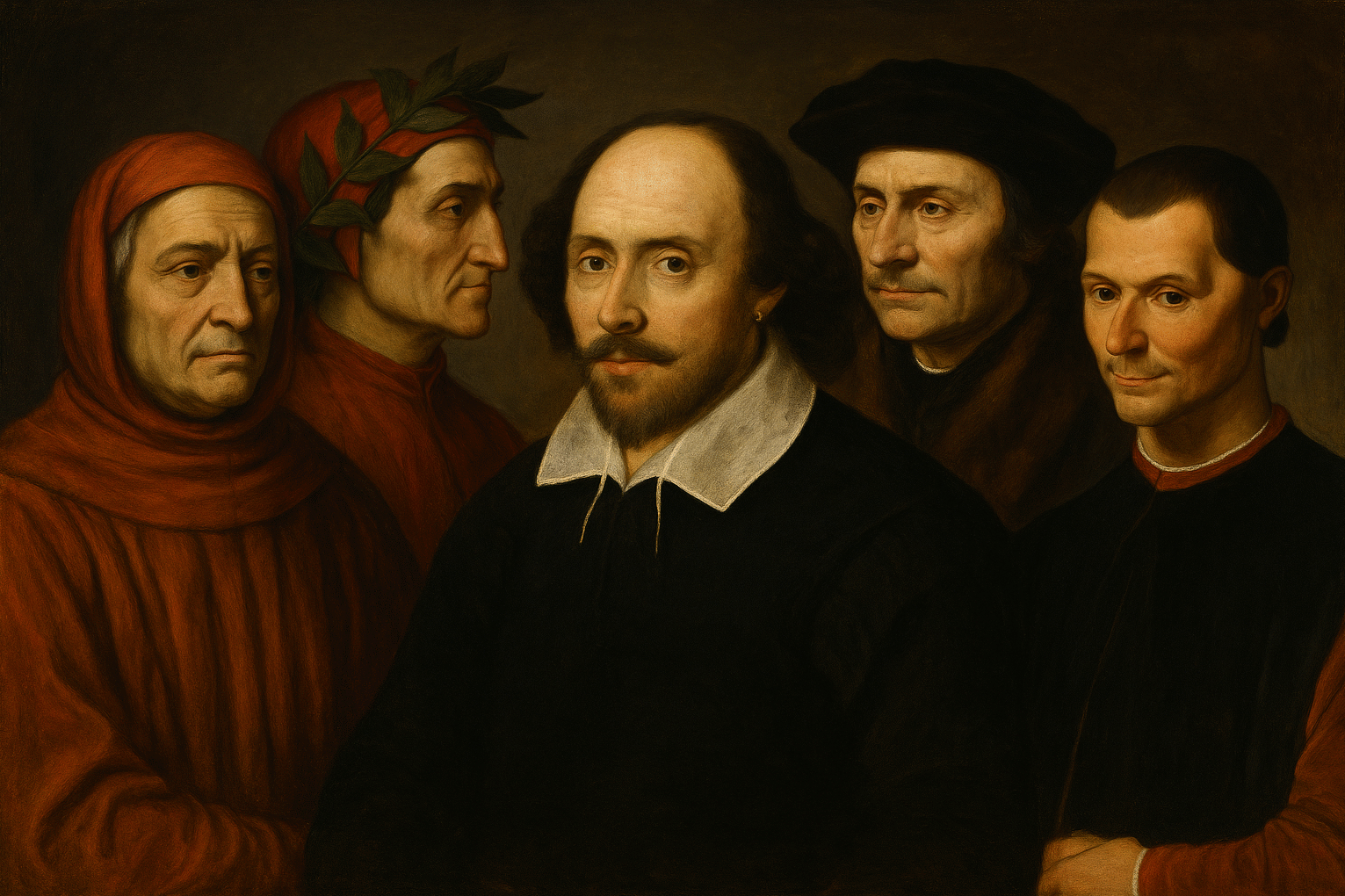
Wyatt introduced the Petrarchan sonnet to English literature. He translated and adapted sonnets from the Italian master Francesco Petrarch. Furthermore, he studied under the influence of Thomas Wyatt as Renaissance Sonneteer traditions deeply. Consequently, he transformed Italian conventions to suit English sensibility. The English language requires different rhythms and rhyme schemes. Additionally, Wyatt often altered his Italian sources significantly. He gave them a sharper, more personal, and more political edge. Therefore, his sonnets feel distinctly English despite their Italian origins. Moreover, Wyatt collaborated artistically with Henry Howard, Earl of Surrey. Together, they pioneered the English sonnet tradition. Furthermore, their work laid the foundation for Shakespeare’s sonnets later. Wyatt’s contribution to English poetry was therefore enormous. Additionally, his sonnets often address themes of disappointed love. Yet they also address political danger, betrayal, and ambition. Consequently, Wyatt expanded the sonnet form’s thematic range. He pushed it beyond love poetry into moral and political territory. Therefore, the poem represents this expansion perfectly. It uses the lyric form to deliver a Stoic philosophical warning. This combination of lyric grace and moral weight defines Wyatt’s genius.
3. The Poem’s Classical Source: Seneca’s Thyestes
The poem draws directly from Seneca the Younger’s tragedy Thyestes. Seneca was a Roman Stoic philosopher and dramatist. Furthermore, his chorus in Thyestes praises the life of quiet retirement. Consequently, Wyatt found in Seneca a perfect classical model. The Roman text warns against the pursuit of power and greatness. Additionally, Seneca argues that the humble man lives more safely. The great man at the top of fortune’s wheel risks everything. Therefore, Wyatt translated and transformed this Senecan argument. Moreover, Stoicism was widely admired in Renaissance humanist circles. Scholars and courtiers read Seneca with great enthusiasm. Furthermore, his moral philosophy offered a framework for surviving tyranny. Wyatt understood this framework from bitter personal experience. Additionally, the Senecan model gave Wyatt’s warning classical authority. He was not merely expressing personal complaint or fear. He was drawing from centuries of accumulated philosophical wisdom. Consequently, the poem gains intellectual weight from its classical source. Furthermore, Wyatt’s adaptation is not a slavish translation but a creative transformation. He sharpens Seneca’s generalized warning into something urgent and specific. Therefore, the classical source enriches the poem without constraining it. The poem honors Seneca while speaking directly to Tudor England.
4. Summary of Stand Whoso List Upon the Slipper Top by Wyatt
Stand Whoso List Upon the Slipper Top by Wyatt opens with a direct challenge. The speaker invites the ambitious to climb fortune’s unstable summit. Furthermore, he watches them strive with detached, knowing observation. Consequently, the poem establishes an ironic distance from worldly ambition. The ambitious man climbs toward power, wealth, and royal favor. Yet the higher he climbs, the greater his danger. Additionally, the poem introduces the metaphor of the slippery top. This image captures the precariousness of courtly success. Therefore, the summit of ambition is never a place of security. Moreover, the speaker positions himself as a wise, retired observer. He has chosen the humble path of withdrawal from power. Furthermore, he does not envy those who strive for greatness. Instead, he pities them and understands their coming fall. Additionally, the poem invokes the classical figure of Fortune’s wheel. Fortune turns constantly, raising some and destroying others. Consequently, no position at the top can last. The poem closes with a celebration of humble, quiet contentment. Therefore, the poem’s argument is clear, urgent, and beautifully structured. The wise man steps back from ambition’s dangerous summit.
5. The Metaphor of the Slipper Top
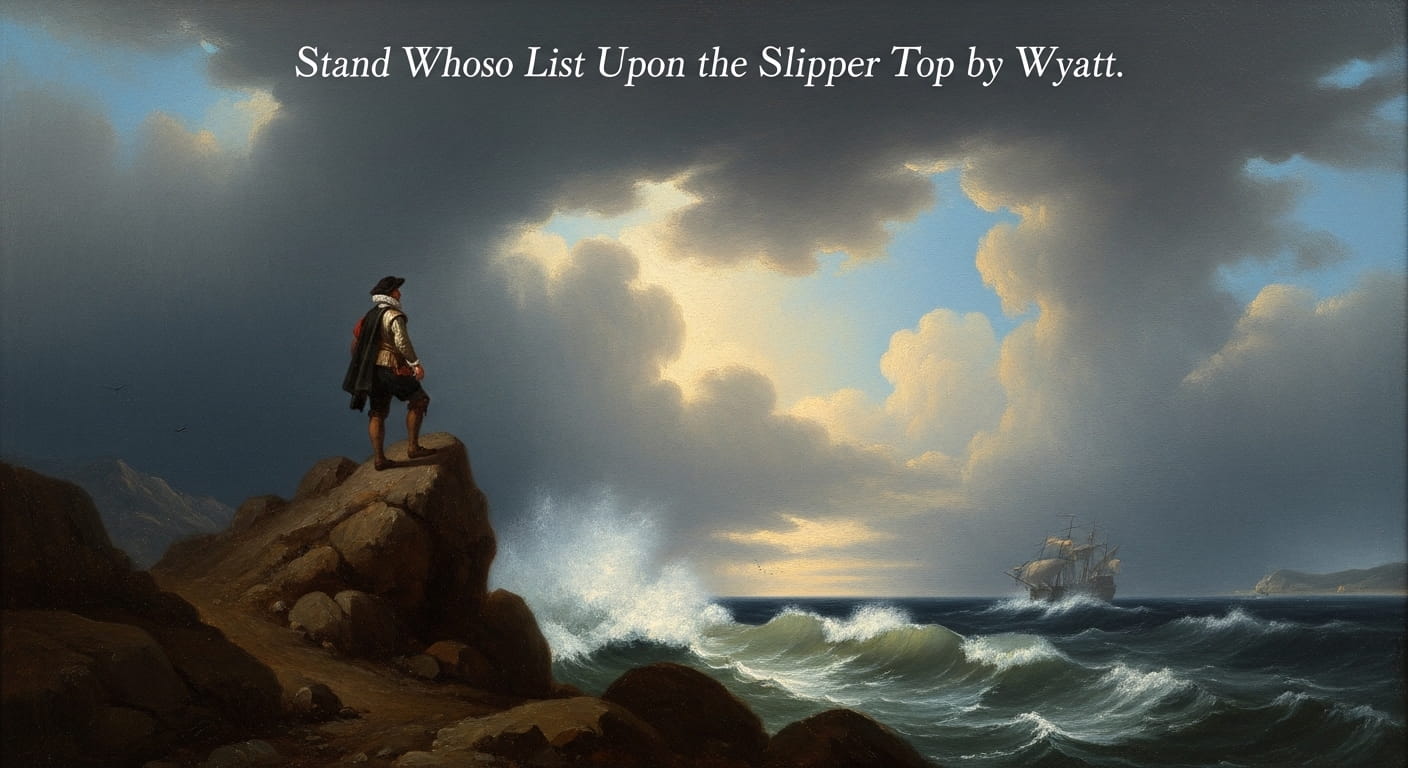
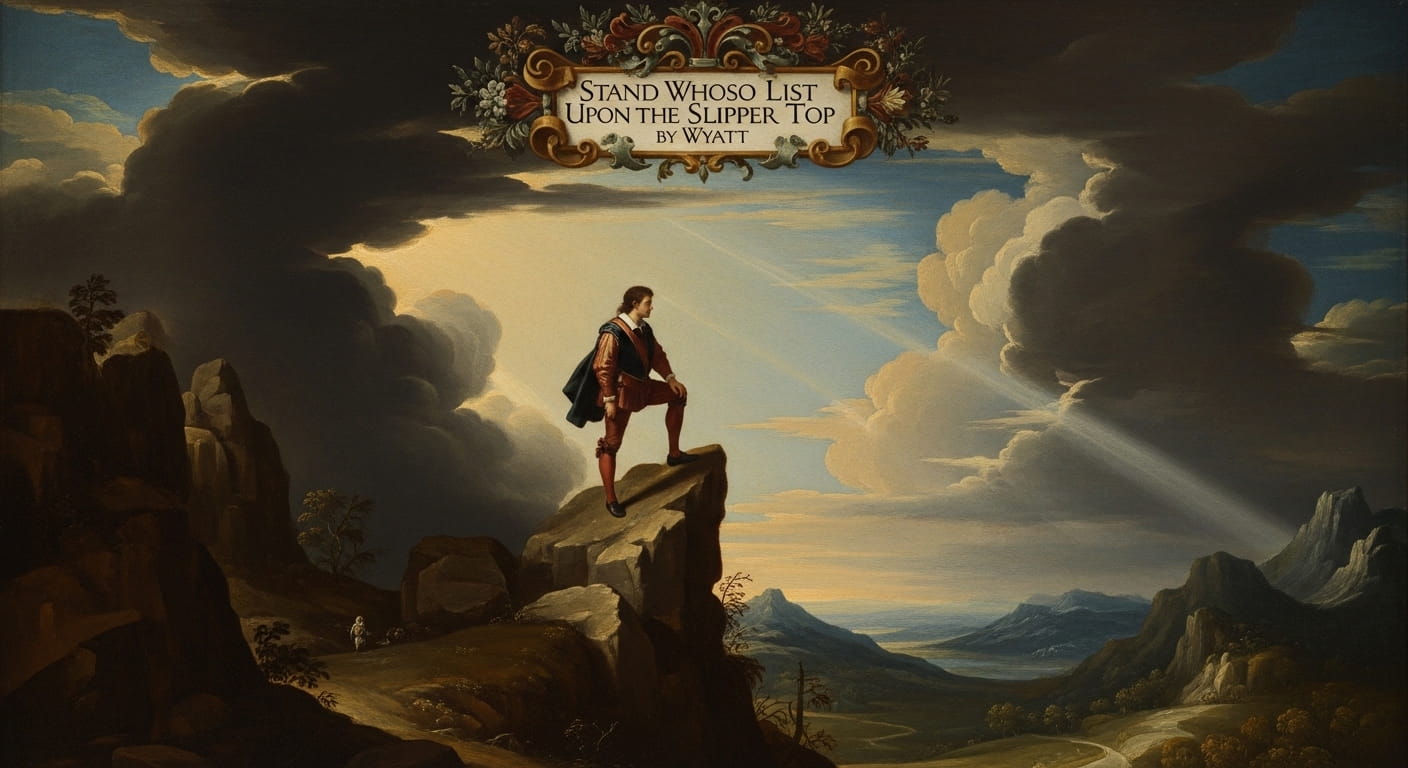
The slipper top is the poem’s central and most powerful image. It captures the essential instability of worldly power. Furthermore, the word “slipper” means slippery rather than a shoe. Consequently, the image conveys a dangerous, unstable footing immediately. Additionally, the top of any structure is its most exposed point. Height brings visibility, envy, and vulnerability to attack. Therefore, the slipper top symbolizes both achievement and imminent danger. Moreover, this image connects to the classical figure of Fortune’s wheel. Fortune raises her favorites to dizzying heights. Furthermore, she turns the wheel and destroys them just as swiftly. The higher the climb, the harder the inevitable fall. Additionally, the slipper top image would have resonated powerfully with Tudor readers. They had witnessed the falls of Wolsey, Cromwell, and Anne Boleyn. Consequently, the metaphor was not merely literary but historically vivid. Furthermore, the image suggests the impossibility of secure achievement. No one can stand firmly on a slippery surface. Therefore, ambition itself is structurally self-defeating in the poem. This poem uses this image with perfect economy. The single metaphor carries the entire philosophical argument. It is one of Wyatt’s most memorable and enduring poetic achievements.
6. Fortune’s Wheel and the Theme of Instability
Fortune’s wheel is a central concept in medieval and Renaissance thought. It appears throughout classical, medieval, and Tudor literature. Furthermore, it was immediately recognizable to Wyatt’s contemporaries. Consequently, the poem speaks a shared cultural language of instability. Fortune, in this tradition, is a blind, capricious goddess. She raises men to power without regard for merit. Additionally, she destroys them with equal indifference. Therefore, no human achievement can rest on Fortune’s favor. Moreover, the wheel metaphor captures the cyclical nature of rise and fall. What goes up must inevitably come down. Furthermore, the Tudor court demonstrated this cycle with terrible regularity. Wyatt watched great men fall within months of their greatest triumphs. Additionally, Fortune’s wheel connects to the poem’s Senecan source. Seneca warned repeatedly against trusting Fortune’s gifts. Consequently, Wyatt’s use of this tradition reinforces his classical authority. Furthermore, the poem implies that wisdom lies in stepping off the wheel entirely. The retired, humble man escapes Fortune’s dangerous rotations. Therefore, withdrawal from ambition is not cowardice but genuine wisdom. Stand Whoso List Upon the Slipper Top by Wyatt presents this withdrawal as the highest form of intelligence. Fortune cannot destroy the man who never sought her favor.
7. Stoic Philosophy in the Poem
Stoic philosophy forms the intellectual core of this poem. Stoicism taught that happiness depends on virtue and inner peace. Furthermore, it argued that external goods like wealth and power are worthless. Consequently, the Stoic sage desires nothing that Fortune can give or take. Additionally, Stoicism flourished among Roman writers like Seneca and Marcus Aurelius. These writers were widely read in Renaissance England. Therefore, Wyatt wrote within a living and admired philosophical tradition. Moreover, the poem’s speaker embodies the Stoic ideal of rational detachment. He observes the ambitious with calm, compassionate distance. Furthermore, he feels neither envy nor contempt for those who climb. Instead, he understands their error with philosophical clarity. Additionally, the Stoic emphasis on retirement connects to the poem’s argument. The wise man withdraws from public life to preserve his virtue. Consequently, this withdrawal is a form of spiritual freedom. Furthermore, Stoicism gave Wyatt a framework for surviving his dangerous world. By desiring nothing from the court, he could not be truly destroyed by it. Therefore, Stand Whoso List Upon the Slipper Top by Wyatt is a deeply Stoic poem. It applies ancient philosophical wisdom to the brutal realities of Tudor court life. The result is poetry of genuine moral and intellectual power.
8. The Tudor Court as a Dangerous World
The Tudor court was among the most dangerous environments in English history. Henry VIII executed two of his six wives personally. Furthermore, he destroyed his most powerful ministers when they failed him. Consequently, courtly service was a constant negotiation with mortal danger. Additionally, favor at court could vanish overnight without warning. A single mistake, false accusation, or royal displeasure meant ruin. Therefore, the ambitious courtier lived in a permanent state of anxiety. Moreover, Wyatt experienced this danger firsthand and repeatedly. He survived two imprisonments in the Tower of London. Furthermore, he saw his close associates executed for alleged treason. These experiences gave his poetry its particular urgency and precision. Additionally, the poem must be read against this historical backdrop. Its warning against ambition was not academic or abstract. It was a survival manual for the Tudor court’s deadly culture. Consequently, Stand Whoso List Upon the Slipper Top by Wyatt carries a political edge. It implicitly critiques the court culture that destroyed so many lives. Furthermore, the poem’s wisdom reflects Wyatt’s hard-won understanding. He knew better than most what the slipper top truly cost. Therefore, the poem speaks with the authority of lived experience.
9. The Speaker’s Voice and Tone
The speaker of the poem adopts a tone of calm, knowing wisdom. He does not rage against ambition or condemn the ambitious. Furthermore, he speaks with detached compassion rather than bitter resentment. Consequently, the tone elevates the poem above mere personal complaint. Additionally, the speaker positions himself as a wise observer standing apart. He watches the ambitious climb with something like pity. Therefore, his detachment is itself a philosophical statement. Moreover, the speaker’s calm suggests he has already made his choice. He has stepped back from the dangerous world of court ambition. Furthermore, this choice gives him a kind of moral authority. He speaks not from fear but from genuine wisdom and experience. Additionally, the tone reflects the Stoic ideal of rational equanimity. The Stoic sage observes the world’s chaos without being disturbed by it. Consequently, the speaker’s calm is not indifference but achieved wisdom. Furthermore, this tone would have resonated with Renaissance humanist readers. They valued the ideal of the wise, retired sage deeply. Therefore, the speaker’s voice carries both personal and cultural authority. The poem achieves its moral power through this measured, compassionate tone. It persuades through wisdom rather than anger or fear.
10. Ambition as the Poem’s Central Theme
Ambition is the dominant and most urgent theme of this poem. The poem does not celebrate ambition as a noble virtue. Furthermore, it presents ambition as a form of dangerous self-delusion. Consequently, the ambitious man does not see the trap he enters. Additionally, ambition blinds its possessor to the risks of climbing. The higher one rises, the more one has to lose. Therefore, ambition carries within it the seeds of its own destruction. Moreover, the poem connects ambition to vanity and worldly pride. These were familiar vices in both classical and Christian moral traditions. Furthermore, the Puritan tradition would later develop similar critiques. Ambition was a symptom of spiritual disorder and ungodliness. Additionally, Wyatt’s treatment of ambition reflects his personal history. He had seen ambition destroy the greatest men of his age. Consequently, his critique of ambition carries genuine emotional weight. Furthermore, the poem does not argue that all achievement is worthless. Instead, it distinguishes between humble contentment and dangerous overreach. Therefore, the poem’s target is specifically the pursuit of the very top. The slipper top is where ambition becomes most deadly. Stand Whoso List Upon the Slipper Top by Wyatt remains one of English literature’s most precise analyses of ambition’s dangers.
11. Imagery and Figurative Language
Wyatt employs powerful imagery throughout this short but dense poem. The central image of the slipper top dominates the entire work. Furthermore, it immediately establishes the poem’s key philosophical argument. Consequently, every other image in the poem reinforces this central metaphor. Additionally, the poem uses the imagery of height and fall repeatedly. Rising and falling are the poem’s fundamental physical movements. Therefore, vertical imagery carries the poem’s moral meaning throughout. Moreover, the poem invokes wind and storm as figures of Fortune’s power. The man at the top is exposed to every wind that blows. Furthermore, storms threaten most severely those who stand highest. This meteorological imagery reinforces the vulnerability of ambition. Additionally, the imagery of the wheel appears implicitly throughout the poem. Though not always named directly, Fortune’s rotation drives the poem’s logic. Consequently, the poem’s figurative language creates a coherent visual world. Furthermore, Wyatt’s imagery is economical and precise rather than elaborate. He achieves maximum effect with minimum ornament. Additionally, the simplicity of the imagery gives it universal appeal. These are images anyone can visualize and immediately understand. Therefore, the poem’s figurative language is both intellectually rich and accessibly vivid. Wyatt’s mastery of imagery is one of his greatest poetic achievements.
12. Structure and Form of the Poem
The poem uses a carefully controlled form. The poem follows the tradition of lyric verse with moral purpose. Furthermore, Wyatt employs a regular rhyme scheme throughout the poem. Consequently, the formal structure gives the moral argument aesthetic order. Additionally, the poem’s brevity is itself a formal statement. A short, controlled poem suits a message about restraint and withdrawal. Therefore, form and content work together with elegant precision. Moreover, Wyatt uses enjambment to create forward movement in the verse. Lines flow into each other, reflecting the inevitable momentum of Fortune. Furthermore, the poem’s rhythm is largely regular but with significant variations. These variations create moments of emphasis and surprise. Additionally, the poem’s opening line is its most dramatic and memorable. The direct address to the ambitious reader creates immediate engagement. Consequently, the poem establishes its relationship with the reader powerfully. Furthermore, the structure moves from challenge to warning to resolution. The speaker first invites, then warns, then celebrates wisdom. Therefore, the poem’s structure mirrors its philosophical argument. It moves from the dangerous world of ambition toward the peaceful world of retirement. This structural logic gives the poem its satisfying intellectual completeness.
13. The Theme of Retirement and Contentment
Retirement and contentment form the positive counterpart to ambition’s dangers. Stand Whoso List Upon the Slipper Top by Wyatt celebrates withdrawal. The wise man steps back from the court’s dangerous competitions. Furthermore, he finds peace in humble obscurity and quiet living. Consequently, retirement becomes a form of genuine wisdom rather than failure. Additionally, this theme connects to the classical ideal of otium. The Romans distinguished between otium (leisure and retirement) and negotium (public business). Therefore, Wyatt draws on a deep classical tradition of praising retirement. Moreover, the retired man escapes Fortune’s dangerous favors entirely. He cannot fall from a height he never sought. Furthermore, his contentment does not depend on royal favor or courtly success. He finds happiness within himself rather than in external achievement. Additionally, the theme of retirement carried personal resonance for Wyatt. After his second imprisonment, he retreated from court to his Kent estate. Consequently, the poem’s praise of retirement reflects his own hard-won choice. Furthermore, retirement connects to the Stoic ideal of self-sufficiency. The wise man needs nothing that power can provide. Therefore, the theme of contentment is both philosophical and deeply personal. Wyatt lived the wisdom he wrote about in this poem.
14. Petrarchan Influence and Adaptation
Wyatt adapted Petrarchan conventions throughout his poetic career. His work on Whoso List to Hunt demonstrates his creative approach to Italian sources. Furthermore, Petrarch provided a model for courtly love poetry primarily. Consequently, Wyatt often transformed love conventions into political commentary. Additionally, the Petrarchan tradition gave Wyatt formal tools and vocabulary. He used those tools for purposes Petrarch never intended. Therefore, Wyatt’s relationship with his Italian source is creatively subversive. Moreover, in this poem, the Senecan influence outweighs the Petrarchan. The poem is more a philosophical argument than a love lyric. Furthermore, it uses the lyric form to carry a Stoic moral message. This fusion of lyric grace with philosophical weight is distinctly Wyatt’s achievement. Additionally, the Petrarchan tradition of the suffering courtier resonates here. The courtly lover suffers under the power of his beloved. Similarly, the courtier suffers under the power of Fortune and the monarch. Consequently, Wyatt transfers the Petrarchan dynamics of power into political territory. Furthermore, this transfer was entirely natural given his court experience. Therefore, the Petrarchan and Senecan traditions merge in Wyatt’s hands. The poem represents this creative synthesis brilliantly.
15. Power, Monarchy, and Political Subtext
The poem carries a significant and carefully veiled political subtext. Wyatt wrote under one of England’s most dangerous monarchs. Furthermore, Henry VIII demanded absolute loyalty and obliterated those who failed him. Consequently, any criticism of power had to be indirect and carefully coded. Additionally, the poem’s attack on ambition implies a critique of the court system. The court itself creates and rewards the dangerous ambition the poem condemns. Therefore, the poem implicitly criticizes the culture Henry VIII cultivated. Moreover, Wyatt could not attack the king directly without risking his life. Instead, he used classical and philosophical frameworks as protective cover. Furthermore, Seneca’s authority shielded the poem’s political implications. This was not personal complaint but ancient wisdom. Additionally, the poem’s political subtext connects to his broader poetic project. Several of Wyatt’s poems address power, betrayal, and courtly danger obliquely. Consequently, Stand Whoso List Upon the Slipper Top by Wyatt participates in this pattern. Furthermore, the poem’s warning to the ambitious could be read as advice to the king himself. Even monarchs stand on a slipper top. Therefore, the poem’s political resonance is both subtle and profound. Wyatt used poetry as a space for truths too dangerous to speak aloud.
16. Comparison With Whoso List to Hunt
Wyatt’s Whoso List to Hunt offers a revealing companion piece. Both poems use the “whoso” address to a hypothetical ambitious person. Furthermore, both warn against pursuing something dangerously beyond reach. Consequently, the two poems share a thematic and rhetorical kinship. Additionally, Whoso List to Hunt addresses romantic pursuit rather than political ambition. Yet the political subtext of that poem is equally significant. Therefore, Wyatt consistently used indirect address to explore dangerous themes. Moreover, both poems draw on classical and continental sources. Whoso List to Hunt adapts Petrarch’s Sonnet 190 directly. Furthermore, both poems reflect Wyatt’s experience at Henry VIII’s court. The hunted deer of the one poem echoes the slipper top of the other. Additionally, both poems counsel withdrawal from dangerous pursuits. The wise hunter stops chasing the untouchable deer. The wise man stops climbing the unstable summit. Consequently, withdrawal and wisdom form a consistent theme across Wyatt’s work. Furthermore, reading the two poems together reveals Wyatt’s philosophical coherence. He returned repeatedly to the same fundamental insight. Therefore, the poem gains meaning from this comparison. The poems illuminate each other and reveal the depth of Wyatt’s vision.
17. Renaissance Humanism and the Poem
Renaissance humanism deeply shaped Wyatt’s intellectual world. Humanists valued classical learning, moral philosophy, and rational inquiry. Furthermore, they read Seneca, Cicero, and Plutarch with passionate attention. Consequently, Wyatt’s engagement with Senecan Stoicism placed him firmly within humanism. Additionally, humanists prized the ideal of the learned courtier. This courtier combined political service with scholarly cultivation. Therefore, Wyatt embodied the humanist ideal in both life and poetry. Moreover, humanism encouraged the adaptation of classical texts to modern contexts. Wyatt’s transformation of Seneca’s chorus was a humanist exercise. Furthermore, he was not merely translating but genuinely thinking through a problem. The problem was how to live virtuously in a corrupt and dangerous world. Additionally, humanist values of moderation, wisdom, and self-knowledge inform the poem. The wise man knows himself and his limits clearly. Consequently, self-knowledge protects him from ambition’s delusions. Furthermore, Renaissance humanism connected learning to practical moral wisdom. Philosophy was not merely academic but urgently practical. Therefore, Stand Whoso List Upon the Slipper Top by Wyatt is a deeply humanist poem. It applies the best of classical learning to the immediate pressures of Tudor life. Wyatt proves the humanist conviction that ancient wisdom speaks to every age.
18. The Poem and the Elizabethan World Picture
The poem reflects the broader Elizabethan and Tudor worldview. This worldview emphasized order, hierarchy, and the dangers of overreach. Furthermore, it drew on the classical concept of the great chain of being. Consequently, each person had a proper place in the cosmic and social order. Additionally, ambition represented a violation of this ordained order. The ambitious man reached beyond his proper station. Therefore, the poem’s warning against ambition reflected a deeply conservative worldview. Moreover, the Tudor world was acutely sensitive to the dangers of disorder. The memory of the Wars of the Roses shaped political culture profoundly. Furthermore, the monarchy depended on its subjects knowing their proper place. Wyatt’s poem, therefore, reinforced values that the Tudor state itself promoted. Additionally, the poem’s celebration of humble retirement reflected accepted social wisdom. The man who stayed in his station served God and the king. Consequently, the poem’s Stoic argument aligned with Tudor political theology. Furthermore, this alignment protected Wyatt from accusations of political subversion. The poem appeared to reinforce rather than challenge the established order. Therefore, the poem operated on multiple levels simultaneously. It genuinely advised withdrawal while subtly critiquing the system that made withdrawal necessary.
19. Moral and Spiritual Dimensions
The poem carries significant moral and spiritual dimensions. Wyatt was a devout Christian as well as a classical scholar. Furthermore, Christian morality reinforced the poem’s Stoic arguments. Consequently, ambition was sinful in both classical and Christian frameworks. Additionally, Christian teaching warned against pride and worldly attachment. The man who sought worldly glory forgot his eternal soul. Therefore, the poem’s warning carried genuine spiritual urgency. Moreover, the poem’s celebration of contentment echoed Christian virtues. Humility, patience, and acceptance of one’s condition were Christian ideals. Furthermore, the wise man who withdrew from ambition was spiritually as well as philosophically superior. He freed himself for a life of genuine virtue and prayer. Additionally, the poem’s Senecan framework was easily Christianized by Tudor readers. Seneca’s moral philosophy aligned closely with Christian ethics. Consequently, Wyatt could draw on both traditions simultaneously and naturally. Furthermore, the poem’s moral vision is genuinely compassionate throughout. It does not condemn the ambitious with anger or contempt. Instead, it pities them and gently warns them. Therefore, the poem’s moral tone reflects a generous and humane spirit. The poem demonstrates that Wyatt was not merely a skilled technician but a genuinely moral poet.
20. Language, Diction, and Poetic Economy
Wyatt’s language in this poem is precise, controlled, and economical. Every word carries significant weight and purpose. Furthermore, the diction is simple yet philosophically loaded. Consequently, the poem achieves depth without obscurity or excess. Additionally, Wyatt uses direct address to create immediate engagement. The reader feels personally challenged by the poem’s opening invitation. Therefore, the language establishes an intimate relationship with the reader. Moreover, the poem’s vocabulary draws from both classical and vernacular sources. Latin-derived words carry philosophical weight. Plain English words carry emotional immediacy. Furthermore, the balance between these registers gives the poem its distinctive texture. Additionally, Wyatt avoids elaborate ornament or excessive decoration. The poem’s beauty comes from clarity and precision rather than richness. Consequently, the language perfectly suits the poem’s Stoic argument. Stoicism valued simplicity, directness, and rational clarity. Therefore, the language enacts the values the poem argues for. Furthermore, Wyatt’s poetic economy was a genuine innovation in English verse. He showed that English poetry could be philosophically serious and formally controlled. Additionally, this economy influenced later poets, including Sidney and Shakespeare. Consequently, the poem contributed to the development of the English poetic style. Wyatt’s linguistic mastery remains one of his greatest legacies.
21. The Poem’s Influence on Later Literature
Stand Whoso List Upon the Slipper Top by Wyatt influenced subsequent English literature. Its themes of ambition, Fortune, and retirement resonate across centuries. Furthermore, Shakespeare returned to these themes repeatedly in his plays. The falls of Richard II, Wolsey, and Macbeth echo Wyatt’s warning. Consequently, the poem participated in a long literary tradition. Additionally, the Senecan model Wyatt used remained influential throughout the Renaissance. Elizabethan dramatists drew heavily on Senecan tragedy and philosophy. Therefore, Wyatt helped establish Seneca’s authority in English literary culture. Moreover, the poem’s treatment of Fortune’s wheel influenced later moral poetry. Spenser’s Mutabilitie Cantos develop similar themes with great elaboration. Furthermore, the tradition of retirement poetry that Wyatt helped establish continued for centuries. Ben Jonson, Andrew Marvell, and others praised the retired life similarly. Additionally, the poem’s political subtext influenced later court poets. They learned from Wyatt how to speak dangerous truths obliquely. Consequently, the poem shaped both poetic form and political strategy. Furthermore, modern readers continue to find the poem’s warning relevant. Power, ambition, and the dangers of overreach remain universal human concerns. Therefore, the poem’s influence extends far beyond its Tudor moment.
22. Wyatt’s Personal Experience Reflected in the Poem
The poem gains extraordinary authority from Wyatt’s personal experience. He did not write about the slipper top from a safe distance. Furthermore, he had stood on that dangerous summit himself. Consequently, every warning in the poem carries the weight of lived reality. Additionally, his imprisonment in the Tower of London shaped his worldview profoundly. He watched executions from his cell window with horror. Therefore, his retreat from ambition was not theoretical but urgently practical. Moreover, Wyatt’s diplomatic career exposed him to power’s corruption at its highest levels. He negotiated with European monarchs and witnessed their courts. Furthermore, he understood that power operated the same way everywhere. The slipper top was not only a feature of Henry VIII’s England. Additionally, his personal relationships connected him to the most dangerous falls of his era. His association with Anne Boleyn nearly destroyed him completely. Consequently, Stand Whoso List Upon the Slipper Top by Wyatt is autobiographical as well as philosophical. Furthermore, this autobiographical dimension gives the poem genuine emotional depth. The reader feels that the speaker has earned his wisdom through suffering. Therefore, the poem commands respect not merely as clever verse but as hard truth. Wyatt wrote what he knew, and what he knew was painful.
23. Comparative Reading With Anne Bradstreet
Reading Wyatt alongside Anne Bradstreet reveals fascinating resonances. Both poets wrote under systems of power that constrained them. Furthermore, both used classical and philosophical frameworks to navigate danger. Bradstreet’s poem Upon the Burning of Our House also counsels against worldly attachment. Consequently, both poets share a deep suspicion of material and earthly ambition. Additionally, Bradstreet’s The Flesh and the Spirit explores the tension between worldly desire and spiritual wisdom. This tension mirrors Wyatt’s opposition between ambition and retirement. Therefore, the two poets address deeply related moral and spiritual concerns. Moreover, both drew from classical and continental traditions. Bradstreet used Galenic humoral theory and Renaissance cosmology. Wyatt used Senecan Stoicism and Petrarchan lyric conventions. Furthermore, both adapted these traditions to their own urgent personal contexts. Additionally, Bradstreet’s Before the Birth of One of Her Children also confronts mortality directly. Like Wyatt, she faces death with philosophical courage. Consequently, reading these poets together enriches understanding of both. Therefore, the comparative reading opens new interpretive dimensions across literary traditions.
24. The Poem’s Relevance to Modern Readers
The poem speaks with remarkable urgency to modern readers. Ambition, power, and the dangers of overreach remain universal concerns. Furthermore, contemporary culture intensifies the pursuit of status and success. Consequently, Wyatt’s warning resonates more powerfully than ever before. Additionally, modern politics demonstrates Fortune’s wheel turning with terrible speed. Leaders rise and fall with astonishing and often brutal rapidity. Therefore, the poem’s central metaphor retains its full descriptive power. Moreover, the poem’s celebration of quiet contentment offers a counter-cultural challenge. It challenges the modern obsession with visibility, achievement, and public success. Furthermore, the Stoic ideal of inner peace over external achievement speaks to modern anxieties. Many readers today feel the exhaustion of constant striving and competition. Additionally, the poem models a different way of valuing life. The humble, contented man living beneath Fortune’s radar offers genuine wisdom. Consequently, the poem invites modern readers to reconsider their own ambitions. Furthermore, it does so without moralizing or lecturing with self-righteous authority. The speaker speaks from experience rather than superiority. Therefore, the poem earns its wisdom honestly and earns the reader’s genuine respect. Its relevance across five centuries proves its universal and enduring truth.
25. Critical Reception and Scholarly Perspectives
Scholars have long recognized the poem’s philosophical and literary significance. Early critics focused primarily on Wyatt’s technical achievements in versification. Furthermore, they traced his debts to Petrarch and Seneca carefully. Consequently, the poem’s classical sources were well documented by early scholarship. Additionally, twentieth-century criticism brought new biographical and historical approaches. Scholars read the poem in relation to Wyatt’s dangerous court experiences. Therefore, the poem gained a richer and more urgent historical dimension. Moreover, feminist and political criticism have added further layers of interpretation. Scholars examine the poem’s implicit critique of Tudor power structures. Furthermore, they explore the gendered dimensions of courtly ambition. Additionally, new historicist critics place the poem within its precise political moment. They read it against the backdrop of specific executions and court intrigues. Consequently, the poem emerges as a deeply situated political document. Furthermore, comparative studies have placed Wyatt within broader European contexts. His relationship to Italian and French Renaissance traditions is now well understood. Additionally, scholars continue to debate the precise relationship between his classical sources. Therefore, the poem remains a productive and endlessly debated literary object. The poem continues to generate rich and varied scholarly conversation across disciplines.
26. Teaching and Studying the Poem
This poem rewards careful study in any educational context. Students gain enormously from close engagement with its language and arguments. Furthermore, it introduces Renaissance literary history in a vivid and personal way. Consequently, students understand the Tudor period more richly through the poem. Additionally, the poem raises timeless questions about ambition and wisdom. These questions provoke genuine personal reflection and intellectual discussion. Therefore, the poem works beautifully as a starting point for debate. Moreover, the poem’s classical connections offer rich interdisciplinary possibilities. Teachers can connect it to Roman Stoicism and Renaissance humanism. Furthermore, the poem’s political dimensions connect to history and political science. Additionally, its formal qualities make it an excellent subject for close reading. Students learn how form and content work together through the poem. Consequently, it develops both analytical and aesthetic reading skills. Furthermore, comparing Wyatt to contemporaries like Surrey deepens literary understanding. Additionally, reading him alongside Bradstreet creates transatlantic perspectives. Therefore, the poem makes an ideal classroom text. It is short enough for intensive analysis yet rich enough for extended study. For additional resources on English literature, visit englishlitnotes.com. Explore American literary contexts at americanlit.englishlitnotes.com.
27. Legacy and Enduring Significance of the Poem
The poem’s legacy extends across five centuries of English literary history. The poem helped establish a poetic tradition. It proved that English verse could carry serious philosophical weight. Furthermore, it demonstrated the power of classical wisdom applied to modern political reality. Consequently, later poets inherited a richer and more ambitious conception of what poetry could do. Additionally, the poem’s moral vision has never grown stale or dated. Ambition’s dangers and retirement’s wisdom remain permanently relevant. Therefore, the poem speaks as clearly to us today as to Tudor readers. Moreover, Wyatt’s formal achievements influenced the development of English poetry directly. His controlled, economical verse set standards for later generations. Furthermore, his ability to fuse classical authority with personal experience remains admirable. Every great poet since has faced the same challenge. Additionally, the poem’s political courage deserves ongoing recognition and respect. Wyatt risked something real in writing and circulating these verses. Consequently, the poem carries the moral weight of genuine personal commitment. Furthermore, it models the kind of wisdom that genuine suffering produces. Theory and experience merge in Wyatt’s poem with extraordinary power. Therefore, the poem endures because it is genuinely true. It tells us something real and important about human life.
Conclusion
Stand Whoso List Upon the Slipper Top by Wyatt stands as one of Tudor England’s greatest lyric achievements. It combines classical learning with personal urgency and philosophical depth. Furthermore, it speaks a universal truth about the dangers of ambition and overreach. Consequently, it has resonated with readers across five centuries without interruption. Additionally, the poem reflects Wyatt’s extraordinary life and his hard-won wisdom. He wrote not from safety but from the experience of real danger. Therefore, the poem commands genuine respect and intellectual admiration. Moreover, it demonstrates what poetry can achieve at its finest. A short poem can carry the weight of an entire philosophical tradition. Furthermore, it can speak to one specific political moment and to all of human history simultaneously. Additionally, Stand Whoso List Upon the Slipper Top by Wyatt invites every reader to examine his own ambitions. It asks whether the summit we pursue is worth the dangerous climb. Consequently, the poem performs its didactic function with elegant, lasting power. Furthermore, its formal beauty makes the philosophical argument genuinely pleasurable to receive. The poem persuades through aesthetic delight as much as through rational argument. Therefore, it remains one of the essential poems of the English language. Every student of literature gains something vital from its study. Wyatt’s voice speaks across the centuries with undiminished authority and truth.
Discover more from Naeem Ullah Butt - Mr.Blogger
Subscribe to get the latest posts sent to your email.