What Is a Metaphor?
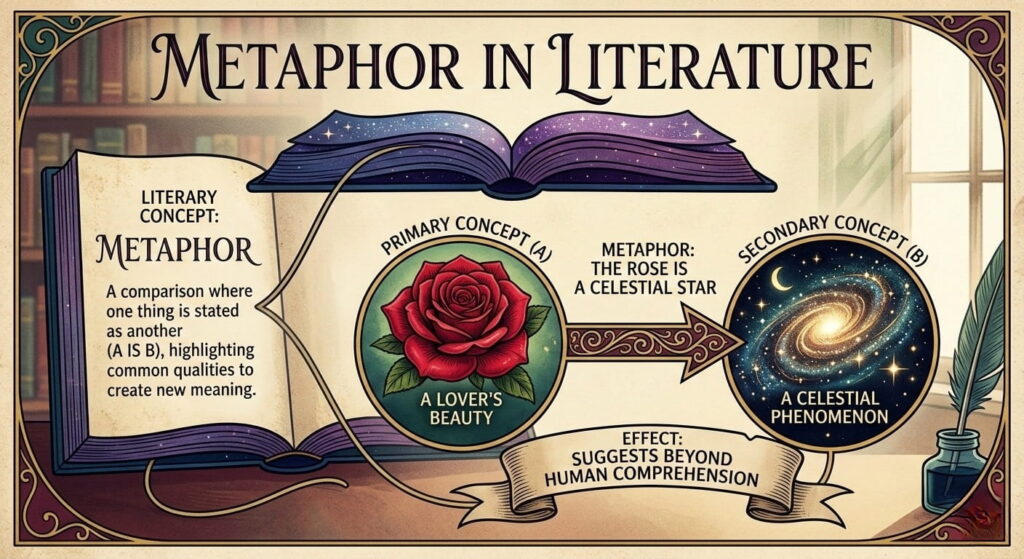
Metaphor is a powerful literary device. It directly compares two different things without using “like” or “as.” Instead of showing similarity, it claims one thing is another. Through this technique, writers create strong images and convey deep emotions. Unlike similes, metaphors feel bold and imaginative.
Why Do Writers Use Metaphors?
Writers rely on metaphors to enrich their language. Instead of explaining an idea in plain words, they create connections that feel alive. Metaphors allow writers to express feelings, moods, and concepts in a more meaningful way. Therefore, readers connect emotionally with the text. In both poetry and prose, metaphors add beauty and strength.
Examples of Metaphor in Literature
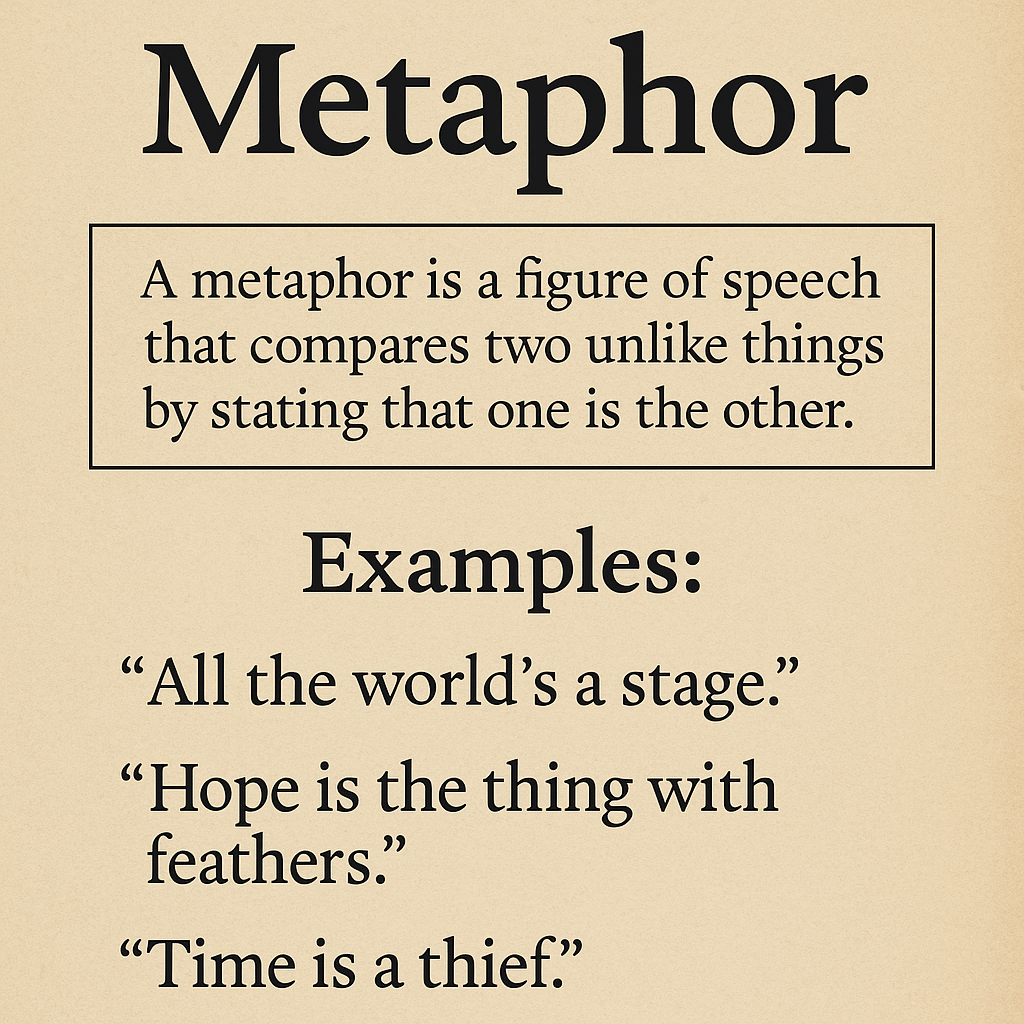
- “All the world’s a stage, and all the men and women merely players.” – William Shakespeare
→ Life becomes a stage. People become actors playing temporary roles. - “Hope is the thing with feathers.” – Emily Dickinson
→ Hope turns into a bird, light and free. It lives in the soul. - “Time is a thief.”
→ Time steals precious moments. It takes away life silently. - “The classroom was a zoo.”
→ The metaphor shows chaos. Children behave wildly, like animals.
Types of Metaphor
1. Primary Types of Metaphors
- Standard Metaphor: A direct comparison where one thing is said to be another. It usually follows the “A is B” structure to highlight a shared characteristic.
- Example: “The classroom was a zoo.” (Comparing the chaos of a room to the wild nature of a zoo).
- Example: “Time is a thief.” (Highlighting how quickly hours can disappear).
- Extended Metaphor (Conceit)This comparison is developed at length. It occurs throughout a series of sentences. It can span a paragraph or an entire literary work.
- Example: In Shakespeare’s As You Like It, the “All the world’s a stage” speech compares life to a play. The “exits and entrances” represent birth and death.
- Implied MetaphorThis type does not explicitly state that “A is B.” Instead, it suggests the comparison by using verbs or adjectives typically associated with the second object.
- Example: “The boss barked his orders at the staff.” (Implies the boss is a dog without saying it directly).
- Example: “The city never sleeps.” (Implies the city is a living person).
- Visual Metaphor These occur when an image or a visual representation is used to suggest a deeper meaning. It is also used for a comparison to an abstract idea.
- Example: A picture of a lightbulb glowing above someone’s head to represent a sudden idea.
- Example: A scale used in a logo to represent justice or balance.
2. Complex and Contextual Metaphors
- Dead Metaphor: These are figures of speech that have lost their “metaphorical punch” through over-usage. They have become so common that we no longer perceive the comparison.
- Example: “The legs of the table.” (Tables don’t have biological legs, but the phrase is standard).
- Example: “Falling in love.” (A conceptual drop rather than a physical one).
- Mixed Metaphor: This occurs when two or more incompatible metaphors are used together. This often results in a confusing or humorous image.
- Example: “We’ll bridge that bridge when we come to it.” (A mix of “bridge that gap” and “cross that bridge”).
- Example: “Let’s iron out the bottlenecks.” (One does not iron a bottleneck).
- Absolute Metaphor: These are comparisons where the two items being compared have no obvious resemblance. Yet, the metaphor works to convey a specific feeling or truth.
- Example: “Life is a journey.” (While not physically the same, the progression from start to end creates a conceptual link).
- Root Metaphor: A root metaphor is a foundational comparison that shapes how we perceive an entire subject or world-view.
- Example: “The universe is a machine.” (This metaphor shaped much of the scientific thinking during the Enlightenment).
How Do Metaphors Work?
Metaphors change how we view the world. By equating one thing with another, they reveal hidden similarities. Consequently, this sparks imagination and deeper understanding. Because of their visual and emotional power, metaphors improve writing instantly. In turn, they transform ordinary lines into unforgettable images.
How to Identify Metaphors
Identifying a metaphor takes focus. First, look for a direct equation between two things. Then ask: Are they different by nature? If yes, the phrase may be metaphorical. Finally, check whether the comparison creates a deeper meaning.
How to Use Metaphors Effectively
Using metaphors adds voice and clarity to your writing. To begin with, metaphors express abstract or complex ideas in vivid, relatable terms, making your writing more engaging. Therefore, choose fresh, original comparisons that reflect your unique perspective. Avoid using clichés like “time is money” or “a heart of stone.” Create metaphors that align closely with your theme. For example, personal growth could be compared to a tree reaching toward sunlight—an image that adds freshness and depth. Furthermore, match the tone of your metaphor with the mood of your piece. Use light metaphors for playful topics. Apply thoughtful imagery to serious subjects. In addition, consider your audience—select metaphors they can easily understand and connect with. Ultimately, well-chosen metaphors enhance your style, stir emotion, and make your writing more memorable.
Famous Metaphors in Poetry
- “The moon was a ghostly galleon tossed upon cloudy seas.” – Alfred Noyes
→ The moon becomes a ship lost in stormy clouds. - “I am a lighthouse worn by the weather and the waves.” – Henry Rollins
→ The speaker becomes a lighthouse, worn by life’s storms.
Why Are Metaphors Important in Literature?
Metaphors help writers express what words cannot say directly. Moreover, readers engage more deeply with metaphorical language. In fact, through metaphor, abstract feelings take visible form. As a result, readers experience stronger emotions and clearer ideas. Furthermore, these tools build a bridge to deep human meaning. Consequently, every comparison creates a vivid and lasting mental image. Similarly, complex concepts become simple through these clever associations. Therefore, literature thrives when authors use such powerful symbolic devices. Ultimately, these figures of speech make every story feel alive. In addition, they transform dull prose into a beautiful experience.
Benefits of Using Metaphors
- To expand on how metaphors function within literary works, here is a detailed breakdown of their benefits.
- Improve emotional impact
- Consequently, metaphors bypass logic to strike the heart directly.
- Furthermore, they stir feelings that simple descriptions often miss.
- In fact, a poignant comparison lingers in a reader’s soul.
- Enhance creativity
- Moreover, unique metaphors push the boundaries of traditional writing.
- Similarly, they encourage writers to see the world differently.
- As a result, every page feels fresh and completely original.
- Clarify abstract thoughts*
- For instance, metaphors turn invisible ideas into solid objects.
- Therefore, difficult concepts become easy for anyone to grasp.
- Specifically, they provide a roadmap for the reader’s mind.
- Strengthen storytelling
- Additionally, symbolic layers add profound depth to every plot.
- Consequently, the narrative carries more weight and lasting significance.
- In effect, the story becomes a mirror for life.
- Create memorable images*
- Thus, a vivid metaphor sticks firmly in the memory.
- Moreover, readers visualize the scene with perfect, sharp clarity.
- Essentially, words paint pictures that a reader never forgets.
- Deepen reader connection
- Above all, shared symbols build trust between author and audience.
- Likewise, metaphors invite the reader to feel truly seen.
- Ultimately, these connections make the reading experience very personal.
Final Thoughts on Metaphor in Literature
Metaphor in literature transforms how we read and feel. In addition, writers use it to express beauty, pain, joy, and complexity. Furthermore, this technique allows deep emotions to surface quite vividly. Because metaphors connect different ideas, they give writing a soul. Moreover, these comparisons create a bridge between the author and the reader. Consequently, the impact of a story becomes much more profound. Therefore, anyone who reads or writes literature must learn to appreciate and use metaphors. Specifically, identifying these links improves your understanding of various complex themes. Similarly, utilizing such devices enhances the creative quality of every single sentence. With practice, you’ll begin to see and apply them naturally. In fact, your perspective on language will shift entirely. Thus, every word carries the potential for a deeper meaning. Likewise, the reading experience grows richer with every creative association. Ultimately, these symbolic tools ensure that the narrative remains truly unforgettable. Additionally, they turn simple observations into timeless truths. In short, your mastery of this art will lead to greatness.
Simile in Literature: https://englishlitnotes.com/2025/06/17/simile-in-literature/
Captain John Smith-A Pioneer of American Exploration and Literature: https://americanlit.englishlitnotes.com/captain-john-smith/
Use of Since and For in English: https://grammarpuzzlesolved.englishlitnotes.com/since-and-for-in-english-grammar/
The Commander and His Horse: https://englishwithnaeemullahbutt.com/2025/05/18/commander-his-horse/
Discover more from Naeem Ullah Butt - Mr.Blogger
Subscribe to get the latest posts sent to your email.