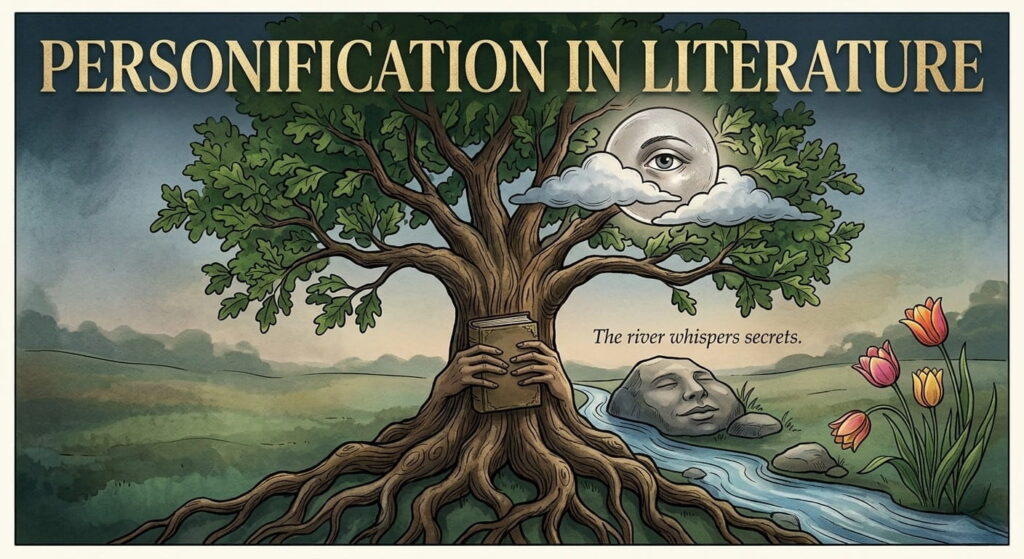
Authors often give life to silent objects. Therefore, scenes gain warmth and emotional color. This creative tool is personification in literature. Moreover, writers use it across poems and stories. It turns a cold house into a watcher. Consequently, the house feels alive to readers. It turns the wind into a singer. Likewise, the wind seems gentle and expressive. Writers use this device to build deep emotions. Furthermore, strong emotions improve reader engagement. Readers feel a stronger bond with the setting. As a result, the story world becomes vivid. Authors also animate trees, rivers, and skies. Thus, nature appears active and meaningful. In addition, abstract ideas influence human behavior. For example, time may run or whisper. Therefore, readers imagine ideas more clearly. This article explores how it works in stories. Moreover, it explains the purpose behind this technique. We will look at its many unique forms. Finally, we will examine examples from literature.
What is Personification in Literature?
Imagine a tree that reaches for the stars. At first, the image surprises the reader. However, imagination quickly fills the scene with life. The tree does not actually have human arms. Yet the mind still pictures stretching branches. Yet personification in literature makes us see those arms. Therefore, the tree appears lively and expressive. This device assigns human traits to inanimate things. Moreover, it gives motion and emotion to still objects. It bridges two worlds through vivid, active imagery. Consequently, readers move smoothly between reality and imagination. One world is human and full of feeling. In contrast, the other world stays silent and physical. Furthermore, the story moves beyond simple facts. Instead, the language paints emotional landscapes. Similarly, the prose gains a rhythmic, melodic quality. As a result, sentences flow with gentle harmony. Consequently, the reader stays engaged with the text. Moreover, vivid imagery strengthens the reader’s curiosity. Therefore, it remains a top stylistic choice. Additionally, many poets rely on this creative tool. Thus, personification in literature continues to shape powerful literary expression.
Key Kinds of Personification
Many people think this device is simple. However, personification in literature has specific variations. Each type serves a different narrative purpose.
1. Pathetic Fallacy
This type focuses on nature and weather. Therefore, writers often describe storms, clouds, and sunlight. Moreover, this form appears widely in poetry and stories. It is a common form of the device. Consequently, many readers recognize it easily. Nature reflects the mood of the characters. Thus, emotions spread into the surrounding landscape.
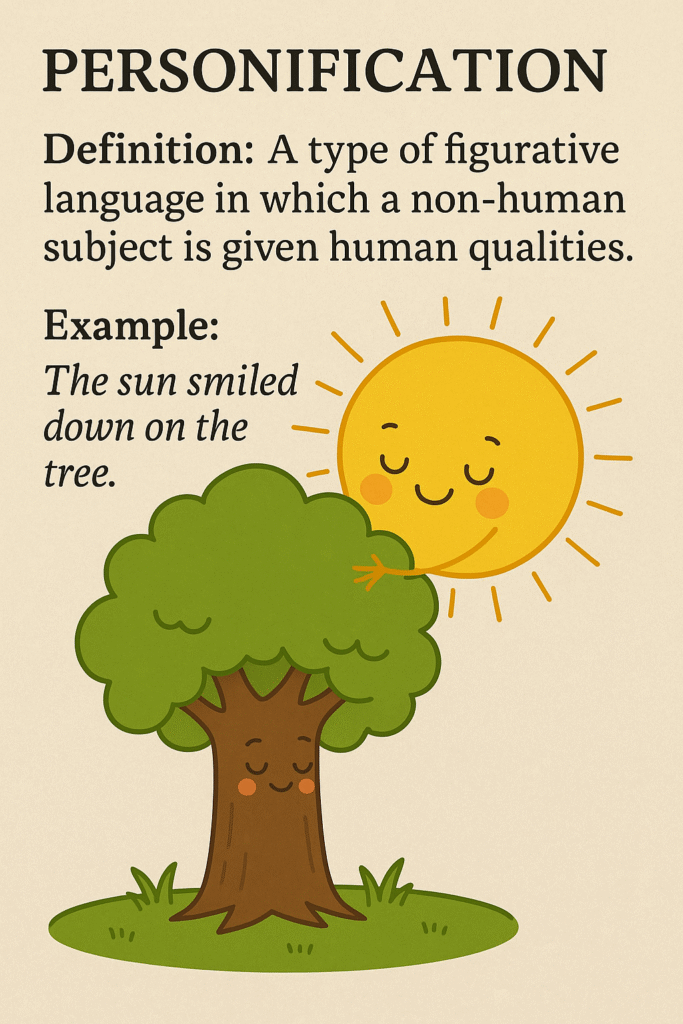
For instance, the clouds cry during a funeral. In this example, rain represents human sorrow. Likewise, the sky seems to mourn the loss. The sun smiles when a hero wins. Here, sunlight reflects joy and victory. Similarly, warm light celebrates the hero’s success. The wind whispers secrets at night. In this case, wind behaves like a quiet speaker. Additionally, the whispering mood creates mystery. The angry storm attacks the lonely shore. Here, thunder and waves express rage. Consequently, the scene feels tense and dramatic.
Moreover, the tired sun sinks behind distant hills. In this example, sunset reflects human exhaustion. Likewise, the day appears to rest peacefully. The playful breeze dances through summer fields. Here, the breeze acts like a joyful dancer. Therefore, the scene feels light and cheerful. The gloomy clouds hide the smiling sun. In this case, clouds seem jealous or protective. Thus, the sky gains emotional depth.
Consequently, the environment validates the character’s internal pain. The storm may echo grief or anger. Moreover, gentle sunlight may mirror happiness. Therefore, the landscape feels emotionally alive. Furthermore, the setting becomes an active storytelling partner.
Moreover, it creates a sense of universal harmony. Nature and humanity appear closely connected. Therefore, the world feels responsive and meaningful. Consequently, readers sense a shared emotional universe. Therefore, the world feels connected to the soul.
2. Apostrophe
Authors sometimes speak directly to an object. Therefore, the writing feels dramatic and personal. Moreover, the speaker treats the object like a companion. This is a bold style of writing. Consequently, it creates strong emotional intensity. A poet might shout at the moon. In this example, the moon becomes a silent listener. They treat the moon like a listening friend. Thus, the moon receives human attention and sympathy.
For instance, a poet may cry, “O moon, hear my sorrow.” Here, the moon appears as a caring companion. Likewise, the lonely speaker shares hidden pain. Another writer may say, “O time, slow your cruel steps.” In this case, time behaves like a moving being. Consequently, the plea expresses fear of passing moments. A traveler might whisper, “Kind road, guide my journey.” Here, the road gains human kindness and wisdom.
Accordingly, the object gains a silent, listening presence. Furthermore, readers imagine the object as emotionally aware. Moreover, this technique strengthens the speaker’s voice. It reveals feelings without another human character. Furthermore, it highlights the speaker’s extreme isolation. The speaker seeks comfort from silent surroundings. Thus, loneliness becomes painfully visible.
Thus, the dialogue becomes a deep internal monologue. The speaker actually talks to personal thoughts. Moreover, the object reflects the speaker’s emotions. Consequently, the reader witnesses a powerful inner struggle. Therefore, this form of personification in literature creates intimate and memorable moments.
3. Chremamorphism
This form reverses typical imagery in literature. Therefore, writers move away from normal personification patterns. Moreover, human characters receive object-like qualities. This is the reverse of typical imagery. Consequently, readers notice the striking comparison immediately. It gives object-like qualities to a human being. Thus, a character appears rigid or lifeless.
For instance, a soldier may rust with silence after war. Here, rust suggests emotional decay and neglect. Likewise, the phrase shows inner damage and abandonment. A broken lover might shatter like fragile glass. In this example, glass represents emotional fragility. Consequently, the character appears completely destroyed by pain. A cruel leader may have a heart of stone. Here, stone suggests hardness and lack of empathy. Thus, the leader seems cold and merciless.
Another example shows a tired worker crumbling like an old wall. In this case, the wall represents exhaustion and weakness. Similarly, a frightened child may freeze like iron in winter. Here, the metal image expresses emotional paralysis. A betrayed friend may feel cracked like dry earth. Consequently, the image highlights deep emotional suffering.
Alternatively, their heart might be a stone. Here, the stone symbolizes emotional emptiness. Consequently, this emphasizes a loss of humanity. The character seems distant and unfeeling. Similarly, it shows a character becoming cold or hard. Moreover, such imagery reflects emotional transformation. Therefore, writers use this technique to show moral decline. Consequently, readers understand the character’s inner change clearly.
Examples of Personification in Literature
Here are more than thirty clear examples. Each shows personification in literature in action.
- The wind whispered through the dark pines. The wind cannot speak words like humans. This imagery suggests a hidden, quiet secret.
- The ancient floorboards sighed under her weight. Wood does not feel fatigue or relief. This mimics a tired, heavy breath of air.
- Opportunity knocked loudly at his front door. Opportunity is an abstract concept, not a person. It gains a physical, urgent presence here.
- The stubborn bolt refused to turn an inch. Metals do not possess a strong or weak will. This highlights the character’s extreme frustration.
- The stars winked playfully from the night sky. Gas giants do not have eyes or humor. This creates a magical and lighthearted mood.
- The camera loves her bright, smiling face. A machine cannot feel affection or preference. Writers use this to show great beauty.
- Fear grabbed his throat with an icy hand. Fear is an emotion, not a physical attacker. It makes the terror feel very real.
- The sun peeked over the mountain’s shoulder. The sun does not have eyes or curiosity. This signals a fresh, new beginning.
- The fire devoured the dry forest in minutes. Fire does not eat or feel hunger. It shows the fire’s massive, destructive power.
- Time crawls when you wait for bad news. Time moves at a constant, steady rate. This describes our internal, emotional clock.
- The ocean danced beneath the silver moonlight. Water does not follow a rhythmic musical beat. It adds grace and movement to nature.
- The alarm clock chided him for sleeping late. An electronic device cannot judge a person’s schedule. It implies a sense of deep guilt.
- The vines strangled the old porch swing. The plants act with a clear, murderous intent. Nature is slowly reclaiming the old house.
- The microwave beeps impatiently at the cook. A machine cannot feel stress or time pressure. This highlights the frantic pace of life.
- The headlights blinked as the car hit bumps. The lights mimic the reflex of human eyes. The vehicle seems startled by the rough road.
- The wind howling through the rafters kept her awake. Wind does not have a throat for crying. This creates an eerie, ghostly atmosphere.
- The skyscraper loomed over the tiny park below. A building cannot stand with a threatening posture. It shows the industry’s dominance over nature.
- The morning dew kissed the rose petals. Water droplets cannot perform acts of affection. This creates a gentle, romantic scene.
- The engine coughed once and then died. A motor does not have lungs or life. This mechanical failure feels like a tragic loss.
- The moon was a lonely, ghostly sailor. The moon is given a profession and struggles. It adds a sense of adventure to the night.
- The book’s spine cracked when he opened it. Books do not have a human skeletal system. This implies the object is very fragile.
- The fire danced with joy among logs. Flame does not possess the capacity for happiness. It describes a healthy, bright fire.
- Shadows reached out to grab her passing ankles. Darkness does not have limbs to catch anyone. This builds intense suspense in horror stories.
- City lights winked at the low-flying plane. Electric bulbs do not have eyes for signaling. This makes the city feel very welcoming.
- The thunder grumbled like a tired old man. Sound waves do not have voices or tempers. It gives the storm a grumpy personality.
- Waves chewed away at the sandy shoreline. The ocean does not have teeth for eating. This shows the steady erosion of the coast.
- The wilted grass begged for a drop. Plants cannot speak or express a vocal plea. This highlights the severity of the drought.
- The old tractor sat lonely in weeds. Machinery cannot feel the sting of social isolation. It suggests a farm long abandoned.
- The hail hammered on the tin roof. Ice pellets do not use tools to strike. This emphasizes the rhythmic violence of storms.
- The news took a firm grip on him. Information is not a being with strong hands. This describes the deep impact of tragedy.
- The tulips nodded their heads in the breeze. Flowers do not have necks for nodding. This creates a peaceful movement in gardens.
- The desert hid secrets under shifting sands. A landscape cannot choose to keep information. It makes the environment seem very mysterious.
Why Use Personification in Literature?
Initially, it makes the abstract feel very concrete. Second, it increases the pace of your prose. Third, it allows for faster character development. Every object becomes a mirror for the soul. Therefore, personification in literature remains a vital tool. It turns a boring report into art. Moreover, it simplifies complex emotions for the reader. Consequently, even children can grasp deep themes. Likewise, adults find new layers in the text. Thus, the device bridges all age groups.
Enhancing the Reader’s Experience
Furthermore, writers use this to build suspense. A “watching” window creates a sense of dread. In addition, “angry” thunder suggests a coming conflict. Because of this, the reader anticipates the next move. Similarly, “friendly” sunlight offers a moment of peace. Thus, the setting dictates the emotional journey. Therefore, the reader stays submerged in the story. Consequently, the book becomes hard to put down.
Personification in Modern Poetry
Modern poets use this tool in very fresh ways. They often personify modern technology and urban life. For instance, a “exhausted” cell phone battery creates sympathy. Thus, the device evolves with our changing world. Today, personification in literature reflects our digital struggles. A “judging” social media feed feels very real. Moreover, poets use it to discuss mental health. Anxiety becomes a “heavy guest” who refuses to leave. Similarly, depression might be a “thief” of time. Consequently, the poem feels deeply personal and raw. Therefore, modern verse stays relevant to younger readers.
Furthermore, these poets avoid old, dusty cliches. They do not just write about “smiling” flowers. Instead, they write about “screaming” sirens in the city. Thus, personification in literature gains a gritty, realistic edge. Subsequently, the reader feels the heat of the street. In addition, it helps express complicated political ideas. A “hungry” government can represent a large systemic issue. Because of this, the poem carries a sharp message. Finally, it makes the mundane feel quite extraordinary. A “lonely” toothbrush tells a story of heartbreak. Consequently, every small detail matters in the verse.
Conclusion: The Lasting Impact
In conclusion, this device changes how we read. Moreover, it transforms ordinary scenes into living experiences. We see the world through a human lens. Consequently, nature and objects feel emotionally connected to us. Personification in literature is not just for kids. Instead, serious writers use it in powerful ways. It appears in the greatest classic novels. Likewise, many famous poets rely on this technique. Shakespeare used it to animate night and time. Similarly, Wordsworth gave life to rivers and clouds. Therefore, this device belongs to mature literary craft.
Use this tool to sharpen your own writing. Moreover, practice describing nature with human emotions. Let the wind whisper gentle advice. Let the mountains watch silent travelers. In this way, your descriptions gain vivid energy. Your readers will thank you for the magic. Consequently, they will imagine every scene clearly. Furthermore, keep practicing these short, punchy sentences. Short sentences create rhythm and clarity. Moreover, they keep readers focused and attentive.
Consequently, your style will become clear and strong. Over time, your voice will sound confident and direct. Therefore, your message will always reach the audience. Additionally, your writing will feel lively and memorable. Thus, personification in literature will remain a powerful creative tool.
English Literature: https://englishlitnotes.com/category/history-of-english-literature/
American Literature: https://americanlit.englishlitnotes.com/the-prologue-by-anne-bradstreet/
Notes on English for All Classes: https://englishwithnaeemullahbutt.com/2025/05/18/chaucers-realism-realist/
Grammar Puzzle Solved: https://grammarpuzzlesolved.englishlitnotes.com/that-vs-which/
Victorian Period in English Literature: https://englishlitnotes.com/2025/04/20/victorian-period-in-english-literature/
Discover more from Naeem Ullah Butt - Mr.Blogger
Subscribe to get the latest posts sent to your email.