1. Introduction to Jon McGregor as Short Story Writer
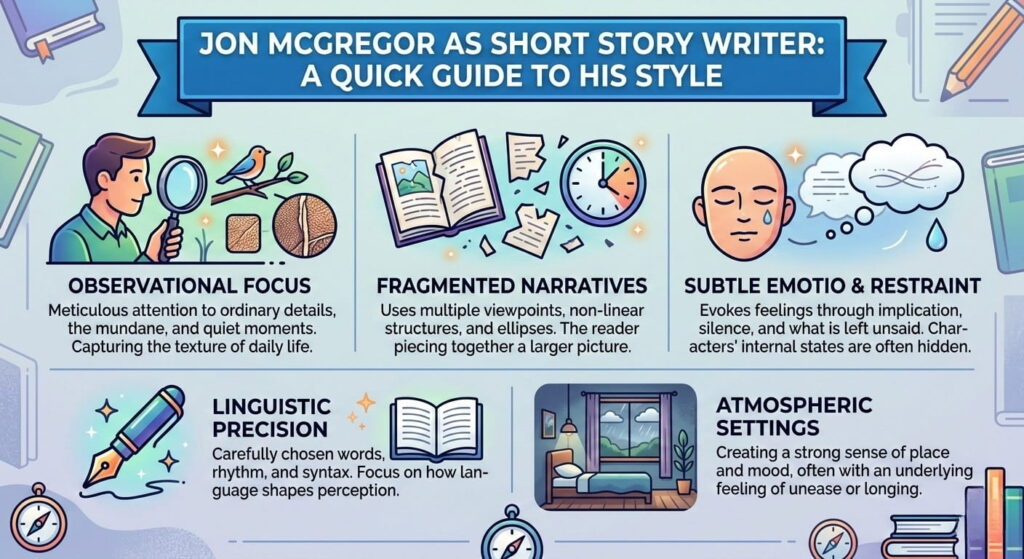
Jon McGregor as short story writer demonstrates how brevity reveals depth through a mastery of atmosphere and subtle movement. His fiction thrives on emotional undercurrents that ripple beneath the surface of seemingly ordinary events. Moreover, he emphasizes silences. These silences speak significantly louder than traditional dialogue. They force the reader to lean in closer to hear the unspoken. Consequently, readers experience narratives shaped by a distinct internal rhythm rather than explosive external action. In addition, Jon McGregor as short story writer utilizes fragmented structures that reflect the scattered nature of modern consciousness. Therefore, his stories feel incredibly alive through their deliberate pacing and refusal to rush toward a conclusion. Furthermore, his approach resists conventional narrative arcs, allowing fleeting impressions to guide interpretation.
2. Early Beginnings and Stylistic Foundations
McGregor began his literary journey with early experiments in short fiction that prioritised restraint over unnecessary exposition. He valued concision and the exploration of silence as a primary way to build tension without noise. Moreover, his first published stories captured critical attention through fragmented styles that broke away from linear storytelling. Consequently, these early works introduced readers to a distinct voice that felt both ancient and radically new. In addition, Jon McGregor built a foundation as a short story writer. This foundation eventually carried over into his celebrated novels. Therefore, his mastery of the short form remains the bedrock of his entire professional bibliography and creative identity. Furthermore, his early work revealed recurring themes of isolation and the persistent nature of human memory.
3. Thematic Exploration of Human Isolation
Isolation defines much of the thematic landscape found within the short fiction of this author. He often portrays individuals living on the jagged edges of society or within the cracks of urban life. Moreover, he captures the specific, aching loneliness of modern existence with a clinical yet empathetic eye. Consequently, his stories resonate universally across cultures because they touch upon the core human fear of being unseen. In addition, isolation highlights the inherent vulnerability within ordinary lives that we often choose to ignore for comfort. Therefore, Jon McGregor as short story writer addresses universal human struggles through the lens of the solitary figure. Furthermore, he uses isolation as a primary narrative engine to drive his characters toward internal realizations.
4. Depiction of Memory and Temporal Complexity
Memory shapes the short fiction of McGregor profoundly, operating as both a central theme and a structural device. Moreover, he emphasizes fragments rather than linear recollection, allowing memory to function as a dynamic, unpredictable force. Consequently, readers confront a sense of uncertainty, questioning not only the characters’ perceptions but also their own interpretations. In addition, memory drives character development by revealing the regrets and emotional residues that inform present-day choices. Therefore, Jon McGregor as short story writer engages with temporal complexity to show how the past is never truly gone. Furthermore, he portrays memories as intrusive yet illuminating forces that shape the very fabric of human consciousness. Readers witness characters haunted by remembered moments.
5. Experimental Narrative Structures and Form
McGregor frequently experiments with narrative form, demonstrating a consistent willingness to challenge every established literary convention. Moreover, he disrupts traditional story arcs and predictable closures to create unexpected trajectories that demand active participation. Consequently, readers must interpret events and connections for themselves, assembling meaning from disjointed sequences and subtle hints. In addition, he employs repetition and shifting perspectives to highlight the subjectivity of the human experience. Therefore, Jon McGregor as short story writer makes experimentation central to his craft, ensuring form reflects meaning. Furthermore, he uses white space strategically on the page, inviting pauses and contemplation that mirror a character’s thought process.
6. Dignifying Ordinary Lives through Fiction
Jon McGregor as short story writer highlights ordinary existence with careful attention and a level of emotional nuance rarely seen. Moreover, he illuminates lives that may seem unremarkable at first glance yet hold a profound and lasting resonance. Consequently, readers begin to notice overlooked details in their own lives, appreciating the beauty found in simplicity. In addition, his characters—often ordinary people—reveal universal truths about the human condition that connect readers across the globe. Therefore, his fiction establishes a bridge of empathy through the familiar, making the everyday feel truly compelling. Furthermore, McGregor deliberately rejects sensationalism, privileging raw authenticity over cheap drama to strengthen the emotional impact.
7. The Expressive Power of Silence
Silence functions centrally in his short stories, serving as a powerful expressive tool that conveys emotion beyond spoken words. Moreover, he uses the absence of speech to highlight tension, grief, and rare moments of intimacy. Consequently, audiences must interpret what remains unsaid, engaging actively with the text to fill in the emotional gaps. In addition, silence contributes significantly to the rhythm and pacing of his prose, allowing the story to breathe. Therefore, Jon McGregor as short story writer ensures that the tempo of the narrative reflects the internal landscape. Furthermore, these strategic silences enhance the overall atmosphere, giving weight to settings and interactions that words might ruin.
8. Exploration of Community and Interdependence
Community often contrasts sharply with the theme of isolation in these stories, serving as a lens for connection. Through this lens, human interdependence becomes visible and meaningful in ways that are both beautiful and tragic. Moreover, he portrays groups navigating shared lives, highlighting the cooperation and conflict found in ordinary social settings. Consequently, readers witness how collective bonds shape individual behavior, choices, and the very concept of identity. In addition, community generates a unique form of tension as characters negotiate the thin line between belonging and alienation. Therefore, Jon McGregor as short story writer examines social dynamics with a careful, almost sociological eye. Furthermore, his narratives show a remarkable continuity.
9. Nature and the Psychological Landscape
The short fiction of this author consistently foregrounds the landscape, making natural settings essential to understanding the characters. Moreover, he situates his characters amid rivers, fields, and wide skies, allowing nature to reflect their inner psychological states. Consequently, readers perceive the environment not merely as a backdrop but as an active participant in the story. In addition, these landscapes reinforce themes of isolation and community as characters respond to the world around them. Therefore, Jon McGregor as short story writer integrates the environment seamlessly into the very structure of the narrative. Furthermore, natural imagery conveys subtle shifts in tone and atmosphere, connecting internal feelings with external observations.
10. Emotional Subtlety and the Art of Restraint
Jon McGregor as short story writer consistently emphasizes emotional restraint to achieve a higher level of narrative intensity. He crafts stories that sustain a powerful mood without ever resorting to melodrama or exaggerated, false sentiment. Moreover, he allows emotions to emerge gradually, letting readers perceive the subtle shifts in feeling across ordinary moments. Consequently, readers must engage with the text actively, interpreting the cues embedded in action, dialogue, and especially silence. In addition, this subtlety deepens the narrative power, creating a resonance that lingers long after. Therefore, McGregor rewards the careful reader, as understanding often depends on noticing what is whispered rather than shouted.
11. The Influence of Place and Geography
Place defines the short stories of McGregor profoundly, as he situates his narratives in locations that are symbolically charged. Moreover, geography consistently informs character behavior, guiding their movements, interactions, and the choices they make under pressure. Consequently, the setting functions as more than a mere stage, actively shaping the emotional landscape of the narrative. In addition, specific places influence memory and identity, affecting how characters perceive themselves and their history. Therefore, Jon McGregor as short story writer establishes a strong connection between the environment and the human psyche. Furthermore, his stories emphasize that every setting carries its own historical, cultural, and social weight.
12. Precision of Language and Prosaic Rhythm
Language defines the artistry of this writer profoundly, as he values clarity while sustaining a rhythmic musicality in his prose. Moreover, his diction carefully avoids any unnecessary ornamentation, ensuring that every single word carries a deliberate weight. Consequently, readers experience a level of precision that enhances the meaning without ever diminishing the aesthetic pleasure of reading. In addition, his sentences balance simplicity with a specific cadence that mirrors the natural flow of thought. Therefore, Jon McGregor as short story writer utilizes a style that demonstrates both economy of language and immense power. Furthermore, his controlled imagery generates a thick atmosphere, enabling readers to sense moods vividily.
13. Fragmentation as a Narrative Strategy
Jon McGregor as short story writer often employs fragmentation intentionally. He uses it as a core strategy to mirror the nature of real life. He uses this approach to break his stories into distinct yet interconnected pieces that the reader must assemble. Moreover, these fragments mirror the nature of disjointed memory and reflect how human recollection is inherently unstable. Consequently, the form of the story aligns perfectly with the thematic concerns of the characters’ lives. In addition, fragmentation demands active engagement, requiring the audience to work alongside the author to build the story. Therefore, the act of interpretation becomes a collaborative effort, deepening the connection between the reader and the text.
14. Characterization Through Minimalist Detail
He crafts his characters with incredibly subtle and precise strokes, revealing personality through gesture rather than overt description. Moreover, his characters often embody a sense of vulnerability and quiet complexity that makes them feel remarkably authentic. Consequently, readers engage with them on a human level, noticing the small nuances that suggest a rich internal life. In addition, tiny details—like a fleeting expression or a habitual pause—illuminate character traits more than a long description could. Therefore, Jon McGregor as short story writer allows audiences to recognize the layers beneath the surface of his people. Furthermore, his characters often reflect a profound ordinariness, yet their interactions resonate universally.
15. The Musicality and Rhythm of Prose
Rhythm underpins every aspect of his writing, shaping the flow and the musicality of every sentence he produces. Moreover, he crafts sentence patterns that reflect specific emotional states, allowing the reader to feel the tension or calm. Consequently, rhythm controls the pacing of the story, guiding the audience through moments of reflection or intense interaction. In addition, rhythmic variation emphasizes the gaps and the unspoken meanings that are so vital to his work. Therefore, Jon McGregor as short story writer makes the flow of prose an essential part of the storytelling process. Furthermore, rhythm directs the focus of the reader, highlighting key details while sustaining a high level of engagement.
16. Minimalism and the Economy of Language
Jon McGregor as short story writer exemplifies the philosophy of minimalism by shaping prose that is deliberate and powerful. Moreover, he avoids any unnecessary detail while emphasizing the importance of rhythm, silence, and the general atmosphere. Consequently, readers are forced to focus on the subtleties, noticing the nuance that is often lost in louder fiction. In addition, this minimalism strengthens the intimacy of the story, drawing the audience into the emotional landscape indirectly. Therefore, the gaps and the pauses in the text carry just as much meaning as the explicit actions. Furthermore, this sense of restraint prevents the story from slipping into melodrama while sustaining resonance.
17. The Recurring Theme of Trauma and Survival
Trauma recurs as a central theme in his work, profoundly shaping the psychological lives of his characters. Moreover, he depicts pain and human resilience through subtle shifts in behavior and the weight of what is left unsaid. Consequently, his narratives delve deeply into how individuals cope with the residues of the past. His work explores this in their daily lives. In addition, Jon McGregor as short story writer treats trauma with a sense of dignity, avoiding sensationalized accounts of suffering. Therefore, his stories provide a realistic and empathetic portrayal of survival and the slow process of healing. Furthermore, he shows that trauma is often a silent companion in the ordinary world.
18. Societal Critique and Marginalized Voices
His short fiction often serves as a subtle societal critique, highlighting the lives of those on the margins. Moreover, he gives voice to characters who are frequently overlooked by mainstream narratives, exposing the inequalities of modern life. Consequently, readers are encouraged to reflect on their own perceptions of class, work, and social responsibility. In addition, Jon McGregor as short story writer uses the domestic sphere to explore broader social issues with great precision. Therefore, his work remains politically relevant without ever feeling didactic or overly preachy. Furthermore, he emphasizes the shared humanity that exists beneath the surface of social divisions and economic hardship.
19. Narrative Ambiguity and Reader Engagement
Ambiguity is a hallmark of his style, as he frequently leaves questions unanswered to provoke deeper reader reflection. Moreover, he trusts the audience to navigate the complexities of the story without the need for neat or easy resolutions. Consequently, the reading experience becomes an active search for meaning, rather than a passive consumption of a plot. In addition, Jon McGregor writes short stories that use ambiguity to mirror uncertainty. They reflect the lack of closure in real life. Therefore, his narratives linger in the mind long after the final page is turned, inviting multiple interpretations. Furthermore, he proves that what is omitted is often as important as what is included.
20. Conclusion: Jon McGregor’s Lasting Contribution
In conclusion, Jon McGregor enriches contemporary English literature as a short story writer. He does this through a mastery of minimalism. He also excels in interiority and narrative experimentation. Moreover, his fiction dignifies ordinary lives, showing how subtle gestures, memory, and silence convey universal truths. Consequently, readers encounter emotional depth and resonance in everyday moments, appreciating the artistry of restrained expression. In addition, his work inspires a new generation of writers to explore the boundaries of the short form. Therefore, McGregor reshapes the landscape of modern literature, confirming the short story’s capacity for both innovation and impact. Furthermore, his legacy remains a benchmark for excellence, reflecting literary courage, subtlety, and deep empathy.
To read a Detailed Note on Jon McGregor as Short Story Writer, follow the link:
https://englishlitnotes.com/2025/09/25/jon-mcgregor-as-short-story-writer/
To read American Literature, follow the link: http://americanlit.englishlitnotes.com
Discover more from Naeem Ullah Butt - Mr.Blogger
Subscribe to get the latest posts sent to your email.