Introduction
Irony in The Spanish Tragedy shapes the play’s tragic tension. First, Thomas Kyd builds meaning through contrast and expectation. Moreover, audiences often know hidden truths before characters. Consequently, suspense grows throughout the dramatic narrative. Furthermore, deception hides crimes inside the royal court. Meanwhile, innocent characters trust dangerous appearances repeatedly. Therefore, tragic misunderstandings develop within many scenes. Additionally, revenge plans remain secret from powerful villains. Similarly, justice appears possible yet repeatedly delayed. Consequently, irony intensifies emotional conflict across the story. Moreover, spectators observe events with greater understanding. Therefore, tragic consequences seem unavoidable and frightening. Furthermore, Hieronimo searches desperately for legal justice. Meanwhile, criminals enjoy protection through political influence. Consequently, the audience senses approaching catastrophe. Moreover, supernatural observers silently watch human corruption. Therefore, destiny appears connected with tragic outcomes. Furthermore, deception shapes relationships within noble society. Meanwhile, revenge slowly develops inside hidden plans. Consequently, suspense increases steadily toward the climax. Thus, this tragedy reveals how irony deepens suffering, tension, and moral meaning.
1. Irony in The Spanish Tragedy
Irony in The Spanish Tragedy strengthens dramatic tension greatly. First, audiences recognize hidden truths early. Meanwhile, characters remain unaware of the surrounding deception. Consequently, suspense grows during every investigation scene. Moreover, villains trust their political protection confidently. Therefore, they ignore approaching danger completely. Furthermore, Hieronimo searches for justice blindly. Meanwhile, spectators understand the corruption clearly. Consequently, emotional tension increases across the narrative. Moreover, revenge develops secretly behind public appearances. Therefore, villains celebrate temporary security foolishly. Furthermore, misunderstanding shapes several important conversations. Meanwhile, innocent characters suffer from hidden crimes. Consequently, the tragic conflict expands throughout the court. Moreover, deception influences relationships among powerful nobles. Therefore, trust becomes dangerously misplaced. Furthermore, audiences anticipate inevitable consequences steadily. Meanwhile, characters continue believing in false security. Consequently, irony guides dramatic expectation toward catastrophe. Thus, this powerful device intensifies suspense and tragic awareness throughout the narrative.
2. Thomas Kyd’s Use of Irony
Thomas Kyd employs irony to strengthen tragic storytelling. First, he contrasts appearance with hidden truth. Consequently, spectators detect deception earlier than characters. Moreover, powerful nobles believe their crimes remain hidden. Therefore, their confidence becomes deeply ironic. Furthermore, the playwright exposes corruption through these contrasts. Meanwhile, audiences observe injustice within the royal authority. Consequently, sympathy grows toward innocent victims. Moreover, tragic tension rises through delayed discovery. Therefore, emotional investment increases steadily. Furthermore, irony shapes audience understanding of events. Meanwhile, characters trust misleading political structures. Consequently, justice appears unreliable throughout the narrative. Moreover, revenge gradually replaces legal authority. Therefore, the drama reveals moral weakness within power. Furthermore, spectators anticipate the final confrontation eagerly. Meanwhile, villains remain unaware of approaching punishment. Consequently, narrative suspense continues building steadily. Thus, Kyd’s ironic contrasts strengthen both emotional engagement and tragic meaning.
3. Dramatic Irony
Dramatic irony appears throughout many scenes of the play. First, spectators learn about Horatio’s murder immediately. Meanwhile, Hieronimo remains unaware for some time. Consequently, emotional tension develops quickly. Moreover, viewers recognize Lorenzo’s deception clearly. Therefore, investigation scenes become painfully suspenseful. Furthermore, villains believe their crimes remain secret. Meanwhile, audiences understand their eventual downfall. Consequently, anticipation grows during each confrontation. Moreover, characters trust false loyalty among nobles. Therefore, the audience observes a dangerous misunderstanding. Furthermore, dramatic irony highlights corruption within the court. Meanwhile, justice appears delayed and uncertain. Consequently, spectators expect revenge gradually. Moreover, tragic consequences become visible early. Therefore, the audience anticipates emotional devastation. Furthermore, this technique strengthens audience involvement constantly. Meanwhile, hidden truths shape future events. Consequently, suspense remains strong until the climax. Thus, dramatic irony guides the audience’s emotional experience.
4. Situational Irony
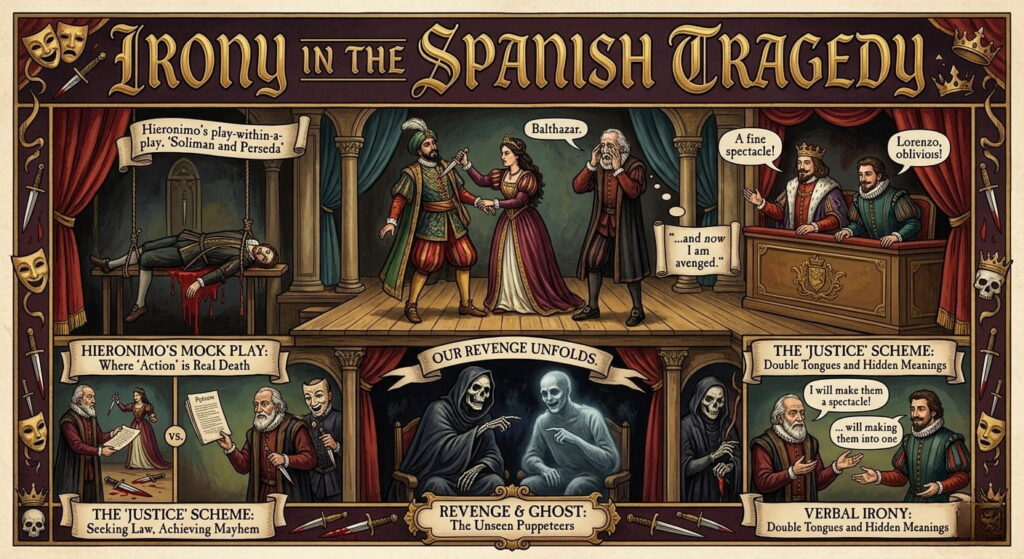
Situational irony emerges through unexpected outcomes. First, Hieronimo serves as a royal judge. Yet justice remains denied to him. Consequently, his authority becomes painfully ironic. Moreover, criminals gain protection from political power. Therefore, innocence suffers while corruption prospers. Furthermore, legal systems appear powerless against manipulation. Meanwhile, victims seek justice desperately. Consequently, revenge becomes their remaining option. Moreover, expectations collapse repeatedly during the narrative. Therefore, tragic irony strengthens emotional conflict. Furthermore, characters trust institutions that ultimately fail them. Meanwhile, powerful figures abuse authority without consequence. Consequently, moral order appears reversed. Moreover, punishment arrives through unexpected violence. Therefore, tragedy exposes institutional weakness clearly. Furthermore, audiences recognize injustice before resolution occurs. Meanwhile, characters continue trusting broken systems. Consequently, the narrative reveals deep societal corruption. Thus, situational irony deepens the tragic meaning.
5. Verbal Irony
Verbal irony appears frequently within dialogue. First, characters speak politely while hiding true intentions. Consequently, conversations contain hidden meanings constantly. Moreover, nobles often praise loyalty while practicing betrayal. Therefore, language becomes a mask for deception. Furthermore, sarcastic remarks reveal frustration with corruption. Meanwhile, villains speak with exaggerated courtesy. Consequently, audiences detect hypocrisy immediately. Moreover, characters express obedience toward authority publicly. Therefore, their words conceal resentment secretly. Furthermore, speeches sometimes criticize injustice indirectly. Meanwhile, listeners misunderstand the deeper message. Consequently, irony shapes communication throughout the drama. Moreover, spectators recognize truth beneath polite expressions. Therefore, tension grows during conversations. Furthermore, this technique exposes moral contradictions clearly. Meanwhile, deception influences many courtly interactions. Consequently, trust collapses gradually among characters. Thus, verbal irony enriches the dramatic language and emotional complexity.
6. Irony and Revenge
Irony strongly influences the revenge narrative within the tragedy. First, criminals believe themselves permanently safe. Meanwhile, audiences foresee their approaching punishment. Consequently, their confidence appears tragically misguided. Moreover, revenge develops quietly behind public appearances. Therefore, villains continue celebrating temporary security. Furthermore, hidden plans slowly approach violent resolution. Meanwhile, justice seems impossible through legal authority. Consequently, revenge becomes the remaining path. Moreover, characters misunderstand the depth of hidden anger. Therefore, confrontation appears suddenly and dramatically. Furthermore, spectators anticipate revenge long before criminals. Meanwhile, deception continues shaping daily interactions. Consequently, tragic tension grows within the narrative. Moreover, revenge transforms emotional suffering into action. Therefore, irony connects grief with punishment. Furthermore, victims appear powerless for much of the play. Meanwhile, hidden justice approaches steadily. Consequently, final events expose earlier arrogance. Thus, irony intensifies the emotional power of revenge.
7. Irony in Hieronimo’s Search for Justice
Hieronimo seeks justice while injustice surrounds him. First, he holds authority as a royal judge. Meanwhile, criminals escape punishment repeatedly. Consequently, his position becomes deeply ironic. Moreover, he trusts the legal system sincerely. Therefore, disappointment grows through constant failure. Furthermore, the court ignores clear moral wrongdoing. Meanwhile, criminals manipulate power for protection. Consequently, the judge becomes powerless in practice. Moreover, spectators recognize corruption before he does. Therefore, the investigation produces painful tension. Furthermore, each failure increases emotional suffering. Meanwhile, villains continue living without fear. Consequently, frustration replaces earlier confidence gradually. Moreover, grief transforms patience into determination. Therefore, revenge slowly replaces hope for justice. Furthermore, irony highlights the weakness of institutions. Meanwhile, audiences understand the tragic direction clearly. Consequently, sympathy grows toward the suffering father. Thus, irony deepens the emotional impact of his search.
8. Irony in Horatio’s Murder
Horatio’s death presents a strong ironic contrast. First, he represents loyalty and innocence. Meanwhile, jealous rivals plot his destruction secretly. Consequently, virtue becomes the victim of ambition. Moreover, the attack occurs suddenly and violently. Therefore, safety disappears within a single moment. Furthermore, Bel-Imperia attempts to protect him bravely. Meanwhile, the attackers overpower him quickly. Consequently, the murder reveals brutal injustice. Moreover, criminals hide the crime carefully afterward. Therefore, the truth remains concealed temporarily. Furthermore, the court fails to recognize this corruption. Meanwhile, audiences know the identity of the murderers. Consequently, tension grows during every investigation. Moreover, grief spreads across innocent characters. Therefore, the tragedy intensifies emotionally. Furthermore, spectators anticipate future revenge strongly. Meanwhile, villains trust their false security. Consequently, their confidence becomes painfully ironic. Thus, this event establishes the tragic momentum.
9. Irony in the Royal Court
The royal court appears powerful yet deeply corrupt. First, the authority promises justice for citizens. Meanwhile, powerful nobles manipulate influence freely. Consequently, the institution fails to protect innocence. Moreover, leaders trust political loyalty blindly. Therefore, deception spreads throughout the court. Furthermore, criminals gain safety through connections. Meanwhile, victims remain unheard and powerless. Consequently, the system produces ironic injustice. Moreover, appearances of order hide moral weakness. Therefore, authority becomes unreliable within the tragedy. Furthermore, spectators observe corruption clearly. Meanwhile, characters still respect the royal structure. Consequently, trust becomes dangerously misplaced. Moreover, officials continue performing formal duties. Therefore, they ignore hidden crimes repeatedly. Furthermore, power protects villains longer than expected. Meanwhile, justice seems endlessly delayed. Consequently, the court itself becomes ironic. Thus, the setting highlights institutional failure and tragic injustice.
10. Political Irony
Political ambition also produces powerful irony. First, nobles compete for influence and authority. Meanwhile, ambition encourages dishonesty and betrayal. Consequently, leadership becomes morally unreliable. Moreover, criminals present themselves as loyal servants. Therefore, trust becomes dangerously misplaced. Furthermore, power hides corruption behind respectability. Meanwhile, innocent citizens suffer silent injustice. Consequently, authority appears both strong and weak. Moreover, political alliances change quickly for advantage. Therefore, loyalty loses meaning within the court. Furthermore, audiences recognize the hypocrisy clearly. Meanwhile, characters still respect official power. Consequently, the contrast produces strong irony. Moreover, ambition blinds criminals to moral consequences. Therefore, they underestimate future revenge. Furthermore, political confidence becomes tragic arrogance. Meanwhile, the hidden truth approaches exposure gradually. Consequently, political irony strengthens dramatic tension throughout the narrative.
11. Irony and Corruption
Corruption creates powerful ironic situations throughout the tragedy. First, powerful nobles claim moral authority publicly. Meanwhile, they secretly practice deception and cruelty. Consequently, their respectability becomes deeply ironic. Moreover, political power protects their crimes repeatedly. Therefore, justice appears weak within the royal system. Furthermore, innocent characters suffer unfair consequences. Meanwhile, criminals enjoy influence and protection. Consequently, corruption spreads quietly through noble society. Moreover, audiences observe this hypocrisy clearly. Therefore, moral tension grows during court scenes. Furthermore, criminals underestimate moral consequences constantly. Meanwhile, victims struggle for recognition and justice. Consequently, injustice appears normal within authority. Moreover, corruption hides beneath elegant manners and speeches. Therefore, truth remains concealed for long periods. Furthermore, the audience anticipates inevitable exposure. Meanwhile, criminals continue believing their safety is permanent. Consequently, their confidence becomes tragically ironic. Thus, corruption strengthens the tragic irony of the narrative.
12. Irony in Lorenzo’s Deception
Lorenzo’s character represents deception and calculated ambition. First, he appears loyal to royal authority. Meanwhile, he secretly organizes Horatio’s murder. Consequently, his loyalty becomes completely false. Moreover, he manipulates events to protect himself. Therefore, suspicion rarely reaches him initially. Furthermore, Lorenzo believes his plans will remain hidden forever. Meanwhile, audiences recognize his guilt immediately. Consequently, his confidence becomes ironically misguided. Moreover, he trusts political influence for safety. Therefore, authority appears easily manipulated. Furthermore, his arrogance increases after the murder. Meanwhile, revenge slowly develops against him. Consequently, the audience anticipates his downfall. Moreover, Lorenzo dismisses danger with careless confidence. Therefore, irony surrounds his actions constantly. Furthermore, deception shapes every interaction he conducts. Meanwhile, the hidden truth approaches dramatic exposure. Consequently, Lorenzo’s pride becomes a tragic weakness. Thus, his deception strengthens the narrative’s ironic tension.
13. Irony in Balthazar’s Character
Balthazar also contributes to the tragedy’s ironic structure. First, he appears honorable as a noble prisoner. Meanwhile, jealousy influences his emotional decisions secretly. Consequently, admiration for Bel-Imperia becomes a destructive obsession. Moreover, he supports Lorenzo’s violent plan. Therefore, noble identity contrasts with cruel action. Furthermore, he believes political status ensures protection. Meanwhile, audiences foresee the consequences clearly. Consequently, his confidence becomes ironically misplaced. Moreover, his rivalry with Horatio drives the crime. Therefore, love becomes the cause of tragedy. Furthermore, Balthazar celebrates a temporary victory proudly. Meanwhile, revenge develops quietly against him. Consequently, his happiness appears dangerously short-lived. Moreover, the audience anticipates his punishment steadily. Therefore, irony surrounds his romantic ambition. Furthermore, emotional arrogance blinds his judgment. Meanwhile, hidden justice approaches through revenge. Consequently, Balthazar’s story strengthens tragic irony.
14. Irony in Bel-Imperia’s Revenge Plan
Bel-Imperia secretly prepares justice for Horatio’s murder. First, she appears obedient within noble society. Meanwhile, she quietly gathers information against the criminals. Consequently, her silence hides determined resistance. Moreover, she communicates secretly with Hieronimo. Therefore, revenge planning develops beneath public calm. Furthermore, villains underestimate her intelligence repeatedly. Meanwhile, audiences recognize her courage clearly. Consequently, her quiet behavior becomes an ironic disguise. Moreover, Bel-Imperia pretends weakness before powerful men. Therefore, deception protects her dangerous intentions. Furthermore, she patiently waits for the right moment. Meanwhile, criminals trust their control over her. Consequently, their confidence becomes ironically foolish. Moreover, her loyalty strengthens the revenge alliance. Therefore, justice approaches slowly yet surely. Furthermore, emotional courage drives her actions constantly. Meanwhile, villains remain unaware of the hidden danger. Consequently, Bel-Imperia’s secrecy strengthens the tragedy’s ironic tension.
15. Irony in the Ghost of Andrea
The ghost observes events with calm expectation. First, Andrea watches the tragedy unfold silently. Meanwhile, human characters struggle with confusion and grief. Consequently, supernatural knowledge contrasts with human ignorance. Moreover, the spirit anticipates future revenge clearly. Therefore, spectators receive insight into the tragic outcome. Furthermore, earthly characters remain unaware of this guidance. Meanwhile, revenge appears distant from their perspective. Consequently, dramatic irony grows stronger throughout the narrative. Moreover, the ghost comments on human corruption. Therefore, moral judgment surrounds each event. Furthermore, spiritual observation emphasizes inevitable justice. Meanwhile, villains believe themselves beyond punishment. Consequently, their confidence becomes deeply ironic. Moreover, Andrea patiently awaits the fulfillment of revenge. Therefore, supernatural awareness shapes audience understanding. Furthermore, the ghost reveals the destiny behind human actions. Meanwhile, characters struggle blindly with tragedy. Consequently, spiritual observation deepens ironic meaning within the play.
16. Irony and Supernatural Observation
Supernatural figures observe events throughout the tragedy. First, Andrea watches human actions calmly. Meanwhile, Revenge predicts future punishment confidently. Consequently, spectators receive knowledge unavailable to characters. Moreover, this difference creates powerful, dramatic tension. Therefore, supernatural commentary becomes deeply ironic. Furthermore, humans struggle blindly with corruption and grief. Meanwhile, spirits understand the coming consequences clearly. Consequently, audience awareness grows stronger during each scene. Moreover, villains continue believing themselves secure. Therefore, their confidence appears tragically misguided. Furthermore, supernatural observation emphasizes moral justice. Meanwhile, earthly authority fails repeatedly. Consequently, destiny replaces human judgment gradually. Moreover, spirits patiently watch the unfolding tragedy. Therefore, revenge appears inevitable from the beginning. Furthermore, audiences anticipate punishment steadily. Meanwhile, criminals ignore spiritual warnings completely. Consequently, their arrogance becomes painfully ironic. Thus, supernatural observation strengthens irony within the narrative.
17. Irony in Hieronimo’s Madness
Hieronimo’s madness creates complex ironic tension. First, grief overwhelms his emotional stability. Meanwhile, others misunderstand his strange behavior. Consequently, they dismiss his suffering quickly. Moreover, the court believes he lost rational judgment. Therefore, suspicion moves away from his intentions. Furthermore, the grieving father sometimes pretends madness deliberately. Meanwhile, villains underestimate his intelligence repeatedly. Consequently, deception protects his revenge plan. Moreover, emotional pain hides a calculated strategy. Therefore, his madness becomes an ironic disguise. Furthermore, audiences recognize the hidden purpose clearly. Meanwhile, criminals remain unaware of approaching danger. Consequently, suspense grows during each interaction. Moreover, the court ignores his warnings and speeches. Therefore, truth hides beneath apparent confusion. Furthermore, the audience anticipates revenge steadily. Meanwhile, villains trust his weakness foolishly. Consequently, their confidence becomes tragically ironic. Thus, madness functions as both suffering and strategy.
18. Irony in the Play-Within-the-Play
The theatrical performance introduces powerful irony. First, Hieronimo organizes a dramatic play publicly. Meanwhile, villains accept roles within the performance. Consequently, they unknowingly participate in their punishment. Moreover, spectators watch the staged tragedy carefully. Therefore, reality and theater merge suddenly. Furthermore, criminals believe the performance is harmless entertainment. Meanwhile, the audience anticipates revenge clearly. Consequently, dramatic irony intensifies emotional tension. Moreover, the performance hides deadly intentions. Therefore, deception controls the final confrontation. Furthermore, Hieronimo directs events with careful precision. Meanwhile, villains remain unaware of the danger. Consequently, suspense builds toward the violent climax. Moreover, justice arrives through theatrical illusion. Therefore, art becomes the instrument of revenge. Furthermore, spectators witness the truth unfolding dramatically. Meanwhile, criminals recognize the trap too late. Consequently, their shock deepens tragic irony. Thus, the staged performance delivers ironic justice.
19. Irony in the Final Revenge Performance
The final revenge scene contains a powerful ironic contrast. First, criminals expect harmless dramatic entertainment. Meanwhile, revenge hides within the performance secretly. Consequently, safety transforms into sudden danger. Moreover, villains trust the theatrical illusion completely. Therefore, they ignore warning signs repeatedly. Furthermore, spectators recognize approaching violence clearly. Meanwhile, actors continue performing their tragic roles. Consequently, reality replaces fiction unexpectedly. Moreover, the criminals face punishment instantly. Therefore, arrogance collapses within a single moment. Furthermore, revenge fulfills long-delayed justice. Meanwhile, spectators experience shock and recognition. Consequently, tragic irony reaches its peak. Moreover, earlier deception returns against the villains. Therefore, the hidden truth finally emerges publicly. Furthermore, revenge exposes corruption dramatically. Meanwhile, the court witnesses violent justice directly. Consequently, the final scene confirms the power of irony.
20. Irony and Tragic Justice
Tragic justice develops through ironic contrast. First, criminals enjoy power for much of the play. Meanwhile, innocent characters suffer grief and injustice. Consequently, the moral balance appears reversed. Moreover, the authority fails to protect the victims. Therefore, revenge becomes the instrument of justice. Furthermore, villains trust their political protection blindly. Meanwhile, spectators anticipate eventual punishment clearly. Consequently, suspense continues building across the narrative. Moreover, revenge restores balance suddenly. Therefore, justice appears through unexpected violence. Furthermore, the court witnesses the collapse of corruption. Meanwhile, victims finally achieve emotional closure. Consequently, earlier arrogance appears deeply ironic. Moreover, criminals lose power within moments. Therefore, the tragic resolution exposes moral truth. Furthermore, suffering leads toward final justice. Meanwhile, spectators reflect on corruption and revenge. Consequently, tragic justice reveals the ultimate irony of the play.
21. Irony and Moral Conflict
Moral conflict grows stronger through ironic situations. First, characters believe authority guarantees justice. Meanwhile, corruption secretly controls political power. Consequently, moral expectations collapse repeatedly. Moreover, victims struggle to defend truth and honor. Therefore, ethical confusion spreads across the court. Furthermore, villains speak confidently about loyalty. Meanwhile, their actions reveal betrayal and cruelty. Consequently, hypocrisy becomes painfully obvious to spectators. Moreover, characters attempt to trust social institutions sincerely. Therefore, disappointment follows every failed appeal. Furthermore, grief intensifies moral questioning constantly. Meanwhile, criminals celebrate temporary success proudly. Consequently, their confidence appears dangerously misguided. Moreover, audiences anticipate moral consequences steadily. Therefore, tension grows between justice and revenge. Furthermore, characters confront difficult ethical choices. Meanwhile, suffering challenges to earlier beliefs strongly. Consequently, moral conflict deepens the tragic narrative. Thus, irony exposes ethical struggle within the drama.
22. Irony in the Failure of Legal Justice
Legal justice repeatedly fails throughout the tragedy. First, victims expect fair judgment from the authority. Meanwhile, political influence protects the criminals. Consequently, justice becomes painfully unreachable. Moreover, officials ignore clear evidence repeatedly. Therefore, corruption weakens the legal structure. Furthermore, Hieronimo petitions for justice sincerely. Meanwhile, the court delays a meaningful investigation. Consequently, frustration grows steadily within the narrative. Moreover, spectators recognize injustice immediately. Therefore, tension rises during every appeal. Furthermore, the legal system promises fairness publicly. Meanwhile, hidden corruption controls actual decisions. Consequently, expectations collapse through bitter irony. Moreover, victims lose faith in institutions gradually. Therefore, revenge replaces legal authority. Furthermore, justice arrives through violence rather than law. Meanwhile, audiences reflect on institutional weakness. Consequently, the tragedy exposes flawed justice. Thus, legal failure strengthens ironic tension within the play.
23. Irony in Courtly Power
Courtly power appears impressive yet deeply unstable. First, nobles display authority through rank and status. Meanwhile, corruption secretly shapes their decisions. Consequently, appearances contrast sharply with reality. Moreover, leaders speak confidently about justice. Therefore, their hypocrisy becomes painfully ironic. Furthermore, the authority fails to protect innocent victims. Meanwhile, criminals exploit influence for protection. Consequently, trust in leadership weakens steadily. Moreover, spectators recognize moral weakness immediately. Therefore, tension grows within court scenes. Furthermore, nobles continue performing official duties proudly. Meanwhile, injustice spreads beneath formal behavior. Consequently, the contrast produces strong irony. Moreover, ambition blinds powerful figures repeatedly. Therefore, they ignore approaching revenge completely. Furthermore, authority becomes vulnerable to hidden resistance. Meanwhile, victims quietly prepare their response. Consequently, courtly power collapses suddenly during the climax. Thus, political authority reveals ironic weakness.
24. Irony in the Revenge Tragedy Tradition
The play reflects the traditions of revenge tragedy. First, victims initially trust the legal system. Meanwhile, institutions fail to deliver justice. Consequently, revenge becomes the remaining solution. Moreover, criminals believe their crimes remain hidden. Therefore, their arrogance increases steadily. Furthermore, audiences anticipate a violent resolution early. Meanwhile, villains continue living without fear. Consequently, suspense grows throughout the narrative. Moreover, revenge appears both justified and dangerous. Therefore, moral tension surrounds every decision. Furthermore, suffering motivates characters toward action. Meanwhile, justice seems endlessly delayed. Consequently, revenge becomes inevitable within the genre. Moreover, audiences expect punishment for corruption. Therefore, tragic irony develops before the climax. Furthermore, revenge destroys both villains and victims. Meanwhile, suffering continues beyond punishment. Consequently, the narrative warns against destructive vengeance. Thus, the revenge tradition strengthens ironic tragedy.
25. Irony and Audience Expectations
Audience expectations shape dramatic irony strongly. First, spectators observe hidden crimes immediately. Meanwhile, characters remain unaware of danger. Consequently, suspense builds during investigation scenes. Moreover, viewers constantly anticipate future revenge. Therefore, emotional engagement grows steadily. Furthermore, audiences expect justice eventually. Meanwhile, criminals celebrate temporary security proudly. Consequently, their confidence appears tragically misguided. Moreover, spectators detect hypocrisy within courtly behavior. Therefore, tension develops during every conversation. Furthermore, dramatic structure guides audience anticipation carefully. Meanwhile, characters misunderstand the surrounding deception. Consequently, irony intensifies emotional experience. Moreover, viewers sympathize with innocent victims deeply. Therefore, tragic consequences appear unavoidable. Furthermore, anticipation continues until the final scene. Meanwhile, villains ignore approaching punishment foolishly. Consequently, expectations transform into dramatic fulfillment. Thus, audience awareness strengthens ironic power.
26. Irony and Emotional Tension
Irony heightens emotional tension across the tragedy. First, spectators understand the hidden dangers clearly. Meanwhile, characters trust false appearances repeatedly. Consequently, anxiety grows during important scenes. Moreover, revenge develops quietly beneath public calm. Therefore, tension continues to increase steadily. Furthermore, victims express grief without knowing the truth. Meanwhile, audiences foresee approaching disaster clearly. Consequently, sympathy deepens for suffering characters. Moreover, criminals underestimate their enemies repeatedly. Therefore, their confidence appears tragically ironic. Furthermore, emotional pressure shapes decisions constantly. Meanwhile, hidden plans move toward execution gradually. Consequently, suspense dominates the narrative atmosphere. Moreover, irony reveals the gap between knowledge and ignorance. Therefore, emotional involvement grows stronger. Furthermore, audiences eagerly anticipate confrontation. Meanwhile, characters continue misunderstanding their situation. Consequently, tension intensifies until the climax. Thus, irony fuels emotional suspense.
27. Irony and Character Transformation
Character transformation develops through ironic experience. First, Hieronimo begins as a loyal royal officer. Meanwhile, injustice shatters his faith gradually. Consequently, grief transforms his personality deeply. Moreover, patience slowly changes into determination. Therefore, revenge becomes his chosen path. Furthermore, Bel-Imperia evolves through suffering and courage. Meanwhile, villains remain blind to their mistakes. Consequently, transformation highlights moral contrast. Moreover, audiences witness emotional change clearly. Therefore, sympathy grows toward the victims. Furthermore, criminals continue to trust their authority. Meanwhile, hidden revenge approaches steadily. Consequently, their arrogance becomes tragically ironic. Moreover, suffering strengthens resistance against corruption. Therefore, characters challenge earlier expectations. Furthermore, grief reshapes identity and purpose. Meanwhile, revenge promises emotional closure. Consequently, transformation drives the narrative forward. Thus, irony shapes personal change within the tragedy.
28. Irony in the Tragic Ending
The tragic ending reveals a powerful ironic resolution. First, villains enjoy confidence before the final performance. Meanwhile, revenge hides within theatrical illusion. Consequently, punishment arrives suddenly and violently. Moreover, criminals realize the truth too late. Therefore, earlier arrogance becomes deeply ironic. Furthermore, victims finally achieve justice. Meanwhile, suffering continues after revenge. Consequently, peace never fully returns. Moreover, spectators reflect on the cost of vengeance. Therefore, tragedy exposes moral complexity. Furthermore, justice appears both necessary and destructive. Meanwhile, authority witnesses violent consequences directly. Consequently, corruption collapses before public view. Moreover, revenge concludes the narrative conflict. Therefore, tragic irony dominates the final scene. Furthermore, audiences recognize the moral warning clearly. Meanwhile, characters pay a heavy price. Consequently, the ending reveals the full power of irony.
29. Irony as a Dramatic Device
Irony functions as a major dramatic technique. First, it contrasts the knowledge between the audience and the characters. Meanwhile, hidden truth shapes narrative suspense. Consequently, emotional engagement grows steadily. Moreover, irony exposes corruption and hypocrisy clearly. Therefore, spectators recognize moral weakness immediately. Furthermore, deception creates powerful dramatic tension. Meanwhile, revenge develops beneath public appearances. Consequently, suspense dominates the dramatic structure. Moreover, audiences constantly anticipate tragic consequences. Therefore, emotional investment strengthens with each scene. Furthermore, irony highlights the gap between expectation and reality. Meanwhile, characters misunderstand the surrounding events repeatedly. Consequently, tragedy unfolds through these contrasts. Moreover, irony connects moral themes with dramatic action. Therefore, the narrative gains deeper meaning. Furthermore, spectators reflect on justice and corruption. Meanwhile, the hidden truth approaches inevitable revelation. Consequently, irony shapes the entire dramatic experience. Thus, the device remains essential to the tragedy.
30. The Overall Significance of Irony
Irony ultimately shapes the tragedy’s moral message. First, it reveals corruption within social authority. Meanwhile, audiences observe the hidden truth clearly. Consequently, tragic tension grows across the narrative. Moreover, irony exposes hypocrisy among powerful nobles. Therefore, moral weakness becomes visible. Furthermore, victims struggle within unjust institutions. Meanwhile, criminals trust their influence blindly. Consequently, arrogance leads toward destruction. Moreover, revenge emerges from failed justice. Therefore, suffering transforms into violent action. Furthermore, irony highlights the contrast between hope and reality. Meanwhile, tragedy develops through misunderstanding. Consequently, emotional impact deepens for audiences. Moreover, spectators recognize moral consequences early. Therefore, anticipation strengthens dramatic experience. Furthermore, the narrative warns against corruption and vengeance. Meanwhile, justice appears through painful sacrifice. Consequently, irony reinforces the tragedy’s lasting meaning.
Conclusion
Irony in The Spanish Tragedy strengthens the play’s tragic power. First, the hidden truth contrasts with public appearance. Meanwhile, audiences understand events earlier than characters. Consequently, suspense grows throughout the narrative. Moreover, corruption spreads within royal authority. Therefore, justice appears weak and unreliable. Furthermore, victims suffer through political injustice. Meanwhile, criminals trust their influence foolishly. Consequently, their confidence becomes deeply ironic. Moreover, revenge replaces failed legal authority. Therefore, violent justice concludes the tragedy. Furthermore, irony exposes hypocrisy within a noble society. Meanwhile, supernatural observers reveal moral consequences. Consequently, destiny appears connected with punishment. Moreover, emotional suffering transforms innocent characters. Therefore, tragic tension dominates the narrative. Furthermore, audiences anticipate inevitable confrontation steadily. Meanwhile, villains ignore approaching danger completely. Consequently, the final scene reveals a devastating truth. Thus, irony shapes both the tragedy’s dramatic structure and moral warning.
Justice and Revenge in The Spanish Tragedy: https://englishlitnotes.com/2026/03/15/justice-and-revenge-in-the-spanish-tragedy/
Ernest Hemingway as a Modern American writer: https://americanlit.englishlitnotes.com/ernest-hemingway-as-a-modern-american-writer/
Discover more from Naeem Ullah Butt - Mr.Blogger
Subscribe to get the latest posts sent to your email.