
Comprehensive Guide to the Present Continuous Tense
The present continuous tense is a vital part of English. It describes actions happening at this very moment. Learners use it in daily conversation frequently. It improves speaking skills very quickly. Students become more confident through regular practice. Teachers introduce it at the early stages of learning. This helps learners understand real-life communication better.
The Basic Foundation of Present Continuous Tense
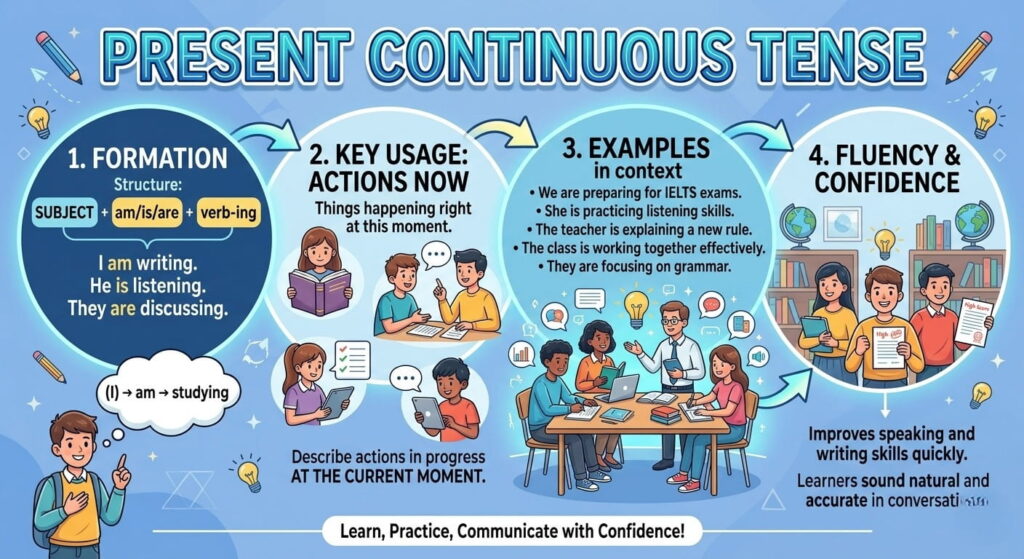
The present continuous tense has a very simple structure. However, learners must remember helping verbs carefully. Practice becomes important for high accuracy. The structure stays clear and fixed for everyone. The formula involves a helping verb and a main verb.
Structure:
Subject + am/is/are + verb (-ing)
For example:
- I am reading.
- She is playing.
- They are working.
Learners understand patterns easily with these simple steps. The present continuous tense forms positive statements with ease. It shows actions happening at the current moment. Therefore, learners express their activities clearly. It improves daily communication skills for all students.
Developing Positive Statements
The present continuous tense requires specific helping verbs. We use “am” with the subject “I.” We use “is” for “he,” “she,” and “it.” We use “are” for “you,” “we,” and “they.”
Examples:
- I am studying English.
- He is eating lunch.
- We are watching a movie.
- The cat is sleeping now.
- Birds are flying in the sky.
- John is driving a car.
- We are learning new words.
- You are listening to music.
Learners describe ongoing actions clearly using these rules. The present continuous tense becomes clearer with more examples. Examples help learners understand usage much better. Students relate sentences to real situations in life. Practice improves sentence formation skills every day.
Expanding Context and Real-Life Examples
She is cooking dinner in the kitchen. The children are playing outside in the garden. My father is reading a newspaper in the room. The sun is shining brightly today. We are planning a small trip. They are painting the old fence. I am writing a long letter. The water is boiling on the stove. Fluency improves over time with these repetitions.
The present continuous tense supports real communication daily. It connects grammar with real-life situations. Learners express ongoing actions clearly to others. It improves speaking and writing skills simultaneously. Confidence grows quickly as students speak more.
Let us look at a modern office environment. The manager is leading a short morning meeting. Five employees are listening to the new project details. A young clerk is taking notes on a tablet. The graphic designer is showing some creative logo drafts. No one is wasting any time this morning. Are the team members feeling excited about the goal? Yes, they are working with great energy today.
Understanding Negative Sentences
The present continuous tense also forms negative sentences. It shows actions not happening right now. Learners use it to deny specific actions. It helps clarify real situations for the listener. Students avoid confusion by using negatives properly. Teachers explain this form clearly to every student. Learners understand both action and non-action easily.
The present continuous tense has a clear negative structure. Learners must place “not” correctly after the helping verb. Practice is important for accuracy in speech. The pattern remains simple and fixed for learners.
Structure:
Subject + am/is/are + not + verb (-ing)
For example:
- I am not reading.
- She is not playing.
- They are not working.
- It is not raining.
- We are not running.
Learners form negatives correctly by following this rule. The present continuous tense also uses contractions in negatives. Contractions make speaking much easier and faster. Learners sound more natural in everyday conversation. These forms are very common in daily English.
Using Negative Contractions
Structure with contractions:
- is not → isn’t
- are not → aren’t
- am not → ’m not
Examples:
- He isn’t sleeping in the bed.
- We aren’t watching TV right now.
- I’m not going to school today.
- They aren’t coming to the party.
- She isn’t wearing a blue coat.
- You aren’t drinking cold water.
- The dog isn’t barking at us.
- It isn’t snowing in the city.
Learners improve fluency while speaking with these forms. The present continuous tense becomes clearer with negative examples. Examples help learners understand real usage in context. Students relate sentences to daily situations effortlessly. Practice improves grammar accuracy for all levels.
Deepening Negative Sentence Knowledge
She is not cooking dinner tonight. The children are not playing outside today. My brother is not studying for the exam. The machine is not working well. We are not eating meat today. They are not buying a new house. I am not feeling tired now. The teacher is not shouting at students. Learners build correct negative sentences through these steps.
The present continuous tense is important in negative communication. It helps express what is not happening clearly. Learners avoid misunderstandings in conversations frequently. Combining forms improves overall grammar skills. Confidence increases in speaking as a result.
Understanding Interrogative Sentences
The present continuous tense forms interrogative sentences easily. It helps ask about actions happening now. Learners use it in daily conversations often. It improves questioning skills clearly and effectively. Students ask about ongoing activities around them. Teachers explain this form simply to the class. Learners understand question patterns easily with practice.
The present continuous tense has a clear interrogative structure. Helping verbs come before the subject in questions. Learners must follow correct word order every time. Practice improves sentence accuracy for every learner.
Structure:
Am/Is/Are + subject + verb (-ing)?
For example:
- Am I reading the book?
- Is she playing the flute?
- Are they working at home?
- Is it raining outside?
- Are we going to the park?
Learners form correct questions using this simple flip. The present continuous tense helps ask real-life questions. It supports clear communication in various conversations. Learners understand situations better by asking these questions. It improves interaction skills with other English speakers.
Mastering Question Forms
- Are you studying English at home?
- Is he eating lunch in the office?
- Are they watching a movie now?
- Is she wearing a red dress?
- Are we meeting the manager today?
- Am I doing this task correctly?
- Is the baby crying right now?
- Are the guests arriving soon?
Learners ask about ongoing actions clearly with these. The present continuous tense allows different types of questions. Learners ask about people and actions easily. It becomes useful in daily communication for everyone. Practice improves confidence in speaking during lessons.
Further Interrogative Examples
Is she cooking dinner for the family? Are the children playing outside in the park? Is your father reading a newspaper now? Is the wind blowing hard today? Are you feeling better this morning? Is he fixing the broken chair? Are they cleaning the large room? Is the bus coming to the stop? Learners create meaningful questions using these patterns.
The present continuous tense strengthens communication through questions. It connects learners with real-life situations directly. Students express curiosity clearly to their peers. Regular practice builds strong grammar skills for life. Fluency improves steadily with every new question asked.
Present Continuous Tense (Interrogative Negative Structure)
The present continuous tense forms interrogative negative sentences. It asks about actions not happening now. Learners use it in daily conversations for clarity. It improves questioning and adds specific detail. Students understand doubt and denial together. Teachers explain this structure clearly to students. Learners build strong grammar understanding through this form.
The present continuous tense follows a fixed interrogative negative structure. Helping verbs come before the subject. The word “not” comes after the subject. The verb always takes the “-ing” form.
Structure:
Am/Is/Are + subject + not + verb (-ing)?
For example:
- Is he not reading the book?
- Are they not playing the game?
- Am I not working hard today?
- Is she not wearing a hat?
- Are we not going there?
Learners form correct interrogative negative sentences this way. The present continuous tense also uses contractions here. Contractions make these sentences easier to speak. Learners sound more natural during their conversations. These forms are very common in spoken English.
Contractions in Interrogative Negatives
Structure with contractions:
Isn’t / Aren’t + subject + verb (-ing)?
Examples:
- Isn’t he reading the daily news?
- Aren’t they playing in the yard?
- Aren’t you studying for the test?
- Isn’t she cooking lunch right now?
- Aren’t we leaving for the airport?
- Isn’t the phone ringing in the room?
- Aren’t they helpfully cleaning the floor?
- Isn’t it getting dark outside?
Learners improve fluency in conversation with these structures. The present continuous tense becomes clearer with more examples. Examples help learners understand usage much better. Students relate sentences to real situations every day. Practice improves accuracy in every spoken sentence.
Practical Examples of Interrogative Negatives
Isn’t she cooking dinner for us tonight? Aren’t the children playing outside in the rain? Isn’t your brother studying for his classes? Isn’t the sun setting behind the hills? Aren’t you wearing your glasses today? Isn’t he driving to the office now? Aren’t we eating dinner at seven? Isn’t she singing a beautiful song? Learners gain confidence by using these complex forms.
The present continuous tense completes the understanding of forms. It connects statements, negatives, and questions together. Learners express ideas clearly in any situation. Practice strengthens grammar skills for all students. Fluency improves steadily as they master each part.
Verbs and Spelling Rules
The present continuous tense has specific spelling rules. Most verbs just add “-ing” at the end. For example, “talk” becomes “talking.” “Sleep” becomes “sleeping.” “Wait” becomes “waiting.”
However, some verbs change slightly before the ending. Verbs ending in “e” drop the “e.” “Dance” becomes “dancing.” “Write” becomes “writing.” “Smile” becomes “smiling.”
Verbs with a short vowel and one consonant double it. “Run” becomes “running.” “Sit” becomes “sitting.” “Swim” becomes “swimming.”
Learners must learn these rules for better writing. Correct spelling improves the quality of written work. Teachers help students with these small changes. Practice makes these rules second nature over time.
Spelling can sometimes be tricky for new English learners. Some verbs end in “ie” like “lie” or “die.” These verbs change “ie” to “y” before “-ing.” Therefore, “lie” becomes “lying” in the continuous form. “Die” becomes “dying” when we add the ending. “Tie” becomes “tying” as we change the structure. Learners must pay close attention to these rare cases.
What about verbs that end in “y”? We do not change the “y” to “i.” We simply add “-ing” to the end. “Play” becomes “playing” without any other change. “Study” becomes “studying” in a very simple way. “Enjoy” becomes “enjoying” for all learners to see. These rules ensure that your writing stays professional. Accuracy in spelling reflects your hard work and study.
Stative Verbs Exception
The present continuous tense is not for all verbs. Some verbs describe states, not active actions. We call these “stative verbs.” Examples include “love,” “hate,” “know,” and “want.” We do not usually use “-ing” with them. We say “I know him,” not “I am knowing him.” We say “She wants water,” not “is wanting.”
Learners must identify these verbs to avoid mistakes. Using the simple present instead is usually correct. This adds a layer of sophistication to grammar skills. Understanding this difference is a sign of progress.
Daily Routine vs. Current Action
The present continuous tense differs from the simple present. Simple present shows habits or daily routines. Present continuous shows what is happening right now.
- Habit: I drink coffee every morning.
- Now: I am drinking tea right now.
- Habit: She works in a large office.
- Now: She is working from home today.
Learners distinguish between these two tenses through practice. It helps them describe their lives accurately. They can talk about their habits and current events. This distinction is vital for clear English communication.
Future Plans and Present Continuous
The present continuous tense also shows future plans. We use it for fixed arrangements in time.
- I am meeting my friend tomorrow.
- We are flying to London next week.
- She is starting a new job Monday.
This usage is very common in English speaking. It shows that the plan is already decided. Learners expand their communication range using this feature. It makes them sound more like native speakers.
The Role of Time Expressions
Specific words often signal the present continuous tense. We call these time expressions or signal words. Common examples include “now,” “at the moment,” and “currently.” We also use “right now” or “today” frequently.
- I am working on a report now.
- They are eating lunch at the moment.
- She is visiting her aunt today.
- The birds are singing right now.
These words help the listener understand the timing. They clarify that the action is not a habit. Instead, the action is happening during this period. Learners should use these words to sound more precise. It helps create a clear timeline in every conversation.
Present Continuous for Temporary Situations
Sometimes, we use this tense for temporary actions. These actions might not happen at this exact second. However, they are happening “around” now.
- I am reading a great book this week.
- She is staying with a friend for now.
- We are looking for a new house lately.
- He is studying hard for his final exams.
In these cases, the action has a clear end. It is not a permanent state of being. The present continuous tense highlights this temporary nature. It tells the listener that the situation will change. This adds more meaning to your English sentences.
Describing Trends and Changes
The present continuous tense also describes changing situations. It helps us talk about trends in the world.
- The weather is getting much colder these days.
- Technology is changing the way we live now.
- My English skills are improving every single day.
- Prices are rising at the local grocery store.
- The population of the city is growing fast.
These sentences show movement and progress over time. They do not show a static or fixed fact. Using the “-ing” form shows that the change continues. This is very useful for news and reports. It keeps your descriptions dynamic and very interesting.
The Importance of the Helping Verb
Never skip the “am,” “is,” or “are” verb. It is the most common mistake for learners. This verb tells us the tense and subject. Without it, the sentence is grammatically broken.
- Wrong: “He playing soccer.”
- Right: “He is playing soccer.”
Always check for this verb in your writing. It acts as a bridge to the action. It is a small word with a big job. If you remember it, your English will improve.
Conclusion and Final Review
The present continuous tense is a fundamental English pillar. It allows us to speak about the living moment. We use it for actions happening right now. We use it for temporary habits and plans. We even use it to describe changing world trends.
Through this article, we explored many different forms. We looked at positive statements and negative sentences. We studied interrogative and interrogative negative structures carefully. We learned about spelling rules and stative verb exceptions.
The goal of grammar is clear communication with others. This tense provides the tools for that clarity. Regular practice is the only way to mastery. Read the examples out loud to gain fluency. Write your own sentences based on your day.
English is a beautiful and very flexible language. The present continuous tense is a bright part of it. Use it with confidence in your daily life. Your speaking and writing will shine with accuracy. Thank you for studying this important lesson today.
Present Indefinite Tense: https://englishlitnotes.com/2026/03/17/present-indefinite-tense-the-ultimate-guide-for-ielts-success/
David Foster Wallace as a Writer of Post-postmodernism: https://americanlit.englishlitnotes.com/david-foster-wallace-as-a-writer/
Discover more from Naeem Ullah Butt - Mr.Blogger
Subscribe to get the latest posts sent to your email.