
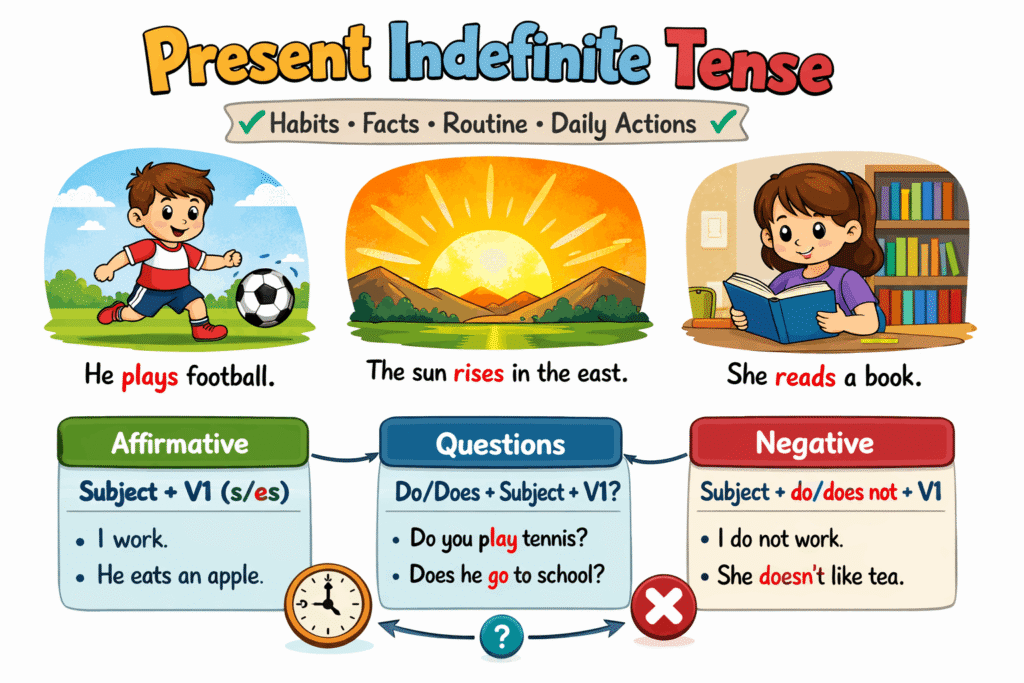
Introduction to the Basic Tense Structure
The Present Indefinite Tense is a fundamental pillar of English. First, you must understand its role in daily communication. This tense describes habits and also permanent states of being. Moreover, it serves as the base for many IELTS tasks. Additionally, students use it to express their own opinions clearly. Furthermore, it follows a very simple and logical sentence pattern. Consequently, you can master it with just a little practice. Thus, focus on the base form of the main verb. Meanwhile, remember the importance of the subject in every sentence. Therefore, identify if the subject is singular or plural. Subsequently, your grammatical accuracy will improve quite significantly over time. Indeed, this tense remains the most used in academic writing. Hence, value its simplicity while you prepare for your exams. Substantially, a consistent study leads to a much higher band score. Overall, start your journey with this basic grammar rule today.
Core Functions of This Tense:
- It describes regular habits and daily routines.
- It expresses universal truths and scientific facts.
- It states permanent situations and long-term states.
- It provides instructions or directions in manuals.
- It narrates scheduled events in the near future.
Using the First Person Singular Pronoun I
I use the Present Indefinite Tense for my personal routines. Initially, I start my day with a light, healthy breakfast. Then, I read the newspaper to stay updated with the news. Moreover, I write my blog posts during the quiet morning. Additionally, I practice my English speaking skills with my colleagues. Furthermore, I value the clarity of short and direct sentences. Consequently, I communicate my ideas without any confusion or delay. Thus, I follow a strict schedule for my research work. Meanwhile, I understand how to use transition words very effectively. Therefore, I never miss my daily grammar drills at home. Subsequently, I feel more prepared for the difficult IELTS test. Indeed, I enjoy learning new vocabulary words every single day. Hence, I maintain a high level of focus during study. Substantially, I achieve my targets through hard work and dedication. Finally, I check my writing for any technical errors.
Practical Examples with I:
- I drink a glass of fresh water every morning.
- I study English for two hours daily at home.
- I write professional articles for my educational blog now.
- I visit the local park to walk every evening.
- I like to read historical books on the weekends.
Using the First Person Plural We
We apply the Present Indefinite Tense during our group activities. Specifically, we attend the academy to learn new advanced skills. Moreover, we discuss various literary eras during our weekly seminars. For example, we analyze the impact of Modernism on English poetry. Furthermore, we collaborate on technical SEO projects for our websites. Consequently, we resolve complex indexing issues through very strong teamwork. Similarly, we organize the annual sports gala for all students. Therefore, we celebrate our collective achievements with great joy together. Meanwhile, we follow the latest updates from the IELTS examiners. Subsequently, we improve our writing style by using the active voice. Indeed, we value the importance of subject-verb agreement in essays. Hence, we practice these rules during our evening study sessions. Substantially, we work hard to reach our target band scores. Overall, we support each other in the learning process daily. Finally, we share our knowledge with the whole global community.
Practical Examples with We:
- We play cricket in the academy ground every Sunday.
- We study the history of English literature together daily.
- We help each other with difficult grammar exercises now.
- We attend the weekly seminars at the Azaan Academy.
- We share our research findings on our digital platform.
Exploring the Third Person Singular He
He practices the Present Indefinite Tense to improve his English. Initially, he selects a topic for his new blog article. Then, he writes exactly five hundred words every single afternoon. Moreover, he teaches English literature at the local academy daily. Additionally, he manages the technical SEO for his WordPress site. Furthermore, he explains the rules of grammar to his students. Consequently, he feels very confident about his upcoming IELTS exam. Thus, he follows a strict routine for his academic research. Similarly, he uses transition words to link his main ideas. Therefore, he maintains a high level of readability in posts. Meanwhile, he avoids complex vocabulary to help his many readers. Subsequently, he checks his work for any subject-verb agreement errors. Indeed, he values the simplicity of the active voice always. Hence, he produces high-quality content for his educational platform now. Substantially, he achieves great success through his very hard work.
Practical Examples with He:
- He speaks with great fluency during his presentations.
- He manages the content updates for his academic blog.
- He helps his students to understand complex English rules.
- He writes daily summaries of his historical research findings.
- He visits the gym to stay fit and healthy.
The Role of the Third Person Singular She
She understands the Present Indefinite Tense rules very well now. Specifically, she applies these rules to her daily writing tasks. Moreover, she creates beautiful images for her academic website posts. For example, she designs a custom layout for her readers. Furthermore, she organizes the final test series for the academy. Consequently, she helps many students to achieve their academic goals. Similarly, she studies the history of the Urdu language carefully. Therefore, she writes scholarly articles for her professional digital blog. Meanwhile, she follows the word count limits for every paragraph. Subsequently, she uses transition words to improve the logical flow. Indeed, she maintains a high standard of accuracy in her work. Hence, she avoids the passive voice to stay very direct. Substantially, she contributes to the growth of the educational community. Overall, she values clarity and also precision in English grammar. Finally, she masters the basics before moving to advanced topics.
Practical Examples with She:
- She designs educational posters for the Azaan sports gala.
- She speaks with great confidence during the IELTS interview.
- She manages the content updates for her WordPress blog.
- She reads classic English literature during her free time.
- She explains the importance of SEO to new bloggers.
Understanding the Third Person Singular It
The pronoun “It” follows specific rules for non-human subjects. Initially, you apply the third-person singular pattern for facts. This structure describes how natural processes function every day. Moreover, it explains universal truths like the rotation of the Earth. Additionally, it works perfectly for describing mechanical or digital operations. Furthermore, it provides a very clear structure for your technical reports. Consequently, it helps the reader to grasp the main points. Thus, it remains an essential part of the Present Indefinite Tense rules. Similarly, it describes how a software application operates on phones. Therefore, it requires a verb with an “s” ending always. Meanwhile, it ensures your scientific descriptions stay very accurate now. Subsequently, it serves as a subject for many different sentences. Indeed, it plays a key role in explaining general truths. Hence, it simplifies the understanding of various complex physical events.
Practical Examples with It:
- It rains heavily during the monsoon season in July.
- It starts at exactly nine o’clock in the morning.
- It looks like a very promising project for students.
- It helps to improve the crawl budget of websites.
- It works on all modern operating systems very smoothly.
Detailed Use of the Pronoun They
Plural subjects like “They” require the base verb form. First, you must identify the group in your sentence. This category includes people, animals, or even abstract plural concepts. Moreover, they follow a very straightforward pattern without extra endings. Additionally, they describe collective habits or shared professional routines daily. Furthermore, they practice speaking English with their classmates regularly. Consequently, they improve their communication skills very quickly now. Thus, they follow the Present Indefinite Tense guidelines quite strictly. Meanwhile, they write articles for their professional blogs daily. Subsequently, they share helpful tips with the online community. Indeed, they value clear structure in their academic essays. Hence, they avoid complex sentences to maintain high clarity. Substantially, they achieve great success in the IELTS test. Overall, they maintain a very disciplined study routine. Finally, they contribute to the growth of the academy.
Practical Examples with They:
- They play football in the academy ground every evening.
- They solve complex SEO issues for their digital blogs.
- They organize the annual prize distribution ceremony for students.
- They attend the English literature classes every Monday.
- They provide high-quality resources for all IELTS candidates.
Singular Names in English Grammar
Using a singular name requires the third-person ending. Specifically, you must add “s” or “es” to verbs. This rule applies to specific individuals or professional titles. Moreover, it highlights the action of a single entity clearly. Additionally, it maintains the logic of subject-verb agreement in writing. Furthermore, the teacher organizes the final test series for success. Consequently, the student achieves a high band in the exam. Thus, the writer follows the Present Indefinite Tense rules daily. Meanwhile, the researcher explores new topics for digital publication online. Therefore, the editor checks the transition density of the text. Subsequently, the reader finds the content very easy to understand. Indeed, the narrator describes the story with great technical skill. Hence, the author maintains a professional tone in every article. Substantially, the mentor provides guidance for the IELTS preparation journey. Overall, the expert values clarity and sentence length.
Practical Examples with Singular Names:
- Naeem teaches at the Azaan Academy of Sciences daily.
- Ahmed manages the technical SEO for his WordPress site.
- Sara creates professional images for her new blog post.
- The principal announces the dates for the sports gala.
- The doctor checks the patients in the local clinic.
Plural Names and Combinations of People
Plural names represent two or more individuals acting together. Initially, you must remember that these subjects use base verbs. This rule applies when you mention multiple names clearly. Moreover, it remains consistent regardless of the number of people. Additionally, these combinations describe shared professional duties or social habits. Furthermore, Ali and Ahmed study their grammar lessons together daily. Consequently, they follow the Present Indefinite Tense requirements for collective actions. Thus, the students and teachers collaborate on various academic projects. Meanwhile, the writers and editors ensure high quality for blogs. Therefore, they avoid adding any extra endings to the verbs. Subsequently, the readers find the sentence structure very logical now. Indeed, these plural combinations provide variety to your academic writing. Hence, you should practice using different names in your essays. Substantially, this approach builds a strong foundation for the IELTS.
Practical Examples with Plural Names:
- Naeem and Ali discuss the history of Canadian literature.
- The students and teachers prepare for the IELTS exam.
- Ahmed, Sara, and John work on the same project.
- The players and coaches celebrate their victory after the match.
- The managers and staff ensure the academy runs smoothly.
Formulating Negative Sentences Correctly
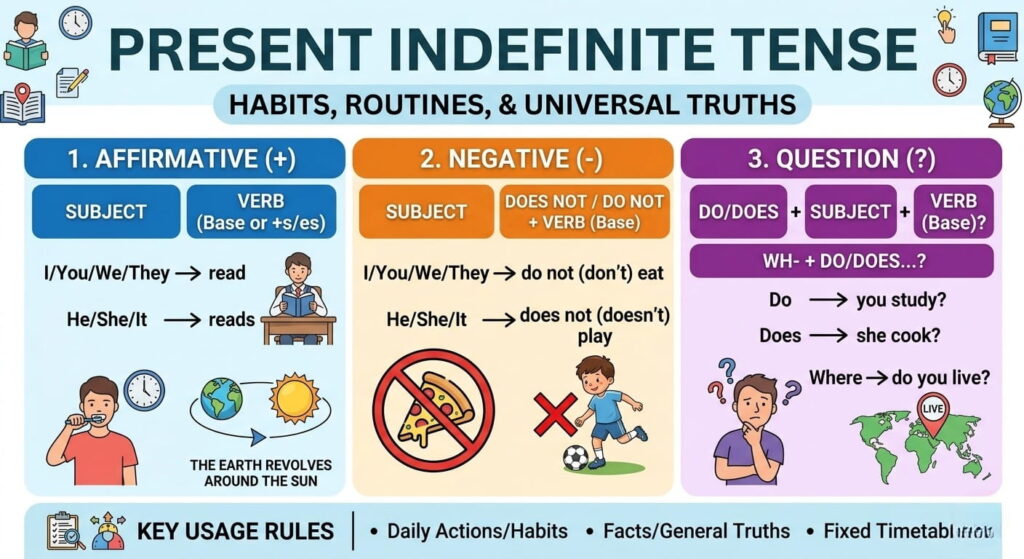
Negative sentences require the help of auxiliary verbs like “do.” Initially, you must choose the correct helper based on subject. Specifically, use “do not” for plural subjects and also “I.” Conversely, “does not” applies to third-person singular subjects like “He.” Moreover, the main verb always returns to its base form. Furthermore, you must remove the ending from the action. Consequently, the structure becomes much simpler for every English learner. Thus, the Present Indefinite Tense maintains a very logical negative pattern. Meanwhile, focus on the placement of “not” after the helper. Therefore, your writing stays grammatically correct and also very professional. Subsequently, you avoid common errors in the IELTS writing tasks. Indeed, these rules ensure clarity in your academic communication now. Hence, practice these negatives to build your overall grammar confidence. Substantially, consistent drills lead to better accuracy in complex essays.
Rules for Negative Sentences:
- Use “do not” for I, We, You, and They.
- Use “does not” for He, She, and It.
- Always use the base form of the main verb.
- Avoid using “s” or “es” with the main verb.
- Place the auxiliary verb before the main action verb.
Creating Interrogative Sentences for Inquiry
Questions in the Present Indefinite Tense start with “Do” or “Does.” First, place the auxiliary verb at the very beginning. Then, follow it with the subject and the base verb. Moreover, this format allows you to ask about habits daily. Additionally, it helps you inquire about universal truths and facts. Furthermore, you must use a question mark at the end. Consequently, the listener understands that you are seeking specific information. Thus, use “Do” for plural subjects and also the pronoun “I.” Similarly, “Does” works perfectly for all third-person singular subjects. Therefore, you maintain the correct subject-verb agreement in your speech. Meanwhile, avoid adding any extra endings to the main verb. Subsequently, your questions sound very natural and also quite clear. Indeed, this skill is vital for the IELTS speaking interview. Hence, practice asking about routines and hobbies with your partners.
Structure for Asking Questions:
- Start with “Do” or “Does” based on the subject.
- Place the subject immediately after the auxiliary verb.
- Use the base form of the verb without endings.
- Add a question mark to indicate a formal inquiry.
- Keep the sentence short for better clarity and impact.
Final Conclusion on Grammar Mastery
The Present Indefinite Tense serves as the most important tool. First, you must internalize the basic rules of subject agreement. This foundation allows you to build more complex sentences later. Moreover, it ensures your IELTS writing and speaking stay accurate. Additionally, consistent practice helps you avoid the common grammar mistakes. Furthermore, use the structured examples to review your basic knowledge. Consequently, you will notice a significant improvement in your score. Thus, remain dedicated to your grammar studies every single day. Meanwhile, keep exploring new vocabulary to enhance your descriptive abilities. Therefore, value the simplicity of this tense while aiming high. Subsequently, your professional blogging career will also benefit from precision. Indeed, clarity and correctness are the keys to success. Hence, continue your journey with confidence and hard work. Substantially, you possess the potential to master English grammar completely. Overall, the journey to success starts with these fundamental rules.
Key Takeaways for Students:
- Master the use of “s” and “es” endings.
- Practice the use of “do” and “does” daily.
- Focus on habits, facts, and also universal truths.
- Keep your sentences direct and also very active.
- Use transition words to connect your academic ideas.
Using Interrogative Pronouns in the Present Indefinite Tense
Interrogative pronouns like “Who” and “What” require special attention in English grammar. Initially, you must notice how these pronouns often act as subjects. Specifically, “Who” and “What” frequently skip the auxiliary verb “does” in this role. For example, “Who teaches English?” uses the third-person singular ending directly. Moreover, this structure differs significantly from pronouns like “Where” or “Why.” Additionally, the Present Indefinite Tense handles these pronouns differently when they act as objects. Furthermore, you must identify the role of the pronoun before writing your question. Consequently, the presence or absence of “do” and “does” depends on this role. Thus, the logic remains consistent but requires very careful study. Meanwhile, “Who” usually assumes a singular subject in many cases. Therefore, you add “s” or “es” to the main verb for subject-based questions. Indeed, mastering these nuances is vital for your IELTS success.
Key Differences for Who and What:
- Subject Role: When “Who” or “What” performs the action, do not use “do” or “does.”
- Object Role: Use “do/does” when the subject (like you/he/they) is already present.
- Verb Endings: Keep “s/es” when “Who” is the subject (e.g., Who speaks?).
- Standard Pronouns: Words like “When” and “Where” always require an auxiliary verb.
- Direct Impact: This structure makes your academic inquiry very clear and professional.
Specific Conditions for Using Do or Does
You use auxiliary verbs with “Who” or “What” when they act as objects. Initially, identify if the pronoun represents the person receiving the action. For instance, “Who do you meet?” asks about the receiver, not the doer. Moreover, this structure follows the standard rules of the Present Indefinite Tense strictly. Additionally, “What” requires “do” or “does” when it refers to an activity or object. Furthermore, you must include the subject immediately after the helper verb. Consequently, the main verb always stays in its base form without any endings. Thus, you follow the same pattern as other interrogative pronouns in these cases. Meanwhile, this distinction helps you avoid very common grammar errors. Therefore, focus on whether the pronoun is the doer or the receiver. Subsequently, your academic questions will sound much more technical and accurate.
Practical Examples: Subject vs. Object:
- Who (Subject): Who writes the articles for the academic blog?
- Who (Object): Who do you write the articles for every day?
- What (Subject): What happens during the annual sports gala event?
- What (Object): What do you do during the annual sports gala?
- Who (Subject): Who teaches the students at the Azaan Academy?
Conclusion: Mastering the Present Indefinite Tense
The Present Indefinite Tense serves as the most important tool for every English learner. First, you must internalize the basic rules of subject-verb agreement to ensure accuracy. This foundation allows you to build more complex sentences in your future studies. Moreover, it ensures your IELTS writing and speaking stay professional and clear. Additionally, consistent practice helps you avoid the common mistakes regarding “s” and “es” endings. Furthermore, use the structured examples and charts to review your knowledge regularly. Consequently, you will notice a significant improvement in your overall band score. Thus, remain dedicated to your grammar studies every single day without fail. Meanwhile, keep exploring new vocabulary to enhance your descriptive abilities now. Therefore, value the simplicity of this tense while aiming for academic excellence. Indeed, clarity and correctness are the keys to your professional success.
| Subject Category | Affirmative (Verb) | Negative (Helper) | Interrogative (Helper) |
| I, We, You, They | Base Verb (e.g., play) | do not + Base Verb | Do + Subject + Base Verb? |
| He, She, It, Singular Names | Verb + s/es (e.g., plays) | does not + Base Verb | Does + Subject + Base Verb? |
| Who/What (as Subject) | Verb + s/es (e.g., Who plays?) | does not + Base Verb | (No helper used for subject) |
| Who/What (as Object) | Base Verb | do/does + Subject | Do/Does + Subject + Base Verb? |
Key Tips for Success:
- Singular Subjects: Always remember the “s” or “es” in positive sentences.
- Negative/Questions: Never use “s” or “es” once “does” appears in the sentence.
- Plural Subjects: Keep the verb in its simplest form for all types of sentences.
- Transition Words: Use words like “Moreover” and “Consequently” to connect your ideas.
Tenses in English Grammar: https://englishlitnotes.com/2026/03/16/tenses-in-english-grammar-article-1/
Thomas Pynchon Postmodern Writer: https://americanlit.englishlitnotes.com/thomas-pynchon-postmodern-writer/
Discover more from Naeem Ullah Butt - Mr.Blogger
Subscribe to get the latest posts sent to your email.