
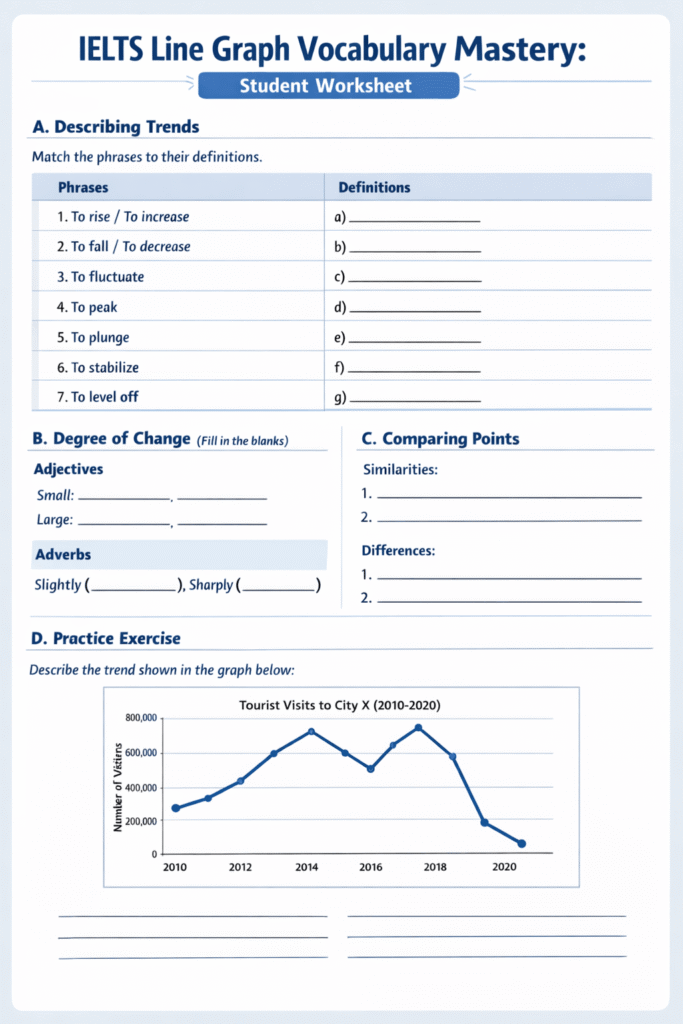
The Importance of Precise Trend Description
Writing Task 1 requires describing data accurately and clearly. You must use formal language for every single report. Line graphs specifically track changes over a set period. Identifying these changes is the first step to success. Most students fail because they use very basic English. However, using IELTS Line Graph Vocabulary correctly solves this problem. You must show the examiner a wide range of words. This proves you are ready for university-level academic writing. Every sentence should contribute to a very clear summary.
Why You Must Practice Data Selection
You cannot describe every single point on a graph. This is a very common mistake among many beginners. You must select only the most significant data features. These features include the highest and lowest points shown. Mastering IELTS Line Graph Vocabulary helps you highlight these points. You should also look for intersections between different lines. These intersections represent moments where the data was equal. Reporting these comparisons is vital for a high score. Focus on the big picture before the small details.
Exercise 1: Directional Verb Mapping
In this exercise, students categorize verbs by their direction. Using the correct verb is the basis of reporting. IELTS Line Graph Vocabulary includes many synonyms for “up” and “down.” Students must learn which verbs are the most formal. Avoid using “go up” or “go down” in reports. These are considered too informal for the IELTS exam. Instead, use verbs that show the intensity of change. This exercise helps build a very strong vocabulary foundation.
The Task: Group the Verbs
Place these verbs into the correct columns below:
- Verbs: Rocket, Plummet, Level off, Fluctuate, Surge, Slump, Plateau, Dip, Soar, Decline.
| Upward (↑) | Downward (↓) | Stable (→) | Unstable (∼) |
| 1. ________ | 1. ________ | 1. ________ | 1. ________ |
| 2. ________ | 2. ________ | 2. ________ | |
| 3. ________ | 3. ________ |
Answer Key for Exercise 1
- Upward: Rocket, Surge, Soar.
- Downward: Plummet, Slump, Decline.
- Stable: Level off, Plateau.
- Unstable: Fluctuate, Dip (temporary).
Exercise 2: Adverb and Adjective Matching
Adverbs describe the speed and scale of a change. They are essential for precise IELTS Line Graph Vocabulary usage. A “sharp” change is very different from a “slight” one. Students must choose the right word for the visual. This exercise focuses on matching intensity to the correct term. It helps students avoid exaggerating or understating the data trends. Precise adverbs lead to much higher marks in grammar. Use these words to modify your verbs in every paragraph.
The Task: Match Intensity to Word
Match the following descriptions to the best adverb:
- A very fast and huge change. (A) Gradually
- A change that is almost invisible. (B) Dramatically
- A slow and very steady movement. (C) Marginally
- A sudden and unexpected movement. (D) Abruptly
Answer Key for Exercise 2
- 1 – B (Dramatically)
- 2 – C (Marginally)
- 3 – A (Gradually)
- 4 – D (Abruptly)
Exercise 3: Visual Trend Identification
Visual literacy is just as important as writing skills. Students must look at a line and describe it. This exercise uses IELTS Line Graph Vocabulary in a practical way. It mimics the first stage of the actual exam. Students should identify if the line is steep or flat. They should also notice if the movement is consistent. This builds confidence in analyzing complex data sets quickly. Quick analysis is the key to finishing in 20 minutes.
The Task: Identify the Trend
Look at the following descriptions and choose the correct visual.
- Question 1: Which phrase best describes this specific line?
- A) The data remained steady for the whole year.
- B) The figures fluctuated wildly throughout the period.
- C) There was a gradual increase in the numbers.
- Question 2: Which phrase best describes this specific movement?
- A) The numbers rocketed significantly over the five years.
- B) There was a marginal dip in the figures.
- C) The trend bottomed out at the very end.
Answer Key for Exercise 3
- Question 1: B (Fluctuated wildly).
- Question 2: A (Rocketed significantly).
Exercise 4: Grammatical Transformation Drill
To get a Band 7, you need sentence variety. You must switch between verb-adverb and noun-adjective structures easily. This is a core part of IELTS Line Graph Vocabulary. It proves you have mastered complex English grammar rules. This exercise asks students to rewrite sentences in different ways. It prevents repetitive writing styles in the final report. Mastering this skill makes your writing sound much more professional. Every student should practice this transformation at least ten times.
The Task: Rewrite the Sentence
Rewrite the following sentences using the structure provided in brackets.
- The population grew rapidly. (Use: There was a…)
- There was a significant fall in sales. (Use: Sales…)
- Oil prices fluctuated slightly. (Use: There was a…)
- There was an abrupt surge in costs. (Use: Costs…)
Answer Key for Exercise 4
- There was a rapid growth in the population.
- Sales fell significantly.
- There was a slight fluctuation in oil prices.
- Costs surged abruptly.
Exercise 5: Preposition Precision Test
Prepositions are the most common source of small errors. You must use “to,” “by,” and “at” correctly. This is a technical part of IELTS Line Graph Vocabulary. “Increased to” refers to the final figure reached. “Increased by” refers to the size of the change. Using the wrong preposition can change your entire meaning. This exercise tests the student’s ability to report numbers accurately. Accurate data reporting is essential for a passing grade. Always double-check your prepositions before finishing your final report.
The Task: Fill in the Blanks
Choose the correct preposition: at, to, by, in, of.
- The price of gold peaked ________ $2,000 per ounce.
- There was an increase ________ 20% compared to last year.
- The number of students rose ________ 500 ________ 800.
- The period saw a significant rise ________ the figures.
Answer Key for Exercise 5
- at
- of
- from / to
- in
Exercise 6: The “Overview” Challenge
The overview paragraph summarizes the most important general trends. It is the most critical part of the report. You should use general IELTS Line Graph Vocabulary here. Do not include any specific numbers in this section. This exercise asks students to identify the “big picture.” It trains the brain to ignore small, distracting details. A strong overview guarantees a much higher overall score. Most examiners look at the overview first when grading.
The Task: Write a General Overview
Read the data summary and write a one-sentence overview.
- Data: Computer sales started at 10 and ended at 90. Phone sales started at 100 and ended at 20. Tablet sales stayed exactly the same.
- Draft your overview here: ____________________________________________________________________
Answer Key for Exercise 6
- Example Overview: “Overall, computer sales saw a significant upward trend, while phone sales declined sharply and tablet sales remained steady.”
Exercise 7: Comparative Language Selection
IELTS Task 1 is about making effective comparisons. You must show how one line relates to another. Using comparative IELTS Line Graph Vocabulary is very important here. Words like “whereas” and “conversely” help connect your ideas. This exercise tests your ability to link different data trends. Linking words improve the “Coherence and Cohesion” of your writing. This is one of the four main grading criteria. Always compare the highest and lowest lines in your report.
The Task: Choose the Correct Linker
Select the best word to complete the academic sentence.
- Coffee consumption rose, ________ tea consumption fell. (A) Whereas (B) Similarly
- Both categories increased; ________, the rise in meat was faster. (A) However (B) Therefore
- London prices climbed. ________, prices in Paris also increased. (A) In contrast (B) Likewise
Answer Key for Exercise 7
- 1 – A (Whereas)
- 2 – A (Howewer)
- 3 – B (Likewise)
Exercise 8: Final Synthesis and Error Correction
In this final task, students must find common mistakes. Correcting others helps you avoid making the same errors. This task focuses on all aspects of IELTS Line Graph Vocabulary. Look for errors in spelling, grammar, and data reporting. Many students lose marks for simple spelling mistakes in keywords. This exercise sharpens your attention to small, important details. Final editing is a skill that every student must learn. Take your time to find every mistake in the text.
The Task: Spot the Five Errors
Find and correct five errors in the short report below.
- “The graph show an increase in sales between 2000 and 2010. First, sales rose sharp from 10 to 50 units. Then, there was a dip of 2005. Overall, the figures remained stedy. Finally, sales rocket to a peak of 100.”
Answer Key for Exercise 8
- show $\rightarrow$ shows (Subject-verb agreement)
- sharp $\rightarrow$ sharply (Adverb needed)
- of 2005 $\rightarrow$ in 2005 (Preposition error)
- stedy $\rightarrow$ steady (Spelling error)
- rocket $\rightarrow$ rocketed (Past tense needed)
Final Advice for IELTS Exam Success
Consistency is the most important part of your preparation. Use the IELTS Line Graph Vocabulary provided in these exercises daily. Practice writing full reports under a 20-minute time limit. This builds the speed you need for the exam. Always focus on your overview and your key features. Avoid describing every tiny fluctuation you see on the lines. Keep your language formal and your structure very clear. You are now well-prepared to achieve your target band.
Summary of the Learning Journey
We have covered verbs, adverbs, nouns, and linking words. These are the tools for a great IELTS report. You have practiced identifying trends and correcting common errors. Use these worksheets to test your students regularly now. Your IELTS Line Graph Vocabulary will continue to improve with use. Stay focused on your goals and keep practicing every day. You have the knowledge and the skills for success. Good luck to all students taking the upcoming exam.

IELTS Writing Task 1 – A Complete Guide: https://englishlitnotes.com/2026/03/17/ielts-writing-task-1-the-complete-guide-for-academic-success/
Jonathan Lethem – A New Sincerity Writer: https://americanlit.englishlitnotes.com/jonathan-lethem-a-new-sincerity-writer/
Discover more from Naeem Ullah Butt - Mr.Blogger
Subscribe to get the latest posts sent to your email.